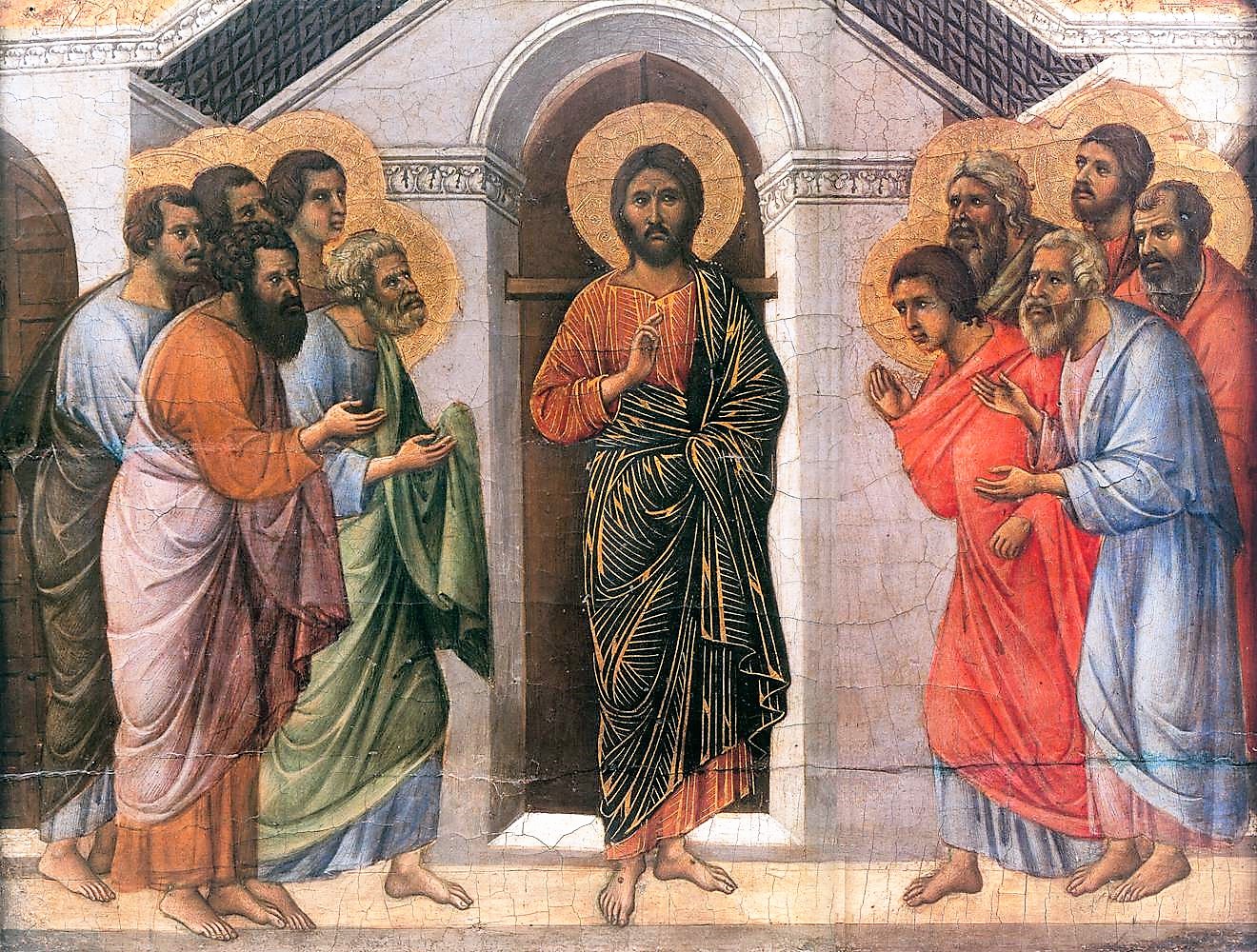

You Are Witnesses of These Things – A Homily for the 3rd Sunday of Easter

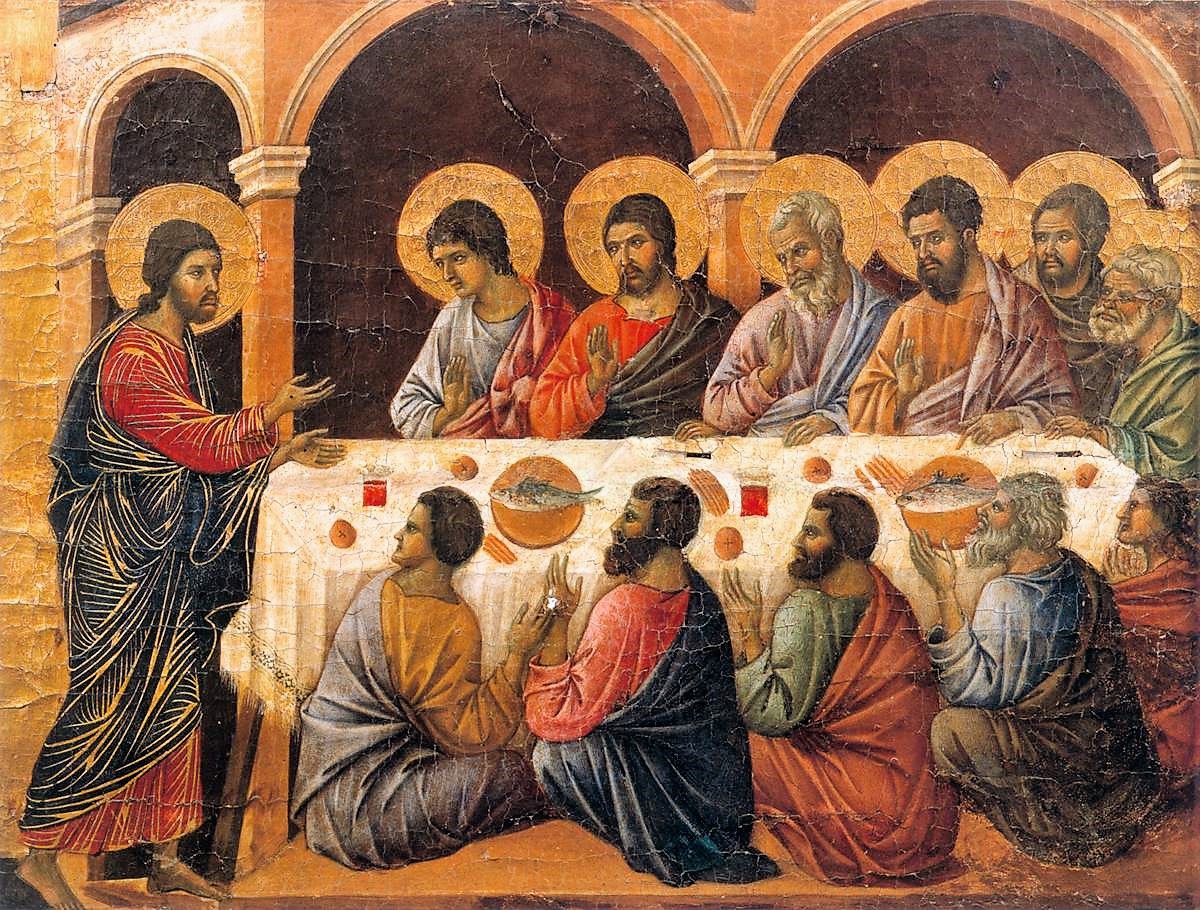
Risen Christ Appears to Apostles, Duccio (1308-11)

This Sunday’s Gospel speaks to the necessity of becoming witnesses of Jesus’ resurrection Jesus. It begins with the necessary foundation of the Church’s proclamation: The Lord has risen indeed, and he has appeared to Simon! (Luke 24:34) This solemn declaration forms the doctrinal certitude of the resurrection. On this foundation of the truth, the personal witness of every Catholic must be built. In this gospel we see how the Lord confirms His resurrection through the teaching authority of the Church, confirms the apostles in its truth, clarifies their faith, and then commissions them to be witnesses. Let’s see how the Lord does this.

I. The Certainty of the Resurrection And [the disciples from Emmaus] rose that same hour and returned to Jerusalem. And they found the eleven and those who were with them gathered together, saying, “The Lord has risen indeed, and he has appeared to Simon!” Then they told what had happened on the road, and how he was known to them in the breaking of the bread.

In the early hours of the first Easter Sunday, the news began to circulate that Jesus was alive and had been seen. These reports were at first disbelieved or at least doubted by the apostles. They dismissed reports from both women and men. Several women, including Mary Magdalene, had seen Jesus alive. St. John had seen the empty tomb and had “believed.” And though Luke does not mention it here, Mark records that when the disciples returning from Emmaus first sent word they had seen Jesus, they too were at first disbelieved (Mk 16:13).

As we pick up the story that evening, there is a sudden change, a declaration by the apostles that the Lord has truly risen!

What causes this change? After the early evening report from the disciples returning from Emmaus, Peter slipped away, perhaps for a walk. According to both Paul (1 Cor 15:5) and Luke (Lk 24:34), the risen Lord then appeared to Peter privately, prior to making Himself known to any of the other apostles. Peter reports Jesus’ appearance to the others and it is at this point that the resurrection moves from being doubted to being the official declaration of the community, the Church. The official declaration is worded as follows: The Lord has truly risen, and he has appeared to Simon!” (Luke 24:34)

Did the women’s and the laymen’s declarations mean nothing? Of course not. Indeed, the Lord later upbraids the apostles for being so reluctant to accept the testimony of the others (Mk 16:14). He calls them “hard of heart” for this reluctance, especially given that He had said He would rise on the third day. Even to this day the Lord often presents apparitions of Mary, the saints, or Himself to the faithful. The clergy must carefully discern such actions, not quickly believing or disbelieving them. However, no apparition or devotion (e.g., the Divine Mercy Chaplet) can become official teaching of the Universal Church until the Church, in union with Peter’s successor, rules it worthy of belief.

This is even more the case with a dogma like the resurrection. It becomes an official teaching when proclaimed so by Peter and his successors. Pope Benedict, writing as Joseph Ratzinger, sees an ecclesiological dimension to Peter’s special role in causing the resurrection to go from being merely attested to being “true indeed.”

… This indication of names [Cephas and then the Twelve], … reveals the very foundation of the Church’s faith. On the one hand “the Twelve” remain the actual foundation stone of the Church, the permanent point of reference. On the other hand, the special task given to Peter is underlined here. … Peter’s special witnessing role is confirmation of his commission to be the rock on which the Church is built. … So, the resurrection account flows naturally into ecclesiology. … and it shapes the nascent Church [Jesus of Nazareth Vol 2., pp. 259-260].

So, the resurrection is now officially declared by the Church; it is certain and true. Faith is a way of knowing. Our faith in the Church as stated in the Creed (I believe in one, holy, catholic, and apostolic Church) leads us to the certain knowledge of the resurrection by the Church’s dogmatic declaration: The Lord has truly risen, and he has appeared to Simon!” (Luke 24:34)

However, even though the faith is a communal and official declaration of the Church through the College of Apostles with Peter as its head, it cannot remain simply this. Faith must reach every member on a personal level. It is not enough for us to say, “Peter says …,” or “The Church says …,” or “Scripture says …,” or “My mother says …” We must also be able to add our own voice to the witness of the Church. We must be able to say, “Jesus is risen; it is true! What the Church has always taught, I, too, have experienced. All her teachings and doctrines, all that the Lord has taught and revealed is true because in the laboratory of my own life I have tested them and found them to be true!”

Thus, we must stay with these disciples in their journey to experience the proclamation of the Church: “The Lord has truly risen, and he has appeared to Simon!”

II. The Contact with the Resurrection – While they were still speaking about this, he stood in their midst and said to them, “Peace be with you.” But they were startled and terrified and thought that they were seeing a ghost.

The truth, if we will lay hold of it, is consoling and freeing. Jesus, in the truth of His resurrected glory, stands before them and says, “Shalom,” peace. While the truth does liberate and bring peace, a journey is usually necessary to realize and accept this. Before we can receive the gift of truth, we must often accept the conflict that it introduces into our life.

As we all know, the truth can startle and even upset; it can break conventions and challenge what we know and think. The apostles are at first startled. It is one thing to hear and accept that the Lord is risen, that He has appeared to Peter, but it is another thing to be personally confronted with the truth.

It is one thing for them to believe with the Church and say, “The Lord is truly risen, and he has appeared to Simon!” But it is another for them to personally experience this. It breaks through everything they have ever known. Their belief is no longer abstract; it is no longer merely communal. Now they are personally in contact with the reality of it.

So, too, for us on our journey to deeper faith. It is a faith declared by the Church, but a faith that we must come to know and experience personally. Thanks be to God that the Lord is willing to help us to do so. For He does not simply shatter our notions. Rather, He helps us to “connect the dots” between His truth and what we already know.

III. The Clarification of the Resurrection – Then he said to them, “Why are you troubled? And why do questions arise in your hearts? Look at my hands and my feet, that it is I myself. Touch me and see, because a ghost does not have flesh and bones as you can see I have.” And as he said this, he showed them his hands and his feet. While they were still incredulous for joy and were amazed, he asked them, “Have you anything here to eat?” They gave him a piece of baked fish; he took it and ate it in front of them. He said to them, “These are my words that I spoke to you while I was still with you, that everything written about me in the law of Moses and in the prophets and psalms must be fulfilled.” Then he opened their minds to understand the Scriptures.

The truth can often startle us; it can challenge what we know and think. For this reason, some avoid it or resist it, at least initially.

But the Lord, in His mercy, often sends us assurances. He helps us to “connect the dots” between what challenges us and what we already know, between what is new and what is ancient and attested to. Truth has a unity; greater truths build on lesser ones. God prepares us in stages for the full truth. Jesus once said to the apostles, I have many more things to say to you, but you cannot bear them now. But when He, the Spirit of truth, comes, He will guide you into all the truth (Jn 16:12-13).

Thus, in this Gospel the Lord sets forth a kind of continuity and clarification for them. Through various methods He shows them that though gloriously risen and transformed, He who stands before them now is also the same Jesus who walked with them days before. He shows them His hands and side to indicate that He was indeed the one they saw crucified. He bids them to touch Him and see that He is not a ghost. He eats to console them and to show them that He still has fellowship with them among the living; He is no shimmering apparition from another realm. Finally, He opens their minds to the understanding of Scripture, so that they may know that all that happened is not some radical break with or tearing up of God’s plan. Rather, it is a fulfillment of all that was written, all that was prophesied.

What seems new and different is in fact in line with, in continuity with, all that has gone before. This is the new Passover that opens the way to the true, more glorious and eternal Promised Land of Heaven. This is not failure; it is fulfillment. This is not rejection of the Old Covenant; it is the ratification of it and the transposition of it to a higher and more glorious level than ever before. Moses gave them manna, but Jesus gives Himself as the true bread from Heaven. Moses gave them water, but Jesus changed water into wine and wine into His saving blood. The blood of the Passover lamb staved off a death that would come later, but the Blood of the True Lamb cancels the second death of Hell.

This is clarification. Jesus is helping them to “connect the dots” between what they have known and this startling new reality: that He has overcome torture and death. It is really He, though as the resurrection accounts indicate, He is transformed. He has not merely taken up His former life; He has elevated it to a new and mysterious level. He has a humanity that is not only risen from the dead, but is glorified. His Lordship and glory shows through as never before. He can appear and disappear at will and is able, it would seem, to alter his appearance.

So here is a truth to which we must journey: Jesus is not a mere Rabbi or ethical teacher from the ancient world; He is the Lord. He is our brother and yet also our Lord. He raised our humanity from the dead but glorified it as well. He lives at a new level, and we who are baptized into His death also rise with Him to a new and higher life (Rom 6:4). Therefore, if anyone is in Christ, he is a new creation. The old has passed away; behold, the new has come (2 Cor 5:17).

In our journey to what is new, the Lord does not destroy what is behind, what He has done. He takes it up, fulfills it, and elevates it. His truth builds, and while what is new challenges us, it does not destroy or cancel our reason or what we have already come to know as true (if in fact it was true).

It is for us to cooperate with His grace and personally lay hold of the truth declared by the Church. The Lord does this in a way that respects our intellect and our sense of the faith. In this way our conflicts are gradually overcome. Our faith is deepened and though communal, also becomes more personal. Now we are ready to become witnesses to the Church’s unchanging declaration, “The Lord is risen indeed, and he has appeared to Simon!” and to every other teaching that flows from this.

IV. Commissioning of the Resurrection – And he said to them, “Thus it is written that the Christ would suffer and rise from the dead on the third day and that repentance, for the forgiveness of sins, would be preached in his name to all the nations, beginning from Jerusalem. You are witnesses of these things.”

What is a witness? Well, it is not someone who merely repeats what others have seen and heard; it is one who testifies to what he himself has seen and heard. The apostles, having contacted personally the certain truth of the resurrection proclaimed by the Church and having had it clarified for them, are now ready to go forth as witnesses. Bishops, priests, deacons, catechists, and parents must move beyond merely repeating formulas, precious and necessary thought they are (please, do not go out and invent your own religion!). That Jesus is risen from the dead is certain and true because the Church solemnly proclaims it: “He is risen indeed, and he has appeared to Simon!”

Next must come that moment when we allow the Lord to stand before us and affirm what He proclaims through the Church. Having this contact, we must allow Him to clarify it and then commission us to go forth as His witnesses. As witnesses, we can and must say, “The Church says that He is risen. The Scriptures say that He is risen. And I say to you that He is risen.” You are witnesses of these things.

Are you?

From Fear to Faith – A Homily for the Second Sunday of Easter

Risen Christ Appears to Disciples, Duccio (1308-11)

In Sunday’s Gospel, the risen Lord appeared to the Apostles, who were gathered together in one place. The fact that they were gathered in one place is not without significance, for it is there that the Lord chose to appear to them. One of them was not there and thus missed the blessing of seeing and experiencing the risen Lord. It might be said that Thomas, the absent Apostle, blocked his blessing.

Some people want Jesus without the Church. No can do. Jesus is found in His Church, among those who have gathered. There is surely joy to be found in a personal relationship with Jesus, but the Lord also announced a special presence whenever two or three are gathered in His name. It is essential for us to discover how Mass attendance is essential for us if we want to experience the healing and blessing of the Lord. This Gospel has a lot to say to us about the need to gather together to find the Lord’s blessing in the community of the Church, in His Word, and in the sacraments. Let’s look at today’s Gospel in five stages.

I. Fearful Fellowship – Notice how the text describes the gathering of the Apostles: On the evening of that first day of the week, when the doors were locked, where the disciples were, for fear of the Jews …. These men are frightened, but they are in the right place. It is Sunday, the first day of the week, and they have gathered together. The text says nothing about what they are doing, only that they have gathered, but in a sense this is all we need to know, for this will set the stage for blessings and for the presence of the Lord.

These are men who need a blessing! The locked doors signify their fear of the Jewish authorities. One may also assume that they are discouraged, lacking in hope, and maybe even angry. They have experienced the earthquake that Jesus’ crucifixion was for them. Some of the women in their midst claim to have seen Him alive, but now it is night and they have heard of no other sightings.

Thanks be to God, they have gathered. It is not uncommon for those who have “stuff” going on in their lives to retreat, withdraw, and even hide. This is probably the worst thing that one can do. It would seem that Thomas has taken this approach, though his absence is not explained. Their gathering is an essential part of the solution to everything that afflicts them. This gathering is the place in which their new hope, new hearts, and new minds will dawn.

So it is for us, too, afflicted as we are in so many ways, troubled at some times and joyful at others. It is critical importance that we gather each Sunday, each first day of the week. In every Mass the Lord prepares blessings for us. I am powerfully aware that every Mass I celebrate, especially Sunday Mass, is a source of blessings for me. Not only does God instruct me with His Word and feed me with His Body and Blood, He also helps form me through the presence and praise of others: the people I have been privileged to serve. I don’t know where I’d be if it were not for the steady support of the people of God: their prayers, their praise, their witness, and their encouragement.

The Book of Hebrews states well the purpose and blessing of our liturgical gatherings:

Let us hold fast the confession of our hope without wavering, for He who promised is faithful; and let us consider how to stir up one another to love and good deeds, not neglecting to meet together, as is the habit of some, but encouraging one another; and all the more as you see the Day drawing near (Heb 10:22-25).

So the Apostles are meeting together, encouraging one another. They are about to be blessed, but the blessing occurs only in the context of the gathering, so Thomas will miss it. This blessing is only for those who are there. So it is for us, too, who also have blessings waiting but only if we are present, gathered for Holy Mass. Don’t block your blessings!

II. Fabulous Fact – Then comes the blessing: For where two or three are gathered in my name, there am I among them (Matt 18:20). The text from today’s Gospel says, Jesus came and stood in their midst and said to them, “Peace be with you.” When he had said this, he showed them his hands and his side. The disciples rejoiced when they saw the Lord. Jesus said to them again, “Peace be with you.”

Suddenly there is a completely new reality, a new hope, a new vision. Note that there is also a new serenity, a peace, a shalom. Not only do they see and come to experience an entirely new reality, they also receive an inner peace. Observe again that this is only for those who are present.

This is a basic purpose of the gathering we call the Sacred Liturgy. It is here that we are invited to encounter the living Lord, who ministers to us and offers us peace. Through His Word, we are increasingly enabled to see things in a new way, one that gives us hope, clarity, and confidence. Our lives are reordered. Inwardly, too, a greater peace is meant to come upon us as the truth of this newer vision begins to transform us, giving us a new mind and heart. Looking to the altar, I draw confidence that the Lord has prepared a table for me in the sight of my enemies and my cup is overflowing (Ps 23). The Eucharist is thus the sign of our victory and our election. As we receive the Body and the Blood of the Lord, we are gradually transformed into the very likeness of Christ.

Is this your experience of the gathering we call the Mass? Is it a transformative reality or just a tedious ritual?

As for me, I can say that I am being changed, transformed into a new man, into Christ, by this weekly—indeed daily—gathering we call the Mass. I have seen my mind and heart changed and renewed. I see things more clearly and have greater hope, joy, and serenity. I cannot imagine what my life would be like were it not for this gathering of the Holy Sacrifice of the Mass, where Jesus is present to me and says, “Shalom, peace be with you.” Over the years, I am a changed man.

Yes, the Mass works. It transforms; it gives a new mind and heart. Don’t block your blessings; be there every Sunday.

III. Forgiving Fidelity – Next comes something quite extraordinary, something that simply cannot take place within a private notion of faith. The text says, “As the Father has sent me, so I send you.” And when he had said this, he breathed on them and said to them, “Receive the Holy Spirit. Whose sins you forgive are forgiven them, and whose sins you retain are retained.”

In this remarkable moment, the Lord gives the Apostles the power to forgive sin. Note that He is not simply giving them the ability to announce that we are forgiven; He is giving them the juridical power to forgive or in certain cases to withhold/delay forgiveness. This is extraordinary! Not only has He given this authority to men (cf Matt 9:8), He has given it to the very men who abandoned Him (with the exception of John) at His crucifixion. These are men who are well aware of their shortcomings. Perhaps it is only because Jesus knows of their awareness that He can truly trust them with such power.

There are those who deny that Confession is a biblical sacrament, but here it is in today’s Gospel. There are other texts in Scripture showing Confession to be quite biblical:

  • Also many of those who were now believers came, confessing and divulging their practices (Acts 19:18).
  • Is any one of you sick? He should call the presbyters of the church to pray over him and anoint him with oil in the name of the Lord. And the prayer offered in faith will make the sick person well; the Lord will raise him up. If he has sinned, he will be forgiven. Therefore, confess your sins to one another and pray for each other so that you may be healed. The prayer of a righteous man is powerful and effective (James 5:14-16).

Many consider it sufficient to speak to God privately about their sins, but the Scriptures instruct us away from such a solitary notion and bid us to approach the Church. The Lord gives the Apostles the authority to adjudicate and then to absolve or retain sins, but this presupposes that someone has first approached them for such absolution. St. Paul was approached by the believers in Ephesus, who made open declaration of their sins. The Book of James also places the forgiveness of sins in the context of the calling of the presbyters, the priests of the Church, and sees this as the fulfillment of this passage: declare your sins to one another … the prayer of the righteous man has great power (James 5:16).

Thus, again, there is a communal context for blessing, not merely a private one. I have written more on the biblical roots of Confession here: The Sacrament of Confession.

IV. Faltering Fellowship – We have already noted that Thomas blocked his blessing by not being present. The text says, Thomas, called Didymus, one of the Twelve, was not with them when Jesus came. So the other disciples said to him, “We have seen the Lord.” But he said to them, “Unless I see the mark of the nails in his hands and put my finger into the nail marks and put my hand into his side, I will not believe.”

Thomas exhibits faltering fellowship in two ways:

First, he is not with the other Apostles on resurrection evening, thus he misses the blessing of seeing and experiencing the resurrection and the Lord.

Second, Thomas exhibits faltering fellowship by refusing to believe the testimony of the Church that the Lord has risen.

One of the most problematic aspects of many people’s faith is that they do not understand that the Church is an object of faith. In the Creed every Sunday we profess to believe in God the Father and in Jesus Christ, His only Son, our Lord, and to believe in the Holy Spirit, the Lord and giver of life. But we are not done yet. We go on to say that we believe in one, holy, catholic, and apostolic Church. We know and believe what we do about Jesus Christ on the basis of what the Church hands on from the Apostles. Some say, “No, I believe in what the Bible says,” but the Bible is a book of the Church. God has given it to us through the Church who, by God’s grace, collected and compiled its contents and vouches for the veracity of the Scriptures. Without the Church there would be no Bible.

Therefore, in rejecting the testimony of the Church, Thomas is breaking fellowship and refusing to believe in what the Church, established by Christ to speak in His name (e.g. Lk 24:48; Lk 10:16; Matt 18:17; Jn 14:26; 1 Tim 3:15; inter al.), teaches. We, too, falter in our fellowship with the Church if we refuse to believe the testimony of the Church in matters of faith and morals. This a privatization of faith, a rejection of fellowship, and a refusal to gather with the Church and accept what she proclaims through her Scriptures, Tradition, and the catechism.

Note that as long as Thomas is not present, he has blocked his blessings. He must return to gather with the others in order to overcome his struggle with the faith.

V. Firmer Faith – Thomas then returns to fellowship with the other Apostles. Just as we do not know the reason for his absence, his return is also unexplained. Some may wish to chalk up his absence to some insignificant factor such as being busy, or in ill health, or some other largely neutral factor, but John seldom provides us detail for no reason. Further, Thomas does refuse to believe the testimony of the others, which is not a neutral fact.

Praise God, Thomas is now back with the others and in the proper place for a blessing. Whatever his struggle with the faith, he has chosen to work it out in the context of fellowship with the Church. He has gathered with the others. Now comes the blessing.

You know the story, but the point here is that regardless of our doubts and difficulties with the faith, we need to keep gathering with the Church. In some ways faith is like a stained glass window that is best appreciated from inside the church. From the outside there may seem very little about it that is beautiful. It may even look dirty and leaden, but once one ventures inside and adjusts to the light, one can see that the window radiates beauty.

It is often this way with the faith. I have found that I could only really appreciate some of the more difficult teachings of the Church after years of fellowship and instruction by the Church, in the liturgy and in other ways. As my fellowship and communion have grown more intense, my faith has become clearer and more firm.

Now that he is inside the room, Thomas sees the Lord. When he was outside, he did not see and so he doubted. The eyes of our faith see far more than our fleshly eyes, but in order to see and experience our blessings we must gather; we must be in the Church.

Finally, it is a provocative but essential truth that Christ is found in the Church. Some want Christ without the Church. No can do. He is found in the gathering of the Church, the ekklesia, the assembly of those called out. Any aspects of His presence that are found outside the Church are mere glimpses, shadows emanating from the Church. He must be sought where He is found, among sinners in His Church. The Church is His Body and His Bride. It is here that He is found. “Feeling” His presence while alone on some mountaintop can never compare to hearing the priest say, “Behold the Lamb of God.”

Thomas found Him, but only when he gathered with the others. It is Christ’s will to gather us and unite us (Jn 17:21). Congregavit nos in unum Christi amor (The love of Christ has gathered us in one).

Note: This Sunday is also Divine Mercy Sunday. I published a homily in the past (Perfect Mercy) with this focus.

The Cross Always Wins – A Homily for the 5th Sunday of Lent

To the world and to those what are perishing, Sunday’s Gospel is utter madness, utter foolishness. Christ in effect declares that dying (to this world) is the only way to true life. While the world’s so-called wisdom holds that the way to life is through power, prestige, possessions, and popularity, Jesus says that in order to find true life, one must die to all that. This seems to be a paradox. The true gospel (not a watered down, compromised one) is a real insult to the world.

Indeed, most of us struggle to understand and accept what the Lord is saying, but He can give us a heart for what really matters, a heart for Him, for love, and for the things awaiting us in Heaven. The way to this new life is through the cross. Jesus had to go to the cross and die to give us this new life. We, too, must go to His cross and die with Him to this world’s agenda in order to rise to new life.

To those who would scoff at this way of the cross, there is only one thing to say, “The cross wins. It always wins.”

Let’s examine the Lord’s paradoxical plan to save us and bring us to new life.

I The Plan of Salvation that is acclaimed – As the Gospel opens we find a rather strange incident. The text says, Some Greeks who had come to worship at the Passover Feast came to Philip, who was from Bethsaida in Galilee, and asked him, “Sir, we would like to see Jesus.” Philip went and told Andrew; then Andrew and Philip went and told Jesus. Jesus answered them, “The hour has come for the Son of Man to be glorified.”

What is odd is Jesus’ apparent overreaction to the simple fact that some Greeks wish to speak to Him. From this seemingly simple and unremarkable (to us) fact, Jesus senses that His “hour” has now come. Yes, the time has come for His glorification, that is, His suffering, death, and resurrection. He goes on later to say, “I am troubled now. Yet what should I say? ‘Father, save me from this hour’? But it was for this purpose that I came to this hour. Now is the time of judgment on this world; now the ruler of this world will be driven out. And when I am lifted up from the earth, I will draw everyone to myself.” He said this indicating the kind of death he would die.

Yes, all this because certain Greeks (i.e., certain Gentiles) want to talk to Him.

Even more remarkable is that nothing in the text indicates that Jesus actually goes over to speak to them. Having given this stunning soliloquy and announced that the drama was to unfold, Jesus does not appear to have gone over to the Greeks to evangelize them. We will see why this in a moment.

First, let us examine why this simple request kicks off the unfolding of Holy Week. In effect, the arrival of the Gentiles fulfills a critical prophecy about the Messiah, wherein He would gather the nations unto Himself and make of fractured humanity one nation, one family. Consider two prophesies:

  • I come to gather nation of every language; they shall come and see my glory. just as the Israelites bring their offering to the house of the Lord in clean vessels. Some of these I will take as priests and Levites says the Lord …. All mankind shall come to worship before me says the Lord (Is 66:18, 23).
  • And the foreigners who join themselves to the LORD, to minister to him, to love the name of the LORD, and to be his servants, every one who keeps the Sabbath, and does not profane it, and holds fast my covenant—these I will bring to my holy mountain, and make them joyful in my house of prayer; their burnt offerings and their sacrifices will be accepted on my altar; for my house shall be called a house of prayer for all peoples (Is 56:6-7).

Thus we see that one of the principle missions of the Messiah would be to save not only the Jews but all people and to draw them into right worship and unity in the one Lord. Jesus explicitly states elsewhere His intention to gather the Gentiles:

I am the good shepherd; I know my own and my own know me, as the Father knows me and I know the Father; and I lay down my life for the sheep. And I have other sheep, that are not of this fold; I must bring them also, and they will heed my voice. So there shall be one flock, one shepherd (John 10:14).

So it is that this apparently simple request of the Greeks (Gentiles) to see Jesus, the Jewish Messiah, carries such significance.

Why did Jesus not run and greet them at once? Simply put, the call and salvation of the Gentiles must wait for His death and resurrection to be accomplished. It will be His atoning death that will reunite us with the Father and with one another. A simple sermon or slogan like “Can’t we all just get along” isn’t going to accomplish the deeper unity necessary. Only the blood of Jesus can bring true Shalom with the Father and with one another; only the blood of Jesus can save us.

Consider this text from Ephesians:

But now in Christ Jesus you [Gentiles] who once were far off have been brought near in the blood of Christ. For he is our peace, who has made us both {Jews and Gentiles] one, and has broken down the dividing wall of hostility, by abolishing in his flesh the law of commandments and ordinances, that he might create in himself one new man in place of the two, so making peace, and might reconcile us both to God in one body through the cross, thereby bringing the hostility to an end. And he came and preached peace to you who were far off and peace to those who were near; for through him we both have access in one Spirit to the Father. (Eph 2:13ff)

Thus, nothing but the blood of Jesus can make us whole, can save us, or can make us one with the Father or with one another. There is no true unity apart from Christ, and He secures it by His blood and the power of His cross. Only by baptism into the paschal mystery do we become members of the Body of Christ and find lasting unity, salvation, and true peace.

The door has opened from the Gentiles’ side, but Jesus knows that the way through the door goes by way the cross. His apparent delay in rushing to greet the Gentiles makes sense in this light. Only after His resurrection will He say, Go therefore and make disciples of all nations (Matt 28:19). Now there is the power through baptism to make all one in Christ. The price of our salvation, our new life, our peace with one another and the Father, is the death and resurrection of Jesus. Thank the Lord that Jesus paid that price. The old hymn “At Calvary” says, “Oh, the love that drew salvation’s plan! Oh, the grace that brought it down to man! Oh, the mighty gulf that God did span! At Calvary!”

II. The Plan of Salvation applied – Jesus goes on to say, Amen, amen, I say to you, unless a grain of wheat falls to the ground and dies, it remains just a grain of wheat; but if it dies, it produces much fruit. Whoever serves me must follow me, and where I am, there also will my servant be. The Father will honor whoever serves me.

Now while it is true that Jesus pays the price for our peace and our unity with the Father and with one another, it is also true that He sets forth a pattern for us and applies it. Note that Jesus says, “Amen, amen I say to you …. He also says, “Whoever serves me must follow me.”

Thus the pattern of His dying and rising to new life must also be applied to the pattern of our life. If we seek unity and peace and want to enjoy this new life with the Father, we must die so as to rise again. We must follow in the footsteps of Jesus. If we want peace we have to be willing to accept the pattern of dying for it and rising to it.

How must we die for this? We have to die to:

  • our ego
  • our desire for revenge
  • our hurts from the past
  • our desire to control everything
  • our sinful and unbiblical agendas
  • our irrational fears rooted in ego and exaggerated notions
  • our hatreds
  • our unrealistic expectations
  • our stubbornness
  • our inflexibility
  • our impatience
  • our unreasonable demands
  • our greed
  • our worldliness

Yes, we have to be willing to experience some sacrifices for unity and to obtain new life. We have to let the Lord put a lot of sinful and unhealthy drives to death in us. New life does not just happen; peace and unity do not just happen. We have to journey to them through Calvary. We must allow the Lord to crucify our sinful desires and thereby rise to new life.

But remember, the cross wins; it always wins.

III. The Plan of Salvation at day’s end – Jesus speaks of a great promise of new life but presents it in a very paradoxical way. He says, Whoever loves his life loses it, and whoever hates his life in this world will preserve it for eternal life.

In other words, if we are not willing to follow the pattern He sets forth of dying to ourselves and to this world, we cannot truly live. If we go on clinging to our worldly notions of life, if we live only for ourselves, if we live only for power, possessions, popularity, and prestige, we are already dead. Indeed, if we live only for the things of this world (and many do), ours will be a cruel fate, for we will die and lose all.

If we allow the Lord to help us die to this world’s agenda and to its pathetic charms, then and only then can we pass increasingly to real life, to true unity with the Father and to deeper unity with one another in Christ. Only then does a newer, deeper life dawn upon us. Only then do we see our lives dramatically transformed day to day.

Jesus had to die to give this to us. In order to have it bestowed on us we must be configured to Christ’s death to this world so that we can live in Him and find this new life. We die to a sinful and overrated world so as to live in a whole new way in a life open to something richer than we could ever imagine.

Note that Jesus calls this new life “eternal life.” Eternal life means far more than living forever. While not excluding the notion of endless length, eternal life at a deeper level has more to do with its fullness.

For those who know Christ, this process has already begun. Now that I am well past age fifty, my bodily life has suffered setbacks, but spiritually I am more alive than I ever was at twenty. Just wait until I’m eighty! Our bodies may be declining, but if we love and trust Christ, our souls are growing younger and more vibrant, more fully alive. Yes, I am more joyful, more serene, more confident, less sinful, less angry, less anxious, more compassionate, more patient, and more alive!

All of this comes from dying to this world little by little and thereby having more room for the life Christ offers.

What is the price of our peace and our new life? Everything! We shall only attain to it by dying to this world. While our final physical death will seal the deal, there are the thousand little deaths that usher in this new life even now. Our physical death is but the final stage of a lifelong journey in Christ. For those who know Christ, the promise then will be full. For those who rejected Him, the loss will be total.

Again from the hymn “At Calvary”: “Now I’ve given Jesus everything, Now I gladly own Him as my King, Now my raptured soul can only sing of Calvary!”

Yes, the promise is real, but it is paradoxically obtained. The world calls all this foolishness. You must decide. Choose either the “wisdom” of this world or the “folly” of Christ. You may call me a fool, but make sure you add that I was a fool for Christ. I don’t mind. The cross wins; it always wins.

The Enduring Love of God – A Homily for the 4th Sunday of Lent

The readings from Sunday Mass speak to us of our desperate condition and how God’s abiding love has not only set us free but has lifted us higher as well. God was not content to restore us to some earthly garden, paradise though it was. No, He so loved the world that He sent His Son, who opened Heaven itself for us and has given us a new, transformed, and eternal life.

Let’s look at some of the themes and ponder how God demonstrates His ardent love for us and persistently works to lift us higher. If there are any problems, they are not from God; they are from us.

I. ProblemsIn those days, all the princes of Judah, the priests, and the people added infidelity to infidelity, practicing all the abominations of the nations and polluting the LORD’s temple.

Here we see our repeated infidelity, worldliness, and impurity. It is not as though we have had just a few bad moments; we have been consistently, persistently sinful. The cup of human wickedness never seems drained. This is what God has been dealing with in the long and often sad tale of human history.

Are there good chapters? Certainly, but any honest look at human history will reveal that there is something deeply flawed in human nature. We are living in a fallen world, governed by a fallen angel, and we have fallen natures. Thrice fallen! This is what God is dealing with. Despite our ruinous state, God does not remove His love; His love for us remains ardent.

II. ProphetsEarly and often did the LORD, the God of their fathers, send his messengers to them, for he had compassion on his people and his dwelling place. But they mocked the messengers of God, despised his warnings, and scoffed at his prophets, until the anger of the LORD against his people was so inflamed that there was no remedy.

God’s first attempt is to call us through the prophets and through His Word. Like any loving Father, He does not seek merely to punish, but to instruct. Perhaps we will hear and mend our ways.

Have we? Is the presence of God’s Word among us a saving remedy? Again, the answer is mixed, but in general, we have responded poorly.

To some extent Jesus’ call to love has led to greater healing in this world. The light of faith, which once informed the Western world, gave rise to, love for the poor, respect for human dignity, hospitals, the university system, and the scientific method. The barbarians of ancient Europe were given faith, and many of them found unity in the bosom of the Church, in more stable governments, and in respect for just law.

Unfortunately, too much of human history, even in the Christian era, has been marked by violence, war, lack of forgiveness, injustice, unchastity, and a lack of commitment to the truth of the Gospel.

Yet God continues to send His prophets in and through the Church. Can the world really say that St. John Paul the Great and Benedict XVI have not been prophets? How about Saint Teresa of Calcutta, St. Padre Pio, Venerable Fulton Sheen, C.S. Lewis, and countless others?

Despite our ruinous state, God does not remove His love; His love for us remains ardent.

III. PunishmentsTheir enemies burnt the house of God, tore down the walls of Jerusalem, set all its palaces afire, and destroyed all its precious objects. Those who escaped the sword were carried captive to Babylon, where they became servants of the king of the Chaldeans and his sons until the kingdom of the Persians came to power.

Punishment is not God’s way of venting anger; He does not seek vengeance.

The purpose of punishment is to allow us to experience the effects of our sins in smaller ways so that something worse does not befall us. Thus the ancient Babylonians afflicted Israel, and God punished and purified His people.

God may well permit great suffering to come upon us, not to vent His anger but rather to summon us to repentance, lest something worse befall us, namely the eternal fires of Hell.

We humans are a difficult case. With the decline of the West one would think we’d have come to our senses by now. Our families are ruined, our birthrates have plummeted, our educational system is in steep decline, our economies are out of control, we have debts we cannot pay, and we seem incapable of chastity or of making commitments and keeping them. Yet we stubbornly persist in our path away from God and His gospel of truth and freedom.

Will we come to our senses or will we vanish like empires before us? That remains to be seen, but the Church will persist; though punished and pruned, she will endure.

Despite our ruinous state, God does not remove His love; His love for us remains ardent.

IV. PurposeAll this was to fulfill the word of the LORD spoken by Jeremiah: “Until the land has retrieved its lost Sabbaths, during all the time it lies waste it shall have rest while seventy years are fulfilled.”

Sin causes damage and that damage must be repaired. We must understand that sin is not just the breaking of abstract rules; it causes real harm.

The Christian term “reparation” refers to the repair that must be made for the damage caused by sin. The verse in today’s reading talks about healing the breach caused by sin.

While God never withholds His love, He must journey out onto the wayward paths we have taken in order to lead us back. This is a work of God’s, not just a wave of His hand, not just a legal declaration.

We have done more than disobey a legal precept; we have strayed far away and a journey of reparation must be made. The Lord Himself will shepherd us back!

Despite our ruinous state, God does not remove His love; His love for us remains ardent.

V. Persevering – (from the Sunday Gospel) For God so loved the world that he gave his only Son, so that everyone who believes in him might not perish but might have eternal life. For God did not send his Son into the world to condemn the world, but that the world might be saved through him.

Thus is fulfilled the great and passionate love God has for us. His own Son comes and finds us in all our wayward places and leads us back.

Despite our ruinous state, God does not remove His love; His love for us remains ardent.us.

VI. Promotion – (from the Epistle) God, who is rich in mercy, because of the great love he had for us, even when we were dead in our transgressions, brought us to life with Christ—for by grace you have been saved—raised us up with him.

Thus is our redeemed state even greater than our original justice. We have been raised up with Christ. Grace has brought us higher than we ever were before.

Now no mere earthly garden is granted, but Heaven itself.

Despite our ruinous state, God does not remove His love; His love for us remains ardent.

VII. Peril – (from the Gospel reading) – Whoever believes in him will not be condemned, but whoever does not believe has already been condemned, because he has not believed in the name of the only Son of God. And this is the verdict, that the light came into the world, but people preferred darkness to light, because their works were evil. For everyone who does wicked things hates the light and does not come toward the light, so that his works might not be exposed. But whoever lives the truth comes to the light, so that his works may be clearly seen as done in God.

Many who love to quote John 3:16 (God so loved the world …) stop before getting to the lines above. Yet they are critically important to the overall passage because they remind us that we must welcome the saving love of God.

God has done everything to help us and to summon us to Him, but He does not force the deal. He stands at the door and knocks (Rev 3:20). He does not barge in; we must open ourselves to Him.

But some do not open! Why? Because they prefer the darkness to the Light. To them, the Light is harsh and convicting. It exposes their deeds for what they are: wicked, sinful, and unjust. Pride and obstinacy keep many from answering God’s call. They reject the saving love He offers and the many ways He has reached out to them.

Here, then, is the peril of human free will. God offers, but some reject Him, preferring sin and darkness. God permits this rejection because He wants our love to be offered freely. Love cannot be forced; it must be given freely. God wants to save us and lift us higher. The peril is that many prefer wickedness, darkness, and earthly pleasures. They would prefer to “reign” (they will not) in Hell rather than serve in Heaven. The peril comes from us, form our obtuse hearts. It is not from God.

For those of us who do open ourselves to Him, God’s love is ready to lift us higher. He offers us eternal life, the fullness of a life that grows richer every year until it opens to one so full and beautiful that eye has not seen nor has ear heard of the glories waiting for us (cf 1 Cor 2:9). Praise God! Rejoice!

I know that this song isn’t religious, but transpose it to a higher key, the way the Song of Songs does the Bible. Consider these lyrics as referring to the Lord and how His love satisfies all of our desires and lifts us higher:

Your love, is liftin’ me higher
Than I’ve ever been lifted before
So keep it up, quench my desire
And I’ll be at your side forevermore.

Now once I was downhearted
Disappointment was my closest friend
But then you came and he soon departed
And you know he never showed his face again
That’s why your love is liftin’ me, higher, and higher …

I’m so glad I finally found you
Yes, that one in a million
And with your loving arms around me
I can stand up and face the world.


The Ten Commandments Are a Picture of the Transformed Human Person – A Homily for the 3rd Sunday of Lent

The first reading this Sunday (Year B) contains the Ten Commandments and thereby communicates a brief but sweeping summary of the Christian and biblical moral vision. Too often, there is a tendency to reduce the Christian moral vision to a set of rules. It is sad that many people today resent the Church for her “rules” because of this reductionist notion. Every group or activity has rules. If you join a bowling league there are rules; if you drive on the highway there are rules. There are rules at work; there are rules at the grocery store. Languages have rules. Whenever people interact, rules are necessary.

However, to see the Christian moral vision or the Ten Commandments simply as “rules” is to miss the point entirely. The goal of the commandments is not so much to enforce obedience as to open us to what God can do for us. They seek not so much to compel us as to conform us to the image of the transformed and glorious humanity that Christ died to give us.

The Ten Commandments do not merely prescribe; they describe the transformed human person. They are expressed in imperative form not to order us about, but rather to convey the power that comes from God’s Word. The same God who commands, “Let there be light” (and thus there is light) also says, “Be holy” and thus conveys to us the power to actually become holy if we will accept His transformative work. He thus commands to create in us the very holiness He announces.

If we would but see the commandments as promises, as power, as prolepsis, many would be far less resentful and far more joyful in what the Lord offers. Let’s consider aspects of the Ten Commandments that may help us come to a richer understanding of the Christian and biblical moral vision. They describe the life Jesus died to give us, a wholly transformed and increasingly glorified life, as we see sins put to death and every kind of virtue come alive.

The First Commandment

I, the LORD, am your God, who brought you out of the land of Egypt, that place of slavery. You shall not have other gods besides me. You shall not carve idols for yourselves in the shape of anything in the sky above or on the earth below or in the waters beneath the earth; you shall not bow down before them or worship them.

In this first commandment is the promise that we experience increasing love of God above all things, above all people, and above life in this world.

We were made to know God and to have our life centered on Him. This is what properly orders and orients us. Whenever we value any person or thing above God, our life quickly becomes disordered and miserable. If we live for money, power, sex, possessions, popularity, or anything other than God, we are not happy.

God promises us an increasingly well-ordered heart, one that loves Him and His heavenly kingdom above all earthly things. He promises us freedom from the shackles of this world—which seeks to claim us, divide our hearts, and misdirect our life from its true goal.

In this commandment, the Lord seeks to heal our duplicitous and adulterous hearts and to order us to the “one thing necessary,” which is to know and love God above all things. What a blessing, what a promise it is to have our petulant, divided, wounded hearts made whole and directed to God! So much serenity comes from being focused on the One, who is God—and He can do this for us.

The Second Commandment

You shall not take the name of the LORD, your God, in vain.

In this commandment, the Lord promises a heart with which to love Him. To revere God’s name is to have a deep love for Him, a deep sense of wonder and awe. It is also to have experienced God’s tender and abiding love for us. With this gift to love God comes a heart that is sensitive and open to every gift He wants to give us.

When we love God we keep his ways—not because we have to but because we want to. To fear His name is to revere Him, to love Him, to have deep gratitude to Him, and to be docile and open to His every word. We love God’s name because we love Him.

God can give us this gift to love Him in a deep and abiding way. He promises it in this commandment.

The Third Commandment

Remember to keep holy the sabbath day. Six days you may labor and do all your work, but the seventh day is the sabbath of the LORD, your God.

In this commandment, the Lord promises us a joyful sense of resting in Him and of allowing Him to minister to us.

Many people today consider attending Mass a duty, but to those who are transformed by God and abide in His love, it is the greatest privilege of their lives. What a joy it is to go and be with God and among His people, to hear the joyful shout, and to praise Him whom we love! What a privilege it is to be taught by God and fed with His Body and Blood, to be strengthened for every good work!

As the Lord begins to transform our heart, we start to look forward to the greatest day of the week: Sunday. We joyfully anticipate being with our Lord, hearing His voice, and having deep communion with Him and all the angels and saints.

Yes, God can give us a heart for worship, a desire to praise, a hunger for His Word and for the Body, Blood, Soul, and Divinity of Jesus. No more is Mass a tedious ritual; it is a transformative reality. God promises this and can do it for us.

The Fourth Commandment

Honor your father and your mother, that you may have a long life in the land which the LORD, your God, is giving you.

This is a promise by God to give us a deep love for our parents, elders, and lawful authority, and an openness to the wisdom of those who have preceded us. He promises to cool our pride and the rebelliousness that closes us off from the blessings of reverence for the wisdom of elders.

One of the chief problems in the modern age is disrespect for elders. Even those who are not perfect (and none are) have important things to teach us. I probably learned as much from my parents’ struggles as from their strengths.

Without reverence and respect, there can be no teaching, no handing on of wisdom and knowledge. We live in times that are largely cut off from the past; we tend to be dismissive of previous generations.

Because of our pride, there has emerged a hermeneutic of discontinuity, of disconnectedness from the past. We do a lot of foolish things today; we seem to lack the wisdom that was common in the past. In this commandment, the Lord promises us a heart that is docile (i.e., open to instruction), a heart that reveres and listens to the wisdom of elders, lawful authority, and past generations.

The Lord wants to unlock for us the collected wisdom of thousands of years of experience. He taught our ancestors and guided them over and through many trials, difficulties, victories, and joys. In this commandment, the Lord promises to quell the rebelliousness and pride that lock us down and turn us inward on ourselves.

The Fifth Commandment

You shall not kill.

In this commandment, the Lord promises to subdue the anger, hate, resentfulness, and vengefulness that eat away at us and unleash terrible destruction.

The Lord describes a transformed person, one who has authority over his anger and is able to love even his enemies, one who is able to forgive and maintain serenity even under trial. He describes a person who loves and respects life, a person who works to build up life in others rather than tearing it down.

He describes a person who reverences the sacredness of every human life and sees in it the hand and the love of God.

God describes here one who is joyful in this life, ecstatic over the prospect of eternal life, and eager to share life and love with others both here and in the life to come. What a gift it is simply to love others! God can do this for us.

The Sixth Commandment

You shall not commit adultery.

The Lord promises to quell the often unruly passions of lust. He declares that the transformed human person has authority over his or her sexuality. The Lord also offers us a joyful reverence for marriage and the sacredness of human life.

Too many people today are slaves to sexuality through addiction to pornography. Many struggle with fornication, masturbation, and adultery. Participation in homosexual acts is also a terrible problem today. The consequences of all the sexual bondage of our times are high: STDs, AIDS, abortion, teenage pregnancy, high divorce rates, single motherhood (absent fatherhood). All of this takes a huge toll on children who are raised amidst this confusion and lack of proper family foundations.

God wants to set us free. He wants to subdue our lust, to give us authority over our sexuality, and to bring us to sexual maturity.

The transformed human person God describes here reverences the gift of sexuality and knows its purpose and place. God can give us pure hearts and minds and He promises it in this commandment.

The Seventh Commandment

You shall not steal.

In this commandment, the Lord wants to instill in us a gratitude for what we have, to overcome our greed, and to cool our fear. Some steal out of fear that they do not have enough. Others do so on account of greed; they are not satisfied with what they have.

God also wants to give us a love for the poor and a desire to share our excess with them. If I have two coats, one of them belongs to the poor. To withhold my excess from the poor unreasonably is a form of theft.

The transformed human person God describes is generous, grateful, and increasingly free of the fear that makes him hoard. God promises us a new and generous heart. He who commands it is He who will accomplish it.

The Eighth Commandment

You shall not bear false witness against your neighbor.

God promises a great love for the truth and respect for the reputation of others. In a way, there is nothing more precious in human terms than our reputation, for by it all other doors are opened.

The transformed human person loves others and is eager to point out their gifts. He is not interested in sharing or hearing unnecessary information about others; he says only the good things and only those that people really need to hear.

The transformed person speaks the truth in love. He has a well-trained tongue and speaks only to glorify God. His conversation is always full of grace, seasoned with salt (Col 4:6). God, who commands this, is the same God who can and will do this for us.

The Ninth and Tenth Commandments

You shall not covet your neighbor’s house.
You shall not covet your neighbor’s wife, nor his male or female slave, nor his ox or ass, nor anything else that belongs to him.

Here the Lord wants to quell the fires of greed within us. Greed is the insatiable desire for more. When it takes off, we are miserable—never having enough, always wanting more, always thinking we need more.

The Lord wants to set us free from the aching desire to possess what another has.

He wants to give us a heart that is increasingly focused upon and satisfied with the good things waiting for us in Heaven. Once again, the Lord describes the transformed human person as one freed from enslaving passions. God can do this for us.

Do you see how different this understanding is from merely seeing the Christian and biblical moral vision as rules? They are not rules; they are releases. They are not hoops to jump through; they are hopes that inspire.

In the Gospel today, Jesus cleanses the Temple, saying that they have turned it into a marketplace. But you are the Temple of God, and the danger is that you sell yourself short by accepting mediocrity. We sell our souls to the world, the flesh, and the devil, accepting in exchange false and empty promises.

The Lord enters the temple of our souls and seeks to drive out every huckster who seeks to buy us out. Jesus has already paid the price of our redemption. Our totally transformed life, the life described in the Ten Commandments and the moral vision of the Scriptures, is the life that Christ died to give us. Don’t settle for anything less!

From Trials to Transfiguration – A Homily for the Second Sunday of Lent

What is it that gives hope, peace, and serene joy to the Christian life? Briefly, it is the vision of glory, a glimpse into the Promised Land of Heaven, which the Lord can and does give to His people. Today’s Gospel shows forth a kind of process through which the Lord lays the foundations of hope, peace, and joy.

The Paradoxical Prelude – The text says, Jesus took Peter, James, and John and led them up a high mountain apart by themselves. Note that in order to get them to a place where they can see glory, the Lord must first lead them “up a high mountain.”

It’s easy to pass over this fact: they had to climb that mountain. Anyone who has been to the site of Tabor can appreciate just how difficult a climb it is, almost 2000 feet and steep as well. It takes the better part of a day and the climb might well have been more dangerous back then. Once at the top, one feels as if one is looking from an airplane window out on the Jezreel Valley (a.k.a. Megiddo or Armageddon). So Tabor is a symbol of the cross and of struggle. It was a difficult, exhausting climb for Peter, James, and John and it tested their strength.

I have it on the best of authority that as they climbed they were singing gospel songs like these: “I’m comin’ up on the rough side of the mountain, and I’m doin’ my best to carry on!”; “My soul looks back and wonders how I got over!”; “We are climbing Jacob’s ladder, every round goes higher, higher.”

This climb should remind us of our life here on this earth. We’ve often had to climb, to endure; we’ve had our strength tested. Perhaps it was the climb of earning a college degree, or raising children, or building a career. What do you have that you really value that did not come at the price of a climb, of effort, of struggle? Most of us know that although the climb is difficult, there is glory at the top. We have to endure, to push through. Life’s difficulties are often the prelude to success and greater strength.

Herein lies the paradox: peace, joy, and hope are often the products of struggles, climbs, and difficulties. These things are often the prelude to seeing and experiencing glory. Scripture says,

We can rejoice, too, when we run into problems and trials, for we know that they are good for us—they help us learn to be patient. And patience develops strength of character in us and helps us trust God more each time we use it until finally our hope and faith are strong and steady (Romans 5:3-4).

In this you greatly rejoice, though now for a little while you may have had to suffer grief in all kinds of trials. These trials are only to test your faith, to see whether or not it is strong and pure. It is being tested as fire tests gold and purifies it—and your faith is far more precious to God than mere gold; so if your faith remains strong after being tried in the test tube of fiery trials, it will bring you much praise and glory and honor on the day of his return (1 Peter 1:6).

Yes, there is a paradoxical prelude to glory and it can only come through God’s wisdom—human beings just don’t think this way. An old hymn says,

“Trials dark on every hand. And we cannot understand, all the ways that God will lead us to that blessed promised land. But he guides us with his eye and we follow till we die and we’ll understand it better by and by.”

The Practices Portrayed – The text lays out various aspects of how Peter, James, and John come to experience a joyful peace in the presence of the Lord’s glory. The text says, And he was transfigured before them, and his clothes became dazzling white, such as no fuller on earth could bleach them. Then Elijah appeared to them along with Moses, and they were conversing with Jesus. Then Peter said to Jesus in reply, “Rabbi, it is good that we are here! Let us make three tents: one for you, one for Moses, and one for Elijah.” There are three things Peter, James, and John do that enable them to come to this joyful peace:

1.  They see. The text speaks first of the event itself that they see. It uses a word that says the Lord was transfigured (μετεμορφώθη (metemorphothe)), that His appearance was gloriously altered. While common in the Christian vocabulary, this word is in many ways mysterious and difficult to understand. The text supplies some information, telling us of a brightness that shone through the Lord, a kind of dazzling light.

But we ought not get lost in speculation and miss the point: that Peter, James, and John are given a glorious vision, beams of Heaven! Yes, this is Jesus. This is who He really is. The magnificence of His glory so astounds them that they fall down in reverence.

Have you ever seen or experienced glory? Maybe it was at the birth of a child, or upon hearing some other wonderful news. Perhaps it was a profound experience of relief, or a deep vision in prayer, or at the Liturgy. Yes, look for glory and rejoice when it comes!

We must learn to see things as they really are. Regardless of the trials and struggles, we must endure on the way. If we are faithful our end is glory.

So look for glory and expect to find it. The Lord can and does give us glimpses of glory in our life, beams of Heaven as we go! Do not minimize glories when they are revealed. Cultivate a spirit of wonder and awe at what God has done and continues to do in creation and in your life. Glory is all around us. Learning to see this glory is one of the ways God produces peace in us.

2.  They are scriptural. Notice that the text says that Moses and Elijah appeared with Him. Why Moses and Elijah? Because Moses and Elijah represent the Law and the Prophets, which is a Jewish way of speaking of the Bible. Thus another way of having peace produced in us is to search the Scriptures. The other day, I “cheated” and looked at the last page of the Bible. I know, we are not there yet, but I looked anyway. Guess what it says? It says that Jesus wins and so does everyone who is with Him. We have to stay rooted in our story. If we stay with Jesus, glory is at the end of our story. Know your Scriptures and thereby know your story, a story that ends with glory.

3.  They savor. Peter wants to stay on the mountaintop, to pitch tents and stay put. Some preachers give him a hard time for this, but I see it as a good thing, even if a bit excessive. The point is to savor glory, to store good memories and experiences deep in our soul, to cultivate a deep gratitude for the wonderful things the Lord has done for us, to savor deeply our experiences of glory.

The Prescription Proclaimed – The text then says, Then a cloud came, casting a shadow over them; from the cloud came a voice, “This is my beloved Son. Listen to him.” Suddenly, looking around, they no longer saw anyone but Jesus alone with them.

The prescription couldn’t be simpler and yet how poorly we often follow it. Listen to Jesus! In other words, carefully ponder every word of His teaching and begin to base your life on what He says.

How much pain, anxiety, and strife come into this world and our lives simply because we do not listen to the Lord and obey His teachings! Our stubbornness, our lack of forgiveness, our unchastity, our greed, our lack of concern for the poor, our idolatry, our lack of spirituality, and the fact that we are often just plain mean, bring enormous suffering to us and to others.

If we would but give our life to the Lord and ask Him to conform us to His word, so much suffering would vanish. We would have so much more peace and would experience greater joy and hope.

Listen to Jesus and by His grace conform your life to what you hear Him say. There is no greater source for joy, peace, and hope.

The Persevering Purpose – The text says, As they were coming down from the mountain, he charged them not to relate what they had seen to anyone, except when the Son of Man had risen from the dead.

There is fairly universal agreement that the purpose of this mountaintop experience of glory was to prepare the apostles for the difficult days ahead. Thus, while Jesus tells them to keep it to themselves, He wanted them to keep it, to remember it. Having seen and savored glory, having “seen what the end shall be,” having been bathed in beams of Heaven, they need to keep the memory alive and remember who Jesus is as the Passion begins. If they do this, they will be able to endure the folly and suffering of the cross.

Did they successfully persevere in keeping the memory alive? Only John made it to the foot of the cross, but one out of three isn’t so bad. Having experienced peace and joy, and having seen the Lord’s glory, John made it to the cross, enduring its shame and remembering the glory he had seen.

What about you? Have you seen the glory of the Lord? Have you experienced His love and glory deeply enough that, when difficulties come, you don’t allow them to overwhelm you? Have you come to experience and possess a peace and joy that the world did not give and hence cannot take away? Have you allowed the Lord to lay a foundation of hope in your life? Have you let Him take you up the mountain and show you glory? Have you seen the promised land and have you seen what the end shall be? This is what this Gospel describes and promises.

There is an old hymn by Charles Tindley that says,

“Beams of Heaven, as I go, / Through this wilderness below / Guide my feet in peaceful ways / Turn my midnights into days / When in the darkness I would grope / Faith always sees a star of hope / And soon from all life’s grief and danger / I shall be free someday.”

Notice what it is that gets us through: beams of Heaven!

Yes, it was those same beams of Heaven that Peter, James, and John saw on the mountaintop. Those beams, having been experienced and remembered, shine on every darkness and show the way. Those beams of Heaven give us hope and turn our midnight into day. Let the Lord show you His glory. Savor every moment and never forget what the Lord has done for you. The light of His Glory will light every way.

The hymn goes on to say,

“Burdens now may crush me down / Disappointments all around / Troubles speak in mournful sigh / Sorrow through a tear stained eye / There is a world where pleasure reigns / No mourning soul shall roam its plains / And to that land of peace and glory / I want to go some day.”

Losing our Leprosy – A Homily for the 6th Sunday of the Year

In the Gospel this Sunday, we see the healing of a leper (this means you and me). In Scripture, leprosy describes more than just a physical affliction; it is a metaphor for sin as well. Obviously leprosy itself is not sin, but its effects are similar. Like leprosy, sin disfigures us; it deteriorates us; it distances us (lepers had to live apart from the community) and it brings death if left unchecked.

The following passage can be seen as comparing sin to leprosy:

There is no soundness in my flesh because of thy indignation; there is no health in my bones because of my sin. For my iniquities have gone over my head; they weigh like a burden too heavy for me. My wounds grow foul and fester because of my foolishness, I am utterly bowed down and prostrate; all the day I go about mourning … there is no soundness in my flesh … My friends and companions stand aloof from my plague, and my kinsmen stand far off (Psalm 38).

Perhaps a brief description of leprosy might be in order so that we can further appreciate both the physical disease and by analogy how sin gradually devastates us. I have compiled this description from several sources, among them, William Barclay’s Commentary on Mark.

Leprosy begins with an unaccountable lethargy and pains in the joints. Then there appear on the body, especially on the back, symmetrical discolored patches with pink and brown nodules and the skin becomes thickened. Gradually the symptoms move to the face and the nodules gather especially in the folds of the cheek, the nose, the lips, and the forehead. The whole appearance of the face is changed till a person loses his human appearance and looks more like a lion. The nodules grow larger and larger and they begin to ulcerate, and from them comes a foul discharge of pus. The eyebrows fall out and the eyes become staring. The voice becomes hoarse and the breath wheezes because of the ulceration of the vocal cords. Eventually the whole body becomes involved. Discolored patches and blisters appear everywhere. The muscles waste away; the tendons contract until the hands look more like claws. Next comes the progressive loss of fingers and toes until a whole hand or foot may drop off. It is a kind of a terrible and slow, progressive death of the body.

The disease may last from ten to thirty years and ends in mental decay, coma, then finally death.

Yet this was not all. The lepers had to bear not only the physical torment of the disease, but also the mental anguish and heartache of being completely banished from society. They were forced to live outside of town in leper areas. Everyone they knew and loved was lost to them and could only be seen from a distance.

In the middle ages, when people were diagnosed with leprosy, they were brought to the Church and the priest read the burial service over them, for in effect they were already dead, though still alive.

This description of leprosy shows how the illness develops, how it disfigures, deteriorates, and distances the leper. At that time, not every diagnosis of leprosy was accurate (there are many skin conditions that can resemble leprosy in its early stages). If the skin cleared up or at least did not deteriorate, the supposed leper could be readmitted to the community.

What about us spiritual lepers? How are we to find healing? Today’s Gospel suggests four steps to find healing from the spiritual leprosy of sin.

1.  Admit the Reality – The text says, A leper came to Jesus, and kneeling down, begged him and said, “If you wish you can make me clean.” The man knows he is a leper; he knows he needs healing. He humbles himself and pleads for cleansing.

Do we know our sin? Do we know we need healing? Are we willing to ask for it? We live in times in which sin is often made light of; confessional lines are short. We often excuse our faults by blaming others or perhaps we point to some other sinner who is apparently “worse” than we are and think, “Well, at least I’m not as bad as he is.”

All of us are loaded with sin. We can be thin-skinned, egotistical, unforgiving, unloving, unkind, mean-spirited, selfish, greedy, stingy, lustful, jealous, envious, bitter, ungrateful, smug, superior, angry, vengeful, aggressive, unspiritual, and un-prayerful. Even if everything on that list doesn’t apply to you, certainly many of them do, at least at times. And that list isn’t even complete! We are sinners with a capital S and we need serious help.

Like the leper in the Gospel, we must start with step one: admitting the reality of our sin and humbly asking the Lord for help.

2.  Accept the Relationship – Notice two things:

First, the leper calls on the Lord Jesus. In effect, he seeks a relationship with Jesus, knowing that it can heal him.

Second, note how the Lord responds. The text says that Jesus is moved with pity and touches him. The English word “pity,” though often considered condescending, comes from that Latin pietas, which refers to familial love. Jesus sees this man as a brother and reaches out to him in that way. Jesus’ touching of the leper was an unthinkable action at that time; no one would venture near a leper let alone touch one. Lepers were required to live outside of town, typically in nearby caves. But Jesus is God and He loves this man; in His humanity, He sees this leper as a brother. Scripture says,

For he who sanctifies and those who are sanctified have all one origin. That is why he is not ashamed to call them brethren, saying, “I will proclaim thy name to my brethren, in the midst of the congregation I will praise thee” (Heb 2:11).

It is in our relationship with the Lord, a relationship established by faith, that we are justified, transformed, healed, and ultimately saved. If we want to be free of the leprosy of our sin, we must accept the saving relationship with Jesus and let Him touch us.

3.  Apply the Remedy – Having healed the leper, Jesus instructs him to follow through in the following manner: See that you tell no one anything, but go, show yourself to the priest and offer for your cleansing what Moses prescribed; that will be proof for them.

Among the ancient Jews it was the priests who were trained to recognize leprosy and distinguish it from ailments with similar symptoms. Priests were trained to observe and then make the final determination. A confirmed leper was banished from the community. Sometimes, out of an abundance of caution, a person was expelled on suspicion of leprosy, but the condition cleared up or remained stable. It was the priest who made the decision for the community as to whether the person should be readmitted.

Of course this is a metaphor for sacramental confession. What does the priest do in a sacramental confession? He assesses a person’s spiritual condition. If he sees God’s healing mercy at work in the person’s repentance, he reconciles him. In the case of a serious sinner who repents, the priest readmits him into the full communion of the Church. It is God who forgives, but He ministers through the priest.

To us spiritual lepers, the Lord gives the same instruction: go, show yourself to the priest …” In other words, “Go to confession.” The Lord tells us that we should offer for our cleansing what is prescribed. That is to say, we should offer our penance.

Why should the leper bother to do that? After all, the Lord has already healed him. To this we can only answer, “Do what Jesus says: show yourself to the priest and offer your penance.” It is true that God can forgive directly, but it is clear enough from this passage that confession is to be a part of the believer’s life, especially in the case of serious sin.

4.  Announce the Result – When God heals you, you feel that you have to tell someone. There’s just something about joy that can’t be hidden—and people notice when you’ve been changed.

That said, there are aspects of this Gospel that are perplexing: Jesus warns the healed leper not to tell a soul other than the priest.

This (and other passages in which the Lord issues similar commands for silence) is puzzling. The reason is made clear later in the passage. Jesus did not want His mission turned into a magic show at which people gathered to watch miracles occur and see “signs and wonders.” This man’s inability to remain silent means that Jesus can no longer enter a town openly and that many will seek Him for secondary reasons.

That said, commands to remain silent cannot hold for us who have this standing order: Go therefore and make disciples of all nations, baptizing them in the name of the Father and of the Son and of the Holy Spirit, and teaching them to obey everything I have commanded you. And surely I am with you always, to the very end of the age (Matt 28:19).

Hence it is clear that we need to shout what the Lord has done for us and give Him all the glory. When God acts in your life, there is joy that cannot be hidden or suppressed. If our healing is real, we cannot remain silent. To quote Jesus at a later point (when the Temple leaders told Him to silence His disciples), I tell you, if they keep quiet, the very rocks will cry out (Lk 19:40).

The heart of evangelization is announcing what the Lord has done for us. An old gospel song says, “I thought I wasn’t gonna testify … but I couldn’t keep it to myself, what the Lord has done for me!”

Yes, tell someone what the Lord has done. If your healing is real, you can’t keep quiet about it.

When Troubles Rise – A Homily for the 5th Sunday of the Year

In life we face many difficulties; they challenge us and our faith. Deep struggle can lead us to question God, His love, or even His existence. The readings today speak to us of these sorts of difficulties and prophetically interpret them for us. Let’s take a look at these readings in three stages.

I.  The Disillusionment of Deep Despair – The reading from the book of Job clearly articulates the feeling we have all experienced at one time or another. Job said, Is not man’s life on earth a drudgery? … I have been assigned months of misery, and troubled nights have been allotted to me … then the night drags on; I am filled with restlessness until the dawn. My days … come to an end without hope … I shall not see happiness again.

Job is weary and worried, angry and anxious, depressed and discouraged. We’ve all been there, and although we pray it won’t happen, life sometimes cycles back to difficulties even if times are good now.

Notice Job’s disillusionment. He says, I shall not see happiness again. Suffering has a way of drawing us into the illusion that things will never be good again, that we will never again be happy or content. Yet Scripture says that troubles don’t last forever, that weeping may endure for a night, but joy will come with the morning light (Psalm 30:5). This is true even for those of us who are soon to die; death opens to a new and lasting joy provided we are faithful.

Job is caught in the illusion that his life is over, that it will never be good again. This is not the case; he will once again be blessed, blessed with an even greater abundance than he once had.

We, too, can get lost in illusion when suffering sets in. A thousand questions, usually starting with “why,” beset us. And while the mystery of suffering cannot be fully explained, we ought to remember that God permits some trouble in our life so that certain purposes can be accomplished (if we are faithful). God permits trouble to

DIRECT us – Sometimes God must light a fire under us to get us moving. Problems often point us in a new direction and motivate us to change. Sometimes it takes a painful situation to make us change our ways. Proverbs 20:30 says, blows and wounds cleanse away evil, and beatings purge the innermost being. When our way gets too easy, we tend to stray from God.

INSPECT us – Our problems have a way of helping to show what we’re really made of. Through trials and tests in my life, I’ve discovered many strengths I never knew I had. There is a test in every testimony, and trials have a way of purifying and strengthening our faith as well as inspecting it to see whether it is genuine. Trials are only to test your faith, to see whether or not it is strong and pure. (1 Peter 1:6).

CORRECT us – Some lessons can only be learned through pain and failure. Sometimes we only learn the value of something (e.g., health, money, a relationship) by losing it. It was good for me to be afflicted so that I might learn your decrees (Psalm 119:71-72). Before I was afflicted, I strayed. But now I keep your word (Psalm 119:67).

PROTECT us – A problem can be a blessing in disguise if it prevents us from being harmed by something more serious. It might be as simple as getting stuck in traffic, thereby avoiding a terrible accident up ahead. It might be something more serious like losing our health, but along with that losing our ability to sin so seriously. In Genesis 50:20, Joseph said to his brothers (who had sold him into slavery), You intended to harm me, but God intended it for good to accomplish what is now being done, the saving of many lives.

PERFECT us – When responded to properly, problems are character builders. God is far more interested in our character than our comfort. We can rejoice, too, when we run into problems and trials, for we know that they are good for us, they help us learn to be patient. And patience develops strength of character. (Romans 5:3). You are being tested as fire tests gold and purifies it (1 Peter 1:7).

So Job’s disillusionment needs a little correction. God hasn’t given up on him. There’s no doubt that he is in trouble, but trouble doesn’t last forever. God is permitting it for a reason and for a season, but seasons change.

In the depths of despair, such encouragement may not seem emotionally satisfying, but the first step in improving our mental outlook is to root our thoughts appropriately in what God teaches.

II.  The Destination of Distressed Disciples – Simply put, when troubles come, run to the Lord in prayer. In today’s Gospel we are told, Simon’s mother-in-law lay sick with a fever. They immediately told him about her … When it was evening, after sunset, they brought to him all who were ill or possessed by demons. The whole town was gathered at the door. He cured many who were sick with various diseases, and he drove out many demons.

Note the instinct of the people to turn to the Lord “immediately.” A few old songs come to mind:

  • I love the Lord, he heard my cry and pitied every groan. Long as I live and troubles rise, I’ll hasten to his throne.
  • What a friend we have in Jesus, All our sins and griefs to bear. What a privilege to carry everything to God in prayer! Oh what peace we often forfeit, oh what needless pain we bear, all because we do not carry, everything to God in prayer.
  • King Jesus is a-listenin’ all day long to hear some sinner pray.

Indeed, while God may have reasons for permitting us to experience difficulties, it does not mean that He does not want us to ask for grace, strength, and healing. The Book of James says, simply, Ye have not because ye ask not (James 4:2).

In seeking the Lord, we ought to remember that perseverance is also an important aspect of prayer.

  • Then Jesus told his disciples a parable to show them that they should always pray and not give up (Luke 18:1).
  • I tell you, though [the grouchy neighbor] will not get up and give [his neighbor] bread because he is his friend, yet because of the man’s persistence he will get up and give him as much as he needs (Luke 11:8).
  • The effectual fervent prayer of a righteous man availeth much (James 5:16).

Here, too, the words of a song come to mind: “If I hold my peace my Jesus will be coming for me one day, King Jesus is a-listenin’ when you pray.” Thus, in times of distress and difficulty, the instinct of a true disciple is to hasten to the Lord in prayer, to seek comfort, consolation, healing, and peace.

III.  The Doctrine of Divine Decision – We have reviewed two truths that are in some tension: that God sometimes permits trouble for a reason and for a season, and that we ought to run to the Lord in prayer when trouble comes, seeking help and relief. One teaching has us seek immediate relief from God. The other reminds us that weeping may endure for a while, but it is always for a reason, a reason deemed by God to be both necessary and productive.

In the end, the “Doctrine of Divine Decision” says that we should accept with trust that God knows what is best. We run to Him for relief and permit Him to say either “now” or “later” in response to our prayers.

In the Gospel today, we see both these teachings illustrated First, many came to Him for healing and He healed them all. But then we read this:

Rising very early before dawn, he left and went off to a deserted place, where he prayed. Simon and those who were with him pursued him and on finding him said, “Everyone is looking for you.” He told them, “Let us go on to the nearby villages that I may preach there also. For this purpose have I come.” So he went into their synagogues, preaching and driving out demons throughout the whole of Galilee.

Therefore, note that although some have remained back in the town seeking immediate healing, Jesus chooses to move on, for He is not here simply to be a medical miracle worker but rather (as He says) to preach the Kingdom and ultimately to die for our real problem: our sin. It may be difficult for us to hear Jesus say no to this town and move on. In fact, Peter indicated some frustration at Jesus’ having left the town to pray and then ultimately moving on. Nevertheless, for those back in Capernaum, Jesus said to some of them, “now,” and to others, “wait.” This is His decision and He knows what is best.

Consider this: either way we are blessed. Either we experience healing now and then have a testimony to give, or our faith is strengthened because we receive the Good News that that everything is going to be all right. Scripture says,

And we know that all things work together for good to them that love the Lord, to them who are the called according to his purpose (Romans 8:28).

In other words, even the difficult things in life, by God’s grace, work unto good; they bring some benefit. God permits the struggle for now because he knows of the benefit. Scripture also says,

In this you rejoice, though now for a little while you may have to suffer various trials, so that the genuineness of your faith, more precious than gold which though perishable is tested by fire, may redound to praise and glory and honor at the revelation of Jesus Christ (1 Peter 1:6).

Thus our sufferings have a purpose: to strengthen and purify us.

The Doctrine of Divine Decision leaves things up to God. Whether now or later, everything is going to be all right if we trust in God. If there is a delay, it’s because He has His reasons, and even if these reasons are mysterious and irksome for us, the decision is God’s.

Here, then, are some directions for disciples when dealing with difficulties. Briefly put, reject disillusionment, run to Jesus, and respect His decision.

The words of this song say,

You don’t have to worry
And don’t you be afraid
Joy comes in the morning
Troubles they don’t last always
For there’s a friend in Jesus
Who will wipe your tears away
And if your heart is broken
Just lift your hands and say
I know that I can make it
I know that I can stand
No matter what may come my way
My life is in your hands