
Why Does Jesus Say That the Father Is Greater Than He If the Members of the Trinity Are Equal?

A common question arising around the time of Trinity Sunday is rooted in this passage from John’s Gospel:

If you loved me, you would be glad that I am going to the Father, for the Father is greater than I (Jn 14:28).

This is somewhat puzzling because we are taught that each Divine Person of the Blessed Trinity fully possesses the nature of God and is equally to be adored and glorified. What, then, did Jesus mean when He said, “the Father is greater than I”?

The most common (and correct) answer is that in this passage Jesus was speaking in reference to His human nature, in which He is inferior to the Father; in His divine nature He is equal to the Father. Many of the Church Fathers spoke in this way. For example,

    • St Augustine said, Let us acknowledge then the twofold substance of Christ, the divine, which is equal to the Father, and the human, which is inferior. But Christ is both together, not two, but one Christ: else the Godhead is a quaternity, not a Trinity. Wherefore He says, If ye loved Me, ye would rejoice, because I said, I go to the Father; for human nature should exult at being thus taken up by the Only Begotten Word, and made immortal in heaven; at earth being raised to heaven, and dust sitting incorruptible at the right hand of the Father. Who, that loves Christ, will not rejoice at this, seeing, as he doth, his own nature immortal in Christ, and hoping that He Himself will be so by Christ (Quoted in the Catena Aurea at John 14:28).
    • Didymus the Blind said, When he says “greater” he indicates that his divinity can be equaled to the Father, since he is of the same substance as him, but the Father is greater because the Son accepted a body…The Son’s nature is understood to be less than that of the Father inasmuch as the Son became man (Fragments on John at 14).
    • Hilary of Poitiers said, By the birth of the Son the Father is constituted greater … in that the Son, born of the Father, after assuming an earthly body, is taken back to the glory of the Father (On the Trinity, 9:56).
    • Theodoret of Cyr had Jesus speak, saying, Sometimes therefore I, [Jesus] say that I am equal to the Father, and at other times say that the Father is greater than I. I am not contradicting myself, but I am showing that I am God and a human being … If you want to know how the Father is greater than I, I was talking from the flesh, not from the person of the Divinity (Dialogue 1:56).

Thus, the first answer is clear: As God, Jesus is equal to the Father, but as Man, He is inferior to the Father.

In a qualified way, however, it is also possible to speak of a particular greatness of the Father even within the Trinity. While all three persons of the Trinity are co-eternal, co-equal, and equally divine, the Father is the Principium Deitatis (the Source in the Deity). So, although the members of the Trinity are all equal in dignity, there are processions in the Trinity. The Father is the Principium, the Son eternally proceeds from Him and is eternally begotten by Him (Jn 8:42); the Holy Spirit eternally proceeds from the Father and the Son as from one principal (Jn 15:26).

Thus, even from the perspective of His divinity it is possible for Jesus to say, “I delight that the Father is the eternal principal of my being. Even though I have no origin in time, I do eternally proceed from Him.”

The Athanasian Creed says the following regarding these processions:

The Father is made by none, neither created nor begotten.
The Son is of the Father alone, neither made nor created, but begotten.
The Holy Spirit is of the Father and of the Son, not made, nor created, nor begotten, but he proceeds from them.

St. Thomas Aquinas speaks poetically of the Trinity in the familiar hymn “Tantum Ergo”:

Genitori, Genitoque … Procedenti ab utroque … compar sit laudautio.
(To the One Who Begets, and to the Begotten One, and to the One who proceeds from them both, be equal praise.)

So, although the Persons of the Trinity are equal, the processions within the Trinity do have an order. The Father is “greater” in the very qualified sense that He is the Principium Deitatis, the Principal of the Deity, but is co-eternal and equal in dignity to the Son and the Holy Spirit.

Devotionally, Jesus may also be speaking of the Father as greater in the sense that He always does what pleases His Father. Jesus loves His Father; He’s crazy about Him. He is always talking about Him and pointing to Him. By calling the Father “greater,” Jesus says (in effect), “I look to my Father for everything. I do what I see Him doing (Jn 5:19) and what I know pleases Him (Jn 5:30). As God, we share one will; as human, my human will and His will are one. What I will to do proceeds from Him. I do what I know accords with His will.”
Love on the Move: Of the Divine “Dance” In the Holy Trinity

There is a kind of tension in some of the imagery we use for God. On the one hand we call Him the “Unmoved Mover.” We also say that God is everywhere. If He is everywhere then there is nowhere for him to go, no need for Him to move because He is already there. Yet we also speak of “processions” in the Trinity.

St. Thomas artfully and with precision speaks of the Trinity and the two “processions” as Gentori Genitoque laus et jubilatio … Procedenti abutroque compar sit laudatio (To the One who generates and to the One who is generated be praise and jubilation … To the One proceeding from them both be equal praise).

St. Thomas also points out an important difference between material procession and divine procession:

In material things, what comes forth from another is no longer in it, since it comes from it by a separation from it in essence or in space. But in God, coming forth does not arise in this way. The Son came forth eternally from the Father in such a way that the Son is still in the Father from all eternity. And so, when he is in the Father, he comes forth. And when he comes forth, he is in him, in such a way that he is always coming forth, and always in him (Commentary on John, 16:28).

So, it would seem that the Unmoved Mover, our Triune God, has processions of love within. There is a kind of dynamism of love! Of course, our feeble words fall short and our analogies are weak.

There is a beautiful Greek word used by the Church Fathers (e.g., St. John Damascene) to describe the inner life of the Trinity: perichoresis. It is a combination of two words: peri, meaning “around” and chorein, meaning “to make space.” Therefore perichoresis, literally translated, means “to make space around.” It points to the way in which someone or something makes space around itself for others or for something else.

What a picturesque word! It suggests a kind of swirling or a dance. It is close in its spelling to the Greek word for dance, choreuo, so many people refer to it as the dance of love in the Trinity. Father, Son, and Holy Spirit make room for one another; they “dance” about and “with” one another in a way that shows a mutual indwelling while still maintaining space for each person.

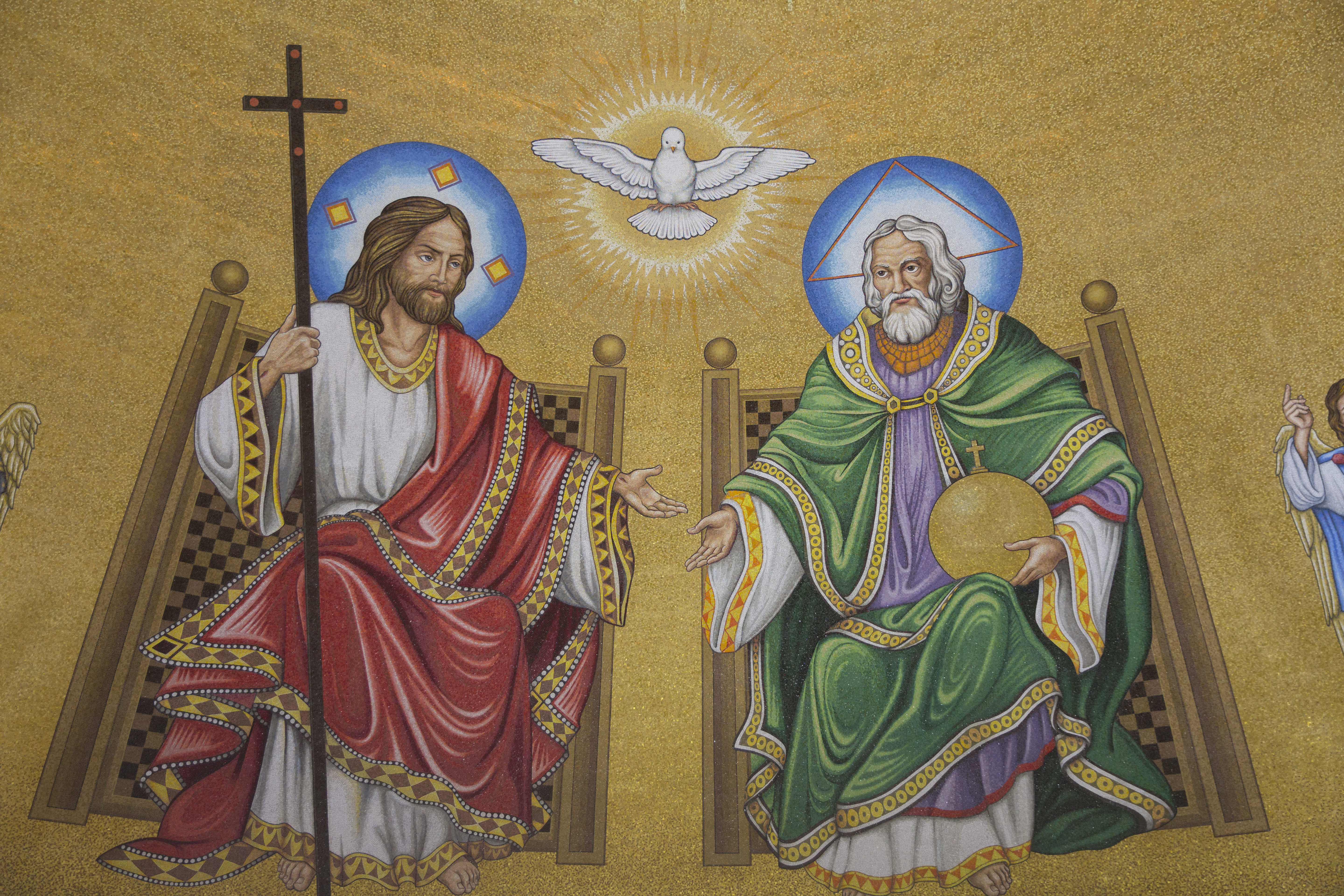
Yes, love is dynamic. There is a movement of love between the persons of the Trinity. This imagery is powerfully different than the one that most people have of the Trinity (God the Father on one throne, sitting next to His Son on another, with the Holy Spirit hovering like a dove between them). This is not wrong. Scripture speaks of thrones in Heaven and of the Father and the Son seated, but the thrones are likely more an image of authority than of inactivity.

Surely the inner life of the Trinity is more than merely being seated. It is a glorious procession of love: The Father loves the Son, the Son loves the Father, and the Holy Spirit is the love proceeding from them both. Yes, there is a great movement, a dance of love.

To this “dance” of love, Christ draws His Bride, the Church. It is our destiny and dignity to be caught up one day to the great dance of love of the Trinity. Heaven is not a static vision of God from some distance; it is a beatific vision, an experience of love that is dynamic and moving, a dance of ecstasy.

Put on your dancing shoes and get ready for the dance! Remember that to dance well we must surrender all pride and learn to dance as if no one is watching. Only the humble can really dance well, only those who can make space for the Lord and let Him lead.

I hope you will forgive the secular source, but below is an image of Christ drawing His bride to the dance.

Heaven is an Acquired Taste

There is a tendency today to forget that Heaven is an acquired taste; not everyone wants what God offers. While everyone wants to be happy, often happiness is conceived of in an egocentric way. Heaven is thought of as a personally designed paradise where we will be happy on our own terms.

But that is not what Heaven is. Heaven is the Kingdom of God in all its fullness. Its values and qualities are manifold but include many things that are not immediately desirable to those who live with hearts and minds that are worldly and sinful. The Kingdom of God features ideas that are often unpopular: love of one’s enemies, generosity, love of the poor, and chastity. Heaven features God and His teachings at the center, not me and what I think. Yes, Heaven is a place where every aspect of God’s law is perfectly manifested. Yet many find some of these things not only undesirable but downright obnoxious; some even call them hateful and intolerant. To those in darkness, the light seems harsh.

Yes, Heaven is an acquired taste. This helps to explain that the existence of Hell is not due to a “mean” God trying to remove people whom He doesn’t like from His presence. It is a respectful acceptance by God of the free decision made by those who do not want what He is offering. They do not want to think differently or even be told what to think. They do not want to give up their favorite sins or have their hearts purified of unruly or disordered appetites. In the end, God will not force us to love what and whom He loves. He will not force us to live in His Kingdom.

In his book The Great Divorce, C.S. Lewis makes this very point. In it, many people come to “tour” Heaven, some of whom do not like what they find. Some struggle to adjust, others are resentful and say, in effect, “No thanks.” If you have not read it, I strongly encourage you to do so; it is an important book to read and ponder.

In yesterday’s Gospel, the Lord inquires after our hearts by giving us the images of buried treasure and a pearl of great price. The one who finds them goes and sells all he has in order to obtain them. Does this describe your heart? Does it describe the hearts of our family, friends, and compatriots? Often, the answer is no. Most people are not will to give up everything for the Kingdom of Heaven. Our hearts are disordered. We easily desire things that are sinful and harmful, and not so much those that are good, holy, and lasting. We prefer apparent goods to true goods. If we are faithful, the Lord can get us to that disposition of heart—but it takes time. At least grant Him your willingness to get to that place!

In yesterday’s Gospel the Lord also speaks of a dragnet. While he uses it as an image for the final judgment, that final judgement ultimately depends on the myriad judgments we make in our daily life. As you haul the net of your life ashore, what do you keep, finding it valuable, and what do you discard? Do you value what God is offering and retain it or do you more highly value other things in the net? What do you keep and what do you discard? The answers to questions like these points to your place in the net at the last judgment. God will gather into His Kingdom those who have desired it, not those who have rejected it.

Give the Lord your heart. Open when He knocks. Let Him create a desire in you for the very things He is offering. In the end, Heaven is an acquired taste, more so than we commonly imagine. Let God give you a taste for better and higher things.

This song says, “I’m trying to make heaven my home!”

Love on the Move: Of the Divine “Dance” In the Holy Trinity

There is a kind of tension in some of the imagery we use for God. On the one hand we call Him the “Unmoved Mover.” We also say that God is everywhere. If He is everywhere then there is nowhere for him to go, no need for Him to move because He is already there. Yet we also speak of “processions” in the Trinity.

St. Thomas artfully and with precision speaks of the Trinity and the two “processions” as Gentori Genitoque laus et jubilation … Procedenti abutroque compar sit laudatio (To the One who generates and to the One who is generated be praise and jubilation … To the One proceeding from them both be equal praise).

St. Thomas also points out an important difference between material procession and divine procession:

In material things, what comes forth from another is no longer in it, since it comes from it by a separation from it in essence or in space. But in God, coming forth does not arise in this way. The Son came forth eternally from the Father in such a way that the Son is still in the Father from all eternity. And so, when he is in the Father, he comes forth. And when he comes forth, he is in him, in such a way that he is always coming forth, and always in him (Commentary on John, 16:28).

So, it would seem that the Unmoved Mover, our Triune God, has processions of love within. There is a kind of dynamism of love! Of course, our feeble words fall short and our analogies are weak.

There is a beautiful Greek word used by the Church Fathers (e.g., St. John Damascene) to describe the inner life of the Trinity: perichoresis. It is a combination of two words: peri, meaning “around” and chorein, meaning “to make space.” Therefore perichoresis, literally translated, means “to make space around.” It points to the way in which someone or something makes space around itself for others or for something else.

What a picturesque word! It suggests a kind of swirling or a dance. It is close in its spelling to the Greek word for dance, choreuo, so many people refer to it as the dance of love in the Trinity. Father, Son, and Holy Spirit make room for one another; they “dance” about and “with” one another in a way that shows a mutual indwelling while still maintaining space for each person.

Yes, love is dynamic. There is a movement of love between the persons of the Trinity. This imagery is powerfully different than the one that most people have of the Trinity (God the Father on one throne, sitting next to His Son on another, with the Holy Spirit hovering like a dove between them). This is not wrong. Scripture speaks of thrones in Heaven and of the Father and the Son seated, but the thrones are likely more an image of authority than of inactivity.

Surely the inner life of the Trinity is more than merely being seated. It is a glorious procession of love: The Father loves the Son, the Son loves the Father, and the Holy Spirit is the love proceeding from them both. Yes, there is a great movement, a dance of love.

To this “dance” of love, Christ draws His Bride, the Church. It is our destiny and dignity to be caught up one day to the great dance of love of the Trinity. Heaven is not a static vision of God from some distance; it is a beatific vision, an experience of love that is dynamic and moving, a dance of ecstasy.

Put on your dancing shoes and get ready for the dance! Remember that to dance well we must surrender all pride and learn to dance as if no one is watching. Only the humble can really dance well, only those who can make space for the Lord and let Him lead.

I hope you will forgive the secular source, but below is an image of Christ drawing His bride to the dance.

Why Does Jesus Say That the Father Is Greater Than He If the Members of the Trinity Are Equal?

A common question arising around the time of Trinity Sunday is rooted in this passage from John’s Gospel:

If you loved me, you would be glad that I am going to the Father, for the Father is greater than I (Jn 14:28).

This is somewhat puzzling because we are taught that each Divine Person of the Blessed Trinity fully possesses the nature of God and is equally to be adored and glorified. What, then, did Jesus mean when He said, “the Father is greater than I”?

The most common (and correct) answer is that in this passage Jesus was speaking in reference to His human nature, in which He is inferior to the Father; in His divine nature He is equal to the Father. Many of the Church Fathers spoke in this way. For example,

    • St Augustine said, Let us acknowledge then the twofold substance of Christ, the divine, which is equal to the Father, and the human, which is inferior. But Christ is both together, not two, but one Christ: else the Godhead is a quaternity, not a Trinity. Wherefore He says, If ye loved Me, ye would rejoice, because I said, I go to the Father; for human nature should exult at being thus taken up by the Only Begotten Word, and made immortal in heaven; at earth being raised to heaven, and dust sitting incorruptible at the right hand of the Father. Who, that loves Christ, will not rejoice at this, seeing, as he doth, his own nature immortal in Christ, and hoping that He Himself will be so by Christ (Quoted in the Catena Aurea at John 14:28).
    • Didymus the Blind said, When he says “greater” he indicates that his divinity can be equaled to the Father, since he is of the same substance as him, but the Father is greater because the Son accepted a body…The Son’s nature is understood to be less than that of the Father inasmuch as the Son became man (Fragments on John at 14).
    • Hilary of Poitiers said, By the birth of the Son the Father is constituted greater … in that the Son, born of the Father, after assuming an earthly body, is taken back to the glory of the Father (On the Trinity, 9:56).
    • Theodoret of Cyr had Jesus speak, saying, Sometimes therefore I, [Jesus] say that I am equal to the Father, and at other times say that the Father is greater than I. I am not contradicting myself, but I am showing that I am God and a human being … If you want to know how the Father is greater than I, I was talking from the flesh, not from the person of the Divinity (Dialogue 1:56).

Thus, the first answer is clear: As God, Jesus is equal to the Father, but as Man, He is inferior to the Father.

In a qualified way, however, it is also possible to speak of a particular greatness of the Father even within the Trinity. While all three persons of the Trinity are co-eternal, co-equal, and equally divine, the Father is the Principium Deitatis (the Source in the Deity). So, although the members of the Trinity are all equal in dignity, there are processions in the Trinity. The Father is the Principium, the Son eternally proceeds from Him and is eternally begotten by Him (Jn 8:42); the Holy Spirit eternally proceeds from the Father and the Son as from one principal (Jn 15:26).

Thus, even from the perspective of His divinity it is possible for Jesus to say, “I delight that the Father is the eternal principal of my being. Even though I have no origin in time, I do eternally proceed from Him.”

The Athanasian Creed says the following regarding these processions:

The Father is made by none, neither created nor begotten.
The Son is of the Father alone, neither made nor created, but begotten.
The Holy Spirit is of the Father and of the Son, not made, nor created, nor begotten, but he proceeds from them.

St. Thomas Aquinas speaks poetically of the Trinity in the familiar hymn “Tantum Ergo”:

Genitori, Genitoque … Procedenti ab utroque … compar sit laudautio.
(To the One Who Begets, and to the Begotten One, and to the One who proceeds from them both, be equal praise.)

So, although the Persons of the Trinity are equal, the processions within the Trinity do have an order. The Father is “greater” in the very qualified sense that He is the Principium Deitatis, the Principal of the Deity, but is co-eternal and equal in dignity to the Son and the Holy Spirit.

Devotionally, Jesus may also be speaking of the Father as greater in the sense that He always does what pleases His Father. Jesus loves His Father; He’s crazy about Him. He is always talking about Him and pointing to Him. By calling the Father “greater,” Jesus says (in effect), “I look to my Father for everything. I do what I see Him doing (Jn 5:19) and what I know pleases Him (Jn 5:30). As God, we share one will; as human, my human will and His will are one. What I will to do proceeds from Him. I do what I know accords with His will.”
Love on the Move: Of the Divine “Dance” In the Holy Trinity

There is a kind of tension in some of the imagery we use for God. On the one hand we call Him the “Unmoved Mover.” We also say that God is everywhere. If He is everywhere then there is nowhere for him to go, no need for Him to move because He is already there. Yet we also speak of “processions” in the Trinity.

St. Thomas artfully and with precision speaks of the Trinity and the two “processions” as Gentori Genitoque laus et jubilation … Procedenti abutroque compar sit laudatio (To the One who generates and to the One who is generated be praise and jubilation … To the One proceeding from them both be equal praise).

St. Thomas also points out an important difference between material procession and divine procession:

In material things, what comes forth from another is no longer in it, since it comes from it by a separation from it in essence or in space. But in God, coming forth does not arise in this way. The Son came forth eternally from the Father in such a way that the Son is still in the Father from all eternity. And so, when he is in the Father, he comes forth. And when he comes forth, he is in him, in such a way that he is always coming forth, and always in him (Commentary on John, 16:28).

So, it would seem that the Unmoved Mover, our Triune God, has processions of love within. There is a kind of dynamism of love! Of course, our feeble words fall short and our analogies are weak.

There is a beautiful Greek word used by the Church Fathers (e.g., St. John Damascene) to describe the inner life of the Trinity: perichoresis. It is a combination of two words: peri, meaning “around” and chorein, meaning “to make space.” Therefore perichoresis, literally translated, means “to make space around.” It points to the way in which someone or something makes space around itself for others or for something else.

What a picturesque word! It suggests a kind of swirling or a dance. It is close in its spelling to the Greek word for dance, choreuo, so many people refer to it as the dance of love in the Trinity. Father, Son, and Holy Spirit make room for one another; they “dance” about and “with” one another in a way that shows a mutual indwelling while still maintaining space for each person.

Yes, love is dynamic. There is a movement of love between the persons of the Trinity. This imagery is powerfully different than the one that most people have of the Trinity (God the Father on one throne, sitting next to His Son on another, with the Holy Spirit hovering like a dove between them). This is not wrong. Scripture speaks of thrones in Heaven and of the Father and the Son seated, but the thrones are likely more an image of authority than of inactivity.

Surely the inner life of the Trinity is more than merely being seated. It is a glorious procession of love: The Father loves the Son, the Son loves the Father, and the Holy Spirit is the love proceeding from them both. Yes, there is a great movement, a dance of love.

To this “dance” of love, Christ draws His Bride, the Church. It is our destiny and dignity to be caught up one day to the great dance of love of the Trinity. Heaven is not a static vision of God from some distance; it is a beatific vision, an experience of love that is dynamic and moving, a dance of ecstasy.

Put on your dancing shoes and get ready for the dance! Remember that to dance well we must surrender all pride and learn to dance as if no one is watching. Only the humble can really dance well, only those who can make space for the Lord and let Him lead.

I hope you will forgive the secular source, but below is an image of Christ drawing His bride to the dance.

Why Does Jesus Say That the Father Is Greater Than He If the Members of the Trinity Are Equal?

A common question arising around the time of Trinity Sunday is rooted in this passage from John’s Gospel:

If you loved me, you would be glad that I am going to the Father, for the Father is greater than I (Jn 14:28).

This is somewhat puzzling because we are taught that each Divine Person of the Blessed Trinity fully possesses the nature of God and is equally to be adored and glorified. What, then, did Jesus mean when He said, “the Father is greater than I”?

The most common (and correct) answer is that in this passage Jesus was speaking in reference to His human nature, in which He is inferior to the Father; in His divine nature He is equal to the Father. Many of the Church Fathers spoke in this way. For example,

    • St Augustine said, Let us acknowledge then the twofold substance of Christ, the divine, which is equal to the Father, and the human, which is inferior. But Christ is both together, not two, but one Christ: else the Godhead is a quaternity, not a Trinity. Wherefore He says, If ye loved Me, ye would rejoice, because I said, I go to the Father; for human nature should exult at being thus taken up by the Only Begotten Word, and made immortal in heaven; at earth being raised to heaven, and dust sitting incorruptible at the right hand of the Father. Who, that loves Christ, will not rejoice at this, seeing, as he doth, his own nature immortal in Christ, and hoping that He Himself will be so by Christ (Quoted in the Catena Aurea at John 14:28).
    • Didymus the Blind said, When he says “greater” he indicates that his divinity can be equaled to the Father, since he is of the same substance as him, but the Father is greater because the Son accepted a body…The Son’s nature is understood to be less than that of the Father inasmuch as the Son became man (Fragments on John at 14).
    • Hilary of Poitiers said, By the birth of the Son the Father is constituted greater … in that the Son, born of the Father, after assuming an earthly body, is taken back to the glory of the Father (On the Trinity, 9:56).
    • Theodoret of Cyr had Jesus speak, saying, Sometimes therefore I, [Jesus] say that I am equal to the Father, and at other times say that the Father is greater than I. I am not contradicting myself, but I am showing that I am God and a human being … If you want to know how the Father is greater than I, I was talking from the flesh, not from the person of the Divinity (Dialogue 1:56).

Thus, the first answer is clear: As God, Jesus is equal to the Father, but as Man, He is inferior to the Father.

In a qualified way, however, it is also possible to speak of a particular greatness of the Father even within the Trinity. While all three persons of the Trinity are co-eternal, co-equal, and equally divine, the Father is the Principium Deitatis (the Source in the Deity). So, although the members of the Trinity are all equal in dignity, there are processions in the Trinity. The Father is the Principium, the Son eternally proceeds from Him and is eternally begotten by Him (Jn 8:42); the Holy Spirit eternally proceeds from the Father and the Son as from one principal (Jn 15:26).

Thus, even from the perspective of His divinity it is possible for Jesus to say, “I delight that the Father is the eternal principal of my being. Even though I have no origin in time, I do eternally proceed from Him.”

The Athanasian Creed says the following regarding these processions:

The Father is made by none, neither created nor begotten.
The Son is of the Father alone, neither made nor created, but begotten.
The Holy Spirit is of the Father and of the Son, not made, nor created, nor begotten, but he proceeds from them.

St. Thomas Aquinas speaks poetically of the Trinity in the familiar hymn “Tantum Ergo”:

Genitori, Genitoque … Procedenti ab utroque … compar sit laudautio.
(To the One Who Begets, and to the Begotten One, and to the One who proceeds from them both, be equal praise.)

So, although the Persons of the Trinity are equal, the processions within the Trinity do have an order. The Father is “greater” in the very qualified sense that He is the Principium Deitatis, the Principal of the Deity, but is co-eternal and equal in dignity to the Son and the Holy Spirit.

Devotionally, Jesus may also be speaking of the Father as greater in the sense that He always does what pleases His Father. Jesus loves His Father; He’s crazy about Him. He is always talking about Him and pointing to Him. By calling the Father “greater,” Jesus says (in effect), “I look to my Father for everything. I do what I see Him doing (Jn 5:19) and what I know pleases Him (Jn 5:30). As God, we share one will; as human, my human will and His will are one. What I will to do proceeds from Him. I do what I know accords with His will.”

Love on the Move: Of the Divine “Dance” In the Holy Trinity

There is a kind of tension in some of the imagery we use for God. On the one hand we call Him the “Unmoved Mover.” We also say that God is everywhere. If He is everywhere then there is nowhere for him to go, no need for Him to move because He is already there. Yet we also speak of “processions” in the Trinity.

St. Thomas artfully and with precision speaks of the Trinity and the two “processions” as Gentori Genitoque laus et jubilation … Procedenti abutroque compar sit laudatio (To the One who generates and to the One who is generated be praise and jubilation … To the One proceeding from them both be equal praise).

St. Thomas also points out an important difference between material procession and divine procession:

In material things, what comes forth from another is no longer in it, since it comes from it by a separation from it in essence or in space. But in God, coming forth does not arise in this way. The Son came forth eternally from the Father in such a way that the Son is still in the Father from all eternity. And so, when he is in the Father, he comes forth. And when he comes forth, he is in him, in such a way that he is always coming forth, and always in him (Commentary on John, 16:28).

So, it would seem that the Unmoved Mover, our Triune God, has processions of love within. There is a kind of dynamism of love! Of course, our feeble words fall short and our analogies are weak.

There is a beautiful Greek word used by the Church Fathers (e.g., St. John Damascene) to describe the inner life of the Trinity: perichoresis. It is a combination of two words: peri, meaning “around” and chorein, meaning “to make space.” Therefore perichoresis, literally translated, means “to make space around.” It points to the way in which someone or something makes space around itself for others or for something else.

What a picturesque word! It suggests a kind of swirling or a dance. It is close in its spelling to the Greek word for dance, choreuo, so many people refer to it as the dance of love in the Trinity. Father, Son, and Holy Spirit make room for one another; they “dance” about and “with” one another in a way that shows a mutual indwelling while still maintaining space for each person.

Yes, love is dynamic. There is a movement of love between the persons of the Trinity. This imagery is powerfully different than the one that most people have of the Trinity (God the Father on one throne, sitting next to His Son on another, with the Holy Spirit hovering like a dove between them). This is not wrong. Scripture speaks of thrones in Heaven and of the Father and the Son seated, but the thrones are likely more an image of authority than of inactivity.

Surely the inner life of the Trinity is more than merely being seated. It is a glorious procession of love: The Father loves the Son, the Son loves the Father, and the Holy Spirit is the love proceeding from them both. Yes, there is a great movement, a dance of love.

To this “dance” of love, Christ draws His Bride, the Church. It is our destiny and dignity to be caught up one day to the great dance of love of the Trinity. Heaven is not a static vision of God from some distance; it is a beatific vision, an experience of love that is dynamic and moving, a dance of ecstasy.

Put on your dancing shoes and get ready for the dance! Remember that to dance well we must surrender all pride and learn to dance as if no one is watching. Only the humble can really dance well, only those who can make space for the Lord and let Him lead.

I hope you will forgive the secular source, but below is an image of Christ drawing His bride to the dance.