Jesus and the Sacraments are More than a Flu Shot!

It is tragic to me as a Catholic priest that many parents bring their children to baptism but nothing else and think all the while that they have done all that they should. Almost as though Baptism was no more than a flu shot: Take it and forget it.

But let me ask you, is it enough to give birth to a child and think your work is over?  Hah!…It has just begun!  We cannot simply bring children to birth, we have to feed, cloth, teach and care for them for years. It is the same with baptism, we cannot simply think that bringing  them to new life in baptism is all that is required. These children need to be taught about God and prayer, nourished on the Eucharist, bathed in confession, strengthened in confirmation, fed every Sunday at God’s altar, brought to maturity in Christ. Real faith is  not about a half-hour ritual many years ago. It begins there but it does not end there. The work for a Catholic parent has just begun. It is a work that is costly and cannot simply be reduced to a half-hour baptismal ceremony.

And if you’re a baptized Catholic don’t tell me that just getting baptized is all it took. If you get born and never eat your life is doomed. If you get born and never grow, learn to walk and talk, never reach maturity, something is terribly wrong.  Likewise, if you get baptized and never grow, never feed on the Eucharist, never learn of Jesus Christ and begin to speak of him, something is seriously wrong. You can’t reduce your faith to a simple half-hour ceremony, as though it were simply a flu shot. Real faith costs something, it demands change and effort from us. We have to die, so that Christ can live in us. This is costly.

Many of the Protestants have a strange and quite unbiblical notion called “Once saved, always saved.” That is, once you get saved, you can never lose that salvation no matter what. Well, I don’t have time to tell you all the biblical texts that such a notion violates but really, tell me if that makes any sense at all. We all know that we can make commitments and sadly walk away from them. But here too, on display is the nation that faith costs nothing more than walking up in a service and saying the “sinners prayer” or some little ritual. No indeed, faith is more costly than that, we are called to give our life to Jesus.

We do not get our faith “on sale.” The kind of work Jesus has to do in our life is not inexpensive or minor. It cost Jesus his life, and, I’ve got news for you, it will cost you your life too. It’s not some simple ritual, not like a simple flu shot. The Catholic Theology of baptism is that we die with Christ and rise with him to new life. Did you hear that? We die. Truth be told, we all have a lot of things to die to: sin, ego, possessions, popularity, greed, resentments, hatred, sensuality and on and on. Give your heart to Jesus but realize, it’s not just some sort of inexpensive, harmless ritual. To embrace our baptism is to die to this world and all its pomp and glory, to die to our ego and all its exaggerated needs.

Watch this video, it isn’t long. The speaker is a Southern Baptist, Paul Washer. He is rebuking his fellow Baptists some of whom think God’s grace is cheap and can be reduced to a simple altar call or to a “Once saved always saved” notion. But we Catholics do it to. Some of us think all we need are a few rituals and an occasional prayer. But the sacraments are more than this, they are not mere rituals, they are meant to be transformative realities. Sacraments cost Jesus everything, and, if you are serious about them, they will cost you too, and effect a radical transformation that isn’t always easy and costs us something. Faith and the sacraments  are more than a flu shot.
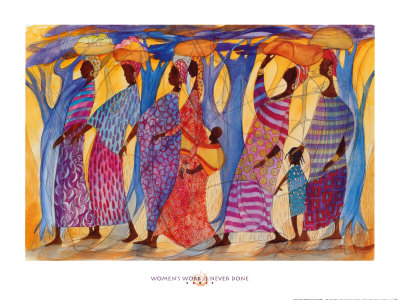
Women in the trenches

womenatwork

Does this sound like your life? Dr. Donna Orsuto, an American theologian at the Gregorian University in Rome and Director of the Lay Center at Foyer Unitas Institute believes the trenches are a place of contemplation.

See:

http://www.h2onews.org/index.php?option=com_content&view=article&id=19543&catid=54&Itemid=14

It is a good reminder that as lay women and men we are called to bring the Gospel to the “trenches” and to share as we prayed in the Psalm at today’s Mass, ” how the Lord has done marvelous deeds for me.” This, of course, is  Mary’s prayer. Take a minute and pray with her:

My soul magnifies the Lord,
And my spirit rejoices in God my Savior.
For He has regarded the low estate of His handmaiden,
For behold, henceforth all generations shall call me blessed.
For He who is mighty has done great things for me, and holy is His name. And His mercy is on those who fear Him from generation to generation.
He has shown strength with His arm:
He has scattered the proud in the imagination of their hearts.
He has put down the mighty from their thrones,
and exalted those of low degree.
He has filled the hungry with good things;
and the rich He has sent empty away.
He has helped His servant Israel, in remembrance of His mercy;
As He spoke to our fathers, to Abraham and to His posterity forever.

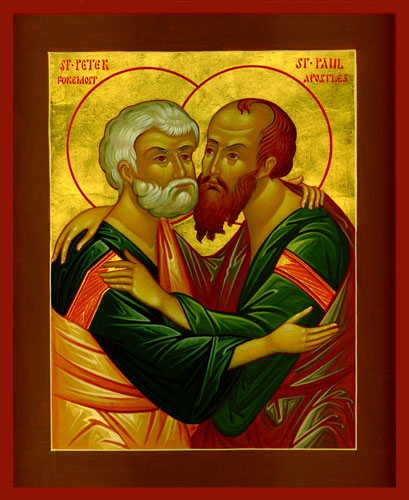
The Feast of Sts. Peter and Paul

On Monday we celebrate the Solemnity of Peter and Paul, one of the great feasts in the Church cal245_0035162142_peter-and-paul-apostles1endar. It has very special meaning for me because of having lived  in Rome for five years when I was doing my doctoral studies. One year a friend who is a priest and serves as a chaplain in the Air Force came to visit and brought along another chaplain who is a Protestant minister. The first two sites that Chaplain Chase wanted to see were the tomb of Saint Peter and the place where Paul was imprisoned. As we were standing at Peter’s tomb, he said, “for all of the differences there are among Christians, we all agree that Paul and Peter were here in Rome and that they were the church’s first two great leaders.” It was a reminder for me, that indeed, Peter and Paul are revered by all Christians. The three of us could stand and pray together at the tomb of Saint Peter grateful for the preaching and witness of these two martyrs of the faith.
 An Ecumencial Celebration

Indeed, the official celebration of the solemnity is Ecumenical. Pope Benedict XVI will gather with leaders of Christian communities for a Vespers service at the Basilica of St. Paul Outside the Walls. This will also mark the closing of the official celebration of the year of Saint Paul.

 The Petrine and Pauline Charism Today

Often within religious institutions or Catholic organizations people speak of the birth of the organization reflecting the Pauline and Petrine charisms. For many, the founder of a religious order tends to be like Paul, charismatic, dynamic, a preacher with a vision who can attract followers. Perhaps Francis of Assisi or Mother Theresa come to mind. The person who succeeds the founder, very often is someone with the Petrine charism. This is the person responsible for taking the vision and creating a structure so that the work of the founder can grow and spread. The “second founder” as these men and women are sometimes called, are not always as well known as the founder, but their work is vital to the success of the mission.


As a church that is universal in scope, the office of the Pope–the Petrine Office –secures the institutional life of the Church.  It both represents the unity of the Catholic Church and it insures our common identity and mission. At the same time, the church is at its core is missionary and so it insists that men and women, clergy, religious and lay are preaching and teaching the Gospel throughout the world–the Pauline charism.


As we celebrate this feast, give thanks to God for the leadership of Peter and Paul and for those who continue building the kingdom of God through the Pauline and Petrine charism.

 Fireworks 

On a lighter note, it is not only a feast day, but a civic holiday because Peter is the patron saint of Rome. The city of Rome celebrates the feast in a big way, business and shops are closed and the day ends with spectacular fireworks.


On Being Catholic

Did you catch the piece in the Washington Post last Saturday called “On Faith”? It featured an interview with a woman writing a book on Catholics on the Supreme Court. If Judge Sotomayor is confirmed there will be six Catholic justices. The author, Barbara Perry, opines that the number of Catholics is related to liberal and conservative politics more than religion. When asked how she thinks Judge Sotomayor’s Catholicism will play into her decisions if confirmed, she describes Judge Sotomayor as someone who attends church for family and special occasions, guessing she will be more liberal—a social justice type of Catholic. Whereas justices like Scalia and Roberts are conservative on issues such as abortion and church and state matters.


This kind of conversation is so common in political discussions and in church conversation and it is really misguided. There is only one kind of Catholic; the person who is baptized saved by God’s grace and called to share in the very mission of Jesus Christ. Happily, once baptized a Catholic, or baptized in another Christian community and later received into the Church through Confirmation, one is forever a Catholic.

The only real Catholic is the one who daily strives to love God through prayer, love the people God sends into one’s life, and regularly receive the sacraments, beginning with Sunday Mass. The sacraments are not magic and though Baptism is forever, one must continually grow in faith and love, one’s faith needs to mature in much the same way we mature physically, psychologically and socially.


Unhappily, we know that there is a wide range of ways in which people stop growing in the faith. In the field of Evangelization we try to identify (one might say label) stages in the practice of the faith in hopes that we can call all Catholics to full and active participation in the faith.


We speak of unchurched Catholics who were Baptized and maybe received Eucharist and confirmation but were not raised in the faith and so have no real understanding of what it means to be Catholic. We also speak of inactive Catholics, those Catholics who identify themselves as Catholics but go to Mass no more than a few times a year outside of weddings or funerals. A third group is called alienated Catholics and they are Catholics who though they call themselves Catholic, they stay away from participation in the church because of a negative experience of some sort. In many case there is a desire for reconciliation and healing in order to feel welcomed or at home in the Church.


Like a family, all of these people are Catholics and considered part of the Catholic family. We who are fellow Catholics or work for the Church have a responsibility for seeking out, listening, inviting, and encouraging these sisters and brothers to deepen their faith and rediscover the gift of the Catholic tradition.


Labels like liberal, conservative, cultural, or radical Catholic tend to suggest that it’s possible for an individual Catholic to decide what it means to be Catholic. When I think of some of the American Catholic saints, life Mother Katherine Drexel or Elizabeth Seton I discover women who would defy all of our popular labels. They were passionate in their love of God, their love of the Church and their love for others, especially the poor and the marginalized. Fr. Pedro Arrupe, S.J., once Master General of the Jesuits captures the passion that faith brings to life in this prayer.


“Nothing is more practical than finding God, that is, than falling in love

in a quite absolute, final way.

What you are in love with, what seizes your imagination,

will affect everything.

It will decide what will get you out of bed in the morning,

what you will do with your evenings,

how you will spend your weekends,

what you read, who you know,

what breaks your heart,

and what amazes you with joy and gratitude.

Fall in love, stay in love and it will decide everything.”


Who is a Catholic? Enjoy this video displaying the rich Tapestry of the Catholic Church!

Latest News – From the Self-Inflicted Wounds Department

I almost think I need to establish a new series on this blog: the “Self-inflicted Wounds Department.” This latest issue of Gloria TV news once again demonstrates how we as Catholics frequently do not see eye to eye on matters of great significance and thereby become an ineffective witness to the world. The lack of a united front, the lack of consensus on how to interact with a world increasingly at odds with us  has become a crucial issue that impacts our ability to be coherent to the world. It amounts to a self-inflicted wound.

For example on the issue of Abortion, the Catholic teaching is clear. But we seem to have little consensus on how to speak to  the world that prefers euphemisms such as “choice” and “reproductive freedom” and “privacy” to the simple and clear truth that abortion is the killing of children in the womb. Now take this item from the news today:

According to the editor-in-chief of the Vatican newspaper L’Osservatore Romano, US-President Barack Obama in his pre-presidential voting record may have “made decisions that certainly cannot be defined as pro-life,” but this does not make him “pro-abortion.” “He was, rather, pro-choice,” Gian Maria Vian claimed in an interview for the National Review Online. The interview came after a series of articles in L’Osservatore praising Obama and soft-pedalling the opposition of the US bishops. The articles have been heavily criticized by pro-life leaders.

Now mind you, this is not merely an average Catholic speaking, this is the Editor in Chief of the Vatican’s own newspaper, a paper that, theoretically speaks for the Vatican and represents its views. Now I don’t actually think this is the view of the Vatican but Mr. Vian cannot simply be ignored. Further he was commenting on a series of articles in L’Osservatore Romano which all raised problems for pro-life Catholics. If the Editor in Chief of the Vatican’s own newspaper seems ambiguous about our President’s stand on Abortion, and if it’s editor uses the euphemistic language of the pro-abortion movement, where do we stand? I cannot begin to understand his motivation since I do not understand European politics. But as a casual observer of European thinking (filtered through our own media) it seems that Europe is quite fond of President Obama. He has taken positions they strongly support on a whole range of other issues (war in Iraq etc.) and thus they are disposed to find ways of overlooking the fact that he is perhaps the most pro-abortion president we have ever had. He even refused to support the “born alive infant act” and limits on partial birth abortion. There are many reasons for Catholics, both Americans and Europeans,  to like and support President Obama, but Abortion is not one of them. And speaking in the language of our pro-abortion opponents and using their own euphemisms is a self-inflicted wound. We need to work more carefully to develop coherent and consistent ways of speaking and acting so that we communicate our teaching clearly.

A second issue on this same video involves a Madonna Concert in Poland on August 15, the Solemnity of the Assumption. While this issue is far less serious than the one above, it also illustrates how Catholics are seen as quite divided by the world. Many Catholics there have protested the concert of Madonna, who has quite a record of anti-Catholic antics. But a Jesuit priest is quoted in the media as flippantly remarking that August 15 seems to be a fine day for a concert. Enter this too into the “Self-inflicted wounds Department of this blog.” (Sigh)

Here then is the latest news:

Einstein on the Problem of Evil

I first saw this video at Patrick Madrid‘s Website. Many have struggled with the problem of evil. Now evil is often thought of as an existing reality when in fact is is really a privation, that is, a lack of something that should be there. To sin is to lack justice, to lack truth, to lack love, mercy etc. God did not create evil, evil is a lack of something God intends.

You’ll need to watch this video closely. It is in German with subtitles but it is well worth the work. It depicts how the youthful Einstein once debated a professor on the problem of evil.

25…45…55…75…

wedding-feastI was reading the newspaper, enjoying a cup of coffee in a café on Capitol Hill when the conversation between two 30something women caught my attention. One woman was saying to the other that though she couldn’t be happier with her husband and she loves being married, she doubted she would remain married to him her entire life. Well, needless to say, I couldn’t help but keep listening. She went on to say that marriage was invented at a time when people did not live past 50 or so, and so one could imagine being married for twenty or thirty years but today, when people live to be ninety, you can’t really expect people to stay married to the same person for the rest of their lives.

Well, tell that to the more than 550 couples in the Archdiocese who will come together on Sunday at the National Shrine of the Immaculate Conception to celebrate being married twenty-five years or more. 272 of these couples have been married fifty or more years. One couple, who can’t be at Mass on Sunday, but who will be honored at their parish has been married 75 years!

It’s probably safe to say that none of these marriages are perfect but all of the couples and have experienced the beauty of married love that has stood the test of time. As Helen Sewell, married 59 years shared “I know he’d do anything for me.”

If you are wondering what makes a marriage work, these are the people to ask. I think that they would have a multitude of reasons for what has made their love so enduring. If I had to guess, I would bet learning how to forgive, the importance of family life, praying together, laughter and not taking the small stuff too seriously would all be on the list.

While not a fan of country music, when flipping through channels one night, the refrain of the song that was playing was “saying I do, means saying “I will…” I’m not sure who sings that song but the couples we will honor on Sunday are the best proof we have that marriage is made to last a lifetime.

Hearts as large as the World

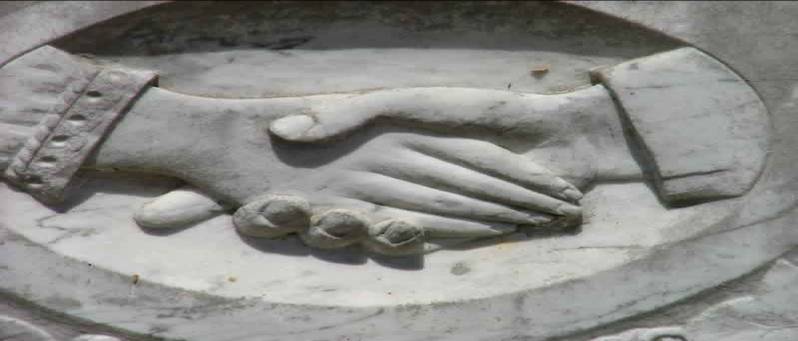
handsTo Love is to Serve

Discovering our Catholic Hearts

When Catherine of Siena, an Italian Lay Woman and Doctor of the Church was a young adult she decided she wanted to love God with her whole soul, mind and heart.  She thought she could best do that by spending her days in adoration of the Blessed Sacrament in a small room (she called it her cell) in her house. She left the house only to attend daily Mass.  After a short time of this practice, she heard God’s voice. She records in The Dialogue(the story of her life) a conversation with God. God says to Catherine, “if you want to love me as much as I love you, than you need to serve your sisters and brothers.” God, in a sense, pushed Catherine out of her cell and into the world.  Catherine discovered the face of Christ in those who were dying of the plague and Catherine preached peace to her sisters and brothers who were at war with one another. Catherine learned that to love God is to serve the world.

The Archdiocese of Washington is taking up the theme of service and love in a one day Social Ministry Conference on Saturday June 13.   See www.adw.org/service for more information.

The day features keynote presentations and break-out sessions on the Church’s mission to proclaim the Good News of Christ’s love for the poor and how the Church carries out this mission, locally, nationally, and internationally. There are workshops for teens, young adults and adults. Participants will have a chance to gather with Catholics from all over the Archdiocese of Washington and to explore the relationship of theology, prayer and service. The day will conclude with a prayer service with Archbishop Wuerl.

Catherine’s experience of taking her love for the Lord to the streets taught her that her “cell” was within her, that she could stay close to the Lord in midst of the noise and distractions of  daily life. Most of all Catherine discovered a heart as large as the world. She discovered a Catholic Heart!