Posts Tagged ‘Saints’
The Real St. Nicholas – Not Fat and Not Particularly Jolly
Today is the Feast of St. Nicholas. The real St. Nicholas was nothing close to the St. Nick (Santa Claus) of the modern age. He was a thin curmudgeonly man with a zeal for the Lord that caused flairs of anger. Compromise was unknown to him. The slow transformation of him into “Jolly ole’ Saint Nicholas is a remarkable recasting of him centuries in the making. Some years ago the Washington Post featured an article entitled Poles Apart: Nicholas of Myra; How a 4th-Century Bishop Achieved Fame 1,500 Years Later, With a Whole New Attitude.
Since I had to blog twice yesterday (due to the need to respond to the current Washington Post article on Clergy Sexual Abuse) I thought I might take a break and present excerpts from the article that detail the real St. Nicholas of Myra. It is a very engaging look at the cantankerous Saint who lived through some very tough times.
I am aware that hagiography (the study of the Saints) is sometimes more art than science. I cannot vouch for every detail in the article and would be interested if some of you intrepid hagiographers what to clarify, correct or add to the details given.
The Full Article (which details, somewhat thoroughly, St. Nicholas’ transition to Santa) can be read here: Poles Apart. I have also placed a PDF of the whole article which is more easily printed here: PDF – Poles Apart Nicholas and Nick
Enjoy this excerpt on the real St. Nicholas of Myra (aka Santa):
The year is 325. The place is Nicaea, a small town near the Black Sea in what is now Turkey. Thousands of priests, 318 bishops, two papal lieutenants and the Roman emperor Constantine are gathered to face a looming church crisis…..
One of the churchmen rises to speak. Arius, from the Egyptian city of Alexandria, tells the gathering that Jesus was not divine. He was just a prophet. Suddenly, a second man is on his feet, an obscure, cantankerous bishop named Nicholas. He approaches Arius, fist raised menacingly. There are gasps. Would he dare? He would. Fist strikes face. Arius goes down. He will have a shiner. Nick, meanwhile, is set upon by holy men. His robes are torn off. He is thrown into a dungeon.
Peer down through the bars. Behold the simmering zealot sitting there, scowling, defiant, imprisoned for his uncompromising piety. Recognize his sallow face? No? Well, no reason you should. But he knows you. He’s been to your house many times….
[O]n this holiday we examine the puzzling paradox of Santa Claus. On the one hand, we have the modern Santa, a porcine, jolly man who resides at the North Pole with a woman known only as Mrs. Claus. …
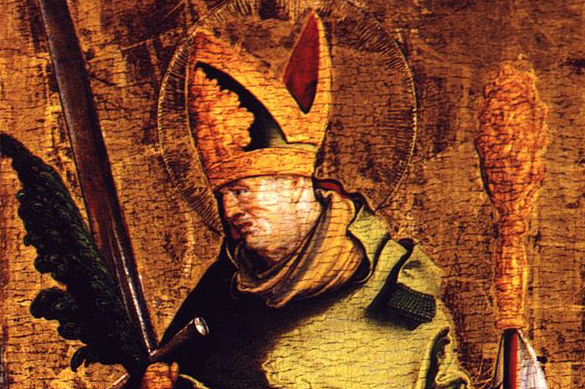
On the other hand, we have the ancient Santa. Saint Nicholas. Paintings show a thin man. He was spare of frame, flinty of eye, pugnacious of spirit. In the Middle Ages, he was known as a brawling saint. He had no particular sense of humor that we know of. He could be vengeful, wrathful, an embittered ex- con….No doubt, Saint Nick was a good man. A noble man. But a hard man.
Nicholas was born in Patara, a small town on the Mediterranean coast, 280 years after the birth of Christ. He became bishop of a small town in Asia Minor called Myra. Beyond that, details of his life are more legend than fact….He became a priest at 19, and bishop in his twenties….Diocletian ruled the Roman Empire; it was the early 300s, and…began the “Great Persecution.”…. Nicholas kept preaching Christianity, and was arrested and tortured for disobeying the new laws. He spent more than a decade in jail. Among his punishments, according to Saint Simeon’s 10th-century history, were starvation and thirst. That is how Santa got skinny…. Twelve years later, AD 312, ….Constantine triumphed. Across the empire, bishops and priests returned to work and Nicholas got out of jail. He tended to local business. He was not pleasant about it. At the time, Myra was a hotbed of Artemis-worship…Nicholas prayed for vengeance, and his prayers were answered. Artemis’s temple crumbled. ” …The priests who lived in Artemis’s temple ran in tears to the bishop. They appealed to his Christian mercy. They wanted their temple restored.….Nicholas was not moved. Prison had left him in no mood for compromise. “Go to Hell’s fire,” he is said to have said, “which has been lit for you by the Devil.”
The Time of Nick In his lifetime, Nicholas crusaded against official corruption and injustice, seeing both as an affront to God. Supposedly, his intervention — through fire-and-brimstone denunciations of corrupt officials — saved at least a half-dozen innocent men from the gallows or the chopping block. He was forgiven for punching Arius and rescued from the dungeon. In the end, his views on the Trinity were vindicated by the adoption of the Nicene Creed, which declares Christ divine. Saint Nick died on Dec. 6. The year could be 326 or 343 or 352, depending whose account you rely on. Why we know the day of the year, but not the year itself, will be explained forthwith…..
……Nicholas of Myra might not seem like the kind of person who relates to kids, and few acts attributed to him involve children. There are two, though neither is exactly the stuff of sugar plums and Christmas stockings. In one tale, widely told, Nicholas secretly delivers three bags of gold to a penniless father. The debtor dad uses the loot as dowries so his three girls do not have to become prostitutes….The second anecdote tells of the time a tavern owner robbed, murdered three children, hiding their remains in pickle barrels. …Fortunately, Saint Nicholas happened to walk through the tavern-keeper’s door….Soon, all three boys, were back home, reeking of pickle juice. What became of the shopkeeper is unrecorded…. By the Middle Ages, Nick had become the patron saint of children, and he had a new gig: gift-giving. Throughout Europe, the legend spread: He delivered trinkets to good kids and twigs to naughty ones. It was an uneasy transition — from curmudgeon to cuddle-bear. ….
As said above you can click on those links to read the full story of how St. Nicholas of Myra morphed into Santa Claus.
Here’s a Medieval Version of “Jolly old St. Nicholas.” The text is the Introit for the feast of St. Nicholas (Statuit ei Dominus) and translated says: The Lord made unto him a covenant of peace, and made him a prince, that the dignity of the priesthood should be to him forever.
Here’s the Modern Version:
How Can the Saints Hear Us? Because God is Able!
A common Evangelical protest against the Catholic practice of praying and interacting with the saints is that they “can’t hear us.” Those who disbelieve our practice often quote 1 Kings 8:39 which says, for you alone (O Lord) know the hearts of all men. Hence, according to this quote Saints, who are not God, cannot know our thoughts unless we speak them aloud.
This means, we must therefore speak them aloud. And this in turn ridiculed, or at least dismissed, by many Evangelicals who consider it absurd to think a saint way up in heaven would have adequate hearing to perceive us, way down here on earth talking to them. Further, even if they could hear us, how could they distinguish thousands or millions of people talking to them all at once? And so on, with these sorts of objections. To be fair, not every Evangelical shares all these objections nor do they always attempt to ridicule our practice. But objections and attitudes like this are common enough to merit response.
The straight answer to the objections that saints cannot know our prayers due to lack of hearing, or inability to mind read, is set aside by Scripture itself which does speak of them as interacting with our prayers. More of this in a moment.
But some attention should also be paid to the highly naturalistic notions held by our critics, of the saints in heaven. To simply presume they “hear” in same way we do here on earth, or that their minds are operative in same way that ours are, or that they even experience time in the same serial way we do, are all highly questionable premises.
To begin with, the saints, through their more perfect union with Christ, ought not be presumed to experience their human faculties in exactly the same way as here on earth. Obviously their bodies have not yet risen, and hence they do not “hear” in the same manner as we do who still have bodies. Neither are their minds mediated through the physical brain as our is. Even when the trumpet shall sound and the bodies of the saints be restored to them, we need to understand that their humanity, body and soul, will be a glorified humanity. While we do not know all the aspects of a glorified humanity we will surely not have the forgetful and slow minds we have now. Neither ought we presume that our hearing will be limited as it is now.
So, to be clear, we ought not merely presume that the saints in heaven, even now, experience all the limits we do. They are caught up in Christ, and bound to Him more intimately and perfectly.
Secondly, the saints do not likely experience time like we do. Heaven is called, among other things in Scripture “eternity” or “eternal life.” Now eternity does not refer merely to the length of time or life, but also to the fulness of it. The fulness of time includes past, present and future, as one thing, in one moment. While we cannot be sure if the saints experience the “comprehensive now” as God does, we ought not presume that they experience time merely as we do either. Heaven is quite surely outside our earthly experience of time.
Hence, our understanding of heaven ought to include a mystical dimension and it is wrong to simply project our currently broken and fallen human condition on to the Saints in heaven or to presume them inside time exactly as we are.
Jesus rebukes the minimalists of his day – Regarding this tendency to make heavenly realities look either silly or untenable by projecting earthly categories there, Jesus had to rebuke the Sadducees of his day. They attempted to make heaven (which they rejected as a reality) look silly by projecting an earthly marriage scenario there of a woman who had seven husbands. Jesus said to them “Are you not in error because you do not know the Scriptures or the power of God? When the dead rise, they will neither marry nor be given in marriage; they will be like the angels in heaven (Mk 12:24-25). Thus, heaven is not like earth, and should not be reduced to it. Nor are the souls in heaven presumed to be exactly the same as they are now.
Hence, to presume that Saints can hear us is not outlandish, for they are in Christ, and they are perfectly in communion with him in heaven. It is obviously Christ himself, then, who fosters our union with the Saints and their ability to remain in communion with us. For there is only one Body of Christ, and all the members are untied by the Head, who is Christ.
Now that the Saints do interact with us and present our prayers to God is stated in the Book of Revelation:
[T]he twenty-four elders fell down before the Lamb, each one holding a harp and golden bowls full of incense, which are the prayers of the saints. (Rev 5:8)
Later we also see that the angels also collect the prayers of the saints:
Another angel, who had a golden censer, came and stood at the altar. He was given much incense to offer, with the prayers of all the saints, on the golden altar before the throne (Rev 8:3).
“Saints” here is used in the common first Century biblical sense as meaning those on earth who have accepted Christ (cf Eph 1:1; Phil 1:1; 2 Cor 9:1; Phil 1:5; Rom 16:2 and many,many more), not merely in the modern Catholic sense as only the canonized saints in heaven.
And thus, the image and teaching here is that the Holy Ones in heaven collect the prayers of the saints on earth and present them to God, like incense.
That these prayers have dramatic effects is illustrated in the verses that follow in Rev 8:
The smoke of the incense, together with the prayers of the saints, went up before God from the angel’s hand. Then the angel took the censer, filled it with fire from the altar, and hurled it on the earth; and there came peals of thunder, rumblings, flashes of lightning and an earthquake. (Rev 8:4-5)
There follow seven trumpet blasts with confer God’s judgment and justice.
So the saints in heaven do hear us, they do collect our prayers and present them God and their intercession has powerful effects, the text from 1 Kings above, not withstanding.
Those who merely deny this based on some human notion of implausibility I would argue come under the Lord’s judgement: Are you not in error because you do not know the Scriptures or the power of God? (Mk 12:24). For though it may seem implausible to human minds, our God is able. And he reveals in Scripture that he not only able to empower the heavenly saints and angels in this regard, he is also most willing.
Here is a very good and brief video on this by Tim Staples
Every Saint was a sinner and every sinner could be a Saint.
While getting ready for Mass one Sunday, one of my fellow parishioners commented that he felt so far from the Kingdom of God sometimes. Specifically, he said that when listening to the stories of the saints, his only thought is, “That could never be me!” His comment was not simply a statement of humility but rather one of despair.
You should have known me when. . .
The stories of the saints are supposed to inspire us but if we think the saints were born perfect, sainthood does seem unattainable. Only Saint Mary, the Mother of God, was born without sin. The rest of the Saints had the same human weaknesses and failings that all of us pilgrims on Earth are experiencing now. Saint Peter denied Christ three times. Saint Augustine was raised by a Christian mother but became pagan before turning his life back over to Christ. Each declared Saint of God was a flawed sinner. In fact, some of their flaws were far greater than ours. Yet, God can meet anyone anywhere in their lives and lead them to heaven, including you and me!
Not perfect, just holy.
There is a big difference between being perfect and being holy. I work every day on holiness, not perfection. There has been only one perfect man in the history of humankind and you all know what we did to him. I have no interest in being perfect. Being holy on the other hand is something I strive for everyday. The saints were certainly not perfect. But, each of them was holy even though they were sinful. In the midst of the holy season of Christmas, let’s strive to be holy, not perfect!
How’s that for a New Year’s resolution?
What Will Our Resurrected Bodies Be Like?
In today’s first reading at Mass St Paul writes to the Philippians of the glory that our currently lowly bodies will one day enjoy:
He will change our lowly body to conform with his glorified Body by the power that enables him also to bring all things into subjection to himself. (Phil 3:19)
I once spoke with an older woman who wasn’t all that pleased to hear that her body was going to rise and be joined again to her soul: “Oh, Father, you don’t mean this old decrepit body?! If this body has to rise I am hoping for an improved model!”
Yes! I think most of us can relate to the need that our current lowly bodies will be improved. And they will surely be. Notice how the passage above says, that these lowly, often weak, diseased, and often over-weight bodies will be changed and reflect the glory of the resurrected body of Jesus. Yes, this old general issue clunker that I’m currently experiencing is going to be upgraded to a luxury model. We’re headed for first class.
In this month of November when we recall the four last things: Death, judgment, heaven and hell, we ought to consider for a moment what scripture and tradition have to say to us about what our resurrected bodies will be like.
Now an important starting point in discussing this matter is a little humility. The fact is, a lot of what we are going to say here is speculation. But, it is not WILD speculation. It is rooted in Scripture to be sure. However, Scripture is describing things that are somewhat mysterious and difficult to reduce to words. Further, Scripture does not always elaborate on things which are said. Where we might wish for more details, none are given. Sometimes too, we infer qualities of the resurrected body based only on scriptural texts whose main purpose is not so much to describe the resurrected body. Rather, their purpose is to set forth the fact of the resurrection of Jesus. For example, Jesus appears and disappears at will in a room though the doors are locked. The point of the text is to tell us he appeared, not necessarily that the resurrected body has something we have come to call “agility” (see below). Hence the text does not elaborate on this point and we are left to infer things about Jesus resurrected body and then apply it to our own. This is not wrong, for Paul above says that our resurrected bodies will have qualities that conform to Jesus’ resurrected body . But the point is that the biblical texts do not elaborate on this or other qualities in a detailed manner and so, we are left to speculate and infer some of what we know.
St. John the Apostle expresses some of the humility we should bring to this discussion:
Beloved, now we are children of God, and it has not appeared as yet what we will be like. But We know that when He appears, we will be like Him, because we will see Him just as He is. (1 John 3:2)
I do not interpret John to mean we know nothing, for in so doing, he would negate other Scriptures. But I interpret him to mean that we do not fully grasp the meaning of what we are discussing, and that much of it is mysterious. Something is known and revealed but much more of it is unknown and far beyond what we have yet experienced.
With the need for humility in mind let’s consider some of what we might be able to say of the qualities of a resurrected body. Perhaps it is well that we start with the most thorough passage in the New Testament on this subject and then list the traditional seven qualities of a resurrected body.
St. Paul writes of the resurrected body in First Corinthians 15:
But someone will ask, “How are the dead raised? With what kind of body will they come?” How foolish! What you sow does not come to life unless it dies. When you sow, you do not plant the body that will be, but just a seed, perhaps of wheat or of something else. But God gives it a body as he has determined, and to each kind of seed he gives its own body…..The splendor of the heavenly bodies is one kind, and the splendor of the earthly bodies is another……The body that is sown is perishable, it is raised imperishable; it is sown in dishonor, it is raised in glory; it is sown in weakness, it is raised in power; it is sown a natural body, it is raised a spiritual body. If there is a natural body, there is also a spiritual body. So it is written: “The first man Adam became a living being”; the last Adam, a life-giving spirit. The spiritual did not come first, but the natural, and after that the spiritual. The first man was of the dust of the earth; the second man is of heaven. As was the earthly man, so are those who are of the earth; and as is the heavenly man, so also are those who are of heaven. And just as we have borne the image of the earthly man, so shall we bear the image of the heavenly man…..Listen, I tell you a mystery: We will not all sleep, but we will all be changed— in a flash, in the twinkling of an eye, at the last trumpet. For the trumpet will sound, the dead will be raised imperishable, and we will be changed. For the perishable must clothe itself with the imperishable, and the mortal with immortality. When the perishable has been clothed with the imperishable, and the mortal with immortality, then the saying that is written will come true: “Death has been swallowed up in victory.” “Where, O death, is your victory? Where, O death, is your sting?”(1 Cor 15:35-55 selectae).
Now using this passage and others we can distinguish seven traditional qualities of a resurrected body. Here we will allow our source to be the Summa of St. Thomas. You can click on each quality (in blue) to read more a the NewAdvent Summa online.
1. Identity – What this means essentially is that the very same body that falls in death will rise to be glorified. We cannot claim that we will get a different body, but rather, that our current body will rise and be glorified. St. Thomas says, For we cannot call it resurrection unless the soul return to the same body, since resurrection is a second rising, and the same thing rises that falls: wherefore resurrection regards the body which after death falls rather than the soul which after death lives. And consequently if it be not the same body which the soul resumes, it will not be a resurrection, but rather the assuming of a new body (Supl, Q 79.1).
This does not mean that the body will necessarily be identical in every way. As St. Paul says above, are current bodies are like the seed. And just as a seed does not have all the qualities of the mature plant, but does have all these qualities in seed form. So too our body is linked to our resurrected body causally and essentially though not all the qualities of the resurrected body are currently operative. Again, the Summa states: A comparison does not apply to every particular, but to some. For in the sowing of grain, the grain sown and the grain that is born thereof are neither identical, nor of the same condition, since it was first sown without a husk, yet is born with one: and the body will rise again identically the same, but of a different condition, since it was mortal and will rise in immortality. (Ibid).
Scripture attests that the same body that dies will also rise. Job said, And after my flesh has been destroyed, yet in my flesh I will see God; I myself will see him with my own eyes—I, and not another (Job 19:26-27). And to the Apostles, shocked at his resurrection Jesus said, Look at my hands and my feet. It is I myself! Touch me and see; a ghost does not have flesh and bones, as you see I have (Luke 24:39).
Hence the same body rises and so there is continuity. But there is also development and a shining forth of a new glory and capabilities that our bodies do not currently enjoy.
2. Integrity – We will retain all of the parts of our current bodies. Now this means every physical part of our body, even the less noble parts such as intestines etc. In the Gospel Jesus plainly ate even after the resurrection. He ate a fish before them (Luke 24:43). He also ate with the Disciples in Emmaus (Luke 24:30). He ate breakfast with them at the lake shore (Jn 21:12). Hence it follows that even less noble parts of our body will rise for eating and digestion are still functions of a resurrected body. Now Thomas argues (I think rightly) that food will not be necessary to the resurrected body (supl 81.4). But it is clearly possible to eat, for Christ demonstrates it.
St. Thomas reasons that every aspect of our bodies will rise since the soul is the form of the body. That is, the body has the faculties it has due to some aspect of the soul. The soul has something to say and hence the body has the capacity to talk and write and engage in other forms of communication. The soul has the capacity to do detailed work and hence the body has complex faculties such as delicate and nimble fingers, arms and so forth, to carry out this work. Now body is thus apt for the capacities of the soul, though now imperfectly, but then even more perfectly. (cf Summa supl. Q. 80.1).
At some level it seems we have to suspend our speculation and keep it within limits. The Summa goes into matters which I think are highly speculative and you can click on the blue word integrity above to read these speculations. But personally I think we should refrain from trying ask questions about whether hair and nails will grow and what bodily fluids will still be necessary and why. Will latrines be needed in heaven or will food be perfectly absorbed and nothing wasted? etc. We just have to stop at a certain point and say we just have no business knowing this stuff and it is purely speculative to discuss it. The bottom line is that, yes the Body shall rise, whole and complete. Its functions will be perfected and perfectly apt for the soul in a way beyond what they are now. But as to the intimate details, we ought to realize that humilty is the best posture.
3. Quality – Our bodies will be youthful and will retain our original gender. Now youthful here does not necessarily mean 18-22. Note that in the Philippians text that began this post, Paul says that our glorified bodies will be conformed to Christ’s glorified body. Now his body rose at approximately 30 – 33 of physical age. Elsewhere St. Paul exhorts Christians to persevere, Until we all meet into the unity of faith, and of the knowledge of the Son of God, unto a perfect man, unto the measure of the age of the fulness of Christ (Eph 4:13). Hence it would seem that Christ’s resurrected body is the perfect age.
St Augustine also speculates, that Christ rose again of youthful age,….about the age of thirty years. Therefore others also will rise again of a youthful age (cf De Civ. Dei xxii).
St. Thomas further notes: Man will rise again without any defect of human nature, because as God founded human nature without a defect, even so will He restore it without defect. Now human nature has a twofold defect. First, because it has not yet attained to its ultimate perfection. Secondly, because it has already gone back from its ultimate perfection. The first defect is found in children, the second in the aged: and consequently in each of these human nature will be brought by the resurrection to the state of its ultimate perfection which is in the youthful age, at which the movement of growth terminates, and from which the movement of decrease begins. (Supl Q. 81.1)
Further, since gender is part of human perfection, it will pertain to all to rise according to the gender we are now. Other qualities such as height, hair color and other such diverse things will also be retained, it would seem, since this diversity is part of man’s perfection.
Here too we have to realize that merely picturing Jesus as a 33 year old guy is not sufficient. All the resurrection appearances make it clear that his appearance was somehow changed, though also recognizable, and this is a mystery. Further the heavenly description of Jesus is far from simple to decode in manners of age and appearance:
and among the lampstands was someone “like a son of man,” dressed in a robe reaching down to his feet and with a golden sash around his chest. His head and hair were white like wool, as white as snow, and his eyes were like blazing fire. His feet were like bronze glowing in a furnace, and his voice was like the sound of rushing waters. In his right hand he held seven stars, and out of his mouth came a sharp double-edged sword. His face was like the sun shining in all its brilliance. (Rev 1:12-18)
Hence we must avoid over-simplifications when it comes to speaking of how our resurrected bodies will appear. We cannot simply project current human realities into heaven and think we understand what a resurrected body will look like in terms of age, stature, and other physical qualities. They are there but they are transposed to a higher level.
4. Impassability – We will be immune from death and pain. Scripture states this clearly: The dead will be raised imperishable, and we will be changed. For the perishable must clothe itself with the imperishable, and the mortal with immortality. (1 Cor 15:52-53). And again, He will wipe every tear from their eyes. There will be no more death’ or mourning or crying or pain, for the old order of things has passed away.” (Rev 21:4). Thomas goes on at some length and you can click on the blue word impassibility to read more. But for here let the scriptural reference suffice
5. Subtlety – Our bodies will be free from the things that restrain them now. Subtlety refers to the capacity of the resurrected body to be completely conformed to the capacities of the soul. St Thomas says of this quality, the term “subtlety” has been transferred to those bodies which are most perfectly subject to their form, and are most fully perfected thereby….For just as a subtle thing is said to be penetrative, for the reason that it reaches to the inmost part of a thing, so is an intellect said to be subtle because it reaches to the insight of the intrinsic principles and the hidden natural properties of a thing. In like manner a person is said to have subtle sight, because he is able to perceive by sight things of the smallest size: and the same applies to the other senses. Accordingly people have differed by ascribing subtlety to the glorified bodies in different ways. (Supl. Q. 83.1)
In other words, the Body is perfected because the soul is. And the body is now fully conformed to the soul. Currently in my lowly body, I may wish to go to Vienna, Austria in a few moments to hear an opera, but my body cannot pull that off. It does not currently pertain to my body to be able to instantly be somewhere else on the planet. I have to take time to get there and exert effort. However it will be noticed that Jesus could appear and disappear in a room despite the closed doors. Although, before his resurrection he had to take long physical journeys, now he can simply be where he wants (cf John 19:20, 26). This quality is very closely related to agility which we consider next.
6. Agility – We will have complete freedom of movement, our souls will direct our bodies without hindrance. St Thomas says, The glorified body will be altogether subject to the glorified soul, so that not only will there be nothing in it to resist the will of the spirit…..from the glorified soul there will flow into the body a certain perfection, whereby it will become adapted to that subjection: …Now the soul is united to body not only as its form, but also as its mover; and in both ways the glorified body must be most perfectly subject to the glorified soul. We have already referred to the capacity of Jesus’ in his glorified body to anywhere at once and not be hindered by locked doors etc. Consider too these description of the agility of the resurrected body:
- As they [on the road to Emmaus] talked and discussed these things with each other, Jesus himself came up and walked along with them; (Luke 24:15)
- Then their eyes were opened and they recognized Jesus, and he disappeared from their sight. (Luke 24:31)
- While they were still talking about this, Jesus himself stood among them and said to them, Peace be with you (Luke 24:36)
7. Clarity – The glory of our souls will be visible in our bodies. We will be beautiful and radiant. It is written in the Scriptures “The just shall shine as the sun in the kingdom of their Father,” (Matthew 13:43) . And again: “The just shall shine, and shall run to and fro like sparks among the reeds.” (Wisdom 3:7). And again, The body in sown in dishonor, it shall rise in glory. (1 Cor 15:43).
So, rejoice! The Lord is going to take these lowly bodies of our and change them to conform with his own body. We’re going to upgrade to an improved model to be sure. And in your glorified body you won’t have to take all this time to read this post, you’ll just know it. A long post to be sure. I am posting it in PDF form as well in case you want to print it our and read it. You can get it here: What Will Our Resurrected Bodies Be Like
Lessons from the Life of St. Francis
Many fine histories exist on the life of St. Francis and I would not need to replicate them here. But on this Feast of St. Francis it might be significant for us to reflect on a few lessons from his life.
1. On the possibility of radical conversion and the role of affliction and humiliation - St. Francis had lived and experienced the life of great wealth. The son of a successful cloth merchant, he enjoyed a very affluent easy life growing up and partook of the permissiveness of the times. He was a natural leader and drew to himself a crowd of young people who spent their nights in wild parties. His biographer, Thomas of Celano, said of him that him that, “He attracted to himself a whole retinue of young people addicted to evil and accustomed to vice.” He had visions of grandeur and became a knight. Perhaps the horrors of battle and a year as a prisoner of war began a gradual conversion in him. The Fourth Crusade was called in 1205 and Francis impulsively bought new armor and sallied forth. But perhaps his own anxiety, and more surely a vision, wherein God rebuked his manner of life, led him to turn back. At home he was derided as a coward and suffered great wrath from his earthly father.
This crisis in his life led ultimately to his conversion, and a dramatic one at that. The Book of Psalms says, Before I was afflicted I strayed. But now I have kept your word, O Lord (Psalm 119:67). We all know people whose conversion seems unlikely. But God may yet humble them and draw them to conversion. Further, we ought never underestimate the fact that affliction and humiliation may be a necessary component of conversion for many of us. At times we may feel as though God has abandoned us, or others we love. In fact he may be doing some very important work. Our greatest enemy is pride and our best friend is humility. Humility and affliction may be gifts in strange packages. Learn to trust in God’s ways, painful though they may be, sometimes. God may be drawing us, and those we love, to deeper conversion.
2. On the freedom of poverty and simplicity – Francis and his early companions embraced a life of radical poverty. So severe was this poverty that some thought them mad and rebuked their ways as beyond rational. St. Francis responded, If we had any possessions we should need weapons and laws to defend them. One hagiographer says, Possessing something was the death of love for Francis. Also, Francis reasoned, what could you do to a man who owns nothing? You can’t starve a fasting man, you can’t steal from someone who has no money, you can’t ruin someone who hates prestige. They were truly free. [1] Not all of us may be able to embrace this radical poverty due to our obligations to others. But, more and more, we ought to experience a growing simplicity of life that frees us from the power of this world. Poverty and simplicity are powerful and fruitful gifts of God. Once again, they are gifts in strange packages. But, if we can learn to embrace them, we discover greater freedom.
3. On the Love of God’s Church and how reform is best accomplished - During St. Francis’ lifetime the Church was in need of reform. Greed, worldliness and scandal were problems among clergy and laity as well. Heresies were abundant. Some, noting sin in the Church have chosen to hate the Church and leave her. But others, like Francis, hear the call of God, who never ceases to love His Church, and they, themselves, intensify their love for the Church and work for her reform. In a vision, St. Francis sensed the call from God: “Francis, Repair my Church.” Gradually he deepened his understanding of the Lord’s call and began that reform by seeing first to his very own life.
It is possible for critics of the Church to excoriate the sins of others, but not see their own. Francis began in the vineyard of his own life and then went forth gently preaching conversion by personal example to his neighbors. The movement for reform spread. It was grassroots, it was personal. True reform begins with me. Simply denouncing the sins of others or the Church, real though these sins may be, seldom has lasting effect. The best reform starts with personal conversion. Personal conversion spreads to others, and reform is underway. Within 10 years there were over 5,000 men in Francis’ community and the Poor Clares were also well underway. It works. If I let God set me on fire, then I can spread that fire.
4. On unity with all creation and the gift of wonder and awe -St. Francis thought of nature, all God’s creation, as part of his brotherhood. In some sense, the sparrow was as much his brother as the Pope.
There is a radical tendency today, in some of the environmental movement, that sees man as the enemy of the natural world, rather than an integral part of it. We can tend to see ourselves as outsiders of the natural world, rather than partakers and members of it. But for St. Francis there was brotherhood. And in brotherhood there are legitimate needs we supply one another. Nature supplies us and we in turn help to perfect nature. We have done this in our best moments by helping to increase the yield of our fields and bring far greater bounty to the earth by agriculture and animal husbandry. We also seek to master disease and push back the destructive boundaries of what is unruly in nature, such as infestations and the like. It is true we have often transgressed by unnecessary pollution and the like. But in the end we are not the enemies of nature, we are companions and brethren to the natural world.
St. Francis can help us to find this balance. He surely exhibited a sense of gratitude for God’s creation and a deep wonder and awe at all that God has given. We too ought to develop a deep appreciation for the beauty of God’s work and reverence our very selves as a part of that creation. In the first video below is a meditation based on the poem and prayer of St. Francis known as the Canticle of the Sun, his meditation on the magnificence of creation.
5. On the Need to Evangelize the Muslim World – We may think that the struggle with the Muslim world is new. It is not. In his life, St Francis decided to go to Syria to convert the Moslems while the Fifth Crusade was being fought. In the middle of a battle, Francis decided to do the simplest thing and go straight to the sultan to make peace. He and his companion were captured and Francis was taken to the sultan, Melek-el-Kamel. Francis challenged the Muslim scholars to a test of true religion by fire; but they refused. Francis proposed to enter the fire first, under the condition that if he left the fire unharmed, the sultan would have to recognize Christ as true God. The offer was turned down but the sultan was so impressed that he allowed Francis to preach to his subjects. Though Francis did not succeed in converting the sultan, the last words of the sultan to Francis of Assisi were, Pray for me that God may deign to reveal to me that law and faith which is most pleasing to him. This work of Francis and his attempted rapprochement with the Muslim world had far-reaching consequences, long past his own death, since after the fall of the Crusader Kingdom, it would be the Franciscans, of all Catholics, who would be allowed to stay on in the Holy Land and be recognized as “Custodians of the Holy Land” on behalf of Christianity. [2]
In times like these, when extremist forms of Islam have emerged, we need, more than ever to have the courage of St. Francis to engage the Islamic world and seek to bring them to Christ. It may be difficult work and successes may be few at this stage. But God calls us to be faithful, not successful. Ultimate success is up to God. We who are Catholics have a special role in this evangelization since the Muslim world shares with us a respect for Mary, Mother of Jesus our Lord. More on that in a future post.
This first video is set to the Music “All Creatures of Our God and King.” This hymn is based closely on the poem by St. Francis Canticum Fratris Solis (Canticle of Brother Sun) :
This second video is a very charming video of a man who has taught his dog to pray:
St. Wenceslaus, King and Martyr
When we think of St. Wenceslaus we usually think of Christmas due to the Christmas Carol about him. But today is his feast day and we ought to reflect a bit on his life. In so doing remember to pray for all kings and rulers that they might be so faithful as was he. Here is an excerpt of his life from a popular history:
St. Wenceslaus was born about the year 907 at Prague, Bohemia in what is now the Czech Republic. His father was killed in battle when he was young, and the kingdom came to be ruled by his pagan mother. But Wenceslaus was educated by his grandmother, St. Ludmilla and she taught him to be a Christian and to be a good king. She was killed by pagan nobles before she saw him king, but she left him with a deep commitment to the Christian faith.
In his years as a duke he was most kind to his subjects, and quite generous toward the poor. He was known frequently to carry wood on his own shoulders to the houses of the needy. He often attended the funerals of the poor and ransomed captives. He was filled with a deep reverence for the Church and labored with his own hands to sow the wheat for making altar breads. He also pressed grapes for the wine used in the Mass. During winter he would visit the churches barefoot through snow and ice, frequently leaving behind bloody footprints.
Wenceslaus was eighteen years old when became king. He worked to convert his largely pagan country. He ended the persecution of Christians, built churches and brought back exiled priests. As king he gave an example of a devout life and of great Christian charity, with his people calling him “Good King” of Bohemia.
His brother Boleslaus, however, turned to paganism. One day he invited Wenceslaus to his house for a banquet. The next morning, on September 28, 929, as Wenceslaus was on the way to Mass, Boleslaus struck him down at the door of the church. Before he died, Wenceslaus forgave his brother and asked God’s mercy for his soul. Martyred at the age of twenty-two, St. Wenceslaus is the national hero and patron of the Czech Republic. He is the first Slav to be canonized.
It is a rare combination that those who have the reigns of world power are so turned to God. In an increasingly secular age such as ours we ought to pray through the intercession of St. Wenceslaus that God would move the hearts of the powerful to deep faith, hope and profound charity.
I want to ask you to look carefully at the Carol: Good King Wenceslaus. Look beyond the first verse. It is a little masterpiece of the English Language. Consider well its powerful message. In the verses is described the King who sees a poor man who has recently moved into the area. On the Feast of St. Stephen, (Dec 26), he wishes to welcome him and share with him a feast that he will provide. He enlists the help of one of his pages who accompanies him. Yet in a winter storm the page almost dies on the way. St. Wenceslaus, on fire with the love of God, is unaffected by the chill and bids his page to stay close. Because of the the fiery love the saint, the page is saved.
Isn’t that to be the life of the Christian? In a cold world that seeks to chill the hearts of others, we are to bring warmth and light. We are to radiate the fire of God’s love to all we meet and help them endure the deep winter of this world.
Please read all the verses of this beautiful carol and (according to me) small masterpiece of the English Language written by John Mason Neale and published in 1853. The video contains the music if you’d like to listen and read:
Good King Wenceslas looked out
On the feast of Stephen
When the snow lay round about
Deep and crisp and even
Brightly shone the moon that night
Though the frost was cruel
When a poor man came in sight
Gath’ring winter fuel
“Hither, page, and stand by me
If thou know’st it, telling
Yonder peasant, who is he?
Where and what his dwelling?”
“Sire, he lives a good league hence
Underneath the mountain
Right against the forest fence
By Saint Agnes’ fountain.”
“Bring me flesh and bring me wine
Bring me pine logs hither
Thou and I will see him dine
When we bear them thither.”
Page and monarch forth they went
Forth they went together
Through the rude wind’s wild lament
And the bitter weather
“Sire, the night is darker now
And the wind blows stronger
Fails my heart, I know not how,
I can go no longer.”
“Mark my footsteps, my good page
Tread thou in them boldly
Thou shalt find the winter’s rage
Freeze thy blood less coldly.”
In his master’s steps he trod
Where the snow lay dinted
Heat was in the very sod
Which the Saint had printed
Therefore, Christian men, be sure
Wealth or rank possessing
Ye who now will bless the poor
Shall yourselves find blessing
The Price of Our Faith: Do You Know How the Apostles Were Martyred?
It is too easy to take our faith for granted. We can complain at the slightest requirement. Perhaps the Mass is “too long.” Perhaps the air conditioning or PA system is less than ideal. Perhaps the Church’s moral teaching seems too demanding or “out of touch” with modern thinking. Perhaps some aspect of the Liturgy seems “boring.” And so forth.
But have you recalled that martyrs died so you could have this faith? Every one of the Apostles except St. John the Evangelist died a martyr’s death for our capacity to know that Jesus is Lord and that he died and rose for us.
- Andrew was crucified on an X shaped cross after being scourged. He preached to his tormentors to his last breath.
- Bartholomew had his skin flayed off
- James the Great (Son of Zebedee) was beheaded
- James the Younger was cast off the Southeast pinnacle of the Temple. When the 100 foot drop did not fully kill him he was beat to death with clubs.
- John the Evangelist was thrown into a vat of boiling oil and when he miraculously survived he was sent to prison on the Isle where Patmos where he died years later.
- Jude was shot through with arrows
- Simon was Crucified
- Matthew was killed with a sword
- Phillip was beheaded
- Peter was crucified upside down.
- Thomas was stabbed to death with a spear
- St. Matthias was stoned then beheaded.
- Mark was dragged to death by horses.
- Paul was beheaded
- Luke was Hanged to death
What will you suffer for handing on the faith? The martyrs went to death to proclaim Christ but some us cannot bear if some one merely raises an eyebrow at us or scoffs. Merely being less popular or excluded from the world’s admiration is too high a price for many. The next time you recite the Creed at Mass remember those words are written with blood. The next time you kids protest going to Church or your teenager scorns the faith you insist they practice, remember that others have faced far more formidable does than an unhappy child. The next time you are challenged for your faith and merely have to risk ridicule, remember others suffered (and still suffer) prison. Many were (and still are) killed for it.
Remember the Martyrs and stay faithful, dedicated and courageous. Stand firm in the Faith and never give up.
St. Joseph and Manhood
I remember once being amused to hear that a certain Franciscan Theologian from the 19th Century (whose name I cannot remember) wrote a six volume “Life of St. Joseph.” Six volumes?! How could one possibly get enough material? We know so little of Joseph from the Scriptures. He seems to have been the strong, silent type. Not a word of his is recorded. But his actions have much to say, especially to to men. On this feast of St. Joseph we do well to ponder him as a model for manhood, for husbands and fathers.
- A man who obeys God and clings to his wife – Joseph was betrothed to Mary. This is more than being engaged. It means they were actually married. It was the practice at that time for a couple to marry rather young. Once betrothed they lived an additional year in their parents’ household as they became more acquainted and prepared for life together. Now at a certain point it was discovered that Mary was pregnant, though not by Joseph. The Scripture says that Joseph was a “just man.” This is does not mean that Joseph was a fair and nice guy (though I presume he was). What it means was that he was a follower of the Law. He based his life of the Jewish Law that God gave through Moses and as interpreted by the Rabbis. Now the Law said that if a man discovered that a woman to whom he was betrothed was not a virgin, he should divorce her and not “sully” his home. Joseph as a just man, that is a follower of the Law, was prepared to follow its requirements. However, he did not wish to expose Mary to the full force of the law which permitted the stoning of such women. Hence he chose to follow the law by filing the divorce decree but not publicly accusing her. He would remain quiet as to his reason for the divorce and Mary would escape possible stoning. To fail to divorce Mary would expose Joseph to cultural ramifications. Just men just didn’t marry women guilty of fornication or adultery. To ignore this might have harmed not only Joseph’s standing in the community but also that of his family of origin. But you know the rest of the story. Joseph is told in a dream not to fear and that Mary has committed no sin. Matthew records: When Joseph awoke, he did what the angel of the Lord had commanded him and took Mary home as his wife. (Matt 1:24). Now a man obeys God even if it not popular, even if he may suffer for it. Joseph is told to cling to his wife. He may suffer for it but he as a man “obeys God rather than men.” It takes a strong man to do this especially when we consider the culture in which Joseph lived, and in a small town, no less. Joseph models strong manhood and has something to say to the men of our day. In the current wedding vows a man agrees to cling to his wife, for better or worse, richer or poorer, in sickness or health. This is what a man is to do. Our culture often pressures men to bail out when there is trouble Joseph shows the way by obeying God over the pressures of prevailing culture, even if he will personally suffer for it.
- A man whose vocation is more important than his career – In Bethlehem Joseph is warned by an angel in a dream: Get up, take the child and his mother and escape to Egypt. Stay there until I tell you, for Herod is going to search for the child to kill him (Matt 2:13). Joseph may well have had much to lose in this flight. Back in Nazareth he had a business, a career if you will. He had business prospects, business partners and contacts. Fleeing to a distant land might mean others would take his business etc. But Joseph was a father and husband before he was a businessman. His child was threatened and his first obligation was to Jesus and Mary. His vocation outweighed his career. In a culture like ours where too many parents make their careers and livelihoods paramount and their children are too easily placed in day care Joseph displays a different priority. It is true that many parents feel they have no choice but to work. But it is also true that many demand a lifestyle which requires a lot of extra income. Perhaps a smaller house, less amenities etc would permit a daycare free childhood for more of our children. Joseph points the way for parents: vocation has priority over career. For fathers especially Joseph shows that a man is a husband and father before he is a businessman.
- A man who protects his family- And for men, Joseph also models a protective instinct that too many men lack today. Our children, like Jesus was, are exposed to many dangers. Our American scene does not feature a lot of physical dangers but moral dangers surely abound. Fathers, what are your children watching on TV? What are their Internet habits? Who are their friends? What do your children think about important moral issues? Are you preparing them to face the moral challenges and temptations of life? Are you teaching them the faith along with your wife? Or are you just a passive father, uninvolved in the raising of your children? A man protects his children from harm, physical, moral and spiritual. Joseph shows forth this aspect of manhood.
- A man of work -The Scriptures (Matt 13:55) speak of Joseph as a “carpenter.” The Greek word however is τέκτονος (tekton, os) which can mean more than a worker in wood. It can also refer to a builder or any craftsman. It seems unlikely that Joseph and Jesus would have worked exclusively in wood since wood was more rare in the Holy Land and used more sparingly than in our culture. Stone was surely plentiful and so it may be that Joseph also worked with stone as well as wood in his work. It was and through his work Joseph supported his family. It is the call of a man to work diligently and to responsibly and reliably provide for his family. Joseph models this essential aspect of manhood. Paul felt it necessary to rebuke some of the men of his day for their idleness: In the name of the Lord Jesus Christ, we command you to keep away from every brother who is idle and does not live according to the teaching you received from us….For even when we were with you, we gave you this rule: “If a man will not work, he shall not eat.” We hear that some among you are idle. They are not busy; they are busybodies. Such people we command and urge in the Lord Jesus Christ that with quietness they earn the bread they eat. (2 Thess 310-12)
- A man who teaches his son- We learn from Scripture that Jesus too was a carpenter (Mk 6:3). It is obvious that it was Joseph who taught this trade to Jesus. Consider the hours each day they spent together as Joseph patiently handed this trade on to Jesus, teaching him of its intricacies, and methods. It is not enough for a father to provide for his children, he must also prepare them for life. He does this through modeling and teaching discipline, moderation, hard works, self-control, and many other life skills. In our times it is more rare for fathers to teach a trade to their sons or other children. But in the end a man prepares his children for life. Joseph models manhood by preparing his Son Jesus for life as a tradesman.
Joseph is a model for manhood. Nothing he ever said was recorded but his life speaks eloquently enough. He is referred to at the Guardian and Patron of the Universal Church. He has these titles for he was guardian, protector and patron(provider) of the Church in the earliest stage, when the Church was just Jesus and Mary. But since the Church is the mystical Body of Christ, in protecting, providing and preparing Jesus he was doing that for us for we are in Christ as members of his body. Men especially do well to imitate St. Joseph and invoke his patronage in all their endeavors as Husbands, Fathers and providers.
St. Joseph, pray for us.
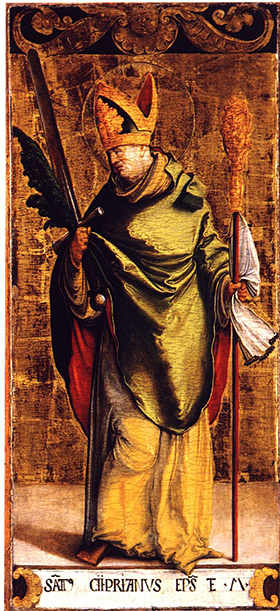
The Martyrdom of St. Cyprian
Today is the feast of St. Cyprian the patronal saint of my parish. What follows is an account of his martyrdom.
In the year 258 AD severe edicts were issued from Rome indicating that those who persisted in their refusal to worship the pagan gods were to be put to death. Knowing his end was near, Cyprian spent his final days encouraging his flock and expressing his affection for them. He also undertook personal penances in preparation for death.
Sentenced to Death – Cyprian had already been imprisoned and exiled to the City of Curubis the year before for his refusal to burn incense to the Roman gods. Soon enough orders came and Cyprian was brought back to Carthage to stand trial once again. When word got out among the populace that Cyprian was in custody, a large multitude gathered and lamented him. Even a great many pagans protested on his behalf for they remembered his kindness, courage and generosity during the recent plague. But it was to no avail, the new proconsul, Galerius Maximus, seemed anxious to enforce the death penalty.
We are blessed to have received from antiquity the account of St. Cyprian’s final trial which is substantially reproduced here:
- Proconsul: Are you Thascius Cyprian?
- Cyprian: I am
- Proconsul: Are you the person who has been bishop and father to men of ungodly minds?
- Cyprian: I have been their bishop.
- Proconsul: The most sacred emperors have commanded you to conform to the ceremonies of the Roman religion.
- Cyprian: I cannot
- Proconsul: Consider again for your own safety.
- Cyprian: Obey your orders. In so manifestly just a case there is no need for me to reconsider.
- Proconsul: Long have you lived with an irreligious heart and have joined great numbers with yourself in an unnatural conspiracy against the Roman deities and their holy rites. Nor have our sacred and most pious emperors…been able to claim you to their ceremonies. Since you have been a ringleader in crimes of such a heinous nature, you shall be made an example to those whom you have seduced to join with you and discipline shall be established in your blood. I will that Thascius Cyprian be beheaded.
- Cyprian: Blessed be God
Many Christians who were within the room cried out, Let us be beheaded with him! As Cyprian was led out to die a large crowd pressed in on all sides so that a strong cohort of soldiers was required to escort him. They led him outside the city to an open field ringed by large trees. Many onlookers climb those trees to better see him.
Martyred - On arriving at the spot where he was to die, Bishop Cyprian took off his mantle (or overcoat), and fell to his knees and prostrated himself before God. Then, arising he took off his dalmatic which he gave to his attending deacons and remained in his long white robe. He payed his executioner the sum of 25 gold denarii. While this gesture was not unheard of especially for a person of some means it nevertheless tells us of the graciousness and forgiveness in the heart of Cyprian. He himself tied the blindfold over his eyes after which his hands were tied. Kneeling again he awaited the final blow. At length the sword passed and Cyprian ended his pilgrimage here. It was September 14, 258.
We have solemnly renounced the world and therefore, while we continue in it should behave like strangers and pilgrims. We should welcome that happy day (of our death) which is to fix us, everyone, in our proper habitation, to rescue us from the embarrassments and snares of this world, and remove us to the kingdom of heaven…. There we shall meet with the glorious choir of apostles; with the goodly company of the prophets; with an innumerable multitude of holy martyrs; there we shall be blessed with the sight of those triumphant virgins who have subdued the inordinate lusts of the flesh; and there we shall behold the rewards of those who, by feeding the hungry and consoling the afflicted have with their earthly treasure stored up for themselves treasure in heaven. To these beloved brethren let us hasten with eager longing! Let us pray that it may befall us speedily to be with them; speedily to come to Christ. (St. Cyprian, De Mortalitate, 26)
From a dysfunctional family comes…Saints
Today is the memorial of St. Monica, mother of Saint Augustine. A family who produces two saints must look more like the holy family than your family or my family, but this family may surprise you. Monica married a man who was an alcoholic and as often happens with alcoholism, violent and abusive. She lived in the home of her mother-in-law, who was also an alcoholic and so it is not hard to imagine how difficult her family life must have been. Monica, however, had one great defense and that was that she was a woman of great faith and a powerhouse of prayer.
Monica prayed for the conversion of her husband and indeed he did convert at some point in his life. Monica is an inspiration for all mothers who fervently pray for their children, particularly when all seems hopeless. She felt that way about Augustine, who was smart, talented, successful, but also a self-described lover of wine and women and the good life. He joined, for a time, a crazy religious sect, and he fathered a child with a woman to whom he was not married. Monica prayed for his conversion, seemingly without ceasing, as St. Paul would say. Augustine, in the true style of an obstinate young man, decided to flee their home in North Africa and go to Italy, in part, to get away from his mother. But Monica was on a mission and not to be deterred, she actually got on the next boat that left after his and followed Augustine to Europe!
The Power of Prayer
Monica is a witness to the strength and fortitude that can come from prayer. She gives all mothers of temperamental teenagers and young adults hope that one day, they will again have a close relationship with their children.
In the spirit of Monica
Today, many mothers are inspired by Monica. I wrote recently about the two planes that crashed over the Hudson. In that story is a subplot which brought the story of Monica and Augustine to mind. The pilot of the helicopter, though baptized Catholic had stopped practicing the faith. This did not keep his mother and his fiancee from praying for him and his return to the faith. Last Easter he was confirmed. His mother commented at the time of his death, “It was the perfect time.”
Seeking the intercession of Monica

tomb of Saint Monica
I have a great love for Monica as she is buried in the church of Saint Augustine in Rome. It was my parish while I was studying at the Angelicum. I would often visit the tomb and ask her intercession for situations that seemed hopeless and for my friends who were struggling with their kids. The stories of the prayer of these two mothers are a reminder to me that God’s time is not always our time and that our prayer is never in vain.
Series on the Saints
Here is a three-part series on the Saints of the Catholic Church. It is visually quite beautiful and generally well done. It answers questions such as who is a saint. How does the Church come to recognize and declare certain men and women to be officially recognized saints? How has this process evolved over the Centuries? How are miracles of the saints distinguished and understood…etc.
Careful about part three. There are two problems in that segment. Our gracious host makes a mistake, she says we worship the saints. We do not. We venerate them. To worship them would be a terrible sin. Worship belongs to God alone. A second problem is that one of the interviewed guests suggest that there is some merit to the notion that after the Second Coming of Jesus that hell will be emptied and everyone welcomed to heaven. Sorry there is no merit to this position. Scripture is clear to speak of hell as eternal. Wishful thinking may feel good but the truth is what really sets us free. That hell is eternal is an important way that God teaches us that there comes a time when who we have chosen to be is forever fixed. This is important to understand since the trajectory of our life is an important matter to which we must attend. Through our decisions we gradually form our basic character and over time it becomes more fixed. At some point, we know not when (probably at death) it is fixed forever. Sow a thought, reap a deed. Sow a deed reap a habit. Sow a habit, reap a character. Sow a character reap a destiny. Anyway enjoy the series with these cautions.
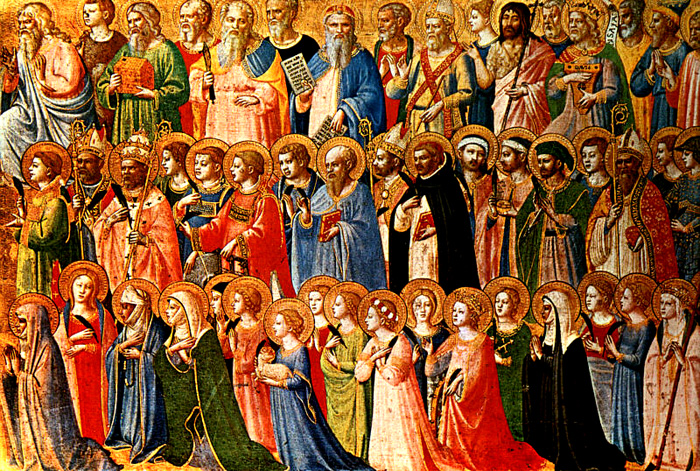
Saints Galore!
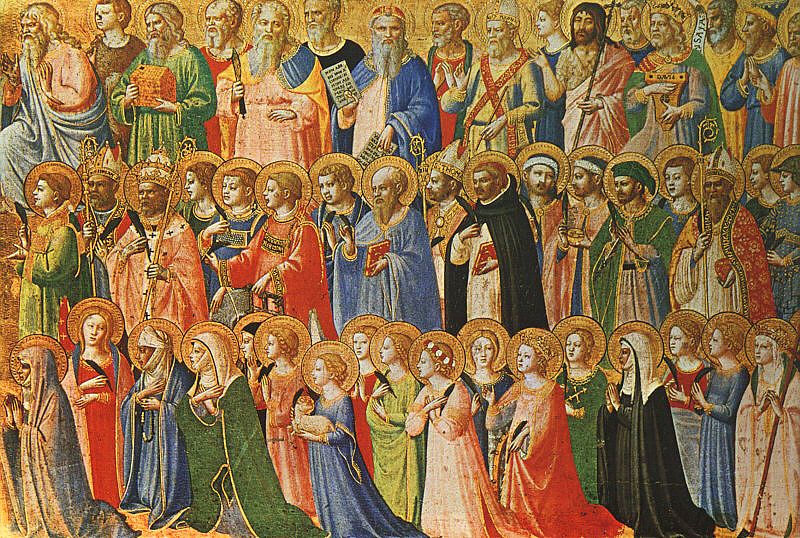
Hat Tip to American Papist for posting this video. Enjoy!