The opening of the Book of Isaiah is provocative, especially for those of us who hold the Liturgy in high esteem, as well we should. However, it is possible for us to distort even great things like the Mass and the sacraments.
Let’s look at the reading and then draw a few teachings from it:
Hear the word of the Lord, princes of Sodom! Listen to the instruction of our God, people of Gomorrah! What care I for the number of your sacrifices? says the Lord. I have had enough of whole-burnt rams and fat of fatlings; in the blood of calves, lambs and goats I find no pleasure. When you come in to visit me, who asks these things of you? Trample my courts no more! Bring no more worthless offerings; your incense is loathsome to me. New moon and sabbath, calling of assemblies, octaves with wickedness: these I cannot bear. Your new moons and festivals I detest; they weigh me down, I tire of the load. When you spread out your hands, I close my eyes to you; Though you pray the more, I will not listen. Your hands are full of blood! Wash yourselves clean! Put away your misdeeds from before my eyes; cease doing evil; learn to do good. Make justice your aim: redress the wronged, hear the orphan’s plea, defend the widow (Is 1:10-19).
Our worship can lack integrity. That which is supposed to glorify God and bring forth in us a holy obedience can become lip service. God seeks hearts that are humble, docile, loving, and repentant. We cannot satisfy Him just by singing a few hymns, saying some prayers, or attending Mass. These things, good though they are, are meant to bring about a conversion in us that makes us more loving of both God and neighbor, less violent, more just, more merciful, more generous, and more holy. Our worship should effect change in us such that we cease doing evil, learn to do good, strive for justice, address injustice, and defend and help the poor, the unborn, the elderly, the dying, and the helpless.
An additional problem with our worship today is that God has become almost an afterthought. Much of our liturgy is self-centered, self-congratulatory, and anthropocentric (rather than theocentric). We are “the aware, gathered community celebrating itself.” While the Mass should focus on God and summon us to humility and joy before Him, too often it seems more an exercise in self-congratulation. We are very narcissistic, even in a communal setting.
God cannot be pleased with all of this. Even if our worship is rightly ordered, we are not going to buy Him off that easily. God wants an obedient heart more than sacrifice. Sacrifice without obedience is a sham.
We need God to restore our integrity and give us a new heart. We are “dis-integrated,” in the sense that pieces of our life that should be together (e.g., worship and obedience, liturgy and healing) are not. Too often our worship does just the opposite of what it should. Instead of drawing us more deeply into the love and obedience of God, it becomes the very occasion of keeping Him at a distance and seeking to placate Him with superficial gestures. This makes our worship a lie and an insult to Him. God doesn’t mince words in the passage above when He says how displeased He is.
We need God to give us a new heart, one that loves Him as well as the people and things that He loves. Only then will our worship will truly reflect the heart that God seeks: a loving, humble, and generous one.
May our worship give us a new heart and deepen our commitment to God and neighbor!
Let’s consider three rather humble but important moments that are often lost in the minds and hearts of the faithful – the Mystery of Faith, the Amen, and the Agnus Dei. They rise in importance because they are moments that belong especially to the faithful rather than the clergy.
I. The Mystery of Faith (Memorial Acclamation)
In the Ordinary Form of the Liturgy, an acclamation of the people has been added just after the consecration. The priest bids them to acclaim the paschal mystery that has just been made present in the Eucharistic Sacrifice.
In effect, this addition to Mass is the “Pauline Comment.” It is so named for the fact that after repeating the words of consecration, St. Paul adds a kind of comment:
For I received from the Lord what I also passed on to you: that the Lord Jesus, on the night He was betrayed, took bread, and when He had given thanks, He broke it and said, “This is My body, which is for you; do this in remembrance of Me.” In the same way, after supper He took the cup, saying, “This cup is the new covenant in My blood; do this, as often as you drink it, in remembrance of Me.”
For as often as you eat this bread and drink this cup, you proclaim the Lord’s death until He comes. (1 Cor 11:23-26)
Critics of the Memorial acclamation see it as a novelty and intrusion into the Roman Rite. They also see it as given merely to imitate the Eastern rites or to give the people something to do in a prayer otherwise uttered entirely by the priest to the Father. But, as noted, the intrusion is not a merely arbitrary insertion, it draws from Paul’s comment on the words of consecration.
However, the criticisms are not without any merit. This practice was largely unknown in the Western rite, and, if the response of the people is desired, it is complicated by the fact that three different versions are offered, each of which differ in ways from the “Pauline comment” as recorded in scripture.
All of this said, the response is there and the faithful are asked to make an acclamation by the celebrant. He says or sings “The mystery of faith.” At this point the rubrics indicate “And the people continue, acclaiming …” Note that it is not anticipated that the priest should join them. At other times the rubrics do dictate that the priest and people sing together. (For example, at the Sanctus the rubric states, “[The priest] joins his hands and concludes the Preface with the people, singing or saying aloud …”)
But in the case of the Mystery of Faith, the rubric simply says, “the people continue, acclaiming …” There are three options:
1. We proclaim your death or Lord, and profess your resurrection, until you come again.
2. When we eat this Bread and drink this Cup we proclaim your death O Lord, until to come again.
3. Save us Savior of the world, for by your Cross and Resurrection, you have set us free.
As noted, these acclamations echo the practice of the Eastern Churches, which contain several acclamations by the people during the Eucharistic Prayer (specifically the Anaphora). For example, in the Liturgy of St. John Chrysostom, the people sing “Amen” after the consecration of the bread and again after the consecration of the wine. The priest then sings, Thine own, of thine own, we offer unto thee, on behalf of all and for all. And the people respond, We praise thee, we bless thee, we give thanks unto thee and we pray unto thee, Lord our God.
The people’s response, not the priest’s. The memorial acclamation is a moment for the people to acclaim the paschal mystery that has just been made present to them. Too often, unfortunately, they seem distracted or uninvolved. Clergy should not usurp the acclamation for themselves by singing or saying it too loudly. Even if it is necessary to “get the people started,” the priest should then pull back and listen reverently to the response that really belongs to the congregation. This is a moment for the people of God to express their praise and worship of the Lord, now present on the altar, in a reverent fashion. They also express by the acclamation that the passion, death and resurrection are made present to them. It belongs to us clergy to instruct the faithful on the meaning and importance of this moment in terms of Eucharistic piety and faith.
II. Amen
The Amen at the end of the Eucharistic prayer is another moment for God’s people to acclaim their “yes,” solemnly and joyfully, to what has just taken place. In this case as well, the speaking or the singing of the “Amen” is assigned to the people, not the clergy. The rubrics state, “The people acclaim: Amen.”
The celebrant, in persona Christi Capitis, has been speaking to the Father on their behalf, recalling the great works of God and the Sacrifice of the Cross made present in the Eucharist. He has asked mercy for the Church: the clergy and all the people, living and deceased.
At the conclusion, the celebrant and deacon hold aloft the Body and Blood of the Lord and sing or say, Through him and with him and in him, O God almighty Father, in the unity of the Holy Spirit, all glory and honor is yours, forever and ever. It is for the people, not the celebrant, to acclaim “Amen.” It is their “yes,” their acknowledgment of all that has been said and has taken place.
Thus, the “Amen” ought to be a vigorous one. There is no need for histrionics, but a good, firm “Amen” is surely called for as a sign of our Eucharistic faith and our grateful hearts. At times, though, it seems one can barely detect the joy and firm affirmation that is deserved. Eucharistic piety demands more than a distracted, feeble “Amen.”
III. The Agnus Dei
Just prior to the Agnus Dei, the optional (though seldom omitted) sign of peace is sung or said. Unfortunately, there are often excesses in what ought to be a modest greeting to those immediately nearby. These excesses often lead to the eclipse of what is a beautiful and pious hymn of preparation for Holy Communion: Lamb of God you take away the sins of the world, have mercy on us … grant us peace.
The recitation or singing of the Agnus Dei begins just after the sign of peace, but many people do not take the hint to refocus and join in. Instead they continue glad-handing as if it were merely background noise/music to the sign of peace. It is not. It is part of a eucharistic piety meant to prepare us for Holy Communion. Consider that the words of the hymn are very tender. We sing to Him who is the Lamb of God, present on the altar, to have mercy on us and grant us peace to approach the Eucharistic altar without servile fear.
The Agnus Dei is especially a song of the people, because the celebrant is usually busy with other prayers. He may join towards the end, but this is a moment for the people to prepare themselves for Holy Communion.
Here, then, are three acclamations of Eucharistic piety that help frame the liturgy and draw us to devotion. My sense is that they are underappreciated by many of the faithful and that clergy often usurp the role given to the lay faithful here, sometimes even acting as a “song leader.”
Ideally, the faithful can discover their own role here and see that the acclamations are not mere formulae, but prayers of a people who believe and celebrate what is announced.
In the afterglow of Corpus Christi, we do well to consider some of our liturgical practices. Over the years on this blog we have done a good deal of this (e.g., Worthiness to receive Communion).
In this post, I would like to consider three rather obscure but still important moments that are often lost in the minds and hearts of the faithful – the Mystery of Faith, the Amen, and the Agnus Dei. They rise in importance because they are moments that belong especially to the faithful rather than the clergy.
I. The Mystery of Faith (Memorial Acclamation)
In the Ordinary Form of the Liturgy, an acclamation of the people has been added just after the consecration. The priest bids them to acclaim the paschal mystery that has just been made present in the Eucharistic Sacrifice.
In effect, this addition to Mass is the “Pauline Comment.” It is so named for the fact that after repeating the words of consecration, St. Paul adds a kind of comment:
For I received from the Lord what I also passed on to you: that the Lord Jesus, on the night He was betrayed, took bread, and when He had given thanks, He broke it and said, “This is My body, which is for you; do this in remembrance of Me.” In the same way, after supper He took the cup, saying, “This cup is the new covenant in My blood; do this, as often as you drink it, in remembrance of Me.”
For as often as you eat this bread and drink this cup, you proclaim the Lord’s death until He comes. (1 Cor 11:23-26)
Critics of the Memorial acclamation see it as a novelty and intrusion into the Roman Rite. They also see it as given merely to imitate the Eastern rites or to give the people something to do in a prayer otherwise uttered entirely by the priest to the Father. But, as noted, the intrusion is not a merely arbitrary insertion, it draws from Paul’s comment on the words of consecration.
However, the criticisms are not without any merit. This practice was largely unknown in the Western rite, and, if the response of the people is desired, it is complicated by the fact that three different versions are offered, each of which differ in ways from the “Pauline comment” as recorded in scripture.
All of this said, the response is there and the faithful are asked to make an acclamation by the celebrant. He says or sings “The mystery of faith.” At this point the rubrics indicate “And the people continue, acclaiming …” Note that it is not anticipated that the priest should join them. At other times the rubrics do dictate that the priest and people sing together. (For example, at the Sanctus the rubric states, “[The priest] joins his hands and concludes the Preface with the people, singing or saying aloud …”)
But in the case of the Mystery of Faith, the rubric simply says, “the people continue, acclaiming …” There are three options:
1. We proclaim your death or Lord, and profess your resurrection, until you come again.
2. When we eat this Bread and drink this Cup we proclaim your death O Lord, until to come again.
3. Save us Savior of the world, for by your Cross and Resurrection, you have set us free.
As noted, these acclamations echo the practice of the Eastern Churches, which contain several acclamations by the people during the Eucharistic Prayer (specifically the Anaphora). For example, in the Liturgy of St. John Chrysostom, the people sing “Amen” after the consecration of the bread and again after the consecration of the wine. The priest then sings, Thine own, of thine own, we offer unto thee, on behalf of all and for all. And the people respond, We praise thee, we bless thee, we give thanks unto thee and we pray unto thee, Lord our God.
The people’s response, not the priest’s. The memorial acclamation is a moment for the people to acclaim the paschal mystery that has just been made present to them. Too often, unfortunately, they seem distracted or uninvolved. Clergy should not usurp the acclamation for themselves by singing or saying it too loudly. Even if it is necessary to “get the people started,” the priest should then pull back and listen reverently to the response that really belongs to the congregation. This is a moment for the people of God to express their praise and worship of the Lord, now present on the altar, in a reverent fashion. They also express by the acclamation that the passion, death and resurrection are made present to them. It belongs to us clergy to instruct the faithful on the meaning and importance of this moment in terms of Eucharistic piety and faith.
II. Amen
The Amen at the end of the Eucharistic prayer is another moment for God’s people to acclaim their “yes,” solemnly and joyfully, to what has just taken place. In this case as well, the speaking or the singing of the “Amen” is assigned to the people, not the clergy. The rubrics state, “The people acclaim: Amen.”
The celebrant, in persona Christi Capitis, has been speaking to the Father on their behalf, recalling the great works of God and the Sacrifice of the Cross made present in the Eucharist. He has asked mercy for the Church: the clergy and all the people, living and deceased.
At the conclusion, the celebrant and deacon hold aloft the Body and Blood of the Lord and sing or say, Through him and with him and in him, O God almighty Father, in the unity of the Holy Spirit, all glory and honor is yours, forever and ever. It is for the people, not the celebrant, to acclaim “Amen.” It is their “yes,” their acknowledgment of all that has been said and has taken place.
Thus, the “Amen” ought to be a vigorous one. There is no need for histrionics, but a good, firm “Amen” is surely called for as a sign of our Eucharistic faith and our grateful hearts. At times, though, it seems one can barely detect the joy and firm affirmation that is deserved. Eucharistic piety demands more than a distracted, feeble “Amen.”
III. The Agnus Dei
Just prior to the Agnus Dei, the optional (though seldom omitted) sign of peace is sung or said. Unfortunately, there are often excesses in what ought to be a modest greeting to those immediately nearby. These excesses often lead to the eclipse of what is a beautiful and pious hymn of preparation for Holy Communion: Lamb of God you take away the sins of the world, have mercy on us … grant us peace.
The recitation or singing of the Agnus Dei begins just after the sign of peace, but many people do not take the hint to refocus and join in. Instead they continue glad-handing as if it were merely background noise/music to the sign of peace. It is not. It is part of a eucharistic piety meant to prepare us for Holy Communion. Consider that the words of the hymn are very tender. We invoke Him who is the Lamb of God to have mercy on us and grant us peace to approach the Eucharistic altar without servile fear.
The Agnus Dei is especially a song of the people, because the celebrant is usually busy with other prayers. He may join towards the end, but this is a moment for the people to prepare themselves for Holy Communion.
Here, then, are three acclamations of Eucharistic piety that help frame the liturgy and draw us to devotion. My sense is that they are underappreciated by many of the faithful and that clergy often usurp the role given to the lay faithful here, sometimes even acting as a “song leader.”
Ideally, the faithful can discover their own role here and see that the acclamations are not mere formulae, but prayers of a people who believe and celebrate what is announced.
The Catholic Faith was illegal in the Roman Empire prior to 313 A.D., when the Emperor Constantine issued the Edict of Milan permitting it to flourish publicly. Prior to that time, Church buildings as we know them today were rare – Mass was usually celebrated in houses.
These “houses” were usually rather sizable, with a central courtyard or large room that permitted something a little more formal than Mass around the dining room table. I remember being taught (incorrectly) that these early Masses were informal, celebrated facing the people, and had a relaxed, communal atmosphere. In fact, the people didn’t just sit around a table or on the floor in circle – not at all. They sat or stood formally, with everyone faced in one direction: east.
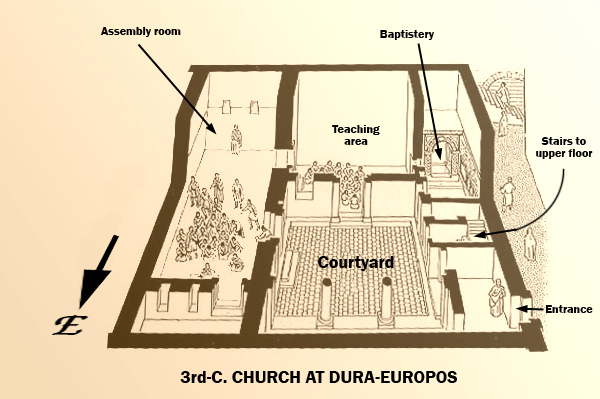
The drawing above shows the layout of an ancient house church (more often called a DomusDei (House of God)), based on an excavated 3rd century house church in Dura-Europos (located in what is now Syria).
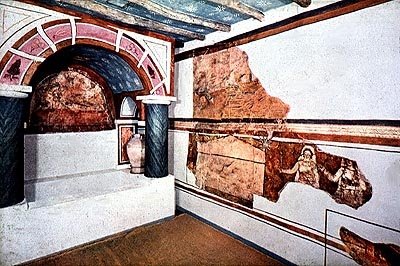
Baptistry at Dura Europos
The assembly room is on the left, and a priest or bishop is depicted conducting a liturgy (facing east) at an altar against the east wall. A baptistry is on the right, and a deacon is shown guarding the entrance. The lonely-looking deacon in the back of the assembly hall is there to “preserve good order,” as you will read below.
What is remarkable about these early liturgies is how formal they were despite the less-than-ideal circumstances. The following text is from the Didiscalia, a document written in about 250 A.D. Among other things, it gives rather elaborate details about the celebration of the early Catholic Mass in these “house liturgies.” I have included an excerpt below (in bold italics); my comments are shown in red text.
Now, in your gatherings, in the holy Church, convene yourselves modestly in places of the brethren, as you will, in a manner pleasing and ordered with care.
These “house liturgies” were not informal; good order and careful attention to detail were essential.
Let the place of the priests be separated in a part of the house that faces east.
Even in these early house Masses, the sanctuary (where the clergy ministered) was distinct from where the laity gathered. People were not all just clustered around a dining room table.
In the midst of them is placed the bishop’s chair, and with him let the priests be seated. Likewise, and in another section let the lay men be seated facing east.For thus it is proper: that the priests sit with the bishop in a part of the house to the east and after them the lay men and the lay women,
Everyone faced east, laity and clergy. Notice that men and women sat in separate sections, which was the tradition in many churches until relatively recently (the last 150 years or so).
and when you stand to pray, the ecclesial leaders rise first, and after them the lay men, and again, then the women. Now, you ought to face to east to pray for, as you know, scripture has it, Give praise to God who ascends above the highest heavens to the east.
Again, note that Mass was not celebrated facing the people, as some suppose of the early Church. Everyone faced in the same direction: east. The text cites Scripture as the reason for this: God is to the east, the origin of the light.
Now, of the deacons, one always stands by the Eucharistic oblations and the others stand outside the door watching those who enter,
Remember that this was a time of persecution; the early Christians were careful to allow only baptized and bona fide members to enter the sacred mysteries. Only the baptized were permitted to enter the Sacred Liturgy. This was called the disciplina arcanis (discipline of the secret), and deacons guarded the door to maintain it.
and afterwards, when you offer let them together minister in the church.
Once the door was locked and the Mass began, it would seem that the deacons took their place in the sanctuary, with one remaining outside it to maintain “good order” among the laity.
And if there is one to be found who is not sitting in his place let the deacon who is within, rebuke him, and make him to rise and sit in his fitting place … also, in the church the young ones ought to sit separately, if there is a place, if not let them stand. Those of more advanced age should sit separately; the boys should sit separately or their fathers and mothers should take them and stand; and let the young girls sit separately, if there is really not a place, let them stand behind the women; let the young who are married and have little children stand separately, the older women and widows should sit separately.
This may seem a bit complicated, but the upshot is that seating was by sex and age. Note that those with young children were to stand in a separate area (the cry rooms of the day!).
And a deacon should see that each one who enters gets to his place, and that none of these sits in an inappropriate place. Likewise, the deacon ought to see that there are none who whisper or sleep or laugh or nod off.
The early Christians did such things? Say it isn’t so! Today, ushers preserve “good order.”
For in the Church it is necessary to have discipline, sober vigilance, and attentive ear to the Word of the Lord.
Well, that is clear and to the point – and the advice is still needed. It is also a fitting way to end today’s post.
For several generations, the Church has used a kind of shorthand in referring to mortal sin, for example, “X is a mortal sin.” The problem is that this general statement is an oversimplification. In order for the individual committing a particular act to be guilty of a mortal sin, three conditions are necessary: grave matter (the act must be intrinsically evil), full knowledge, and deliberate consent (CCC 1857).
It is important to emphasize that even if a particular sinful act does not rise to the level of mortal sin, it is still a sin. No sinful action, even if committed “innocently” will bring a blessing or become good in itself. To sin is always to veer off course and it causes some sort of wound. This is true even if the person is not guilty of committing a mortal sin.
Let’s consider a couple of specific cases of potentially mortal sin and look at the three conditions required to determine that it represents a mortal sin in a particular situation.
Case 1: Skipping Mass on Sunday
Grave Matter
Missing Mass on Sunday is a grave matter because we fail to render fitting thanks and praise to God for His goodness. We sin against justice and charity by failing to gather with God’s people at Mass to do so. In addition, at Mass we are instructed by God and fed with the Body and Blood of the Lord. Jesus says, Unless you eat the flesh of the Son of Man and drink his Blood you do not have life within you (Jn 6:53). Therefore, Mass is necessary for us. Skipping Mass is also a direct violation of the Third Commandment and does harm to the First Commandment. Thus, it is grave matter.
Full Knowledge
Many Catholics today have been poorly instructed and have very few cultural moorings that dispose them to be at Mass each Sunday. Many do not even know that missing Mass is a grave matter. Even if they know that going to Mass is a good thing—surely better than just sleeping in or going shopping—they may not appreciate the seriousness of missing Mass nor understand that the Eucharist is our necessary food. Depending on how responsible they are for this ignorance, their culpability may be reduced, rendering the sin less than mortal.
Deliberate Consent
It is important to consider how thoughtfully a person decides to do something. In some situations, a person may make an impulsive decision, giving little to no thought to the matter. At others, there may be more extensive deliberation. Blameworthiness will center on questions such as these:
How long could the person reasonably have deliberated and formed an intention based on the circumstances? Did he take advantage of the available time to deliberate and do so by applying good moral standards?
Could the situation have been anticipated or did it arise so suddenly that there was little change to form a careful intention?
So, a person who chooses to miss mass due to a last-minute occurrence (e.g., an old friend calls and is in town only for the day) may be less blameworthy than a person who had time to make other arrangements but chose to miss Mass after careful deliberation of the options.
We live in a culture that makes more peripheral demands on people than was the case forty or more years ago. As more and more businesses are open seven days a week, more people are required to work on Sundays. Other activities such as youth sports leagues put pressure on families on the weekend and make scheduling chaotic. Many people travel on weekends, sometimes for pleasure but also for business. These sorts of things make it difficult to keep a regular, consistent schedule. “Juggling” the schedules of various family members is quite common today.
Unusual circumstances can impede the ability to attend Mass, such as one’s own serious illness or the need to care for someone who is seriously ill. Dangerous weather conditions can prevent attendance or make it ill advised. Emergencies, last-minute transportation problems, and the like can all limit the freedom or ability to get to Mass. If one’s freedom is eroded, culpability may be reduced, rendering the sin of missing Mass less than mortal on a particular occasion. It is always deleterious to miss Mass because one misses Holy Communion, fellowship, and instruction, but to the degree that freedom is eroded, one’s blameworthiness may be reduced, even to a minimum.
Hence, to say, “Skipping Mass on Sunday is a mortal sin,” only refers to the fact that it is a grave matter. It is not possible to speak to every possible circumstance that may legitimately excuse a person from Mass. Neither can it speak to how well formed a person’s conscience is, the quality of his deliberation, or the degree of freedom with which he acts.
There are other sins, grave in nature, where the question of freedom is more subtle. This is a common issue with the sin of drunkenness. It is a grave sin to drink to the point that we are impaired, but there are often compulsions and addictions related to alcohol that may limit the full consent of the will.
Case 2: Masturbation
Grave Matter
The Catechism sets forth why masturbation is grave matter:
Both the Magisterium of the Church, in the course of a constant tradition, and the moral sense of the faithful have been in no doubt and have firmly maintained that masturbation is an intrinsically and gravely disordered action. The deliberate use of the sexual faculty, for whatever reason, outside of marriage is essentially contrary to its purpose. For here sexual pleasure is sought outside of the sexual relationship which is demanded by the moral order and in which the total meaning of mutual self-giving and human procreation in the context of true love is achieved (CCC 2352).
Because human sexuality is a great good and is ordered by the Sixth Commandment, the violation of it is grave matter. It amounts to a turning inward, to misusing that very thing which is meant to relate us intimately to another in marriage and for procreation.
Full Knowledge
Society used to take a rather dim view of masturbation. Today it is widely accepted and even promoted to children. The Catholic Church’s position has not wavered, yet it’s unclear how many Catholics today understand the seriousness of the sin.
Deliberate Consent
The Catechism goes on to say:
To form an equitable judgment about the subjects’ moral responsibility and to guide pastoral action, one must take into account the affective immaturity, force of acquired habit, conditions of anxiety or other psychological or social factors that lessen, if not even reduce to a minimum, moral culpability (Ibid).
Hence, what is a grave matter may not always rise to the level of a mortal sin if the required freedom is lacking to some degree. The affective maturity and other psychological and social factors must be assessed by a confessor working realistically and honestly with the penitent. The confessor should neither disregard a person’s freedom and the possibility for growth, nor should he presume that acts of masturbation always proceed from malice or an utterly selfish desire to turn away from the marital and procreative purposes of sexual intimacy.
However, even if a particular penitent may not be guilty of mortal sin, masturbation is sinful. Engaging in it misconstrues the purpose of sex, indulges in fantasy, and feeds distorted notions of sexuality. It also becomes a growing habit and impedes the self-mastery needed for the gift of oneself to one’s spouse. It is a poor way to prepare for marriage and often hinders the maturity needed for marriage, in which one’s spouse is not always what the perfect fantasy describes. It feeds disappointment in one spouse and feelings of inadequacy in the other.
Thus, masturbation is a sin, even if not always a mortal one. No lack of freedom or extenuating circumstances can make a bad thing good. Masturbation should still be confessed, and one should not determine alone whether it rises to the level of mortal sin. A confessor can and should be consulted and a regular schedule of confession should be determined by the confessor based on the penitent’s struggle. The goal is to become ever freer by growing in self-mastery.
Excursus
The topic of divorce and remarriage requires more attention than I can give here but suffice it to say that whatever personal culpability may or may not accrue in a given situation, divorce and remarriage represents an ongoing situation that cannot admit to a firm purpose of amendment or improvement. The couple may not reasonably be able to make the commitment to live chastely. In addition, the fact that they are in a second “marriage” is typically clear if not to the general public, at least to family and friends. Hence, the common good most often demands that public acts be treated by public remedies. As a result, the Church has long held that couples in this situation cannot receive Holy Communion. (In contrast, a person who misses Mass or struggles with masturbation can make some purpose of amendment; furthermore, his sin is not usually public knowledge.)
Some today would like to hold that individual priests are free to offer Communion to such couples in particular situations. Some even go so far as to say that all couples in second (or third, or fourth, …) marriages can partake of Holy Communion. Even Jesus’ plain words to the contrary fail to convince them.
I understand that there are pastorally complex situations, but Jesus understood this as well and yet did not offer concessions or alternative policies. I would simply say to any priest who permits the reception of Holy Communion in these cases that he will answer to God for it and will have to explain to Jesus why His words did not apply. I will not be the judge. I only ask that he alone bear the burden of his advice and not ask the wider Church to prop him up or change her doctrine to suit his pastoral decisions. Let him carry his own practices to the judgment seat and not ask me or others to be complicit in his views or decisions. Indeed, it ill-behooves the Church to make general policies, norms, or laws out of complex and unique situations; no changes to Canon Law ought to be made.
Conclusion:
The statement “X is a mortal sin” is a simplification. It is only stating that a certain act is grave, intrinsically evil. The warning that some sins are grave ex genere suo (by their nature), ought not be dismissed. However, there are other factors to be considered when determining whether mortal culpability accrues to a certain individual in a certain set or circumstances.
Even if the determination in a particular situation is that all of the ingredients that render an act a mortal sin were not present, this should not be taken to mean that no sin was committed. An act that is objectively sinful cannot become good simply because one commits it in ignorance or out of diminished freedom.
Even if a person means well or acts in ignorance, a sin can never bring a blessing. It brings only harm and wounds. Even if I unknowingly ingest rat poison or if am forced by an enemy to do it, I will not get any benefit from rat poison. It is poison of its nature and it will still cause terrible things. I may not be condemned for ingesting rat poison ignorantly or by force, but I will surely suffer.
Rat poison is bad and causes harm. Sin is bad and causes harm. Don’t seek refuge in ignorance or insufficient freedom; just avoid it altogether!
The first reading for Monday of the 15th week of the year is provocative, especially for those of us who hold the Liturgy in high esteem, as well we should. However, it is possible for us to distort even great things like the Mass and the sacraments.
Let’s look at the reading and then draw a few teachings from it:
Hear the word of the Lord, princes of Sodom! Listen to the instruction of our God, people of Gomorrah! What care I for the number of your sacrifices? says the Lord. I have had enough of whole-burnt rams and fat of fatlings; in the blood of calves, lambs and goats I find no pleasure. When you come in to visit me, who asks these things of you? Trample my courts no more! Bring no more worthless offerings; your incense is loathsome to me. New moon and sabbath, calling of assemblies, octaves with wickedness: these I cannot bear. Your new moons and festivals I detest; they weigh me down, I tire of the load. When you spread out your hands, I close my eyes to you; Though you pray the more, I will not listen. Your hands are full of blood! Wash yourselves clean! Put away your misdeeds from before my eyes; cease doing evil; learn to do good. Make justice your aim: redress the wronged, hear the orphan’s plea, defend the widow (Is 1:10-19).
Our worship can lack integrity. That which is supposed to glorify God and bring forth in us a holy obedience can become lip service. God seeks hearts that are humble, docile, loving, and repentant. We cannot satisfy Him just by singing a few hymns, saying some prayers, or attending Mass. These things, good though they are, are meant to bring about a conversion in us that makes us more loving of both God and neighbor, less violent, more just, more merciful, more generous, and more holy. Our worship should effect change in us such that we cease doing evil, learn to do good, strive for justice, address injustice, and defend and help the poor, the unborn, the elderly, the dying, and the helpless.
An additional problem with our worship today is that God has become almost an afterthought. Much of our liturgy is self-centered, self-congratulatory, and anthropocentric (rather than theocentric). We are “the aware, gathered community celebrating itself.” While the Mass should focus on God and summon us to humility and joy before Him, too often it seems more an exercise in self-congratulation. We are very narcissistic, even in a communal setting.
God cannot be pleased with all of this. Even if our worship is rightly ordered, we are not going to buy Him off that easily. God wants an obedient heart more than sacrifice. Sacrifice without obedience is a sham.
We need God to restore our integrity and give us a new heart. We are “dis-integrated,” in the sense that pieces of our life that should be together (e.g., worship and obedience, liturgy and healing) are not. Too often our worship does just the opposite of what it should. Instead of drawing us more deeply into the love and obedience of God, it becomes the very occasion of keeping Him at a distance and seeking to placate Him with superficial gestures. This makes our worship a lie and an insult to Him. God doesn’t mince words in the passage above when He says how displeased He is.
We need God to give us a new heart, one that loves Him as well as the people and things that He loves. Only then will our worship will truly reflect the heart that God seeks: a loving, humble, and generous one.
May our worship give us a new heart and deepen our commitment to God and neighbor!
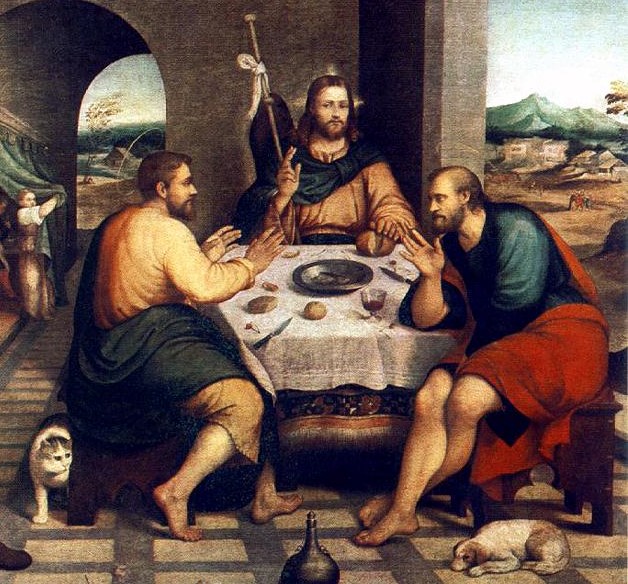
Supper at Emmaus, Jacopo Bassano (c. 1538)I have written before on how the Gospel Passage of the encounter of the two disciples with Jesus on the road to Emmaus is (Luke 24:13-35), from start to finish, in the full form of a Mass. It is a kind of “Mass on the move.” I detail that understanding here: Mass on the Move.
The liturgy begins with two disciples gathering as they make their way to Emmaus, just as we pilgrims gather for Mass. Jesus joins them, just as Jesus joins us in the opening procession and greeting by the celebrant. Jesus engages them in a sort of penitential rite by asking them what they were discussing on their journey and why they look so downcast. After hearing their complaints, He engages them in a kind of Liturgy of the Word, as He both quotes and explains scriptures to them. The Liturgy of the Eucharist follows, as Jesus take the bread, blesses it, breaks it, and gives it to them. It is then that they recognize Him, that the Bread He gives them is His very self. In a kind of Ite missa est (rite of dismissal) they go forth joyfully to share what they have seen and heard. Yes, the basic structure of the Mass is there.
Beyond the structural elements, the Emmaus Gospel also sets forth some of the expected fruits of Holy Mass. Let’s consider some of them.
I. Course Correction (conversion) – As the story begins the two disciples are traveling in precisely the wrong direction. Christ rises in the East, in Jerusalem, but they are headed West, away from Jerusalem, away from the Lord and His Body the Church, which is gathered and already announcing the truth of the resurrection. It’s never a good thing to have your back toward the heavenly Jerusalem or the Church, which is Heaven’s outpost and doorway. The effect of the “Mass on the move” will be to have them turn and “re-turn” toward Jerusalem and toward the Church gathered in the growing light of the resurrection. They return that very evening.
For us, too, the goal of the liturgy is our ongoing conversion, our increasing turning to the East, to the light, to the resurrection, and to the Body of Christ gathered—the Church.
II. Fuller Fellowship (koinonia) – Whatever their struggles, at least the disciples on the road to Emmaus are not alone; they are together and pondering the events of the Lord’s paschal mystery. Jesus said, Where two or three are gathered in my name, there am I in the midst of them (Mat 18:20).
This is an important antidote to the tendency of many (especially among the Protestants) to reduce the faith to a “Jesus and me” experience. Many speak of Jesus as their “personal Lord and Savior.” He is surely that, but this description can easily miss the communal aspect of the faith: that Jesus is Shepherd of the flock. The Lord has a Body, the Church, with many members.
By insisting that we gather, at a minimum each Sunday at Mass, the Lord and the Church dictate that we not walk alone. As we walk together, Jesus joins us and journeys with us.
This “fellowship” is about more than coffee and doughnuts. It is about a shared liturgical experience, a shared instruction in the faith and in the Sacrament of Holy Communion that unites us to the Lord and to one another. When the “Mass on the move” is complete the disciples say, “Were not our hearts burning within us as he spoke the word to us?”
They then return to Jerusalem to join the wider fellowship of the Church gathered there to share their experience and have it affirmed by others. All of this indicates a fuller fellowship, which the Lord expects of us. He expects that we maintain communion with His Body, the Church. Our celebration of Mass in our parishes should unite us to the wider Church throughout the world and across time.
III. Transformative Teaching – The two disciples go from being downcast to having their hearts set on fire. They go from blindness to seeing, from confusion and doubt to clarity and deeper faith. The Lord accomplishes this for us in the Mass by Word and Sacrament.
Consider, first, the Liturgy of the Word. After hearing their concerns and fears, Jesus applies His word, quoting Scripture extensively and explaining it. This sets their hearts on fire and brings clear light to their minds. So, too, for us if we faithfully attend to the Liturgy of the Word. We may come with many doubts, fears, questions, and concerns, but a lifelong formation in the Word of God through the Liturgy of the Word sets our hearts ablaze and clears our minds, which are darkened by sin and worldliness.
The Word of God is a prophetic declaration of reality. It says to us, “Regardless of what you think is going on, this is what is really happening.” Scripture is replete with stories of victory for those who remain faithful. Its steady message is what Jesus says: In this world you shall have tribulation, but have confidence, I have overcome the world (Jn 16:33; Rev 2:10).
This is a vision for our life and a roadmap of ultimate victory if we remain faithful unto death. Formed in this word that the Messiah would suffer but rise on the third day, the disciples move from gloom to glory.
We, too, formed by a steady diet of God’s Word, will see our hearts encouraged and set ablaze, our minds instructed and brought to the light.
IV. Deepening Disclosure – The text says that the disciples’ eyes were opened, and they recognized the Lord in the breaking of the bread. Even as the Liturgy of the Word accustoms us to the Lord’s voice and His wisdom, the Eucharist accustoms us to recognize Him, not only in the Eucharistic elements but in our lives and throughout our day. Through our coming to know Him in Word and Sacrament, we grow spiritually and are able to remain in living, conscious contact with Him throughout every day. We learn of Him in the liturgy and thereby recognize Him active in creation—in the events of our lives and in the people we encounter.
V. Promised Presence – As soon as they recognize the Lord Jesus in the Breaking of the Bread, He vanishes before their eyes. Here, the Lord teaches them that they will not see Him in the earthly way; now they will see Him in the Sacraments and encounter Him in the liturgy.
This teaching is important for us, too. Some seek visions or invocations; others go to mountaintops or deserts to find Jesus. Good though such settings are for quiet prayer, the Lord is not so far away. He need not be sought in visions and invocations. He is as near as the closest tabernacle, as the nearest liturgy.
In Holy Mass or any other liturgy, the Lord speaks to us and ministers to us. He is present in those who gather, in the Word proclaimed, in the priest who celebrates, and above all in the Eucharistic elements. The gift of the Liturgy is Christ Himself.
VI. Exuberant Evangelization – The disciples are then filled with joy and zeal to share what they have seen, heard, and experienced. When one is joyful, one doesn’t need to be told how to share the good news; it comes naturally. When we hear good news we instinctively want to tell others.
These disciples cannot wait to rejoin the others to proclaim what and whom they have seen and experienced. If we are open to experience the Lord, we too will exuberantly go forth to tell others.
When the priest or deacon says, “The Mass is ended. Go in peace,” He is not simply saying, “Go home now and have nice day!” He is saying, “Go tell people what you have seen and heard. Tell them that you encountered the Lord. Tell them what the Lord said and how He fed you. Tell them what He has done for you!” Even if every Mass does not have this effect on you, can’t you at least tell people what a difference going to Mass has made in your life?
How is it possible to encounter the Lord and not come away with joy and a zeal to tell others? Yet many do just that. Moribund and perfunctory celebrations of the Liturgy do not help, of course. A little fiery preaching and the devout celebration of the Eucharist help. All of us need to be more aware what the Mass is; we must go with high expectations of meeting the Lord!
These, then, are some fruits of the liturgy set forth by today’s Gospel about the disciples on the road to Emmaus.
The video below does a good job of imagining some of the Scriptures that the Lord broke open for them. (The Eucharistic dimension is less well developed.)
I have found that one of my favorite quotes from St. Augustine is not all that well known. Here it is in Latin, followed by my own translation:
Quod minimum, minimum est,
Sed in minimo fidelem esse,
magnum est.
What is a little thing, is (just) a little thing, But to be faithful in a little thing, is a great thing.
(De Doctrina Christiana, IV,35)
I first saw this quote on the frontispiece of a book by Adrian Fortescue. Fortescue applied it to the intricate details of celebrating the Old Latin Mass. That form of the Mass has an enormous amount of detail to learn: how exactly to hold the hands, when and how to bow, what tone of voice to use when, what fingers should be used to pick up the host, and so on. Some might see these details as picky and overwhelming, but Fortescue apparently wanted us to think about the fact that love is often shown through attention to the little things.
It’s so easy to become lazy, even about sacred things like saying Mass. I often have to remind myself about little things. Are my shoes in good condition? Are my vestments clean? Have the altar linens been properly cared for? Am I bowing and pausing during Mass when I should? Am I using the proper tone of voice? Am I walking reverently in the sanctuary? Am I pronouncing the sacred words of the liturgy with care and a prayerful spirit? Some may find such questions tedious or even too scrupulous, but when you love, little things are often important.
Married couples may also struggle to remember the little things that show love: a kind remark, a thank you, flowers brought home for no particular reason, a caring look, the gift of listening attentively, cleaning up after yourself in the kitchen, a reassurance like “I’m glad I married you” or “You’re such a great father to our children,” a quick phone call saying “I love you and was thinking about you.”
Yes, they’re just little things, but to be faithful in little things is a great thing. These passages come to mind:
Well done, good and faithful servant! You have been faithful with a few things; I will put you in charge of many things. Come and share your master’s happiness (Matt 25:21).
Whoever can be trusted with very little can also be trusted with much, and whoever is dishonest with very little will also be dishonest with much (Luke 16:10).
Little things—who cares? God does. Little things are great things to those who love.
This song says, “You must be faithful over a few things to be ruler over many things. Be thou faithful unto death and God will give you a crown of life.” It ends with this rousing chorus: “Well done good and faithful servant, well done!”
And because I mentioned the details of the traditional Latin Mass, here is a video that illustrates that little things can mean a lot. Those who are unaccustomed to this form may find such details stuffy, but to those who appreciate them, these “little things” are small signs of love for God and are a way of suppressing a kind of careless informality. One should be natural, not robotic, but some of these small details can add a lot to reverence.

 The opening of the Book of Isaiah is provocative, especially for those of us who hold the Liturgy in high esteem, as well we should. However, it is possible for us to distort even great things like the Mass and the sacraments.