Posts Tagged ‘Mary’
Seeing the Magnificat for the Bold and Edgy Prayer It Is
I pray you might indulge me a little speculation that cuts against the usual “visuals” surrounding the Magnificat. And , if what I say does not please your sensibilities I ask pardon now, and once again your indulgence.
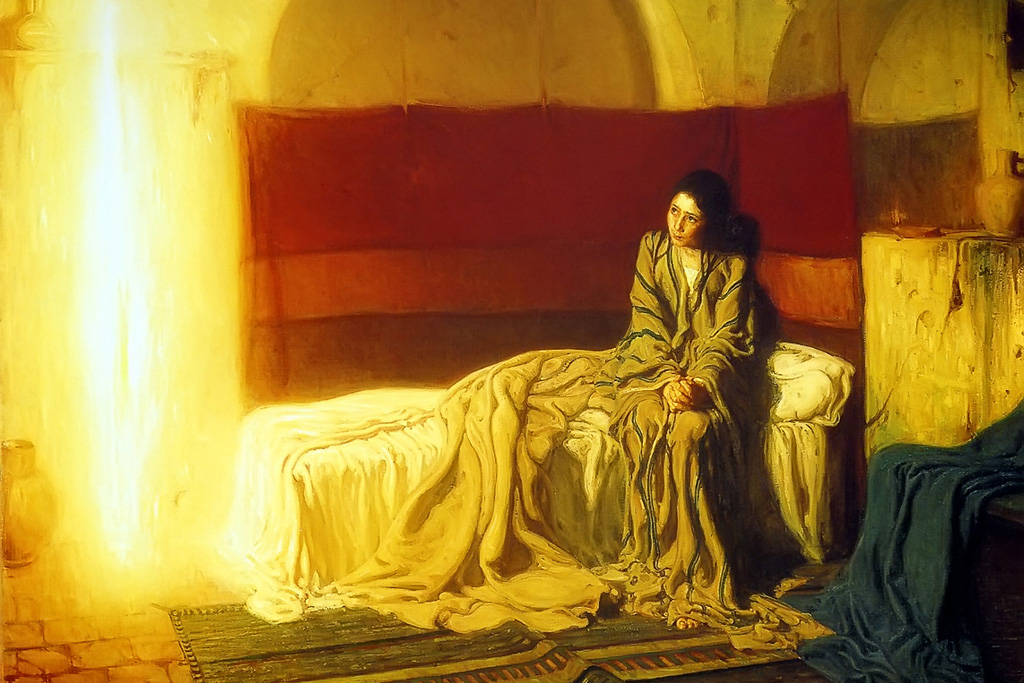
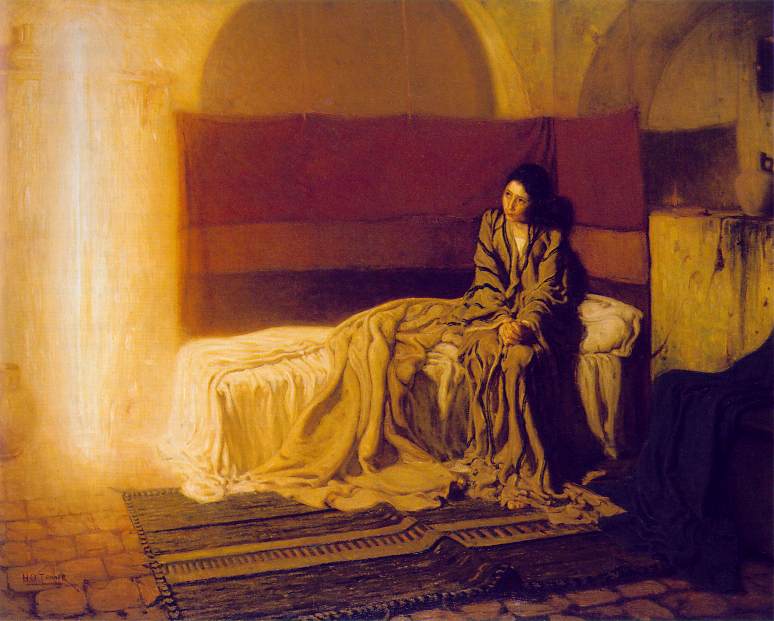
In our western culture we tend to think of Mary in very soft focus, humbly praying, head bowed, quiet and almost shy in her demeanor. And this may all be true. But as I read Mary’s prayer, the Magnificat day after day, and as I read it today’s Gospel, I cannot help but be struck at how bold and charismatic it is. Many of its phrases are taken from ancient Israel and stitched together by Mary in a wondrous and creative way. But as a prayer, it is no gentle meditation. It is one that makes you want to jump to your feet.
My soul Magnifies the Lord! My Spirit REJOICES in God my Savior!
As I have prayed this prayer every day for the last 25 years I have come to experience that I cannot see Mary saying this prayer with hands folded and head bowed. I see, rather, a joyful, young woman, filled with exuberance, head raised in serene confidence and hands upraised in joyful, yes, even charismatic, gestures. African American Catholics often refer to this joyful disposition as “havin’ church,” and would say something like: “Mother Mary and Sister Elizabeth were havin’ some church up in there!”
Havin’ Church – The scene sets up with Mary traveling “in haste” to see Elizabeth. Mary arrives and greets Elizabeth and John the Baptist starts leaping for joy in her womb. You might say he gets things started. The text from Luke then says Elizabeth “cried out with a loud voice: Most blessed are you among women…!” Mary goes on to respond how her soul rejoices in God her savior. No sour-faced saints here, these women are radiant with joy and exuberantly expressing it. Their havin’ church alright, joy beyond all measure is theirs. This sort of exchange is not uncommon among some of the African American women in my parish. A not un-typical dialogue might go something like this:
A: Girl, you are looking radiant! B: Yes Lord! Your sister girl is blessed and highly favored! God’s been GOOD to me! A: Go on!…. God IS good! B: All the time!Yes, it seems, from any straightforward reading of the Lucan text, that the Magnificat was not recited, it was boldly and joyfully proclaimed in a moment celebrated by two women. One who had come in haste bearing our savior, and another, filled with the Holy Spirit and her infant dancing for joy in her womb. Two women filled with the joy of God, two women celebrating what God was doing in their lives. Mary proclaims, and she rejoices and says:
My soul proclaims the greatness of the Lord; My spirit rejoices in God my savior. For he has looked upon his handmaid’s lowliness; behold, from now on will all ages call me blessed. The Mighty One has done great things for me, and holy is his name.
And it is also a prayer that is also bold, even edgy in its critique of the social order:
He has cast down the mighty from their thrones. He has lifted up the lowly. He has filled the hungry with good things and the rich he has sent empty away.
Mary announces a great reversal that is come. Her Son Jesus echoed it: Many who are first will be last, and many who are last will be first (Matt 19:30). Some may which to spiritualize these words, and they surely do have a spiritual meaning. But their critique of the vainglory of this world cannot simply be seen as an abstraction or a generality. They have real meaning for the social order here and now. They surely mean we must learn to esteem the poor, the disabled, the weak. In this world they may need us, but as for the world that is to come, we will need them and their prayers to gain entry. And they, if they had faith, will have first places of honor. The reversal is coming, be careful what you call a blessing and what you call unfortunate. Be careful who and what you esteem and who and what you do not esteem. Yes, this is a bold and edgy prayer. It cuts right to the heart of the world’s vainglory.
So again, I beg your indulgence. I am aware that many have rather specific notions of what Mary is, or should be like. The portrait I have here presented is not the usual one in Western culture. But in the end, at least here, I see a portrait of a joyful, exuberant woman who is bold, even edgy in expressing what God is doing for her and for all Israel.
How do you see it?
Mother of Us All – A Brief Pondering of the Question, “What does Mary look like?”
It is a notable fact that our Lord and his Mother lived in a time long before photographs, even at a time, and among a people, where drawings and portraits of people were almost unknown. Also notably absent in the Sacred Scriptures are any details regarding the physical appearances of most Biblical figures, unless a detail is necessary for the story (e.g. Zacchaeus being short, Goliath tall, Leah being less attractive due to her misshapen eyes). But generally there seems to be an almost complete lack of preoccupation with such things in the Biblical narrative. And even when we are told that David was handsome or Bathsheba was beautiful, we are not really told how.
We live in a polar opposite world when it comes to images. Everything is visual, and we are quite obsessed with appearance and looking acceptable and good, and how other people look.
We attach great meaning (for better, but usually for worse) on our physical appearance. We divide out over race, skin tone, hair etc. We also prize thinness and ridicule fatness, we worry if we are tall enough, pretty enough, if our hair is too straight or not straight enough, if we are tan enough or too dark skinned, and when age sets in many head for the cosmetic surgeon.
Instructive! Thus when we wonder as to what Jesus or Mary “looked like,” it may be instructive for us to reflect on why the Lord would have them live in a time and place, where this data would NOT be supplied us. For, in the end, they look like us. And some historical sketch or painting, had one ever been made, would only tend to limit our vision, rather than allow us to identify with them.
To the question what did Mary look like we may garner five possible answers:
- None of your business.
- Why do you care?
- She looks just like you think she looks.
- She looks like you, because she is your mother.
- She is far more beautiful than you ever imagined (My favorite answer).
But answer four is probably the most helpful when it comes to accepting the diverse ways she is depicted.
Most of us American Catholics see her in very European terms. Historically this may be dubious, by why shouldn’t we see here as looking like us. She is after all our mother.
As I walk though the dozens of chapels in the Basilica of the Immaculate Conception here in Washington, I see her as Chinese, American, Lithuanian, Mexican, Filipino, Korean, African, Lebanese, Irish, Ethiopian, and so on. And why shouldn’t these various Ethnicities see her as looking like them, she is, after all their mother.
In her various apparitions her look varies too. La Virgen de Guadalupe “La Morena” (= dark skinned) is surely different than the descriptions we have from other sights such as Fatima or Lourdes. But here too, why can’t the heavenly beauty of Immaculate Mary, so brightly reflective of God’s glory, not refract through the prism of human experience in different colors and ways?
What does Mary look like? She is our Mother, she looks like us. Jesus is our brother (and Lord), he looks like us.
Happy Feast Day
Questioning the Questioners: Why Do You Not Honor Mary in Accordance With Scripture?
Most of us who are Catholics eventually get asked, “Why do you Catholics worship Mary?” More often than not the question is not a real question it is a rhetorical question. A “rhetorical question,” is a “question” whose purpose is not to seek an answer, but, rather, to make a (usually hostile) point. For example the expression “Who do you think you are!?” is in the form of a question but it does not seek an answer. Instead it is meant as a rebuke. And so it usually is when we Catholics get asked the “question” Why do you worship Mary?” we’re usually aware that it is not a sincere question seeking a sincere answer. However, for those cases where an answer really is sought I might propose the following approach:
“Well, of course we don’t worship Mary since that would be a terrible sin. Worship belongs to God alone. We DO honor her though. After all, she is Jesus’ mother.
But let me ask you a question. Why in your church, do you NOT honor Mary at all? Doesn’t scripture say Every generation will call [Mary] blessed because God who is mighty has done great things for [her]? (Luke 1:48-49) It seems to me that we Catholics are fulfilling Scripture but that in your denomination you are not fulfilling or following it. So why don’t you honor her at all? Why don’t you call her blessed as the Bible says?”
Now stop there and wait for an answer. Don’t keep going. Just stop and wait. Have them answer for a change. We Catholics are always on the defensive, always in answer mode. But we ought to ask a few questions too. When asking, try to avoid a merely rhetorical or hostile tone. Try to allow this question to be genuine, respectful, one meant to provoke thought.
It is possible that many Protestants have never been asked this question or pondered an answer. Now it is also possible that your interlocutor will try to change the subject or evade an answer by piling on about Catholics but just repeat the question respectfully and ask for an answer. Remember your point is not to argue, be hostile or win an argument. Your point is to provoke thought and get a real answer. And even if the conversation ends badly or with no answer, you’ve planted a seed, a question that they will ponder even if they don’t admit it. Jesus often asked questions to provoke thought and conversion. I will be doing a post on this next week.
Another way to explain out devotion and love for Mary is that we are imitating Jesus. We love, honor, respect and entrust ourselves to her care because Jesus did all these things, and we want to be just like Jesus. Consider that the very Son of God, dwelt in Mary’s womb, nursed at her breasts, was held in her arms, sat on her lap and entrusted himself to her care. Our Lord could have chosen to enter our world in other ways. Perhaps He could simply have entered the world as a full grown man. The fact is that He freely chose Mary to be his mother and he was truly her Son. As her son he loved and honored her as any good son must and as her son he entrusted himself to her care. All of this serves to highlight Mary’s dignity and to show us how devotion to her is in perfect imitation of Jesus himself.
What more need we say: Jesus our Lord and God honors and loves Mary, and his very Scriptures sing her praises; so too His Angel Gabriel, Elizabeth, inspired by the Holy Spirit, and countless saints. When we honor Mary we imitate the very Son of God and fulfill Holy Scripture. Certainly our Lord is pleased that we love and honor his mother.
Painting above by French artist William Bouguereau (19th Century)
Update: Mary and the Muslims – A Very Good Video Now Available
You may recall that some months ago I wrote a post on Mary and the Muslim World. If you don’t recall it you can read it here:
Mary and the Muslim World: Is she the key to evangelization?
I recently saw a very well done video on Mary and Jesus in the Qur’an. If you get a moment to watch this video below, it is a real eye-opener, not only because of its depiction of the story of Mary and Jesus in the Qur’an, but also because it depicts Muslim interest and devotion to Mary. It is a non minute video. But please consider watching it, it is most informative and encouraging.
Mary and the Muslim World: Is She the Key to Evangelization?
I have often heard that Muslims hold our Blessed Mother Mary in high regard. This reverence may stop short of devotion but there is said to be a respect for her in the Muslim tradition.
Now, I first learned this from the great Archbishop, Fulton Sheen in his book, The World’s First Love. I read it 25 years ago and have pondered it ever since. I would like to present excerpts from the chapter entitled “Mary and the Moslems” [sic], reflect on its significance and ask a few questions. Please note that the book was written in 1952 and therefore some of the spellings are not the modern ones. Here are the excerpts:
The Koran, which is the Bible of the Moslems, has many passages concerning the Blessed Virgin. First of all, the Koran believes in her Immaculate Conception, and also, in her Virgin Birth…..The Koran also has verses on the Annunciation, Visitation, and Nativity. Angels are pictured as accompanying the Blessed Mother and saying, Oh Mary, God has chosen you and purified you, and elected you above all the women of the earth. In the 19th chapter of the Koran there are 41 verses on Jesus and Mary. There is such a strong defense of the virginity of Mary here that the Koran in the fourth book, attributes the condemnation of the Jews to their monstrous calumny against the Virgin Mary.
Mary, then, is for the Moslems the true Sayyida, or Lady. The only possible serious rival to her in their creed would be Fatima, the daughter of Mohammed himself. But after the death of Fatima, Mohammed wrote: Thou shalt be the most blessed of women in Paradise, after Mary. In a variant of the text Fatima is made to say; I surpass all the women, except Mary.
This brings us to our second point; namely, why the Blessed Mother, in this 20th Century should have revealed herself in the significant little village of Fatima, so that to all future generations she would be known as “Our Lady of Fatima.” Since nothing ever happens out of Heaven except with a finesse of all details, I believe that the Blessed Virgin chose to be known as “Our Lady of Fatima” as pledge and a sign of hope to the Moslem people, and as an assurance that they, who show her so much respect, will one day accept her divine Son too.
Evidence to support these views is found in the historical fact that the Moslems occupied Portugal for centuries. At the time when they were finally driven out, the last Moslem chief had a beautiful daughter by the name of Fatima. A Catholic boy fell in love with her, and for him she not only stayed behind when the Moslems left, but even embraced the Faith. The young husband was so much in love with her that he changed the name of the town where he lived to Fatima. Thus the very place where our Lady appeared in 1917 bears a historical connection to Fatima, the daughter of Mohammed.
Missionaries, in the future will, more and more, see that their apostolate among the Moslems will be successful in the measure that they preach Our Lady of Fatima. Mary is the advent of Christ, bringing Christ to the people before Christ himself is born. In any apologetic endeavor, it is always best to start with that which the people already accept. Because the Moslems have devotion to Mary, our missionaries should be satisfied merely to expand and develop that devotion, with the full realization that our Blessed Lady will carry the Moslems the rest of the way to her divine Son. She is forever a “traitor,” in the sense that she will not accept any devotion for herself, bit will always bring anyone who is devoted to her to her divine Son.
A beautiful reflection by Archbishop Sheen and one we can surely hope will come to pass. Relations are much more tense however between Christians and Muslims today than in 1952.
This leads to my first question.
Do Muslims today still manifest the reverence to Mary that Sheen described in 1952? I have seen a few people in Muslim garb at the Basilica of the Immaculate Conception here in D.C., but I was not sure if they came to pay homage to Mary or just tour. I think we Catholics ought to be careful before we presume too much of what Muslims today think of Mary. The lines in the Quran quoted by Sheen are impressive but that does not mean that Muslims either know them well or interpret them as we would wish. Hence, I am merely posing a question here. If any of you know of good sources that answer the question of the Muslim stance on Mary I would be grateful if you can point it out. The answer to this question has a lot of bearing on my speculations to follow.
Astonishing Fact – I must say, I have always considered it nothing less than astonishing that Mary should appear in a town called, of all things, “Fatima.” Surely this is no mere coincidence and, as Sheen aptly points out, heaven does nothing without purpose. That we are not to merely pass over this detail, is very clear to me. One of the more well known modern titles of Mary is “Our Lady of Fatima.” Fatima is the daughter of Muhammad. This is hugely significant.
Third Secret of Fatima? For many years, before its revelation, I was sure that the Third Secret of Fatima had something to do with the Muslim question. Frankly I figured it likely described a great conflict with the Muslim world that would arise and lead to great suffering for the Church, even a kind of Babylonian captivity, but that ultimately Mary’s Immaculate Heart would triumph by the power of God. Imagine my chagrin when the third secret was finally revealed with a less than worldwide, apocalyptic content. Granted, the assassination attempt on Pope John Paul II was a serious and significant matter but it was less than the worldwide conflict I had expected. It is also true that his would-be assassin was Muslim, but the plot was likely more communist and Russian in origin. In the end my theory was rocked back on its heels and fell flat.
But still we are left with Fatima. Why Fatima? Why a town bearing the namesake of Muhammad’s daughter? It seems clear that Mary will play an important role in the years ahead as the Muslim/Christian conflict likely grows sharper. Perhaps, as Sheen notes, she will be the bridge that connects two vastly different cultures, the common mother who keeps her children talking. Right now this connection seems little pursued, even, as far as I can tell, by the Vatican. But here too allow a question from me. Are there any of you who know if Our Lady of Fatima has any role in Vatican-Muslim dialogue?
The Guadalupe connection - I wonder too if the history of Our Lady of Guadalupe presents some historical parallels to our current struggle with the Muslim world. In the early 16th Century in Mexico, missionaries had made only meager progress in bringing the Aztec people to Christ. It was a combination of the sometimes rude and cruel treatment of the indiginous people by the Spanish soldiers, and also of the fearful superstition surrounding the Aztec gods. These gods required horrific human sacrifices and kept the people locked in with this fear that, unless they fed these gods, their greatest god, the sun, would no longer shine.
Into this fearful and suspicious setting entered Mother Mary. The miraculous image she left in 1531 was richly symbolic: Her face is a mother’s face, gentle and compassionate, unlike the frightful Aztec gods who wore fierce masks. Her features seem to be both an Aztec and European, two cultures are combined in kindness and peace. Her attitude is one of humble prayer, so she is clearly not a god. She is a merciful mother who consoles and prays for us. She is to be honored but not adored. The black band around her waist means that she is with child and offers Jesus to the people. Her message is about him. The sun was the greatest of the Aztec gods and, by standing in front of the sun, Mary shows that she is greater than all their gods. The moon represented to them the god of darkness and death. That she is standing on the moon is a sign that these powers too have been defeated by the son she bears.
Mary brought the breakthrough. Within ten years over 12 million Mexicans came to Christ and entered the Catholic Church.
This history is paralleled in many ways today in the current tensions with the Muslim World. In many Muslim lands today conversions are few. Part of the reason for this is a strong aversion for the western culture from which Catholicism comes. Another reason includes many alleged grievances that Muslims have of American and Western “mistreatment.” Finally, a large factor is fear. Leaving the Muslim faith is likely to get you killed in many parts of the Muslim world. So, it is a combination of a wide cultural gulf, alleged grievances, and fear, that keep conversions low. All not unlike 16th Century Mexico.
Is Mary key? It took Mary to bridge all these similar gaps between the Aztecs and the Christian Missionaries. Might Mary also be that bridge today when similar gaps divide? Time will tell, but one of her greatest Modern titles is Our Lady of Fatima. And then, there is the crescent moon upon which Mary stands in the image of Guadalupe. In modern times the crescent moon is the symbol of Islam. Mother Mary of Guadalupe, by God’s grace, was victorious and overcame the false religion of the Aztecs with love and humility.
Might this crescent moon on which Our Lady of Guadalupe stands also point to our times, and the crescent moon of Islam? Might it indicate that her victories, by God’s grace, are not at an end. Perhaps we can hope that what our Lady of Guadalupe was to the Aztec people of Mexico, Our Lady of Fatima will be to the Muslim people of the world.
As always, I invite your comments and answers to my questions.
Here is “Immaculate Mary” sung in Arabic
The Magnificat is a Bold Prayer!
I pray you might indulge me a little speculation that cuts against the usual “visuals” surrounding the Magnificat. And , if what I say does not please your sensibilities I ask pardon now, and once again your indulgence.
In our western culture we tend to think of Mary in very soft focus, humbly praying, head bowed, quiet and almost shy in her demeanor. And this may all be true. But as I read Mary’s prayer, the Magnificat day after day, and as I read it today’s Gospel, I cannot help but be struck at how bold and charismatic it is. Many of its phrases are taken from ancient Israel and stitched together by Mary in a wondrous and creative way. But as a prayer, it is no gentle meditation. It is one that makes you want to jump to your feet.
My soul Magnifies the Lord! My Spirit REJOICES in God my Savior!
As I have prayed this prayer every day for the last 25 years I have come to experience that I cannot see Mary saying this prayer with hands folded and head bowed. I see, rather, a joyful, young woman, filled with exuberance, head raised in serene confidence and hands upraised in joyful, yes, even charismatic, gestures. African American Catholics often refer to this joyful disposition as “havin’ church,” and would say something like: “Mother Mary and Sister Elizabeth were havin’ some church up in there!”
The scene sets up with Mary travelling “in haste” to see Elizabeth. Mary arrives and greets Elizabeth and John the Baptist starts leaping for joy in her womb. You might say he gets things started. The text from Luke then says Elizabeth “cried out with a loud voice: Most blessed are you among women…!” Mary goes on to respond how her soul rejoices in God her savior. No sour-faced saints here, these women are radiant with joy and exuberantly expressing it. Their havin’ church alright, joy beyond all measure is theirs.
This sort of exchange is not uncommon among some of the African American women in my parish. A not un-typical dialogue might go something like this:
A: Girl, you are looking radiant! B: Yes Lord! Your sister girl is blessed and highly favored! God’s been GOOD to me! A: Go on!…. God IS good! B: All the time!Yes, it seems, from any straightforward reading of the Lucan text, that the Magnificat was not recited, it was boldly and joyfully proclaimed in a moment celebrated by two women. One who had come in haste bearing our savior, and another, filled with the Holy Spirit and her infant dancing for joy in her womb. Two women filled with the joy of God, two women celebrating what God was doing in their lives. Mary proclaims, and she rejoices and says:
My soul proclaims the greatness of the Lord; My spirit rejoices in God my savior. For he has looked upon his handmaid’s lowliness; behold, from now on will all ages call me blessed. The Mighty One has done great things for me, and holy is his name.
And it is also a prayer that is also bold, even edgy in its critique of the social order:
He has cast down the mighty from their thrones. He has lifted up the lowly. He has filled the hungry with good things and the rich he has sent empty away.
Mary announces a great reversal that is come. Her Son Jesus echoed it: Many who are first will be last, and many who are last will be first (Matt 19:30). Some may which to spiritualize these words, and they surely do have a spiritual meaning. But their critique of the vainglory of this world cannot simply be seen as an abstraction or a generality. They have real meaning for the social order here and now. They surely mean we must learn to esteem the poor, the disabled, the weak. In this world they may need us, but as for the world that is to come, we will need them and their prayers to gain entry. And they, if they had faith, will have first places of honor. The reversal is coming, be careful what you call a blessing and what you call unfortunate. Be careful who and what you esteem and who and what you do not esteem. Yes, this is a bold and edgy prayer. It cuts right to the heart of the world’s vainglory.
So again, I beg your indulgence. I am aware that many have rather specific notions of what Mary is, or should be like. The portrait I have here presented is not the usual one in Western culture. But in the end, at least here, I see a portrait of a joyful, exuberant woman who is bold, even edgy in expressing what God is doing for her and for all Israel.
How do you see it?
On The Fittingness and Faithfulness of the Immaculate Conception
Today’s Solemn Feast of the Immaculate Conception is often mistakenly thought to refer to the conception of the Jesus in the womb of the Blessed Mother. It does not. Perhaps it does not help the confusion that the Gospel chosen for today’s feast is in fact the gospel of the Annunciation wherein Jesus is conceived in Mary’s womb by the power of the Holy Spirit. There is a reason this Gospel is chosen as we shall later see. However, the Dogma of the Immaculate Conception refers to Mary’s Conception in the womb of her mother Anne. The Dogma is stated as follows in the Papal Document Ineffabilis Deus issued by Pope Pius IX in 1854:
The Most holy Virgin Mary was, in the first moment of her conception, by a unique gift of grace and privilege of Almighty God, in view of the merits of Jesus Christ, the Redeemer of Mankind, preserved free from all stain of Original Sin (D 1641).
Note how carefully the Dogma is worded. Mary receives this gift from God on account of the merits of Jesus Christ. Hence we do not teach that Mary was not in need of the saving grace of Jesus Christ, for it is only by his merits that she is able to receive this gift.
Why does the Church Teach this? Perhaps we can look at it from three perspectives:
1. Fittingness- When we consider the fittingness of something we do not deny that God could have done things otherwise. We argue only that what he did makes sense and is in accord with what seems best. For example, Jesus could have chosen to appear on earth as a full grown man, never having been born, never having been a child or a carpenter. I was surely possible for God to have done this. He could have created a human nature for himself ex nihilo (from nothing). However it seems fitting that the Lord Jesus lived life as we do, having been conceived, born, raised, nurtured, come to manhood, labored, and finally ministered. So the Lord chose to have for himself a mother and, from this mother, to draw his humanity.
But what sort of humanity would he need to draw from her? It seems clear that the humanity he drew from her had to be sinless since Scripture says of Jesus: For we do not have a high priest who is unable to sympathize with our weaknesses, but we have one who has been tempted in every way, just as we are–yet was without sin. (Heb 4:15). And again, Which of you can accuse me of sin? (John 8:46). So the humanity that Christ drew from Mary was sinless. But Mary cannot give what she does not have. So it is fitting that God preserved her at her conception from the stain (macula) of Original Sin. Hence she is call Immacula (without stain).
Now one might argue that God could simply have done for Christ what he did for Mary and simply intervened at the moment of Christ’s conception and preserved him free of that stain, while leaving Mary with it. This is true, but less fitting. For if Christ did not take all of his humanity from Mary then incarnation becomes something of a charade, incomplete at best. Christ would have taken some of his humanity from Mary and some from…..where? Hence it is more fitting that Mary be preserved and that Christ’s sonship of Mary be full and her Maternity be full.
It is also fitting that Mary be preserved from Original Sin due to her status as the New Eve. Mary fulfils the text of Genesis 3:15: And I will put enmity between you and the woman, and between your offspring and hers; he will crush your head, and you will strike his heel. So Mary is the woman, the new Eve, spoken of in this text. But the first Eve was created sinless. Hence it is fitting that the second Eve also be created sinless. In effect God is revisiting the orginal scenario wherein we were harmed by a man, a woman, and a tree. Hence God decrees that we would be restored in the same way: a man (Christ), a woman (Mary) and the tree of the cross. Hence Christ saves us by the wood of the Cross and his obedience. But, just as the original scenario also featured sinless woman who disobeyed, now another sinless woman would, this time, obey. It is thus fitting that Mary be sinless as the New Eve.
2. Faithfulness to Scripture – The Gospel chosen for today may confuse some for it is the gospel that refers to Christ’s conception. However it is chosen for the fact of what the Angel Gabriel says to Mary: And coming to her, he said, “Hail, full of grace! The Lord is with you (Lk 1:28). There is a Greek word underlying the translation “full of grace” and the word is κεχαριτωμένη (kecharitomene). The meaning of this term is much disputed since it is a hapax legomenon(a word that only occurs once in the whole of Scripture). The great scholar, Greek speaker and Father of the Church Origen said of this word: The angel greeted Mary with a new address which I could not find anywhere else in scripture….This greeting was reserved for Mary alone (Hom 6.7 on Luke).
However, at the heart of the word is the Greek word χαριτόω (Charitoo) which means to show forth grace (charis), or in the passive to have grace shown. Kecharitomene is a perfect, passive, participle of charitoo and hence means endowed with grace (charis). But what does it mean to say it is a perfect participle? A participle is a word that has both the qualities of a adjective and a verb. The ‘perfect’ action of the participle is considered to have been completed before the time of the speaker. How long before is not a consideration, but the Greek verbal idea is that the action has already been completed. Perfected action must imply the past in relationship to the speaker. Thus, Gabriel in using the word, is confessing that Mary had already been graced. So, the most literal rendering of κεχαριτωμένη is “having been endowed with grace.” That is awkward in English however: “Hail! having been endowed with grace, the Lord is with thee!”
So the more standard and still literal way is “full of grace.” Attempts to render the word more vaguely as, “highly favored” do not respect the root word charitoo and charis which is almost always rendered as “grace” and not mere favor. The plain meaning of charis is grace.
Now, grammar aside, it would be strange for Gabriel to say to a woman who had Original Sin that she was full of grace. In no way can the word be implied to mean that she will one day be graced since it is a past participle. The action of her being made full of grace is past, though its effects are present now. So Gabriel is greeting her in this condition. Hence the text implies some prior action of God. Now, this does not ipso facto prove that the moment in the past where God acted was her conception. But, this seems the most fitting timing since Original Sin is contracted at that moment. Gabriel’s greeting only makes sense if Mary is free from Original Sin, for grace and Original Sin are not compatible
But the point remains that Catholic teaching on Mary’s freedom from Original Sin is most faithful to the Scriptural text here. The Angel’s greeting is significant and Catholic teaching best connects the dots, and takes the greeting at its word, respecting its plain meaning. Mary, having been made full of grace, is free from Original Sin.
3. Fathers of the Church- The Church Fathers did not use the term Immaculate Conception but they did teach on Mary’s holiness and sinlessness. Here are some quotes:
- St. Ephrem, 3rd Century – Thou and thy Mother are the only ones who are totally beautiful in every respect; for in thee O Lord there is no spot and in thy Mother, no stain. (Carmina Nisibena, 27.8).
- Hippolytus 3rd Century – The Lord was sinless, because in His humanity He was fashioned out of incorruptible wood, that is to say, out of the Virgin and the Holy Spirit (In Psalm 22; quoted by Theodoret, Dialogus 1; PG 10:610, 864-5)
- St. Augustine 4th Century - All men must confess themselves as sinners except the Holy Virgin Mary, whom I desire for the sake of the honor of the Lord to leave entirely out of the question when the talk is of sin. For from Him we know what abundance of grace for overcoming sin in every particular was conferred upon her who had the merit to conceive and bear Him who undoubtedly had no sin.” (De Natura et gratia 36.42)
- St. Ephrem, 3rd Century – Mary and Eve, two people without guilt, two simple people were identical. Later however, one became the cause of our death, the other the cause of our life (Opus Syr. II, 327)
- Origen, 3rd Century – This Virgin Mother of the Only-begotten of God, is called Mary, worthy of God, immaculate of the immaculate, one of the one. (Homily 1)
- St Ambrose – 4th Century – “Mary, a Virgin not only undefiled but a Virgin whom grace has made inviolate, free of every stain of sin.” (Sermon 22:30)
In the end, Mary receives this honor to be free of original sin for the sake of Christ. All the great Marian doctrines refer back to Christ. Mary too, as the perfect disciple, and Mother of the Church also prefigures the gifts that we will one day enjoy. For, in heaven, having been freed of all our sins and purified by the blood of Christ, we too will be rightfully called Immaculate (without stain). So Mary’s Feast is ours too by way of promise.
There is a beautiful text for today’s feast which says,
Tota pulchra es, Maria,
et macula originalis non est in te.
Vestimentum tuum candidum quasi nix, et facies tua sicut sol.
Tu gloria Jerusalem, tu laetitia Israel, tu honorificentia populi nostri.
Tota pulchra es, Maria.
You are all beautiful, Mary,
and the original stain [of sin] is not in you.
Your clothing is bright as snow, and your face is like the sun.
You are the glory of Jerusalem, you are the joy of Israel, you give honour to our people.
You are all beautiful, Mary.
Here is a setting by Durufle:
“You Just Put Your Hand in Mary’s and Let Her Lead you to Christ”
As a young very young child I was so close to God. I spoke to him in a very natural way and He too spoke plainly to me. I have very few memories of early childhood but surely one of my most vivid is how close I was to God. But somewhere, as early puberty approached, I slipped away from God, drifting into the rebellious and angry years of my teens. As the flesh came more alive, my spirit submerged.
The culture of the time didn’t help. It was the late 1960s and early 1970s and rebelliousness and the flesh were celebrated as “virtues.” Somehow we thought ourselves as being more mature than our pathetic forbearers who were “repressed.” But at that time there was the attitude around among the young that we had come of age somehow and we collectively deluded ourselves through the message of rock music and haze of drug use that we were somehow better.
So it was the winter of my soul. The vivid faith of childhood gave way to a kind of indifferent agnosticism. Though I never formally left Church (mother would never had permitted that as long as I lived in under my parents roof!) I no longer heard God or spoke to him. I may have told you that I joined the Church Youth Choir in High School. This was not religious passion but passion of another kind. There were pretty girls in the choir and I sought their company, shall we say. But God has a way of using beauty to draw us to the truth and week after week, year after year as we sang those old religious classics a buried faith began to awaken.
But what to do? How to pray? I heard I was supposed to pray. But how? As a child it was natural to talk with God. But now he seemed distant, aloof, and likely angry with me. And I’ll admit it, prayer seemed a little goofy to high school senior still struggling to be “cool” in the sight of his friends and in his own eyes. Not only that but prayer was “boring.” an unfocused, unstructured and “goofy” thing.
But I knew someone who did pray. My paternal grandmother “Nana” was a real prayer warrior. Everyday she took out her beads and sat by the window to pray. I had seen my mother pray now and again, but she was more private about it. But Nana, who lived with us off and on in her last years just knew how to pray and you could see it every day.
Rosary Redivivus – In my parish church of the 1970s the rosary was non-existent. Devotions and adoration were on the outs in that sterile time. Even the Crucifix was gone. But Nana had that old time religion. So I asked her one day to show me how to pray the rosary. My mother had taught me as a little child but that was over ten years back. Nana gave the technical details but more importantly she gave me the vision. She said, “Holding these beads is like holding Mary’s hand. You just put your hand in hers and let her lead to Christ.” She went on to say, “You’ll be fine.”
Ad Jesum per Mariam – There are those, non-Catholics especially, who think that talking of Mary and focusing on her at all takes away from Christ. It is as though our hearts were a zero-sum game and we could not do both. But my own experience was that, just as my grandmother said, Mary led me to Christ. I had struggled to know and worship Christ but somehow a mother’s love felt natural, safer, more accessible to me. So I began there, where I could. Simply pole-vaulting into a mature faith from where I was did not seem possible. So I began, a little child again, holding my mother’s hand. And gently, Mother Mary led me on to Christ, her son. And through the rosary, that “Gospel on a String,” I became reacquainted with the basic gospel story.
The thing about Marian devotion is that it opens a whole world to you. For with this devotion comes an open door into so many of the other traditions and devotions of the Church: Eucharistic adoration, litanies, traditional marian hymns, lighting candles, modesty, pious demeanor and so forth. So as she led, she also reconnected me to many things I only vaguely remembered. The 1970s suburban Catholicism had all but cast these things aside and I too had lost them. Now in my late teens I was going into the “Church attic” and taking things down. Thus, little by little, Mother Mary was helping me put things back in place. I remember my own mother being pleased to discover that I had take some old religious statues out of a drawer in my room and placed them again on my dresser. I also took down the crazy rock and roll posters one by one and replaced them with traditional art, to include a picture of Mary.
Praying the Rosary and talking to Mary began to feel natural. And, sure enough, little by little, I began to speak with God. In the middle of College I began to sense the call to the priesthood. I had become choir director by now and took a new job in a city parish at, you guessed it, ”St Mary’s Parish.” There the sterility of suburban Catholicism had never taken hold. The candles burned brightly at the side altars. The beautiful windows, marble altars, statues and the traditional novenas were all on display in Mother Mary’s Parish. The rest is history. Mary cemented the deal between me and her Son, Jesus. I became his priest and can’t stop talking about him. He is my hero, savior and Lord. And praying again to God has become more natural and deeply spiritual for me.
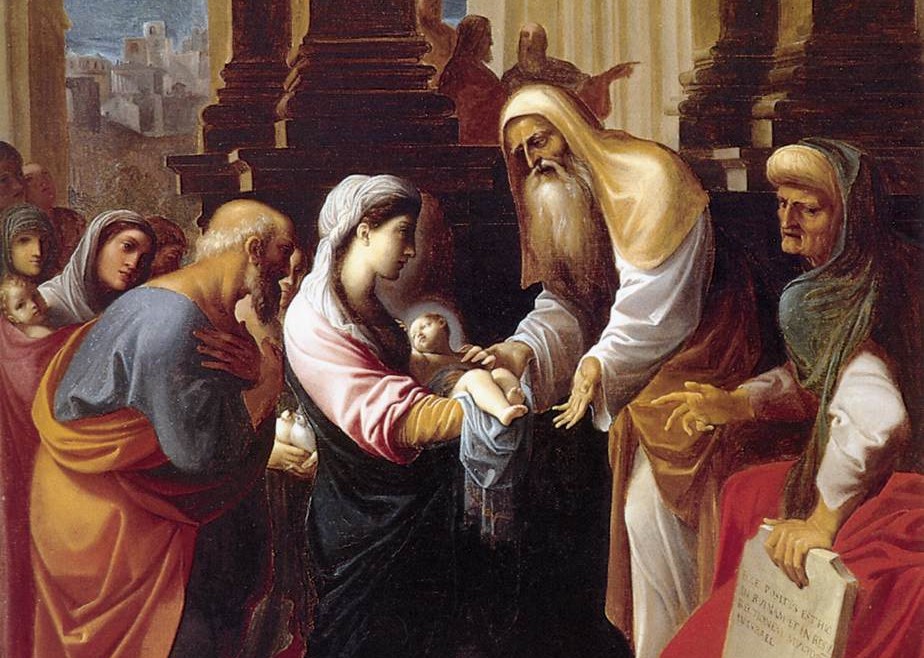
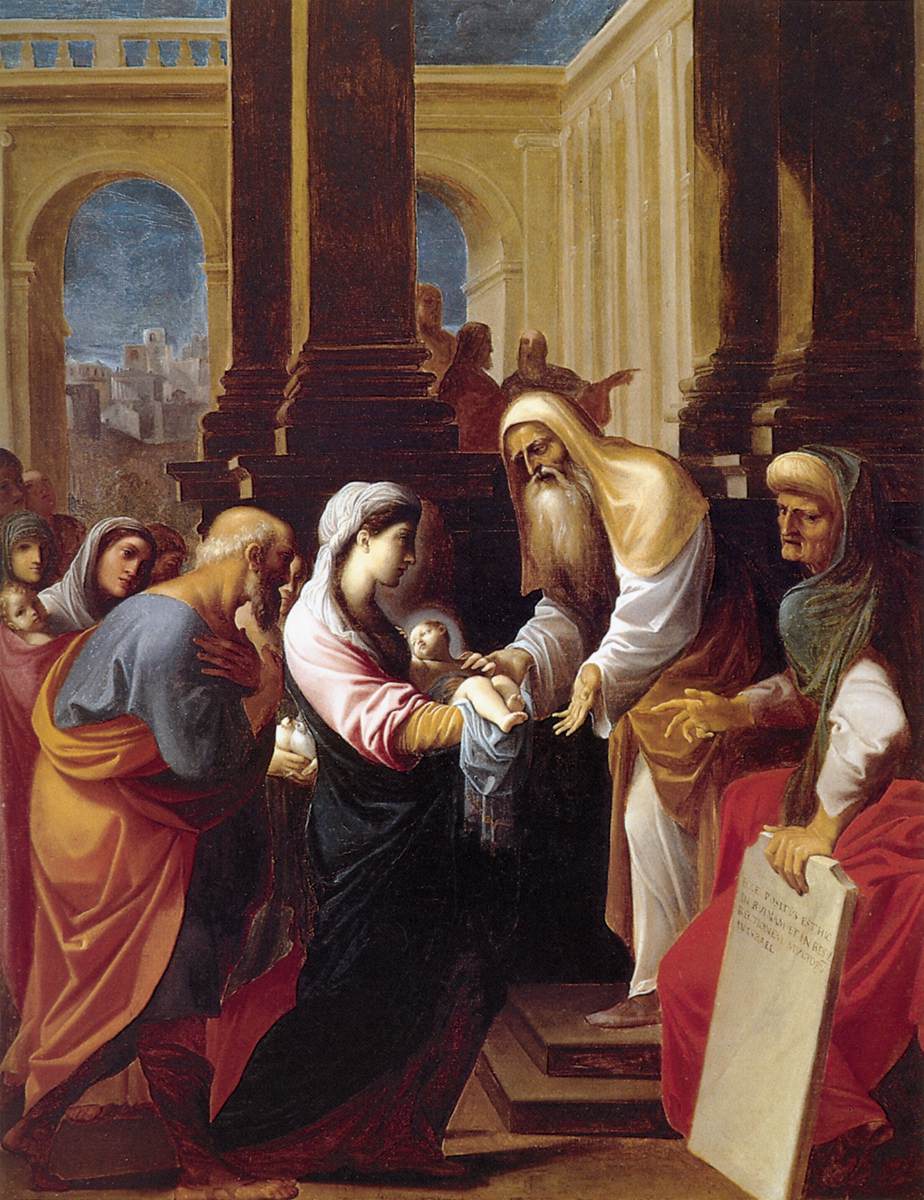
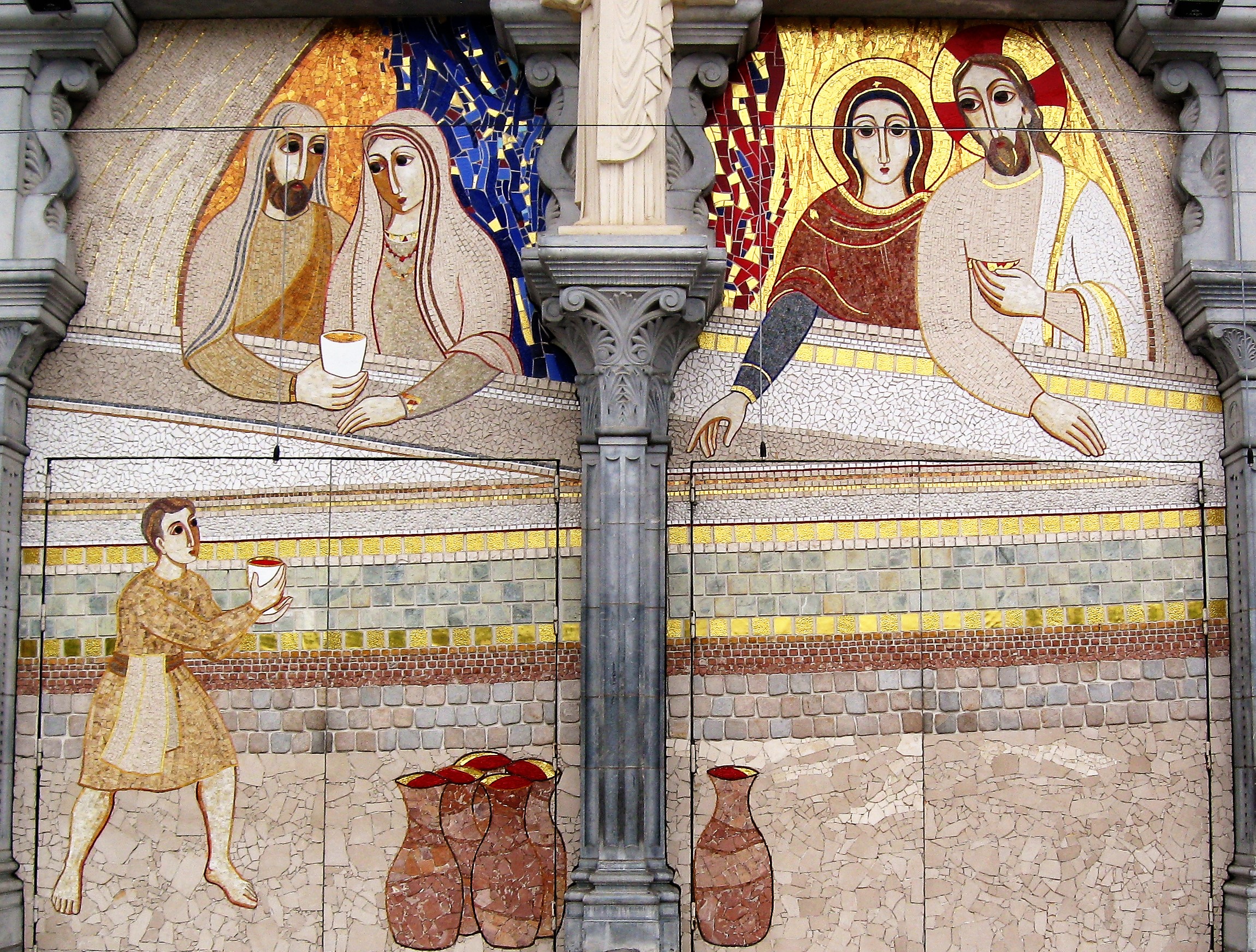
It all began one day when I took Mary’s hand and let her lead me to Christ. And hasn’t that always been her role? She, by God’s grace, brought Christ to us and showed him to us at Bethlehem, presented him in the Temple, ushered in his first miracle even despite his reluctance. Said to the stewards that day and to us now, “Do whatever he tells you.” And on account of that miracle the text says. Jesus did this as the beginning of his signs in Cana in Galilee and so revealed his glory, and his disciples began to believe in him (John 2:11). And so her intercession strengthened the faith of others in her Son. That has always been her role, to take us by the hand and lead us to Christ.
The Feast of the Assumption Is Our Feast Too
This year we are privileged to celebrate the Feast of the Assumption of Mary into heaven on a Sunday. Let’s ponder this feast in three stages:
1. Explained – To be “assumed” means to be taken up by God bodily into heaven. As far back as the Church can remember we have celebrated the fact that Mary was taken up into heaven. We do not just acknowledge that her soul was taken to heaven, as is the case with all the rest of the faithful who are taken there (likely after purgation). Rather Mary was taken up, soul AND body into heaven after her sojourn on this earth was complete. There is no earthly tomb containing her body, neither are there relics of her body to be found among the Christian faithful. This is our ancient memory and what we celebrate today, Mary was taken up, body and soul into heaven.
2. Exemplified - The actual event of the Assumption is not described in Scripture. However, there are assumptions recorded in the Scriptures and the concept is thus biblical.
- It happened to Enoch in the Old Testament The Book of Genesis records: Enoch walked with God; then he was no more, because God took him away (Gen. 5:24). Hebrews 11: 5 elaborates: By faith Enoch was taken up so that he should not see death; and he was not found, because God had taken him. Now before he was taken he was attested as having pleased God.
- It also happened to Elijah as he walked with Elisha: And as they still went on and talked, behold, a chariot of fire and horses of fire separated the two of them. And Elijah went up by a whirlwind into heaven….And he was seen no more. (2 Kings 2:11 ).
- Some say Moses too was taken up since his grave is not known: He was buried in Moab, in the valley opposite Beth Peor, but to this day no one knows where his grave is (Dt. 34:6). The text of course does not say his body was taken up and if it was, it occurred after death and burial. Jude 1:9 hints at the fact when is says, But even the archangel Michael, when he was disputing with the devil about the body of Moses….. (Jude 1:9) Some further credibility is lent to the view of him being assumed by the fact that he appears alongside Elijah in the Transfiguration account. Some of the Church Fathers held this view and there is also a Jewish work from the 6th Century AD entitled The Assumption of Moses that represents the tradition of his assumption. But in the end the Assumption of Moses only a view held by some and it not officially held by the Church.
- And While it is true that the historical event of the assumption is not recorded in Scripture nor are there historical accounts of the event, there may be one other scriptural account that evidences Mary’s whereabouts, body and soul. The Church presents for our consideration in today’s second reading a passage from the Book of Revelation wherein John records his sighting of the Ark of God:
Then God’s temple in heaven was opened, and within his temple was seen the ark of his covenant. And there came flashes of lightning, rumblings, peals of thunder, an earthquake and a great hailstorm. A great and wondrous sign appeared in heaven: a woman clothed with the sun, with the moon under her feet and a crown of twelve stars on her head. She was pregnant and cried out in pain as she was about to give birth. Then another sign appeared in heaven: an enormous red dragon with seven heads and ten horns and seven crowns on his heads… The dragon stood in front of the woman who was about to give birth, so that he might devour her child the moment it was born. She gave birth to a son, a male child, who will rule all the nations with an iron scepter. (Rev 11:19 – 12:5)
The Woman is clearly Mary since the child is clearly Jesus. And where is Mary seen? In heaven. Now some may argue the text does not necessarily indicate her body is in heaven but may only be referring to her soul. However the physicality of the description of her is rather strong. Some also argue that Mary is linked to John’s sighting of the Ark of the Convent which is seen by John in Heaven. He mentions the Ark and goes on to describe the woman clothed with the sun (Mary) and there is a possibility that he is still describing the Ark he sees in Heaven. (I have written on this elsewhere. See here: Mary: The Ark of the New Covenant) If she is the Ark described that Ark is clearly described as being in heaven.
So, the Biblical record, while not recording the event of the Assumption, does set forth other assumptions and thus shows that assumption is a biblical concept. Further, Mary’s physical presence in heaven seems hinted at by John and some would argue that the passage actually attests to her physical presence there.
But remember, the Church does not rely solely on Scripture. In this case what we celebrate is most fundamentally taught to us by Sacred Tradition in that the memory of Mary’s assumption goes back as long as we can remember.
3. Extended - The Feast of the Assumption may be of theological interest to some and may provide for interesting biblical reflection but eventually the question is bound to come: “So What?” How does what happened to Mary have impact on my life and what does it mean for me? The answer to this question is bound up in nearly every Marian Doctrine. Simply put, what happened to Mary in an profound and preliminary way will also happen for us in the end. As Mary bore Christ into he world, we too bear him there in the Holy Communion we receive and in the witness of his indwelling presence in our life. As Mary is (and always was) sinless, so too will we one day be sinless (immaculate) with God in heaven. As Mary cared for Christ in his need, so do we care for him in the poor, the suffering, needy and afflicted. And as Mary was assumed, body and soul into heaven so too will we be there one day, body and soul.
For now our souls go to heaven once purified but our body lie in a tomb. But one day when the trumpet shall sound, on that “great gettin’ up morning” our bodies will rise and be joined to our soul:
For we will all be changed— in a flash, in the twinkling of an eye, at the last trumpet. For the trumpet will sound, the dead will be raised imperishable, and we will be changed. For the perishable must clothe itself with the imperishable, and the mortal with immortality. When the perishable has been clothed with the imperishable, and the mortal with immortality, then the saying that is written will come true: “Death has been swallowed up in victory.” “Where, O death, is your victory? Where, O death, is your sting?”…….Thanks be to God! He gives us the victory through our Lord Jesus Christ. (1 Cor 15:51-57)
So our bodies shall rise shall be assumed and joined to our soul.
Improved model! Now a older woman once said to me upon hearing that her body would rise: “Father if this old body has to rise, I’m hoping for an improved model!” Yes indeed! Me too! I want my hair back, my slender figure and knees that work! I want to upgrade from a general issue late model version, to a luxury model. And God will in fact do that. Scripture says:
- He will take these lowly bodies of ours and transform them to be like his own glorified body. (Phil 3:21)
- But someone may ask, “How are the dead raised? With what kind of body will they come?” How foolish! What you sow does not come to life unless it dies. When you sow, you do not plant the body that will be, but just a seed, perhaps of wheat or of something else. But God gives it a body as he has determined, and to each kind of seed he gives its own body…..So will it be with the resurrection of the dead. The body that is sown is perishable, it is raised imperishable; it is sown in dishonor, it is raised in glory; it is sown in weakness, it is raised in power; …..And just as we have borne the likeness of the earthly man, so shall we bear the likeness of the man from heaven. (1 Cor 15:35-49)
- Yes we shall also be taken up, assumed, and then shall be fulfilled for us the saying of Job: I know that my Redeemer lives, and that in the end he will stand upon the earth. And after my skin has been destroyed, yet in my flesh I will see God; I myself will see him with my own eyes—I, and not another ’s (Job 19:25-27).
The assumption of our bodies, prefigured by Christ in his own power and also in Mary by the gift of God, will one day be our gift too. For now, it waits till that “great gettin’ up morning.” Until that day, and on that day, fare you well, fare you well!
This song is an African American Spiritual and speaks of that Great Gettin’ up morning when our bodies will rise. And if we have been faithful they will rise to glory!
I’m gonna tell you about the coming of the judgement (Fare you well) There’s a better day a coming….In that great gettin’ up morning fare you well! Oh preacher fold your Bible, For the last soul’s converted….Blow your trumpet Gabriel…..Lord, how loud shall I blow it? Blow it right calm and easy Do not alarm all my people….Tell them to come to the judgement…….In that great gettin’ up morning fare you well. Do you see them coffins bursting? Do you see them folks is rising? Do you see the world on fire? Do you see the stars a falling? Do you see that smoke and lightning? Do you hear the rumbling thunder? Oh Fare you well poor sinner. In that great gettin’ up morning fare you well.
On Fixing a Dreadful Error And Taking a Graceful Bow
We are in the heart of Lent but for one day we step back into the Christmas cycle. It is nine months before Christmas and today we celebrate the true feast of the Incarnation. December 25 is the Lord’s birth but today is His incarnation as he is conceived in his Mother’s womb. TODAY the Word becomes flesh.
This needs to be emphasized in an age of abortion where some in our culture deny explicitly or implicitly that human life begins at conception. You are aware that a new translation of the Mass will soon come to us in the English speaking world. It is long needed and treasures of the faith kept hidden for long decades (except for those know Latin) will become visible again.
Among the most egregious errors of the current English version is in the Creed which erroneously indicates that Jesus became man at his birth, rather than his conception. Here is what the current version says:
For us men and our salvation He came down from heaven: by the power of the Holy Spirit, He was born of the Virgin Mary , and became man.
Notice that the text says he became man when he was born. As a poor translation of the Latin text it is irritating enough but to have this mistranslation exist when abortion is thought a legal right is a complete disaster. The Latin text does not say that Jesus became man at his birth (celebrated December 25), but rather at His incarnation (celebrated March 25). Here is what the the Latin text says:
Qui propter nos homines et propter nostram salutem descendit de caelis. Et incarnatus est de Spiritu Sancto ex Maria Virgine, et homo factus est.
The New Translation which will be implemented in a little over a year renders it correctly in the following way:
For us men and for our salvation he came down from heaven, and by the Holy Spirit was incarnate of the Virgin Mary, and became man.
I for one am grateful for the accuracy. The whole translation is going to take some getting used to but it will be of great benefit to see our Holy Faith, so beautifully articulated in the Latin text, properly translated and conveyed at last. Since 1970 the text has been really little better than a paraphrase and so much is lost. This mistranslation of the Creed is but one of ten thousand examples where the current translation is woefully inaccurate and/or incomplete. But surely the mistranslated Creed is most egregious for the reasons stated.
A final thought on this section of the Creed – The Bow. The Congregation is instructed to bow at the words: and by the Holy Spirit was incarnate of the Virgin Mary, and became man. This is in recognition of the great mystery that the incarnation is. How can God, whom the very heavens cannot contain dwell in the womb of the Virgin Mary? How can the infinite become an infant? It is a mystery too great and so we bow in reverence. In the Traditional Latin Mass the practice is to kneel at these words. Such was the practice until about 1970 when it was replaced by a bow. Personally I think we Americans are terrible at bows and would be happy if the genuflection returned. In other cultures bowing is graceful and natural. For most of us here it is awkward and usually lacks proportional and graceful movement. But bow we are told and bow we should. One ought to fold the hands and bow at the waist. Think of your waist as the hinge, not the neck and shoulders which should not move in proportion to the shoulders. The bow is a reverent acknowledgment of the mystery of the Incarnation we celebrate today. Interestingly enough there are still two days in the year when we still kneel at the words of the incarnation. We kneel and pause at these words on Christmas and today, March 25, The Feast of the Annunciation. Otherwise we bow, as gracefully as possible
I am curious if you bow at these words in the Creed and if it is common in your parish. Does your clergy bow, do they teach others to do so? Just asking!
Happy Feast Day!
The ultimate gold medal
My wife has a wonderful devotion to the Blessed Virgin. As a convert to the faith, she often credits the Mother of God with drawing her closer to her Son, Jesus Christ. As part of her devotion, she almost always wears a Miraculous Medal given to her as a gift when she was received into the Catholic Church. For Lent, she asked me to say the prayer on the Medal daily and to think of her while I pray it.
I am victorious!
As we were watching the Olympics recently, we enjoyed witnessing the joy on an athlete’s face when they put the medal around their necks symbolizing their respective victories.
Brothers and sisters, Our Lady’s Miraculous Medal symbolizes victory as well. It symbolizes a victory over sin and death. And unlike an Olympic medal, it is available to anyone who seeks victory over death through Jesus Christ. Also, unlike Olympic medals, the glory of this victory will never fade but only increase. If you have one, put it on. If not, buy one. Few things say, “I believe in Christ!” like a Miraculous Medal.
Take your place on the medal stand!
Let God and your faith in His Only Son, Jesus Christ, put you on the platform and place the ultimate gold medal around your neck!
“O Mary, conceived without sin, pray for us who have recourse to thee.”
The Wedding at Cana: Does Jesus Rebuke His Mother?
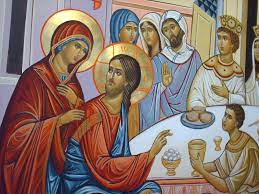
Jesus and his mother Mary were at a wedding feast at Cana (as recorded in John 2). There is what seems to us a tense interaction between them. Mary observes that they have no more wine. And Jesus says to her, Woman, how does this concern of yours affect me? My hour has not yet come. (Jn 2:4).
To modern English ears this response of Jesus seems terse and off-putting. Is Jesus annoyed by his mother’s request? A little study of culture reveals that his repsonse ot his mother is not disrespectful but is in fact a sign of respect and readiness to comply with her request. In order to understand this we need to look at the cultural context of Jesus’ remark.
In the first place Jesus is using a Jewish expression as he speaks to his mother. The English translation we use at Mass renders it rather poorly. The Greek text of the Jewish expression is τί ἐμοὶ καὶ σοί (ti emoi kai soi) which is literally rendered: "What to me and to thee?" What this expression does it to denote a relationship between the one who is asking and the one who is asked. In effect it is something that someone says when they are reluctant to do what the asker wants but, based on their respect for the one who asks, they agree to do it. Maybe the closest English expression is, "What is that between friends?" or "You don’t even have to ask!"
So in this interaction between Jesus and Mary we DOnote some reluctance on Jesus’ part for his hour had not yet come. And yet, because it is his mother who asks he does it. After stating his reluctance he says,"But what is that betweeen you and me?" Mary clearly takes it as an affirmation not a rebuke for she never misses a beat and turns right to the steward and says, "Do whatever he tells you" (jn 2:5).
There are other occurrences of this Jewish expression in the Old Testament. For example in Genesis 23 Sarah had just died and Abraham wanted to bury her in Hebron in the Cave of Machpelah. But the Hittites were in possession of the Land. So Abraham offers to buy the cave from them. The King of the Hittites holds Abraham in high regard and wants to give him the cave for free. But Abraham insists on buying. After further attempts to give it to him fro free, the King of the Hittites reluctantly agrees to sell it to Abraham and utters the phrase, "if you insist on buying it, what it that between you and me (ἐμοῦ καὶ σοῦ τί) and he accepts the money (Gen 23:15). Again, note the pattern, a request is made that a person is reluctant to do, but, based on their respect and relationship with the one requesting, they agree to do it. If you wish, there are other occurrences of this phrase (e.g. 2 Kings 3:13 & Mark 5:7 inter al) which you can consult.
So, in the end it is clear that Jesus IS a bit hesitant at his Mother’s request but out of respect for the fact that it is she who is asking he works the miracle. Far from disrepecting her he is actually indicating respect for her in a tender way that acknowledges that she is his mother and that this fact will make him reconsider and ultimately reject his reluctance. Hence we seem on good grounds for concluding to the power of Mary’s intercession!
UPDATE: In the post above I presented the theory of Dr. Scott Hahn et al in reference to the expression ti emoi kai soi. In discussions with some of you especially Bain (see comments) I am compelled to doubt this explanation. I guess the best we can do with understanding this interaction is that something of a cultural or interpersonal nature eludes us. Mary does seems to act as if Jesus answered affirmatively. Jesus own actions inficate his affirmative response. Perhaps he reconsidered. Perhaps Mary gave him a look only a mother can give. Perhaps our understanding of the Jewish expression is too limited to grasp the nuances of it in this instance and his answer was affirmative from the start. One lesson is clear, Mary interceds and Jesus, even if reluctantly, acceeds to her request. This teaches us to persevere in prayer.