Many are shocked to walk into daily Mass on December 26 and instead of hearing more of the “Baby Jesus” we are confronted with Martyrdom, “The Feast of Stephen” is ancient on the Church’s calendar. More ancient than the Christmas cycle and hence it was not removed to another time.
Bu the martyrdom does not stop there. We are in the midst of the Christmas Octave, an Octave filled with blood as we shall see.
What is an Octave? But first, there may be some of you who wonder what is meant by and “Octave.” An Octave is a period of eight days wherein a feast of the Church is celebrated for that whole period as though it were all the same day. In the modern liturgical calendar we only observe two octaves explicitly: Christmas and Easter.
During the week following Christmas many of the prayers speak of each day as though it were still Christmas. For example some of the prayers and antiphons say, “Today is born our savior, Christ the Lord.” A purist might say, but it is NOT today that he is born, it was back on Saturday the 25th that he was born. But, in certain sense this IS still Christmas day. Christmas Day is one long day of eight days from Saturday the 25th to Saturday January 1st.
It is the same with Easter where for one whole week we announce: “This is the day the Lord has made…”
Why eight days? Some say it is a reference to the eighth day on which Christ rose. I know, you thought it was the third day. But it was also the eighth day! For God made the world in seven days, resting on the seventh (Sabbath or Saturday). But Christ rose on the 8th day (Sunday). So resurrection morning is both the third day AND the eighth day! Others say the practice of the octave goes to Jewish times where some of the feasts (e.g. Dedication and Tabernacles (Booths)) were celebrated over 8 days.
In the old calendar there were more Octaves such as: Epiphany, Pentecost, All Saints, Immaculate Conception, Ascension Sacred Heart and others). Not all of these were privileged Octaves in which no other feasts could be celebrated. Easter and Pentecost were really the only two that blocked out all other feasts entirely. Others, like the Christmas Octave, allowed the celebration of other feasts but still referred to the feast of the octave as well.
So here we are in the Christmas Octave and, in a strong sense it is thus still Christmas Day. TODAY is born our savior Christ the Lord. This feast is so important that we stretch its observance a completed week and into the eighth day.
Bloody Octave – But one of the striking things about the Christmas octave is its bloodiness. It is one of the bloodiest weeks of the Church’s years. Thus, on December 26th, when we have hardly digested our Christmas dinner, we celebrate the Feast of St. Stephen, the Martyr who was stoned to death. On December 28th we celebrate the Feast of the Holy Innocents, the young and infant boys who were murdered by Herod seeking to kill Christ. On December 29th we celebrate the feast of St. Thomas Becket who was murdered in Canterbury Cathedral. Even St. (King) Wenceslaus of whom we happily sing “on the Feast of Stephen” was brutally killed by his brother.
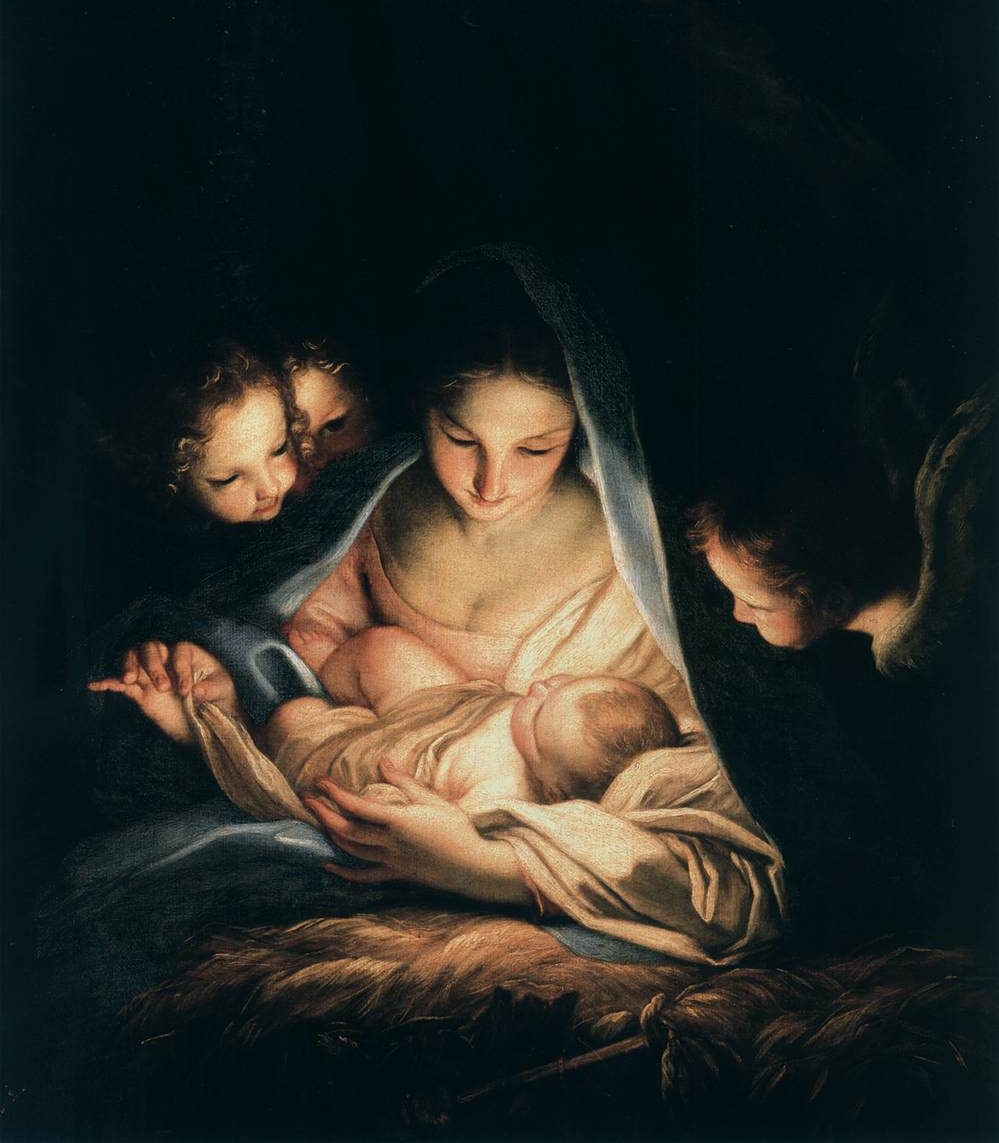
Why all this blood, why this martyrdom? It is almost as though the red poinsettias that we put out in festive Christmas spirit look back to us in testimony. For it is clear that Jesus came to this world, ultimately to die. His crib (likely of wood) in which he was laid, arms and feet bound by swaddling clothes, points inevitably to the wood of his cross where, once again, his arms and legs were bound by nails and, after dying, he was wrapped tightly in a linen shroud.
The blood of the Christmas octave also reminds us that many of us too will share in Christ’s lot. This world hated Christ and had “no room for him.” Neither does this world have room for true Christians and the blood of martyrs stretches down through the centuries in testimony to the world’s hatred for authentic disciples of Christ and the truth they propose.
From this bloody octave the words of Christ ring out: If you belonged to the world, it would love you as its own. As it is, you do not belong to the world, but I have chosen you out of the world. That is why the world hates you (Jn 15:19). The martyrs of the Christmas Octave say, Amen.
And even St. John the Apostle, whose feast also occurs in the Octave (Dec 27), also says Amen. For, though he did not suffer martyrdom he proclaimed his Amen also from his prison cell on Patmos: I, John, your brother and companion in the suffering and kingdom and patient endurance that are ours in Jesus, was on the island of Patmos because of the word of God and the testimony of Jesus (Rev 1:9).
Victory – But all these martyrs and sufferers (St. Stephen, St. John, the Holy Innocents, St. Thomas Becket, and St Wenceslaus) proclaim too the victory that is theirs with Jesus Christ who also said, In the world ye shall have tribulation: but be of good cheer; I have overcome the world (Jn 16:33). And again, Do not be afraid of what you are about to suffer. I tell you, the devil will put some of you in prison to test you, and you will suffer persecution for ten days. Be faithful, even to the point of death, and I will give you life as your victor’s crown. (Rev 2:10) Yes, Lord, the Spirit and the Bride say, Amen.
Did I wish you a merry Christmas?
The fourth verse of this carol says,
Myrrh is mine; its bitter perfume Breathes a life of gathering gloom;— Sorrowing, sighing, Bleeding, dying, Sealed in the stone-cold tomb.
O Holy night! Yes, a silent night! And it came upon a midnight clear! Christmas, it would seem, is a festival of the middle of the night. Jesus is born when it is dark, dark midnight. We are sure of it. And why shouldn’t we be?
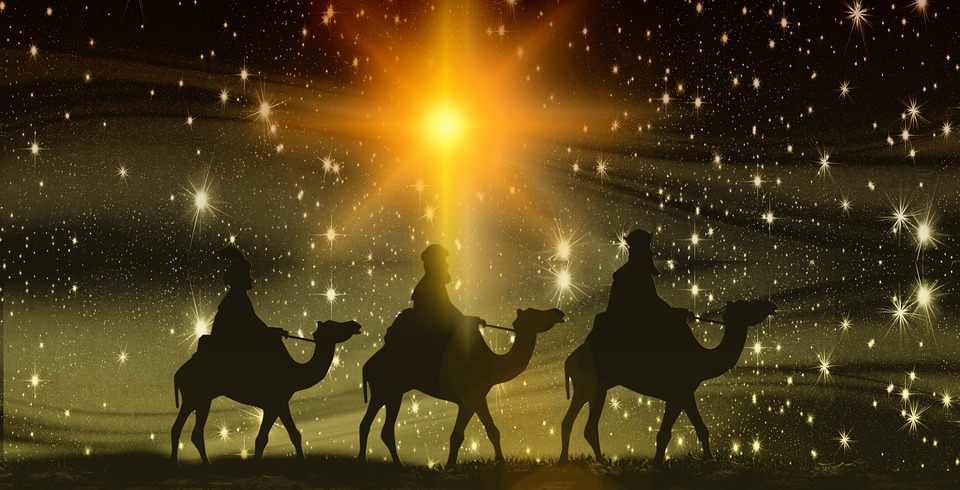
Even though we are not told the exact hour of His birth, we are sure it must have been at night. Scripture does say that the Shepherds who heard the glad tidings were keeping watch over their flock “by night” (cf Luke 2:9). Further, the Magi sought Him by the light of a star, and stars are seen at night, deep midnight. None of this is evidence that Jesus was born at 12:00 midnight but it sets our clocks for night, deep midnight.
Add to this the fact that Christmas is celebrated at the winter solstice, the very darkest time of the year in the northern hemisphere. More specifically, Christmas comes when light is just beginning its subtle return. The darkest and shortest days of the year occur around December 21st and 22nd. But by December 23rd and 24th we notice a definite but subtle trend: the days are getting longer; the light is returning! It’s time to celebrate the return of the light. It’s going to be all right!
How fitting it is to celebrate the birth of Jesus, the true Light of the World, in deep and dark December. Jesus our light kindles a fire that never dies away. Indeed, in the dark hours of December, we notice a trend: the light is returning; the darkness is abating; the days are beginning to grow longer. It is subtle right now, but it will grow. And with the return of light, we celebrate our True Light: Jesus.
But light is best appreciated in contrast. We appreciate most the glory of light when the darkness assails us. There’s just something about Christmas Eve. As the time approaches through December and the darkness grows, we light lights. Yes, all through December we light Advent candles, more candles as it grows darker. Even the secular among us string up lights, in malls, on their houses, in their workplace. It’s as if to say, the darkness cannot win; the light conquers!
Lights show their true glory when contrasted with darkness. Who sees the stars in the middle of the day? Who appreciates the full beauty of light until he has experienced darkness? Yes, Christmas is a feast of the light. We confront the darkness of December and declare to it, “Your deepest days are over. The light is returning.” And we of faith say to a world in ever deeper darkness, “Your darkness cannot prevail. It will be overcome and replaced.” For although darkness has its season, it is always conquered by the light.
Some years ago an atheist scoffed at me in the comments of this blog that our day is over; the world has rejected faith. Sorry, dear atheist friend, the light always wins. On December 22nd, the darkness begins to recede and the light begins to return. The light returns subtly at first, but it always does; the darkness cannot last.
Light has a way of simply replacing the darkness. In three months the equinox occurs and in six months the summer solstice, when we have the most light. Then the darkness will once again seek to conquer. But it always loses! The light will return. Jesus is always born at the hour of darkness’ greatest moment. Just when the darkness is celebrating most, its hour is over; the light dawns again.
We celebrate after sundown on December 24th, in accordance with a tradition going back to Jewish times (feasts begin at sundown the night before). Christmas morning is almost an afterthought. Most pastors know that the majority of their people come to Mass the “night before.” In a deep and dark December, a light comes forth. A star shines in the heavens.
We gather together in and on a dark night. We smile. We are moved by the cry of a small infant, by whose voice the heavens were made.
His little cry lights up the night. The darkness must go; the light has come; day is at hand.
We celebrate at night so as to bid farewell to the darkness. It cannot prevail. It is destined to be scattered by a Light far more powerful than it is, a Light it must obey, a Light that overwhelms and replaces it. Farewell to darkness; the Light of the World has come!
Jesus is the Light of the World.
The video below is a celebration of light. As a Christmas gift to myself I took the afternoon of December 22nd (the darkest day of the year) off so that I could photograph the triumph of light over darkness. I went to a mausoleum, a place where thousands are buried in the walls. But also in those walls are windows, glorious windows where light breaks through and Christ shines forth. Some of the most beautiful stained glass in the city of Washington, D.C. resides in that place of death and darkness. The light breaks through and it speaks of Christ.
This video shows only some of those stained glass windows (I am putting together a video of other windows to be shown later). The text of the music in this video is from Taizé, and it says, Christe lux mundi, qui sequitur te, habebit lumen vitae, lumen vitae (Christ, Light of the World, who follows you has the light of life, the light of life).
As you view this video depicting the Life of Christ, ponder that although stained glass begins as opaque sand, when subjected to and purified by fire it radiates the glory of the light which can now shine through it. So it is for us. Born in darkness but purified by Christ and the fire of the Spirit, we begin to radiate His many splendored Light shining through us to a dark world.
Many are shocked to walk into daily Mass on December 26 and instead of hearing more of the “Baby Jesus” we are confronted with Martyrdom, “The Feast of Stephen” is ancient on the Church’s calendar. More ancient than the Christmas cycle and hence it was not removed to another time.
Bu the martyrdom does not stop there. We are in the midst of the Christmas Octave, an Octave filled with blood as we shall see.
What is an Octave? But first, there may be some of you who wonder what is meant by and “Octave.” An Octave is a period of eight days wherein a feast of the Church is celebrated for that whole period as though it were all the same day. In the modern liturgical calendar we only observe two octaves explicitly: Christmas and Easter.
During the week following Christmas many of the prayers speak of each day as though it were still Christmas. For example some of the prayers and antiphons say, “Today is born our savior, Christ the Lord.” A purist might say, but it is NOT today that he is born, it was back on Saturday the 25th that he was born. But, in certain sense this IS still Christmas day. Christmas Day is one long day of eight days from Saturday the 25th to Saturday January 1st.
It is the same with Easter where for one whole week we announce: “This is the day the Lord has made…”
Why eight days? Some say it is a reference to the eighth day on which Christ rose. I know, you thought it was the third day. But it was also the eighth day! For God made the world in seven days, resting on the seventh (Sabbath or Saturday). But Christ rose on the 8th day (Sunday). So resurrection morning is both the third day AND the eighth day! Others say the practice of the octave goes to Jewish times where some of the feasts (e.g. Dedication and Tabernacles (Booths)) were celebrated over 8 days.
In the old calendar there were more Octaves such as: Epiphany, Pentecost, All Saints, Immaculate Conception, Ascension Sacred Heart and others). Not all of these were privileged Octaves in which no other feasts could be celebrated. Easter and Pentecost were really the only two that blocked out all other feasts entirely. Others, like the Christmas Octave, allowed the celebration of other feasts but still referred to the feast of the octave as well.
So here we are in the Christmas Octave and, in a strong sense it is thus still Christmas Day. TODAY is born our savior Christ the Lord. This feast is so important that we stretch its observance a completed week and into the eighth day.
Bloody Octave – But one of the striking things about the Christmas octave is its bloodiness. It is one of the bloodiest weeks of the Church’s years. Thus, on December 26th, when we have hardly digested our Christmas dinner, we celebrate the Feast of St. Stephen, the Martyr who was stoned to death. On December 28th we celebrate the Feast of the Holy Innocents, the young and infant boys who were murdered by Herod seeking to kill Christ. On December 29th we celebrate the feast of St. Thomas Becket who was murdered in Canterbury Cathedral. Even St. (King) Wenceslaus of whom we happily sing “on the Feast of Stephen” was brutally killed by his brother.
Why all this blood, why this martyrdom? It is almost as though the red poinsettias that we put out in festive Christmas spirit look back to us in testimony. For it is clear that Jesus came to this world, ultimately to die. His crib (likely of wood) in which he was laid, arms and feet bound by swaddling clothes, points inevitably to the wood of his cross where, once again, his arms and legs were bound by nails and, after dying, he was wrapped tightly in a linen shroud.
The blood of the Christmas octave also reminds us that many of us too will share in Christ’s lot. This world hated Christ and had “no room for him.” Neither does this world have room for true Christians and the blood of martyrs stretches down through the centuries in testimony to the world’s hatred for authentic disciples of Christ and the truth they propose.
From this bloody octave the words of Christ ring out: If you belonged to the world, it would love you as its own. As it is, you do not belong to the world, but I have chosen you out of the world. That is why the world hates you (Jn 15:19). The martyrs of the Christmas Octave say, Amen.
And even St. John the Apostle, whose feast also occurs in the Octave (Dec 27), also says Amen. For, though he did not suffer martyrdom he proclaimed his Amen also from his prison cell on Patmos: I, John, your brother and companion in the suffering and kingdom and patient endurance that are ours in Jesus, was on the island of Patmos because of the word of God and the testimony of Jesus (Rev 1:9).
Victory – But all these martyrs and sufferers (St. Stephen, St. John, the Holy Innocents, St. Thomas Becket, and St Wenceslaus) proclaim too the victory that is theirs with Jesus Christ who also said, In the world ye shall have tribulation: but be of good cheer; I have overcome the world (Jn 16:33). And again, Do not be afraid of what you are about to suffer. I tell you, the devil will put some of you in prison to test you, and you will suffer persecution for ten days. Be faithful, even to the point of death, and I will give you life as your victor’s crown. (Rev 2:10) Yes, Lord, the Spirit and the Bride say, Amen.
Did I wish you a merry Christmas?
The fourth verse of this carol says,
Myrrh is mine; its bitter perfume Breathes a life of gathering gloom;— Sorrowing, sighing, Bleeding, dying, Sealed in the stone-cold tomb.
In these days of nearly instant information availability, we think we know a lot about people, things, and issues. Truth be told, we may know more in a quantitative sense but less in a qualitative sense. Too much information can make us less discerning.
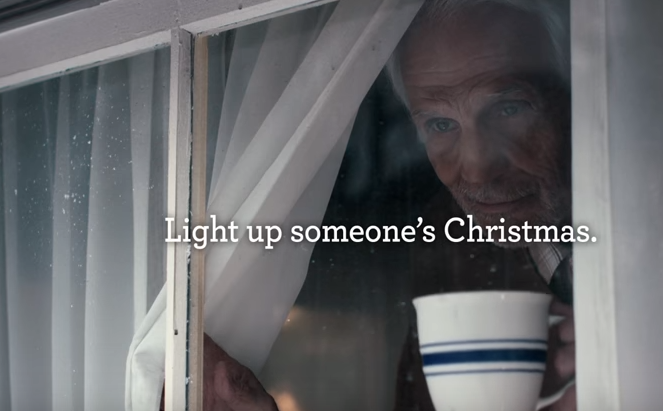
The Christmas commercial below is touching and enlightening at the same time. Basically, it plays off the Scrooge/Grinch theme. The commercial shows a grouchy fellow who is touched and converted by the Christmas kindness of some children. That’s the obvious message.
But I wonder if there isn’t another way to see this commercial. Perhaps it is the children (and we whom they represent) who need to add some depth to their perception of the man. He does come across as lonely and rather private, but that doesn’t necessarily mean he’s a grouch or that he should be feared. Perhaps he’s just shy. Maybe his wife died recently. Perhaps his age has limited him.
At any rate, the man returns the kind gesture of the children, multiplied. And while this might mean that he experienced a miraculous conversion, it more likely means that he wasn’t really as grumpy and cold as they thought.
A while back, someone wrote to me saying that in my writing I come across as grouchy and generally displeased with things. The person continued on to say that hearing the sound of my voice and my laughter on the radio revealed another side of me, such that my writings no longer seem so severe.
Well praise the Lord! We can’t avoid perceptions, but we do well to consider them provisional until we have more information. To seem is not to be.
Who is your neighbor? This isn’t really a request for a list of names; it’s an invitation to ponder more deeply who our neighbor really is.
The Christmas Gospel from Luke provides us with many teachings. One thing that surely stands out, however, is the permeating theme of humility. Throughout the account, God confounds our prideful expectations and insists on being found in the lowest of places.
The newborn Christ is not found where we expect Him to be nor does His birth conform to any script we would design. Right from the start, He gives us many lessons in humility and begins His saving work of healing our wound of pride. Let’s look at these lessons in four stages.
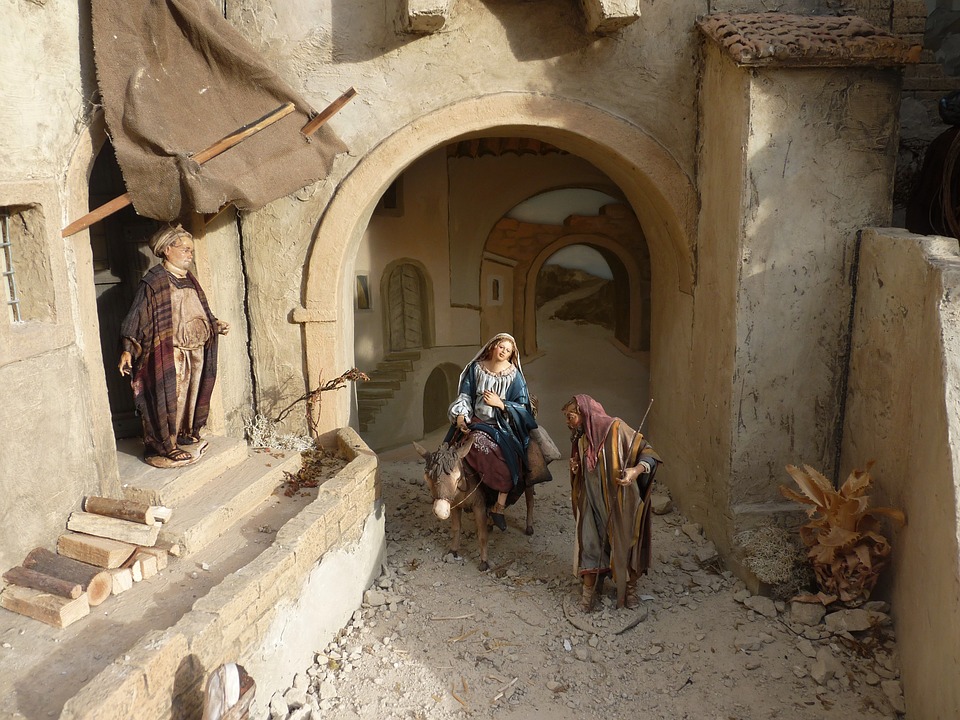
I. The Procession to the Place – In those days, a decree went out from Caesar Augustus that the whole world should be enrolled. This was the first enrollment, when Quirinius was governor of Syria. So, all went to be enrolled, each to his own town. And Joseph too went up from Galilee from the town of Nazareth to Judea, to the city of David that is called Bethlehem, because he was of the house and family of David, to be enrolled with Mary, his betrothed, who was with child.
There is a sort of “cast of thousands” that leads Mary, Joseph, and Jesus to be in Bethlehem. The distant Caesar Augustus sends out a decree affecting millions. He wants a census taken in order to update his tax rolls. He also likely wants to measure his power and may have military deployments and a draft in mind. Soon enough, dozens of governors deploy thousands of troops to enforce the edict. Even in the small town of Nazareth, a town of barely 300 people, Roman troops enforce the decree. Mary is nine months pregnant, but there will be no exceptions.
For many of us, this offends our sense of what should justly happen. Jesus, who is Lord and Savior, should be born in comfort; Mary should be surrounded by loving family and in the care of midwives.
The first lesson in humility is our surprise and even indignation at the events surrounding Jesus’ birth.
God, however, is neither surprised nor stymied. All this fits into His plan to get Jesus, Mary, Joseph, and all of us to the place of blessing. Whatever evil the Emperor intends, God intends it for good (see Genesis 50:20). The Messiah, it was prophesied, would be called a Nazarene (Matt 2:23), be born in Bethlehem (Micah 5:2), and die in Jerusalem (Lk 13:33). God is setting things in place for the blessing.
And here is the second lesson in humility: Your life is not just about you. You and I are part of something far larger. Just as millions were set on the move at the birth of Christ, so you and I are part of the larger plan and providence of God involving billions of people now living, countless others who have lived, and still others who will live in the future. God sees the bigger picture, yet not one detail is lost to Him. Humility! God has more in mind than our comfort and personal agendas. We are part of something bigger as well.
The third lesson in humility is that God must get us to certain places in order to bless us. And they may be strange places, ones we would not choose. Getting us there may involve hardship for us: disappointment that our own plans have not come through, and the painful loss of places, things, and people we love. Yes, God has blessings waiting for us in strange places, involving circumstances we never imagined.
For Joseph and Mary, the procession to the place called Bethlehem involved hardship. But this procession is necessary for them and for us. Bethlehem was where the blessing would be found—there and no other place. And the same is true for us in so many ways.
God has been good to me and blessed me in ways and in places I never expected or planned. God must get us to certain places in order to bless us. I am and have been blessed; I am a witness.
Don’t miss the procession to the place that opens this Gospel. It is a paradigm for our lives. Where is your Bethlehem? Where does God need to get you in order to unlock your blessings? Are you humble and teachable enough to go there?
Remain humble and don’t quickly despair when the surprises and vicissitudes of life emerge. God may be up to something. He can make a way out of no way and write straight with crooked lines.
II. The Paradox of His Poverty – While they were there, the time came for her to have her child, and she gave birth to her firstborn son. She wrapped him in swaddling clothes and laid him in a manger, because there was no room for them in the inn.
Don’t miss the poverty that is manifest here—it is a chosen poverty. St. John Chrysostom said,
Surely if [the Lord] had so willed it, He might have come moving the heavens, making the earth to shake, and shooting forth His thunderbolts; but such was not the way of His going forth; His desire was not to destroy, but to save… And, to trample upon human pride from its very birth, therefore He is not only man, but a poor man, and has chosen a poor mother, who had not even a cradle where she might lay her new born Child; as it follows, and she laid him in the manger (Quoted in the Catena Aurea – Lection 2 ad Luc 2:6).
The paradox of poverty is the fourth lesson in humility! We who are worldly think that poverty is the worst thing, but it is not—pride is the worst thing. And thus the Lord teaches us from the start that greatness and blessings are not found merely in what is high, mighty, pleasant, or pleasing. Blessings are often found in unusual ways and under unexpected circumstances.
The greatest blessing ever bestowed is not found in a palace, or in Bloomindales, or on beachfront property; He is not even found in a cheap Bethlehem inn. He is found in a lowly manger underneath an inn. It is poor and smelly and He rests in a feeding trough. But there He is, in the least expected place, the lowest imaginable circumstances. In this way He confounds our pride and our values.
Are we humble enough to admit this and to stop being so resentful and crestfallen when things don’t measure up exactly to our standards?
He chooses this poverty. Whatever its unpleasant realities, poverty brings a sort of freedom if it is embraced. The poor have less to lose and thus the world has less of a hold on them. What does a poor man have to lose by leaving everything and following Jesus? Wealth has many spiritual risks. It is hard for the rich to inherit the Kingdom of Heaven. Wealth is too easily distracting and enslaving. And even knowing all this, we still want it. In choosing poverty, Jesus confounds our pride, greed, lust, and gluttony.
The Lord does not just confound us; He also chooses this to bless us. St. Paul said,
For you know the grace of our Lord Jesus Christ, that though he was rich, yet for your sake he became poor, so that by his poverty you might become rich (2 Cor 8:9).
He also said,
Christ Jesus, though he was in the form of God, did not count equality with God a thing to be clung to, but emptied himself, taking the form of a servant, being born in the likeness of men. And being found in human form he humbled himself and became obedient unto death, even death on a cross (Phil 2:5).
Bede, the 7th century Church Father, wrote,
He who sits at His Father’s right hand, finds no room in an inn, that He might prepare for us in His Father’s house many mansions; He is born not in His Father’s house, but [under] an inn and by the way side, because through the mystery of the incarnation He was made the way [for us back to our Father’s House] [Catena, Ibidem].
Thank you, Jesus, for the paradoxical perfection of your poverty. Through it you confound our human ways and bless us more richly than we could ever expect! Thank for this lesson in humility.
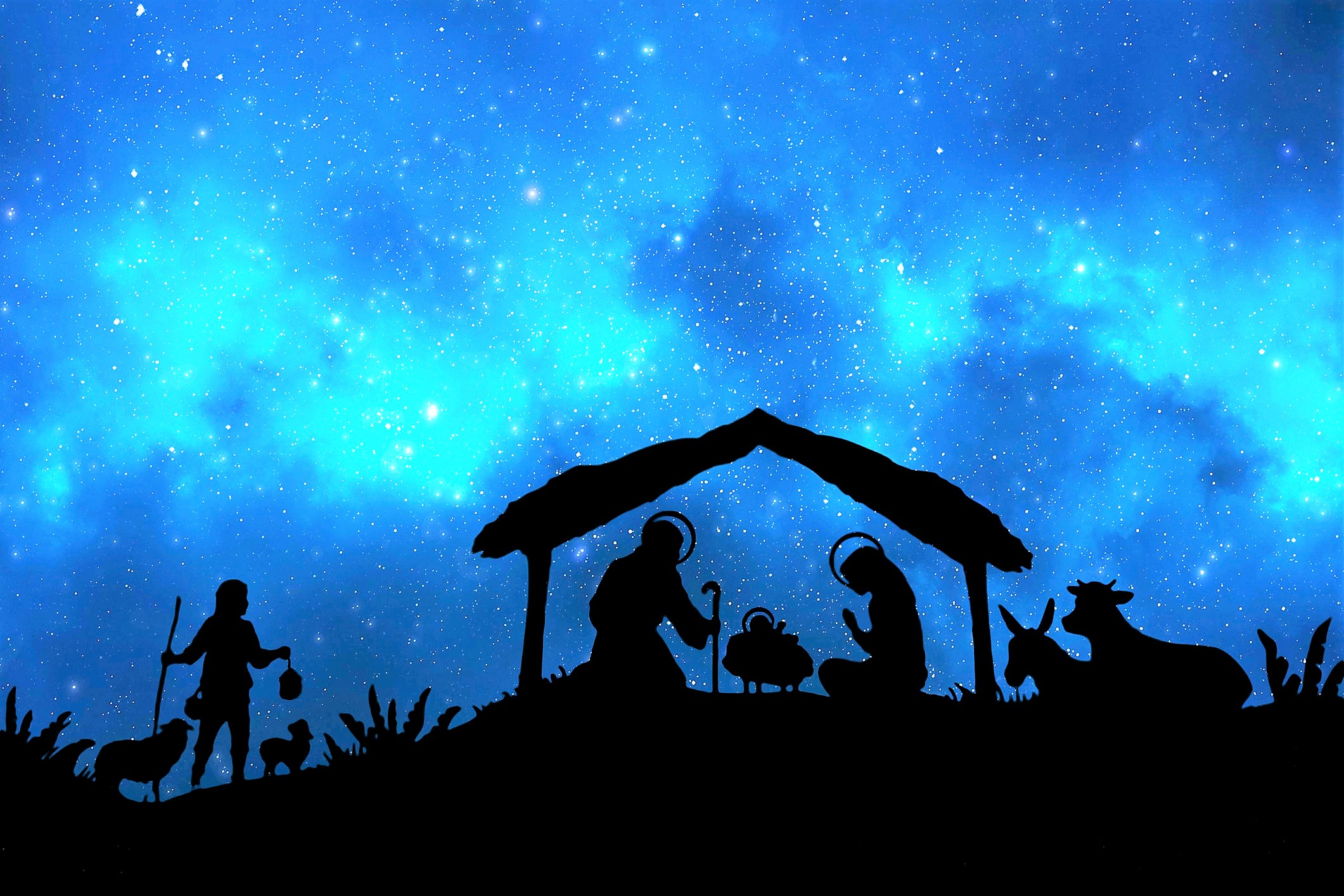
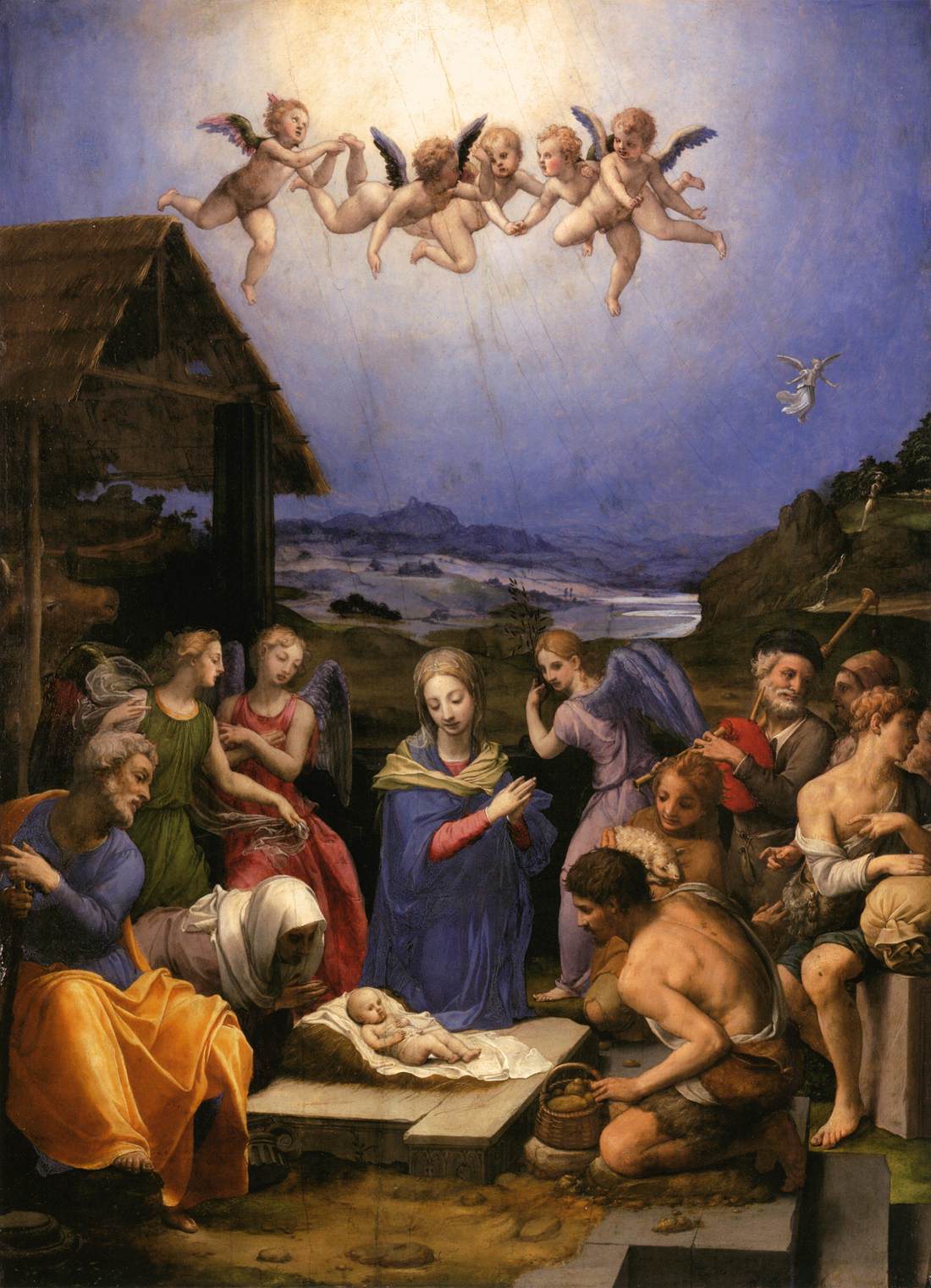
III. Proclamation to the People –Now there were shepherds in that region living in the fields and keeping the night watch over their flock. The angel of the Lord appeared to them and the glory of the Lord shone around them, and they were struck with great fear. The angel said to them, “Do not be afraid; for behold, I proclaim to you good news of great joy that will be for all the people. For today in the city of David a savior has been born for you who is Christ and Lord. And this will be a sign for you: you will find an infant wrapped in swaddling clothes and lying in a manger.”
The fifth lesson in humility throws into question our overemphasis on politics and worldly power. This section of the nativity narrative serves to strongly remind us that our salvation is not to be found in the statehouse, the courthouse, or the White House. We are not to put our trust in princes. Our salvation is in Jesus, only in Jesus. Are we humble enough to admit this and stop exalting worldly power?
Note that in this Gospel, lots of “emperor words” are used to describe this newborn infant, Jesus. Yet here He is in a lowly manger!
Emperors had heralds that preceded their arrival and summoned their subjects. The infant Jesus has the angel of the Lord to announce Him. Later, this heralding angel will be joined by a “host” of angels. The Emperor Augustus has his Legions, but Jesus has His myriad angels.
The angel also uses words appropriate for an emperor. He says, “I proclaim to you good news of great joy that will be for all the people.” This is how the declarations of emperors began. The Greek text makes this even clearer: the angel uses the word εὐαγγελίζομαι (evaggelizomai), which means “I evangelize you,” “I announce good or life changing news.” This word for “evangelize” was associated especially with an edict or announcement from the Emperor. But what the emperors questionably claimed for their edicts is really true with Jesus!
The emperors also claimed the titles “savior” and “lord.” The angel calls Jesus Savior (σωτὴρ – Soter) and Lord (κύριος – Kyrios), and He alone deserves these titles.
Here is the irony that we must humbly accept: this true Lord and Savior, this God of Armies with plenary authority, is not in some palace drinking from goblets and being fanned by slaves. He is lying in a lowly feed box, attended to by animals.
It is a divine comedy. One can almost imagine the shepherds wrinkling their noses or scratching their heads as they hear this great announcement of a King, Savior, Lord and Messiah, and then hearing that He is to be found in a stable, lying in a feeding trough. Perhaps one shepherd said to the other, “Did that angel say ‘manger’?” And another replying, “Yup, a feeding trough.”
It’s a bit anticlimactic! But thank the Lord, they humbly accept the procession that they must now make to the place of true blessing. It is an unexpected place to be sure, but that is where He is to be found. He is King and Lord to be sure, but He is humble and comes to serve and to save. He will wash the feet of the worst sinners and die for the love of them.
Humility!
IV. Praise that is Perfect–And suddenly there was a multitude of the heavenly host with the angel, praising God and saying: “Glory to God in the highest and on earth peace to those on whom his favor rests.”
Note the praises of the angels! Who or what could ever match them? They are a multitude. They are perfected in their glory and acclaim God’s praises more gloriously than any human choir could ever hope to do.
Yet even here there is a humility to consider. For the Lord has taken a human nature to Himself, not an angelic one. In the order of creation, angels are far higher and more noble than we are. Their mere appearance overwhelms us and strikes fear in us. Yet to none of these did God ever say, “You are my Son. This day I have begotten you” (See Hebrews 1:5).
God humbly takes up our human nature and bestows on us an astonishing dignity that comes only from Him. It is due to His choice, not our merits. And though the angels can surely praise the Lord in far more glorious way than we, they cannot say, “One of us is God.”
And glorious though the angel’s praise is, there is a perfect praise that only we can give to God. It was beautifully expressed by the poet Christina Rossetti:
Angels and Archangels may have gathered there. Cherubim and Seraphim thronged the air. But only his mother in her maiden bliss could worship the beloved with a kiss.
And thus, our final lesson in humility is to accept that it is our lowliness which the Lord embraced. We have no glory to give that is even close to what the Lord deserves, but a simple kiss will do, a simple act of love. It is our lowly and sinful hearts that the Lord seeks, so as to heal and exalt them. Our palaces, honors, and titles are of no interest or value to Him. It is our humility that pleases Him most, and He desires to meet us there.
This feast day of January 1st is a very complex tapestry, both culturally and liturgically. Perhaps we can use the second reading by St. Paul to the Galatians as a way to weave through some of the many details. We can look at it in three parts.
The chronology of our celebration – The text from St. Paul’s letter to the Galatians says, When the fullness of time had come …
Most people in the wider culture and in the Church are going about today saying, “Happy New Year!” And rightfully so, for it is the beginning of the new year. But most people think of New Year’s Day in almost wholly secular terms. Sadly, it is best known for excessive drinking and rather loud parties.
Yet it is a mistake to see New Year’s Day simply as a secular holiday. St. Paul reminds us, in speaking of “the fullness of time,” that all time and all ages belong to God.
It is not simply 2020; it is 2020 Anno Domini (A.D.). Even the most secular and unbelieving of people in the Western world locate their place in time in relation to Jesus Christ. It is 2020 years since the birth of Christ. Every time we write the date on a check or at the top of the letter, every time we see the date at the top of the newspaper or on our computer screen, that number, 2020, points back to Christ. He is the Lord of history. Jesus sets the date; He is the clock we go by. All time belongs to Him.
Jesus says in the book of Revelation,I am the Alpha and the Omega, the first and the last, The beginning and the end. He who is, and who was, and who is to come (Revelation 22:13).
If it is true that 2020 references the birth of Christ, the question arises as to why Christmas Day is not also New Year’s Day. But this actually fits in well to liturgical and spiritual sensibilities.
In the Church, and stretching back into Jewish times, it was customary to celebrate the high feasts of faith over the period of a week. In Christian tradition this came to be known as the “octave.” Although we think of a week as comprising seven days, consider that we celebrated Christmas this past Wednesday and this week we celebrate New Year’s Day on Wednesday; Wednesday to Wednesday, inclusive, is eight days.
Wednesday, January 1, 2020 is the eighth day of Christmas. In the Christian tradition the octave is considered really as one long day that lasts eight days. Therefore, Wednesday, January 1, 2020, completes Christmas day; Christmas day is fulfilled. Or as St. Paul says, the “fullness of time” in terms of Christmas day has come. And thus the calendars flip from one year to the next. Now, at the end of Christmas day, our calendars go from 2019 to 2020 A.D.
The rest of the secular world has largely moved on already, barely thinking of Christmas anymore. As I walk in my neighborhood, I see the strange spectacle of Christmas trees already set out at the curb waiting to be picked up by the recycling trucks. Yes, for many in our hurried world, Christmas is over. But we in the Church continue to celebrate the great Christmas feast and cycle. Having completed the octave, we move on to Epiphany week.
Thus, this New Year, we contemplate the “fullness of time.” The passage of another year reminds us of the magnificent truth that to God all time, past, present, and future, is equally present. He holds all things together in Himself. He is the same yesterday, today, tomorrow, and forever. And whenever He acts, He always acts in our time, out of the fullness of time. This is a very deep mystery and we should ponder in silence the mystery that for God, all things are. He is not waiting for things to happen. For Him, everything is accomplished. I will write more on this in tomorrow’s blog.
The content of our celebration – St. Paul goes on to say, God sent forth his son born of a woman. And with this statement we are again reminded that we are still in the Christmas cycle.
We’ve already discussed the concept of the eighth day, of the octave. And while it is New Year’s Day, there is also a complex tapestry of religious meanings to this day as well.
As we’ve already seen, it is still Christmas day, the eighth day of the one long day that we call Christmas Day.
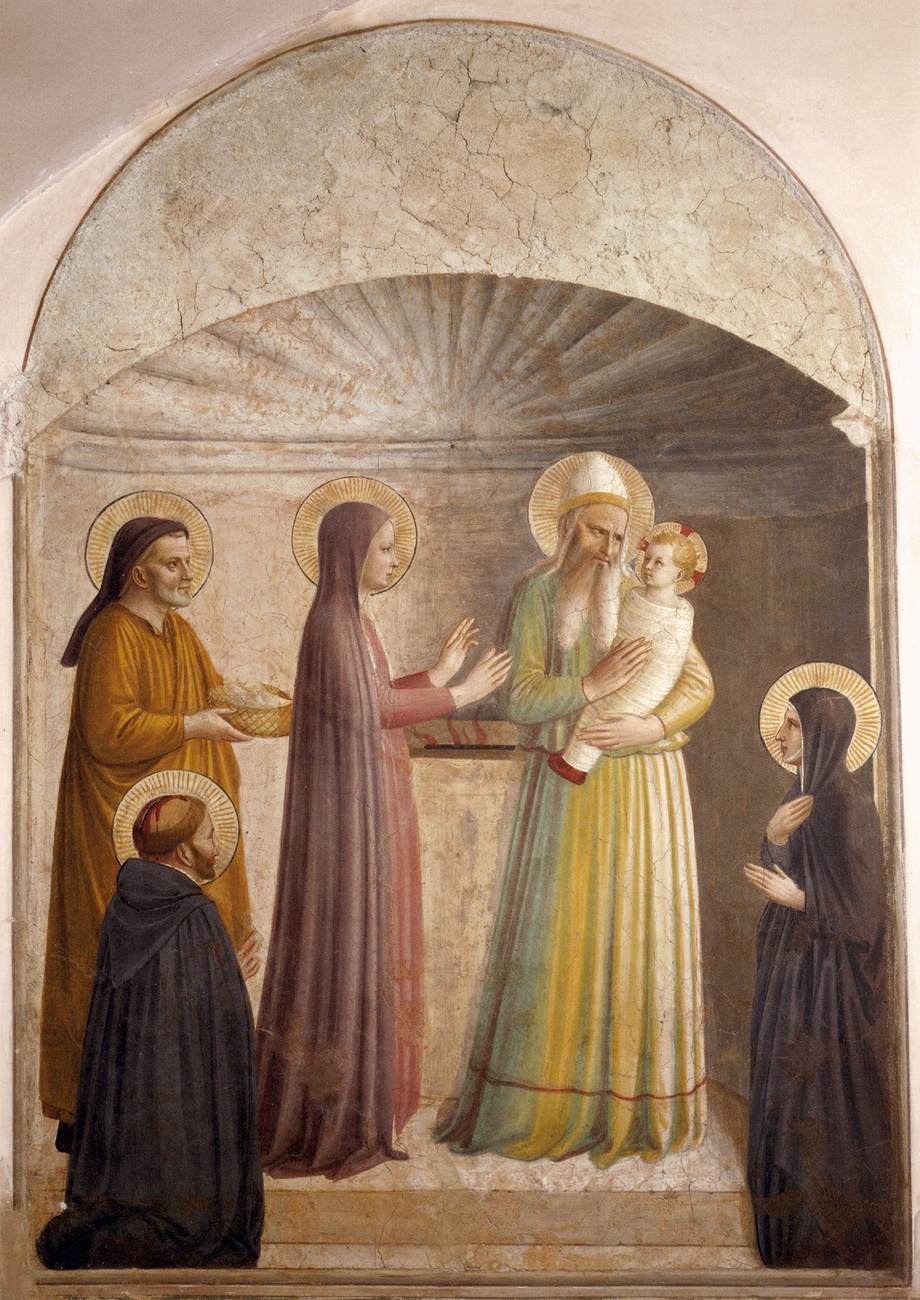
Historically, this is also the day of Christ’s circumcision.And for a long period in Church history that was the name given to this feast day, “The Circumcision of the Lord.” As I have written previously, I personally regret the loss of this feast, at least in terms of its title.
This is the day when Joseph and Mary brought Christ to be circumcised. In this, Jesus as man and also as God reverences the covenant He has made with His people. It is a beautiful truth that God seeks relationship with His people. And in this covenantal act of the circumcision is the moving truth that, as the Letter to the Hebrews puts it, Jesus is not ashamed to call us His brothers (Heb 2:11).
There is here the first shedding of blood by Jesus. It is also a sign of His love for us.
Another truth about the content of this feast is the Holy Name of Jesus. For not only was a Jewish boy circumcised on the eighth day, but he was also given his name, and all hear that name for the first time.
The name, Jesus, means “God saves.” And indeed this most Holy Name of Jesus, when used in reverence, has saving power. We are baptized in His Holy Name along with that of the Father and the Holy Spirit. And all of our prayers conclude with His Holy Name. Scripture says of His great and holy name,
Therefore God exalted him to the highest place and gave him the name that is above every name, that at the name of Jesus every knee should bow, in heaven and on earth and under the earth, and every tongue acknowledge that Jesus Christ is Lord, to the glory of God the Father (Phil 2: 9-11).
And yet another identity and content of this feast day is shown in its current, formal title, “The Solemnity of Mary Mother of God.” This title replaced the title of the Feast of the Circumcision back in 1970. However, it is the most ancient title for this feast day. Again, you can read more on this issue in a previous blog post.
We note in the reading that Paul says that God sent forth his Son, born of a woman. Jesus is the eternal Son of the Father; He is God from God, Light from Light, True God from True God. Jesus is God, and since Mary gives birth to Jesus, Mary is the Mother of God, because Jesus is not two different persons.
Mary did not just give birth to part of Jesus, she gives birth to Jesus. And thus the title “Mother of God” speaks to us as much about Jesus as it does about Mary. It is a title that she has because of the Church’s insistence that Jesus cannot be divided up into two different people. We cannot say that Mary gives birth to one Jesus but not “the other one.” There is only one Jesus, though He has two natures, human and divine.
And thus, on this feast of Christmas, on this eighth day of Christmas, we are reminded and solemnly taught that Jesus is human and also divine. In taking a human nature to Himself from his mother Mary, He remains one person. God has sent forth his son born of woman.
The consolation of our celebration – St. Paul goes on to say, Born under the law to ransom those under the law so that we might receive adoption as sons. As proof that you are sons, God sent the Spirit of his Son in our hearts crying out Abba, Father! So you are no longer a slave, but a son, and, if a son, also an heir through God.
Note three things about this text:
Our Adoption – We have already noted that on the eighth day Jesus is circumcised and enters into the Covenant, into the Law. In the Incarnation He joins the human family; in the Covenant He joins our family of faith. He will fulfill the old Covenant and inaugurate the new one. And by this New Covenant, by baptism into Him, we become members of His Body and thereby become adopted as sons.
We become sons in the Son. When God the Father looks to His Son, loving His Son, he is also looking at us and loving us, for we are in Christ Jesus, members of His Body through baptism. God is now our Father, not in some allegorical sense, but in a very real sense. We are in Jesus and therefore God really is our Father.
Our Acclamation – St. Paul says that the proof of our sonship is the movement of the Holy Spirit in us that cries out Abba! In Aramaic and Hebrew, Abba is the family term for father. It is not baby talk, like “Dada.” But just as most adults called their father “Dad” or some other endearment rather than “father,” so it is that Abba is the family term for father. It would be a daring thing for us to call God “Dad” unless we were permitted to do so, and instructed to do so by Christ.
St. Paul speaks of this word as proof that we are sons. In so doing, he emphasizes that it is not merely the saying of the word that he refers to. Even a parrot can be taught to say the word. Rather, St. Paul is referring to what the word represents: an inner movement of the Holy Spirit wherein we experience a deep affection for God the Father. By our adoption, our baptism into Christ, by our reception of the Holy Spirit, we love the Father! We develop a deep affection for Him and dread offending Him. By this gift of the Spirit, God is my Father whom I deeply love!
Our advancement – Notice that St. Paul then speaks of how we have moved from being a slave to being a son, an heir. In Jesus, we are not just any son, we are the only Son of the Father. And as Jesus has a kingdom from His Father, we too inherit it with Him! As sons in the Son, we are heirs with Jesus to the Kingdom! Jesus speaks of His disciples as one day reigning with Him: And I confer on you a kingdom, just as my Father conferred one on me (Lk 22:29). In Jesus, all Heaven will be ours and we will reign with Christ forever. This is not our doing, not our glory; it is Christ’s doing and His glory in which we share.
And thus we have a very rich tapestry on this New Year’s Day, this feast of the Octave of Christmas, this Feast of the Circumcision of the Lord, this Feast of the Holy Name of Jesus, this Feast of Mary the Mother of God. And also we are given this feast wherein the glory of Christ is held before us and we who are members of His body are told of the gifts that we receive by His Holy Incarnation and His Passion, Death, and Resurrection.
It’s not a bad way to start the new year: reminded of God’s incredible love for us, of His rich blessings and promises.
Something at Christmas urges me (a man of many words) to write of holy silence. Perhaps it is due to one of the great Christmas antiphons, which speaks of the birth of Christ as a magnum mysterium (a great mystery). During Mass recently, the words of Zechariah came to mind:
Sing and rejoice, O daughter of Zion, for behold, I come and I will dwell in your midst, declares the Lord … Be silent, all flesh, before the Lord, for he has roused himself from his holy dwelling (Zechariah 2:11, 13).
There is a common idiom: “Words fail me.” It is in this context that we can best understand God’s call to fall silent before the mystery of the Lord’s incarnation. Notice in the passage above that the call to silence follows the call to “sing and rejoice.”
Is there a difference between singing and rejoice and just plain speaking? Of course there is! By adding the inscrutable sighs we call “song” (a deeply mysterious emanation from our souls) to the words, singing is declaring that “words fail.”
To be sure, words are a “necessary evil” for us, but in using words we indicate more what a thing isnot than what it is. For example, if I say to you, “I am a man,” I have really told you more what I am not than what I am. I have told you I am not a woman nor a chair nor a lion nor a rock. But I have not told what it means to be a man. I have not told you myriad other things about myself that I could: I am a priest; my father was a lawyer and Navy veteran; my mother was a teacher; I am descended from Irish, German, and English immigrants. I have not told you about my gifts or my talents or my struggles or numerous other aspects that make me who I am. And even if I spent several paragraphs relating my curriculum vitae to you, there would still be vastly more left unsaid than was said. Words fail.
Further, words are not the reality they (often poorly) attempt to convey. They are symbols of what they indicate. If you see a sign, “Washington” you don’t stop there and take a picture of the sign. The sign itself is not Washington; it merely points to the reality that is Washington. You pass the sign and enter into a reality far bigger than the metal sign and begin to experience it. Words fail.
Many words are also more unlike the reality they describe than like it. My philosophy teacher once asked us how we would describe the color green to a man born blind. We struggled with the task but were able to come up with some analogies: green is like the taste of cool mint; green is like the feel of dew-covered grass. To some extent green is like these things, but the color green is more unlike these things than like them. Green, as a reality, is so much richer than the taste of cool mint or the feel of dew-covered grass. Words fail.
And if this be so in the case of mere earthly things, how much more so in the case of heavenly and Godly matters! The Lord, therefore, commands a holy silence of us as a kind of reminder that words fail. Silence is proper reverence for the mystery of the incarnation and of God. Words are necessary; without them, orthodoxy could not be set forth, and truth could not be conveyed. But, especially regarding God and the truths of faith, there comes this salutary reminder from St. Thomas Aquinas: Now, because we cannot know what it God is, but rather what he is not, we have no means for considering how God is, but rather how he is not (Prima pars, q. 3, prologue).
Therefore, fellow Catholics, as the mysteries of the incarnation unfold for us liturgically, Let all mortal flesh keep silence, and with fear and trembling stand, Christ our God to earth descendeth, bearing blessings in his hand (from the hymn, “Let All Mortal Flesh Keep Silence”).
O Holy night! Yes, a silent night! And it came upon a midnight clear! Christmas, it would seem, is a festival of the middle of the night. Jesus is born when it is dark, dark midnight. We are sure of it. And why shouldn’t we be?
Even though we are not told the exact hour of His birth, we are sure it must have been at night. Scripture does say that the Shepherds who heard the glad tidings were keeping watch over their flock “by night” (cf Luke 2:9). Further, the Magi sought Him by the light of a star, and stars are seen at night, deep midnight. None of this is evidence that Jesus was born at 12:00 midnight but it sets our clocks for night, deep midnight.
Add to this the fact that Christmas is celebrated at the winter solstice, the very darkest time of the year in the northern hemisphere. More specifically, Christmas comes when light is just beginning its subtle return. The darkest and shortest days of the year occur around December 21st and 22nd. But by December 23rd and 24th we notice a definite but subtle trend: the days are getting longer; the light is returning! It’s time to celebrate the return of the light. It’s going to be all right!
How fitting it is to celebrate the birth of Jesus, the true Light of the World, in deep and dark December. Jesus our light kindles a fire that never dies away. Indeed, in the dark hours of December, we notice a trend: the light is returning; the darkness is abating; the days are beginning to grow longer. It is subtle right now, but it will grow. And with the return of light, we celebrate our True Light: Jesus.
But light is best appreciated in contrast. We appreciate most the glory of light when the darkness assails us. There’s just something about Christmas Eve. As the time approaches through December and the darkness grows, we light lights. Yes, all through December we light Advent candles, more candles as it grows darker. Even the secular among us string up lights, in malls, on their houses, in their workplace. It’s as if to say, the darkness cannot win; the light conquers!
Lights show their true glory when contrasted with darkness. Who sees the stars in the middle of the day? Who appreciates the full beauty of light until he has experienced darkness? Yes, Christmas is a feast of the light. We confront the darkness of December and declare to it, “Your deepest days are over. The light is returning.” And we of faith say to a world in ever deeper darkness, “Your darkness cannot prevail. It will be overcome and replaced.” For although darkness has its season, it is always conquered by the light.
An atheist recently scoffed at me in the comments of this blog that our day is over; the world has rejected faith. Sorry, dear atheist friend, the light always wins. On December 22nd, the darkness begins to recede and the light begins to return. The light returns subtly at first, but it always does; the darkness cannot last.
Light has a way of simply replacing the darkness. In three months the equinox occurs and in six months the summer solstice, when we have the most light. Then the darkness will once again seek to conquer. But it always loses! The light will return. Jesus is always born at the hour of darkness’ greatest moment. Just when the darkness is celebrating most, its hour is over; the light dawns again.
We celebrate after sundown on December 24th, in accordance with a tradition going back to Jewish times (feasts begin at sundown the night before). Christmas morning is almost an afterthought. Most pastors know that the majority of their people come to Mass the “night before.” In a deep and dark December, a light comes forth. A star shines in the heavens.
We gather together in and on a dark night. We smile. We are moved by the cry of a small infant, by whose voice the heavens were made.
His little cry lights up the night. The darkness must go; the light has come; day is at hand.
We celebrate at night so as to bid farewell to the darkness. It cannot prevail. It is destined to be scattered by a Light far more powerful than it is, a Light it must obey, a Light that overwhelms and replaces it. Farewell to darkness; the Light of the World has come!
Jesus is the Light of the World.
The video below is a celebration of light. As a Christmas gift to myself I took the afternoon of December 22nd (the darkest day of the year) off so that I could photograph the triumph of light over darkness. I went to a mausoleum, a place where thousands are buried in the walls. But also in those walls are windows, glorious windows where light breaks through and Christ shines forth. Some of the most beautiful stained glass in the city of Washington, D.C. resides in that place of death and darkness. The light breaks through and it speaks of Christ.
This video shows only some of those stained glass windows (I am putting together a video of other windows to be shown later). The text of the music in this video is from Taizé, and it says, Christe lux mundi, qui sequitur te, habebit lumen vitae, lumen vitae (Christ, Light of the World, who follows you has the light of life, the light of life).
As you view this video depicting the Life of Christ, ponder that although stained glass begins as opaque sand, when subjected to and purified by fire it radiates the glory of the light which can now shine through it. So it is for us. Born in darkness but purified by Christ and the fire of the Spirit, we begin to radiate His many splendored Light shining through us to a dark world.