
Vive la différence – Discovering, Accepting and Appreciating that Men and Women are Different

Early in the pages of Scripture God decreed that It is not good for the man to be alone. I will make a suitable helpmate for him (Gen 2:18). And God made woman. Now the fact is that a woman is VERY different from a man. The physical differences are obvious but these physical differences arise from important differences in the soul. It is the soul that is the form of the body and the qualities of the male and female soul give rise to physical differences. I know that this is politically incorrect today, but it is true. It is a common modern error to be dismissive of the profound differences between the sexes. No one can deny the physical differences but they are dismissed as surface only, of no real significance. But the truth is that our bodies are expressions of the faculties of our soul and male and female differences are far more than skin deep.

It remains true that these differences often give rise to tensions in the marriage and the overall relationships between men and women. That men and women perceive differently, think differently, and have different emotional experiences is just a fact and it is always healthy to recognize and  accept reality. Too often in the modern age there has been a tendency to dismiss these deep differences as just archetypes of bygone “sexist” era. But what ends up happening is that an expectation is created that these differences will just go away when we decide to ignore them or pretend they don’t exist. But guess what , they don’t. And thus resentments and anger follow. Too many marriages end in power struggles because neither spouse can accept that it was not good for them to be alone and that God gave them a spouse who, by design, is very different so that they could be challenged and completed.

It is true, Original sin has intensified our pain at the experience of these given differences. The Catechism links the tension surrounding these difference to the Fall of Adam and Eve:

[The] union [of husband and wife] has always been threatened by discord, a spirit of domination, infidelity, jealousy, and conflicts that can escalate into hatred and separation. This disorder can manifest itself more or less acutely, and can be more or less overcome according to the circumstances of cultures, eras, and individuals, but it does seem to have a universal character. According to faith the disorder we notice so painfully does not stem from the nature of man and woman, nor from the nature of their relations, but from sin. As a break with God, the first sin had for its first consequence the rupture of the original communion between man and woman. Their relations were distorted by mutual recriminations;their mutual attraction, the Creator’s own gift, changed into a relationship of domination and lust; and the beautiful vocation of man and woman to be fruitful, multiply, and subdue the earth was burdened by the pain of childbirth and the toil of work. Nevertheless, the order of creation persists, though seriously disturbed. To heal the wounds of sin, man and woman need the help of the grace that God in his infinite mercy never refuses them. Without his help man and woman cannot achieve the union of their lives for which God created them “in the beginning.”  (CCC #s 1606-1608)

In the end, it seems clear that we need to return to an appreciation of the necessity of our differences. Though our differences can be be intensified by sin, it is a fact that God made us different for a reason. These differences help spouses to complete each other. A husband should say, “My wife has some things important to teach me. I am incomplete without her.”  Likewise the wife should be able  to say that her husband has important things to teach her and that he somehow completes her. In this way we move beyond power struggles and what is right and wrong in every case and learn to experience that some tension is good. No tension, no change. God intends many of these differences to change and complete spouses. God calls the very difference humans he has made “suitable” partners.

And humor never hurts. Here is a wonderful and funny comedy routine about the differences between a man’s brain and a woman’s brain. Humor is often the best of medicines to defuse some of the tensions that arise from our differences.  Vive la difference!

(By the way, as with any humor,  stereotypes are used a bit here. But things are usually funny because they ring true. It is also a fact that not every individual man or woman has every trait described here (for example, I don’t have a very big “nothing box”) but enjoy this video for the humorous descriptions of the general situation).
Epiphany’s Endgame: Going Back to Your Country By Another Route

There are so many wonderful details in the Epiphany story that we may lose the essential message which is:  Conversion. Now the Latin word from which we get “conversion” is conversio which means “a turning around.” Hence we see the concluding effect of the Magi’s visit to the Lord is that they “return to their country by another route.”  To authentically encounter the Lord is to experience conversion.  All the elements of this story serve ultimately to lead them to this conversion. Perhaps we can look at the details and stages of how they come to a saving faith and are able to live differently.

  1. CALL – When Jesus was born in Bethlehem of Judea, in the days of King Herod, behold, magi from the east arrived in Jerusalem, saying, “Where is the newborn king of the Jews? We saw his star at its rising and have come to do him homage.”  –  Notice the identity of these individuals, they are Magi and they are from the East. Exactly what Magi are is debated. Perhaps they are wise men, perhaps they are ancient astronomers. We often think of them as Kings though the text does not call them that and Herod it seems would have been far more anxious had they been actual potentates from an Eastern Kingdom. In our imagination we often think of them as Kings since Psalm 72 read in today’s Mass speaks of Kings coming from the East bearing gifts of gold and frankincense. But here is their key identity: they are Gentiles and they have been called. Up to this point in the Christmas story only Jews had found their way to Bethlehem. But now the Gentiles come. This detail cannot be overlooked for it is clear that the gospel is going to go out to all the world. St. Paul rejoices in this fact in today’s second reading as he says: that the Gentiles are coheirs, members of the same body, and co-partners in the promise in Christ Jesus through the gospel.(Eph 3:6) Most of us are not Jewish by ancestry, and hence we ought to rejoice for in the call of these Magi is prefigured our call. God calls them through something in the natural world. In this case a star. God uses something in creation to call out to them. We do well to wonder what is the star that God used to call us? Perhaps it was Scripture but more usually it is someone God has used to reach us, a parent, a family member, a friend, a priest, religious sister, or devoted lay person. Who are the stars in your life by whom God called you? God can even use inanimate creation like he did for these Magi. Perhaps it was a beautiful Church, a painting or a song. By someone or something  God calls.  He puts a star in our sky. These wise men, these Magi,  follow the call of God and begin their journey to Jesus.
  2. CONSTANCY – Upon their arrival in Jerusalem the Magi find a rather confusing and disturbing situation. The reigning King, Herod, knows nothing of the birth of this King. It must have seemed probable that the newborn King would be related to the current King so his surprise may have confused them. But Herod seems more than surprised, he seems threatened. Even more puzzling, he calls religious leaders to further inform him of this King. They open the sacred writings and the Magi hear of a promised King.  Ah so the birth of this king has religious significance!  How interesting. But, these religious leaders seem unenthusiastic of the newborn King and after giving the location of his birth seem to make no effort to follow the Magi. There is no rejoicing, no summoning of the people that a longed for king had finally been born. Not even further inquiry! So the wicked (Herod) are wakeful and the saints are sleepy. How odd this must have seemed to the Magi. Perhaps it occurred to them to suspend their search. After all the actual King knew nothing of this birth and those who did seemed little interested. Ah, but praise the Lord they persevere in their search. They do not give up! Thanks be to God too, that many today have found their way to Christ despite the fact that parents clergy and others who should have led them joyfully to Jesus were either asleep, or ignorant or just plain lazy. I am often amazed at some of the conversion stories I have heard, people who found their way to Christ and his Church despite some pretty discouraging obstacles like poor religious upbringing, scandalous clergy and bad example. God sometimes allows our faith and call to be tested but Those who persevere to the end will be saved (Matt 24:13).
  3. CONFESSION OF FAITHAfter their audience with the king they set out. And behold, the star that they had seen at its rising preceded them,  until it came and stopped over the place where the child was. They were overjoyed at seeing the star,  and on entering the house they saw the child with Mary his mother. They prostrated themselves and did him homage. – With what little information they have they set out and continue to follow the call of God through the star. Notice too that they enter a “house.”  We often think of the Magi as coming that same Christmas night to the cave or stable but it seems not. Mary (Joseph) and Jesus are found now in a house. It would seem that decent lodging has now been found. Has it been days since the birth? Perhaps even longer but we are likely dealing with a different day than Christmas Day. Notice too  that they “prostrate”  themselves before Jesus. The Greek word is προσεκύνησαν (prosekunēsan) which means more literally “to fall down in worship” or “give adoration.”  The verb is used 12 times  in the New Testament and it is clear each time that religious worship is the purpose of the prostration. This is no mere homage to an earthly King this is religious worship. This is a confession of faith. So our Magi have come to faith!  But is it a real faith, or just a perfunctory observance? It’s not enough to answer an altar call, or to get baptized. Faith is never alone. It is a transformative relationship with Jesus Christ. So lets look for the effects of a real and saving faith.
  4. COST – There is a cost to discipleship. The magi are moved to give three symbolic gifts as a result of their faith and they are costly gifts. Gold is a symbol of all our possessions. In laying this gift before Jesus they and we are saying, “I acknowledge that everything I have is yours. I put all my resources and wealth under your authority and will use them only according to your will.” A conversion that has not reached the wallet is not complete. They give the gift of frankincense. This is the gift of worship for in the Bible incense is a symbol of prayer and worship (eg psalm 141). In laying down this gift we promise to pray and worship God all the days of our life. To be in his holy house each Sunday and render him the praise and worship he is due. To listen to his word and to consent to be fed the eucharist by him. To worship him worthily by frequent confession and to praise him at all times. And they give a strange gift of myrrh which is burial ointment. Surely this prefigures Jesus’ death but it also symbolizes our own. In laying this gift before Jesus we are saying, my life is yours. I want to die so that you may live your life in me. May you increase and may I decrease. Use me and my life as you will. So here are gifts that are highly symbolic. The magi have done more than give a little homage to Jesus. They are beginning to show the fruits of saving faith. And if we can give these gifts so too are we.
  5. CONVERSIONAnd having been warned in a dream not to return to Herod, they departed for their country by another way. Here it is, the evidence is in: conversion. They are walking differently now. They are not going home by the same way they came. They’ve changed direction, they’ve turned around (conversio). They are now willing to walk the straight and narrow path that leads to life rather than the wide road that leads to destruction. They are going to obey Christ. They are going to exhibit what St. Paul calls the “obedience of faith” (Rom 1:5; 16:26). They have not just engaged in a possibly perfunctory worship, they are showing signs of a true and saving faith. They are not just calling Jesus “Lord,Lord!” They are doing what he tells them (cf Luke 6:46).

So there it is. Through careful stages the Lord has brought the Gentiles (this means you) to conversion. He has called. They remained constant, confessed him to be Lord, accepted the cost of discipleship and manifested conversion. Have you? Have I? Wise men still seek him. Even wiser ones listen to him and obey. Are we willing to go back to our country by another route? Is on-going conversion part of our journey home to heaven? If Epiphany means “manifestation” how is our faith manifest in our deeds and conversion?

This song says, “It’s a highway to heaven! None can walk up there but the pure in heart. I walking up the King’s Highway. If you’re not walking start while I’m talking. There’ll be a blessing you’ll be possessing, walking up the King’s Highway. “

A Feast that is Missing in Action?

Today (January 1st)  we celebrated  the Solemnity of Mary, Mother of God.  In the past we celebrated the Feast of the Circumcision of the Lord, a Feast that is currently missing in action. We can discuss that in a moment.

But as for the Feast of Mary Mother of God, it is a great opportunity for us to reflect on who Jesus Christ is. Mary is Mother of God because Jesus is God. Some may want to argue that she only gave birth to his human nature and hence is only mother of what is human in him. But Jesus is ONE PERSON with two natures. This is something called in theology the “hypostatic union” and it is an essential teaching of Christ. He unites in one person the human nature and the divine nature. There are not two Jesuses. Neither is it true that his divine nature came upon him at a later time such as his baptism. No, his two natures were united in his one person from the moment of of his human conception. And since Jesus is one, Mary gives birth and is mother to the whole Christ. Mary is Mother of God because Jesus is God. This title was given to Mary at the Council of Ephesus in 431 in defense of Christ’s divinity. The Greek form of this title is Θεοτόκος (Theotokos) translated more literally as “God Bearer.”

Evidence for the celebration of this feast goes back in the Roman Church all the way to the 7th Century. Prior to that there is evidence of this feast being celebrated in other parts of Europe but usually on the Fourth Sunday of Advent. By the 13th and 14th Centuries However the Feast of the Circumcision of the Lord came to replace this feast, and the Feast of Mary Mother of God was eventually moved to October 11th and renamed the feast of the “Maternity of the Blessed Virgin Mary.” Just after Vatican II The more ancient Feast of Mary Mother of God was restored to January 1st.

That said, and as much as I love the Blessed Mother and affirm her under this proper title, I regret the loss of the Feast of the Circumcision. I generally prefer to stick as close to the Biblical narrative as possible. In this case Scripture is clear, on the eighth day (i.e. January 1st for us), Jesus was Circumcised and his name given. Three important truths and events are celebrated here. First that Jesus was born under the law and submitted himself to it so that he might fulfill it. Secondly there is the first shedding of blood, and this refers to the passion. Thirdly his name is announced: Jesus, a name which means “God saves.” There is no other name given to men by which we are to be saved, there is no other blood that can atone for our sins than the blood of Jesus and there is no one who can fulfill the Law as Jesus does. It seems a bit of a loss not to explicitly celebrate these events in Jesus life and these truth about him on the very day (the eighth day) they happened.

You may wish to dispute this regret of mine and I hope you will use the comments section to advance your points. Obviously the Church has decided to return to the more ancient observance of Mary Mother of God and so this is out of my hands. But I thought it might be appropriate at least give a nod to the Feast of the Circumcision.

I suppose if I had it my what here is what I would do:

  1. Celebrate the Feast of Mary Mother of God on the Sunday Between Christmas and January 1st.
  2. Move the Feast of the Holy Family to the Sunday after Epiphany (where it used to be before 1968). In fact, I would also like to say that the Feast of the Holy Family is rather confusing where it currently is since most the Gospel most years is of the Finding of Jesus in the Temple when he was 12 years old. So, suddenly after Christmas he is 12, and then at Epiphany, days later he is back to being an infant. A little confusing. So this Feast seems better celebrated after Epiphany as a kind of bridge: Jesus at 12 years of age links the infant Chirst and the adult Christ as we return to Ordinary time.
  3. Restore the Feast of the Circumcision to January 1st.
  4. But nobody is asking me from Rome what I think!  🙂  So enjoy my “rant” for what it is, just a slight grief for a feast that is missing in action and a wish to tweek the Christmas calendar so it flows a little better.

For the record, it is still possible to celebrate the Feast of the Circumcision using the Old Latin Mass (Extraordinary Form). However even there, the prayers are a little unusual in that none of them mention the circumcision at all. Rather, they are prayers that focus on the motherhood of Mary. Only the Gospel mentions the Circumcision. Any way don’t fail to thank the Lord Jesus for accepting  humbly the obligations of the Law, shedding his first Blood and for revealing his precious and saving name!

Enjoy The Ave Maria by Rachmanivov on this Solemnity of Mary, Mother of God.

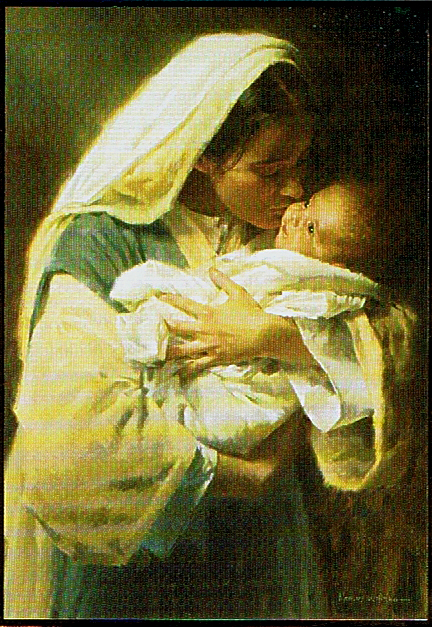
Mary, Mother of God

Today at Mass, the prelude was a hymn that I had never heard before but found to be quite beautiful. It is helping me to understand what Luke meant when he wrote “and Mary pondered all of these things in her heart.” It also seems to capture in song the mysteries of the Rosary.

An audio recording of the song can be heard here The Very First Blessing that Mary Had. It is sung by Candace Carraway on the Album Three Log Night.

Here are the words to The Blessings of Mary:

The very first blessing that Mary had, it was the blessing on one: To think that her Son, Jesus, could live a father’s son; could live a father’s son; like Emmanuel in glory, Father, Son and Holy Ghost, through all eternity.

The very next blessing Mary had, it was the blessing of two: To think that her Son, Jesus, could read the Scriptures through like Emmanuel in glory, Father Son and the Holy Ghost, through all eternity.

The very next blessing Mary had, it was the blessing of three: To think that her Son, Jesus, could set the sinner free; could set the sinner free like Emmanuel in glory, Father Son and Holy Ghost through all eternity.

The very next blessing Mary had, it was the blessing of four: To think that her Son, Jesus, could live for evermore.

The very next blessing that Mary had, it was the blessing of five: To think that her Son, Jesus could bring the dead alive.

*******

I pray that under the patronage of Mary our Mother, that the new year be full of grace for you.

Faith Has to Become Flesh

At Christmas we celebrate the fact of the Word Becoming Flesh. God’s love for us is not just some theory or idea. It is a flesh and blood reality that can actually be seen, heard and touched. But the challenge of the Christmas season is for us to allow the same thing to happen to our faith. The Word of God and our faith cannot simply remain on the pages of  a book or the recesses of our intellect. They have to become flesh in our life. Our faith has to leap off the pages of the Bible and Catechism and become flesh in the very way we live our lives, the decisions we make, the very way we use our body, mind, intellect and will.

Consider a passage from the liturgy of the Christmas Octave from the First Letter of John. I would like to produce an excerpt and then make a few comments.

The way we may be sure that we know Jesus is to keep his commandments. Whoever says, “I know him,” but does not keep his commandments is a liar, and the truth is not in him. But whoever keeps his word, the love of God is truly perfected in him. This is the way we may know that we are in union with him: whoever claims to abide in him ought to walk just as he walked.  (1 John 2:3ff)

  1. Faith is incarnational – Note first of all what a practical man John is. Faith is not an abstraction, it is not about theories and words on a page. It is not about slogans. It is about a transformed life, it is about the actual love of God and his Commandments. It is about the actual love of of my neighbor. True faith is incarnational, it takes on flesh in my very “body-person.” Remember, we human beings are not pure spirit, we are not intellect and will only, we are also flesh and blood. And what we are cannot remain merely immaterial. What we most are must be reflected in our bodies, what we actually, physically do as well. Too many people often repeat the phrase, “I’ll be with you in spirit.” Perhaps an occasional absence is understandable but after a while the phrase rings hollow. Actually showing up and actually doing what we say is an essential demonstration of our sincerity. We are body persons and our faith must have a physical, flesh and blood dimension. Our faith is to be reflected in our actual behavior and the physical conduct of our life.
  2. A sure sign – John says that The way we may be sure that we know Jesus is to keep his commandments. Now be careful of the logic here. The keeping of the commandments is not the cause of faith, it is the fruit of it. It is not the cause of love, it is the fruit of it. Note this too, in the Scriptures, to “know” is always more than a mere intellectual knowing. To “know” in the Scriptures means, “deep intimate personal experience of the thing or person known.” It is one thing to know about God, it is another thing to “know the Lord.” So, what John is saying here is that to be sure we authentically have deep intimate personal experience of God is to observe the fact that this changes the way we live. An authentic faith, an authentic knowing of the Lord will change our actual behavior in such a way that we keep the commandments as a fruit of that authentic faith and relationship with the Lord. It means that our faith becomes flesh in us. It changes the way we live and move and have our being. For a human being who is a body-person faith cannot be an abstraction, it has to become flesh and blood if it is authentic. John also uses the image of walking: This is the way we may know that we are in union with him: whoever claims to abide in him ought to walk just as he walked.  Now walking is a very physical thing. It is also a very symbolic thing. The very place we take our body is both physical and indicative of what we value, what we think.
  3. Liar? – John goes on to say Whoever says, “I know him,” but does not keep his commandments is a liar. John uses strong language here. Either we believe and keep the commandments or we fail to keep the commandments and thus lie about knowing the Lord. But all of us struggle to keep the commandments fully!  John seems so “all or nothing.” But his math is clear. To know the Lord fully, is never to sin (cf 1 John 3:9). To know him imperfectly is still to experience sin. Hence, the more we know him (remember the definition of know from above!) the less we sin. If we still sin it is a sign that we do not know him enough. It is not really John who speaks too absolutely. It is really we who do so. We say, “I have faith, I am a believer, I love the Lord, I know the the Lord!”  We speak so absolutely. Perhaps we could better say, I am growing in faith, I am striving to be a better believer, I’m learning to love and know the Lord better and better. Otherwise we risk lying. Faith is something we grow in. Many Protestants have a bad habit of reducing faith to an event such as answering an altar call, or accepting the Lord  as “personal Lord and savior.” But we Catholics do it too. Many think all they have to do is be baptized but they never attend Mass faithfully later. Others claim to be “loyal” even “devout” Catholics  but they dissent from important Church teachings. Faith is about more than membership. It is about the way we walk, the decisions we actually make. Without this harmony between faith and our actual walk we live a lie. We lie to ourselves and to others. Bottom line: Come to know the Lord more an more perfectly and, if this knowing is real knowing,  we will grow in holiness, keep the commandments be of the mind of Christ. We will walk just as Jesus walked.
  4. Uh Oh! Is this salvation by works? Of course not. The keeping of the commandments is not the cause of saving and real faith it is the result of it. The keeping of the commandments is the necessary evidence of saving faith but it does not cause us to be saved, it only indicates that the Lord is saving us from sin and its effects. But here too certain Protestants have a nasty habit of dividing faith and works. The cry went up in the 16th Century by the Protestants that we are saved by faith “alone.”  Careful. Faith is never alone. It always brings effects with it. Our big brains can get in the way here and we think that just because we can distinguish or divide something in our mind we can divide it in reality. This is arrogant and silly. Consider for a moment a candle flame. Now the flame has two qualities: heat and light. In our mind we can separate the two but not in reality. I could never take a knife and divide the heat of the flame and the light. They are so together as to be one reality. Yes, heat and light in a candle flame are separate theoretically but they are always together in reality. This is how it is with faith and works. We are not saved by works but as John here teaches to know the Lord is always accompanied by the evidence of keeping the commandments and walking as Jesus did.

Faith is real. It is incarnational. The Word became flesh and dwelt among us, really and physically. So too our own faith must become flesh in us, really, physically in our actual behavior in our very body-person.

I put this video together with a lesser known carol (possibly by Praetorius). The translation is as follows:

  • Verbum Caro Factum Est (The Word was made flesh)
  • Habitavit in Nobis (And dwelt among us)
  • Alleluia
  • Notum fecti Dominus (The Lord has made known)
  • Salutare suum (His Salvation)
  • Alleluia
  • Prope invocavit me: (Near is he who calls me: )
  • Frater meus est tu!”” (“You are my brother!”)
  • Alleluia

Jesus is the reason for ANOTHER season – New Years!

How remarkable is it that one man could affect the world so much that our entire calendar system is based on his life and ministry?

What is today’s date?

Once, a man who said that he did not believe in Jesus challenged me. Understand, he was not someone struggling with his faith. Rather, he was obstinate in his disbelief and openly hostile to mine. After listening to his faulty arguments about the non-existence of Christ, I casually asked him for the day’s date. When he responded, I pointed out that his response was based on the life, death and resurrection of a man that supposedly did not exist.

No one else in human history can claim influence over the direction of the world like Christ. No monarch, president or billionaire will ever again change the world to the point that our entire calendar system would be based on his or her life.

Jesus Christ is Lord!

Only a truly divine being could do such a thing. Even without faith in Him, the life of Jesus has touched anyone who has dated a check, booked an airline or hotel reservation, disclosed his or her own birthday or simply answered the question, “What is today’s date?”

2010 AD

In recent years, some have tried to diminish this undeniable fact. For example, some historians have abandoned the designation “A.D.” or “Anno Domini”, which means “Year of our Lord” in favor of the secular “C.E.” which means “Christian Era.” Or “B.C.” or “Before Christ” is replaced with “B.C.E.” or “Before the Christian Era.”  Despite these efforts at secularization, our calendar system is STILL based on the life of Our Lord and Savior, Jesus Christ. A rose by any other name is still a rose. So, as we celebrate the New Year, think about the fact that this is may be the one day everyone in the world expresses a belief in Christ, whether they like it or not.

Happy New Year – New Year of our Lord that is!

The Church Must Be Willing to Be A Sign of Contradiction

It is often demanded of the Church today (bothby non-Catholics and Catholics) that she ought to strive to fit in more, be kinder and gentler than in the past,  and that her essential mission is merely to accept everyone and make sure they feel good about themselves.  She ought to be more appealing and less “alienating” then her membership will increase. When the Church solemnly and unequivocally speaks on moral questions she is often criticized for being too harsh, or perhaps of being judgemental and  intolerant, or out of touch with modern realities. In recent discussions on this very blog many critics of the Church’s position on same-sex marriage have accused her of being “on the wrong side of history.”

But is this really the role of the Church? Is it really her role to be with the times? Surely not, since she is the Bride of Christ and also Body of Christ (for in this holy Marriage she and her spouse are one). And of this Church, there is a teaching in today’s Gospel (the 5th Day of the Octave of Christmas).  Simeon turns to Mary and says:

Behold, this child is destined for the fall and rise of many in Israel, and to be a sign that will be contradicted (and you yourself a sword will pierce)so that the thoughts of many hearts may be revealed. (Lk 2:34)

Simeon looked to Jesus and saw that he would be a sign of contradiction to many. Surely Jesus would not be the affirmer in chief but rather, as one who spoke the truthand feared no man, he would stand clearly and announce the truth without compromise. Some would love him and many would hate him, but no one could remain neutral. He would make us choose, tertium non datur (no third way is given).

And to the Church Christ said two very important things:

  1. If the world hates you, keep in mind that it hated me first. If you belonged to the world, it would love you as its own. As it is, you do not belong to the world, but I have chosen you out of the world. That is why the world hates you. Remember the words I spoke to you: ‘No servant is greater than his master.’If they persecuted me, they will persecute you also. If they obeyed my teaching, they will obey yours also. They will treat you this way because of my name, for they do not know the One who sent me. (John 15:18-21)
  2. Woe to you when all men speak well of you, for that is how their fathers treated the false prophets.(Luke 6:26)

So, that world hates us is not necessarily due to the fact that we have done anything wrong. It is often a sign that we have done something precisely right for it is often our lot, as the Body of Christ,  to be a “sign of contradiction.” That is to say that we must announce the Gospel to a world that is often and in increasing measure, stridently opposed to it. St. Paul admonished Timothy to preach the Gospel, whether in season or out of season (2 Tim 4:2). Increasingly now it is out of season and the world hates us for what we say. But we can do no other, for if we are  faithful, we must speak.

Pope Paul VI said it so well in the very in the “out of season” encyclical Huamane Vitae:

It is to be anticipated that perhaps not everyone will easily accept this particular teaching. There is too much clamorous outcry against the voice of the Church, and this is intensified by modern means of communication. But it comes as no surprise to the Church that she, no less than her divine Founder, is destined to be a “sign of contradiction.”  She does not, because of this, evade the duty imposed on her of proclaiming humbly but firmly the entire moral law, both natural and evangelical.  Since the Church did not make either of these laws, she cannot be their arbiter—only their guardian and interpreter. It could never be right for her to declare lawful what is in fact unlawful, since that, by its very nature, is always opposed to the true good of man. (H.V. # 18)

We in the Church must courageously accept our lot. Simeon spoke of it clearly in the beginning as he held the infant Christ (and thus the infant Church). And then, looking at Mary, who also represents the Church as mother and bride, he says. “A sword will pierce your heart too!” So the Church as Body of Christ and the Church as Bride and Mother cannot evade the fact that we will often be called to be a sign of contradiction. And we will often be required to suffer for our proclamation. The world will try and shame us, try to cause us to experience guilt through indignant outcries and labels such as: Rigid, backward, conservative, right wing, fundamentalist, homophobic, judgmental, intolerant, harsh, mean-spirited, hateful and so on. But do not be amazed and do not buy into the false guilt. Simply pray and accept the fact that the Church is a sign of contradiction and we must continue to address ourselves to the conscience of a world that seems bent on going morally insane. To this world our announcement of the Truth of Gospel must be courageous, clear, consistent, constant and quite often a sign of contradiction. This is our lot, we can do no other, we can be no other.

Pondering Abortion on the Feast of the Holy Innocents

We know well that Holy Innocents continue to be killed in our world through abortion. The Feast of the Holy Innocents is an often over-looked feast on the Church’s Calendar coming is the busy week of the Christmas Octave. And yet there is something very astonishing and even dangerous to consider on this feast.

I’ll explain what I mean by dangerous in a moment. But for now consider some biblical facts with me.

  1. When God was drawing close to liberating his chosen people from slavery in Egypt there occurred the order to murder of the all the baby boys among the Hebrews. It is almost as though Satan sensed that God was up to something good and Satan raged through Pharaoh in murderous anger and fear. Thankfully the actual numbers were reduced since the Egyptian midwives engaged in civil disobedience, refusing to allow the practice to continue.
  2. At the time of Jesus, when God was preparing to liberate his People from sin, there also occured the murder of innocent baby boys. Here too it was almost as though the Devil sensed that God was up to something good and he once again raged, this time through Herod in murderous anger and fear.  Thankfully too this infanticide also ended at some point.
  3. Notice the pattern. When God prepared a great liberation the Devil went after the babies. In our time, on a scale as never before, the Devil is going after our babies in murderous anger and fear. What is he afraid of? Is God planning something big in the near future? Is there a great liberation at hand? Is there a great advancement of evangelization and conversion in the offing? We can only speculate. But patterns are patterns and Scripture has a way of repeating its patterns and echoing down through the centuries.

Why is this a dangerous reflection? Because I want to make it clear that abortion, the killing of the innocents in our age, is NOT and never can be considered something good, or a “positive sign.” Such a speculation as this might cause some to wrongly conclude that abortion is part of God’s plan or something we should see “positively.” We should not. It must be fought. It is of Satan. I want to conclude by reminding you that the great liberation that followed the past infanticides did not occur until AFTER those murderous rages were stopped. Hence, to follow the pattern established in Scripture and to see a potentially great and liberating act of God we must first see an end to the slaughter. Work and pray to end abortion. May the Holy Innocents pray for us!

I put the following video together to honor these young martyrs. The musical setting is by Michael Haydn of the hymn for the Feast of the Holy Innocents: Salvete Flores Martyrum – It is from his Vesperae In F for Equal Voices, Soli and Orchestra.  The singers are the The Group singing is Collegium Instrumentale Brugense. This music is available at iTunes. The Latin text of this ancient hymn is quite beautiful. I produce here the Latin text followed by a fairly literal translation. I would like to call your attention to the second verse  and a very charming detail. That verse described these young, two year old martyrs and holding palm branches (the symbol of martyrdom) but as they hold them they play with them, in the way a young child will often fiddle with palm branches in Church. Beautiful and so very human!

Salvete flores martyrum, – Hail Martyr Flowers
quos lucis ipso in limine – On the very threshold of the dawn (of life)
Christi insecutor sustulit – Christ’s persecutor destroyed (you)
ceu turbo nascentes rosas. – like the whirlwind does the budding roses.

Vos prima Christi victima, – You Christ’s firstfruits
grex immolatorum tener, – A flock of tender sacrificial victims
aram sub ipsam simplices – right up by the very altar
palma et coronis luditis. – now play with your palms and crowns

Iesu, tibi sit gloria, – Jesus to you be glory
qui natus es de Virgine, – who were born of the Virgin
cum Patre et almo Spiritu, – with the Father and loving Spirit
in sempiterna saecula. Amen. – unto to eternal ages. Amen.