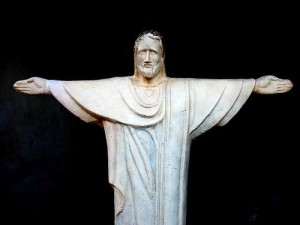
What do John Wayne, Oscar Wilde, Buffalo Bill, and (possibly) George Washington have in common? They all became Catholic on their deathbeds.
Conversions such as these should cause rejoicing! But that’s not always the case. News that a notorious gangster became Catholic as he died was met with howls or protest by those who thought it unfair that such a person might receive God’s mercy. Much like those in today’s gospel who grumbled when the latecoming workers received the same pay as those who’d worked all day.
From the world’s perspective, the conclusion of Jesus’ parable isn’t fair. After all, longer work should lead to greater pay! But Jesus was speaking of the kingdom of heaven, where different rules apply.
On the job, we can earn a paycheck, and even a bonus. But there’s nothing we can do to earn our way into God’s kingdom. We’re welcomed in, not because of anything we’ve done, but because of what Jesus has done. Heaven isn’t a reward for good behavior, it’s a gift from God. There’s no admissions fee, as Jesus already paid the price for us.
Yes, we are accountable for our actions before God, who calls us to lead holy lives. But Jesus’ parable reminds us that those passing through the pearly gates won’t hear, “Congratulations! You’ve earned it!” Jesus will say instead: “Welcome! I love you.”
Wow, what a day. First thing I learned: do not abandon your group to go join some high school friends you see across the room at the Catedral de la Almudena. Turns out you will most likely not be able to find your group again and become lost in a completely foreign Palacio Real. Oh yeah, and you don’t realize this until after you’ve already left the high school friends… definitely panicked for a good twenty five minutes before being reunited at last, thank you St. Anthony!
Turned out to be a huge test of faith as well as humility. But the Cathedral was magnificent and filled to the brim with youth. First thing you would notice? The ceiling. Arches upon arches with gold trim; the simplicity made the Cathedral seem infinitely high. Eager crowds which had been rambunctiously waiting outside quickly became a prayerful wave of souls all pouring eyes over saint after saint and then spiraled up a staircase to venerate a pristine statue of the Virgin of Alumdena, displaying their country’s flag on the way for all to see to see.
Next stop, Calle Mayor—a main street which runs right through the center of town. Walking through many plazas, we were amidst a wave of colors. Every WYD group was dressed head to toe in patriotic wear and waving flags every which way. When we eventually reached Plaza Mayor, we were engulfed by singing, yelling, dancing, and chanting—all for the tremendous show of their country’s spirited participation. The peak of the excitement, or so we thought. At one point, we turned around to find a group of Italians racing towards us waving flags and yelling, “Italia! Italia!” The whole experience was really something.
Spending the rest of the afternoon exploring Madrid, we helped ourselves to some Tinto de Verano, or Sangria, and tried our first Spanish tapas. At 8pm began the opening mass, held at the Plaza de la Cibeles, a massive square…well, more of an odd shaped rectangle. Now, there were not just huge crowds here, there was a multitude of disciples. One ten minute stretch to get to the street was the equivalent of a mosh pit—every man for himself. It was actually insane. Followed by more singing, yelling, dancing, and chanting (this was the real peak of spirit), the mass began.
I knew to expect tons of countries at WYD, but I never fathomed the spirit and the reality of the faith that these young people literally all over the world are living in their daily lives. It was comforting and I felt very calm and relaxed for the rest of the evening, knowing that the fight against the secular society will be won. We are all together in this, we are all member of the One Church and no one can take that away.
Happy trails!
Eliz.
Written by: Elizabeth Lent, Junior at University of Notre Dame and parishioner at Little Flower in Bethesda
Yesterday on the blog we discussed some of the media back and forth on some statements by candidate Michele Bachmann. On of the issues is of a wife being submitted to her husband. Mrs. Bachmann at first indicated support for this biblical principle but has since, in the face of questioning backed off from it more than a little. You can read more of that in yesterday’s post here: Michele Bachmann Interview A portion of the video interview on marriage is also at the bottom of this post.
In yesterday’s post I indicated I wanted to spend some time today setting for this biblical principle of the headship of the husband. It is a headship rooted in love and service, not in power, but it is a headship.
There are cultural and worldly notions that underlie the rejection by many Catholics and Christians of the biblical teaching on the Headship of the husband. Indeed, such a concept is unpopular in our culture which usually gets pretty worked up over questions of authority in general. But that is because the worldly notion of authority usually equates authority only with power, dignity, rights and being somehow “better,” rather than equating authority with love, and service. Consider what Jesus says about authority:
Jesus called them together and said, “You know that those who are regarded as rulers of the Gentiles lord it over them, and their high officials exercise authority and make their importance felt. Not so with you. Instead, whoever wants to become great among you must be your servant, and whoever wants to be first must be slave of all. For even the Son of Man did not come to be served, but to serve, and to give his life as a ransom for many.” (Mk 10:41-45)
Jesus describes then sets aside the worldly notion of authority wherein those in authority wield their power by “lording it over” using fear, and the trappings of power. But in the Christian setting there is authority (there has to be) but it exists for service.
Consider a teacher in a classroom. She has authority. She has to in order to unify and keep order. But she has that authority in order to serve the children, not to berate them and revel in power over over them. The same is true for a police officer who has his authority not for his own sake, but for ours so he can protect us and preserve order.
Further, having authority in a Christian setting does not make one better, for authority is always exercised among equals. Our greatest dignity is to be a child of God, and none of us are more or less so because we hold any position of authority.
But, truth be told, worldly notions of authority affect Christians and many harbor resentments to authority because they think of it in worldly ways. Further, many who have authority (and most of us have some) can also fall prey to worldly notions of authority and abuse their leadership role.
The key to understanding the authority of a husband and father in the home is set aside worldly notions of authority and see the teaching in the light of the Christian understanding of authority as existing for love and service, to unite and preserve.
With that in mind let us turn to the “unpopular” and politically incorrect notion of wives being submissive to their husbands.The teaching is found in a number of places in the New Testament: Ephesians 5:22; Col 3:18; Titus 2:5; 1 Peter 3:1. In all places the wording is quite similar that wives are to be submissive, that is under the authority, of their husbands. In each case however, the teaching is balanced by an exhortation that the husband is to love and be considerate of his wife.
The most well known of the texts is from Ephesians 5, wherein the infamous line is: Wives should be subordinate to their Husbands as to the Lord. For the Husband is the husband is head of his wife just as Christ is the Head of the Church…so wives should be subordinate to their husbands in everything; (Eph 5:20-21, 23) Apparently the Holy Spirit didn’t get the memo that we don’t think and talk like that today! 🙂
Alright, so maybe it grates on modern ears today but don’t just dismiss what God teaches here. One of the great dangers of this passage is that it is so startling to modern ears that many people tune out after the first line into their own thoughts and reactions and thus miss the rest of what God has to say. It will be noticed that there is text that follows, and before a man gloats at the first line, or a women reacts with anger or sadness, we do well to pay attention to the rest of the text, which spells out the duties of a husband. You see if you’re going to be the head of a household there are certain requirements that have to be met. God’s not playing around here or choosing sides. He has a comprehensive plan for husbands that is demanding and requires him to curb any notions that authority is about power and to remember that, for a Christian, authority is always given so that the one who has it may serve. And before we look at submission we might do well to look at the duties of the husband.
So what are the requirements for a husband?
1. Husbands, love your wives– Pay attention men, don’t just tolerate your wife, don’t just bring home money, don’t just love in some intellectual sort of way. LOVE your wife with all your heart. Beg God for the grace to love your wife tenderly, powerfully and unconditionally. Did you hear what God says? LOVE your wife! Now he goes on to tell you to love her in three ways: passionately, purifyingly and providingly.
2. Passionate love – The text says a man is to love his wife: even as Christ loved the Church and handed himself over for her. The Greek word, παραδίδωμι (paradidomi), translated here as, “handed over,” always refers in the New Testament to Jesus’ crucifixion. Husbands, are you willing to give your life for your wife and children? Are you willing to die to yourself and give your life as a daily sacrifice for them? God instructs you to love your wife (and children) with the same kind of love he has for his Bride the Church. That kind of love is summed up in the cross. Love your wife passionately, be willing to suffer for her, be willing to make sacrifices for her and the children.
3. Purifying love – The text says of Christ, and the husband who is to imitate him, that Christ wills to sanctify her, cleansing her by the bath of water with the word, that he might present to himself the church in splendor, without spot or wrinkle or any such thing, that she might be holy and without blemish. Now a husband cannot sanctify his wife in the same way God can. But what a husband is called to do is to help his wife and children grow in their relationship to Jesus Christ. He is first to be under God’s authority himself, and thus make it easier for his wife and children to live out their baptismal commitments. He ought to a spiritual leader in his home, praying with his wife and children, reading scripture and seeing to it that his home is a place where God is loved and obeyed, first of all by him. His wife should not have to drag him to Church, he should willingly help her to grow in holiness, and pray with her every day. And he should become more holy as well and thus make it easier for his wife to live the Christian life. He should be the first teacher of his children, along with his wife in the ways of faith.
Too many American homes do not feature a man being the spiritual leader of his house. If any one is raising up the kids in the Lord it is usually the wife. But Scripture has in mind that the husband and father should be a spiritual leader to his wife and children. Scripture says, Fathers, do not exasperate your children; instead, bring them up in the training and instruction of the Lord (Eph 6:4). Fathers and husbands need to step up here and not leave all the burden to his wife.
4. Providing love – So also husbands should love their wives as their own bodies. He who loves his wife loves himself. For no one hates his own flesh but rather nourishes and cherishes it– Husbands, take care of your wife in her needs. She needs more than food money and shelter, these days she can get a lot of that for herself. What she needs even more is your love, understanding, and appreciation. She needs for you to be a good listener and wants an attentive husband who is present to her. Like any human being she needs reassurance and affirmation. Tell her of your love and appreciation, don’t just presume she knows. Show care for your wife, attend to her needs just like you instinctively do for your own self. Encourage her with the kids. Confirm her authority over the kids and teach them to respect their mother. Show her providing love also by taking up your role and duties as a father who is involved with his kids. That’s what God is teaching here.
OK, so scripture DOES teach that a wife should be submitted to her husband. But what kind of husband does scripture have in mind? A husband who really loves his wife, who is a servant leader, who is makes sacrifices for his wife, who is prayerful and spiritual, submitted to God’s authority and who cares deeply for his wife and her needs. The same God who teaches submission (and he does) also teaches these things clearly for the husband. The teaching must be taken as a whole. But all that said, there IS a teaching on wives being submitted to their husbands (properly understood).
And there is just no way around it, no matter how much the modern age wants to insist there doesn’t need to be headship, there does. Every organization needs a head. Consider your own body first. With two heads you’re a freak, with no head you are dead. The members of your body need a head to unify the parts, otherwise there is disunity, death and decay. Every organization needs headship, a final decider, to whom all look when consensus on significant issues cannot otherwise be reached. The Protestants have tried to have a “church” without a head, without a Pope, and behold the division. Even this Country, which we like to call a democracy, is not actually a pure democracy. There are legislators, judges, law enforcers and many other people and mechanisms who exercise local, federal and final headship and authority.
Thus in a family, where consensus and compromise may often win the day, nevertheless needs a head, a final decider, to whom all look and all submit, to resolve conflicts that cannot be resolved otherwise. Scripture assigns this task to the husband and father. Headship just has to be. But please remember to shed your worldly notions of headship when considering the teaching of Scripture and remember, headship, authority, is for love and service, it is for unity and preservation, not for power, prestige, trappings and superiority.
For more on this consider listening to my sermon Teaching on Marriage in mp3 format. But beware, It is 35 minutes! Consider downloading it if you can’t listen just now. You can download this and other sermons of mine by going here: http://frpope.com/audio/recordings.php and then right clicking on the title of any talk and selecting the “Save Target As” option. You can also get my sermons at iTunes. Just search on my name.
Here is the video clip where Michele Bachmann is attacked for saying a woman should be submitted and then backs down. Please note however, I am not sure a husband’s servant leadership means that he should force his wife to take a law course she does not want to take. Such an exercise of authority hardly seems necessary or proper.
–
–
This video clip is from the movie Fireproof and depicts a heartfelt apology from a husband who realizes he has not loved his wife as he should. A beautiful movie available at Amazon if you have never seen it.
The great English Catholic G. K. Chesterton once remarked that ever since Jesus insisted that it’s easier for a camel to squeeze through a needle’s eye than for the rich to enter the kingdom of God, we’ve been frantically trying to build bigger needles and breed smaller camels!
People of every generation have found this teaching of our Lord hard to swallow. It certainly shocked the disciples, as we just heard. And this saying can make us uncomfortable too, because so often we seek our comfort in the things of this world.
Jesus is not saying that we don’t have legitimate financial needs. We most certainly do! And he wants us to pray for them. What Jesus is saying, however, is that when our wants become needs, we cross the border into the land of idolatry, which is a dangerous and foolish thing to do. Because to love riches more than God is, as Bishop Robert Morneau has put it, to commit spiritual adultery.
And so today’s gospel challenges us to consider our priorities, to evaluate our goals, and assess how we spend our time and energy, to determine if we have de-throned almighty God as Lord of our life, and replaced him with the “almighty” dollar. Because if we wish to enter God’s kingdom, we must seek it, first of all.
I would like to a look at an excerpt of an interview I saw recently of Michele Bachmann. David Gregory is the interviewer and the Show is “Meet the Press.” What I want to examine is Mr. Gregory’s displayed attitude to the Christian Faith and how it reflects an increasingly negative assessment of what is often called “Biblical Christianity.” The assessment is clearly and thoroughly negative, which is not surprising these days. Perhaps I should rejoice, for the Church, to be faithful, will often be hated and considered a sign of contradiction. But another part of me says we ought also to be clear to point to and uncover the growing hostility to the traditional Catholic and Christian faith, lest a perfect storm take aim on us. It is that vein that I raise some of the concerns expressed here.
The general tone of Mr Gregory’s questions to Mrs. Bachmann regarding her faith is, You don’t really believe all that backward biblical stuff do you?….You don’t really take all that stuff too seriously do you?……You don’t really mean to tell me you’d ask God for advice and then do what he told you, do you?….You wouldn’t actually try to apply your (backward) faith to actual, and real decisions you’d make in office, would you?….And by the way, aren’t you Christians really a bigoted crowd when it comes down to it? Like any professional interviewer he uses a “pleasant tone” bu the upshot of his remarks is that the historical Judeo-Christian view is indefensible.
Let’s take a look at the transcript of the interview. As usual, the original text is in bold, black italics and my own remarks are in plain red text.
Disclaimer: I am not indicating, by my remarks support or lack of support for Michele Bachmann as a candidate. I am honestly undecided about the 2012 Presidential election.
MR. GREGORY: From the economy, I want to move on to another topic that’s deeply meaningful and important to you, and that’s your faith in God. This is something that not only motivates you as a person, inspires you as you try to live a virtuous life, but it’s also been very important to your political identity as well. OK, fair enough, if she chooses to make it part of her political identity it’s fair game for the press to question her on it.
MR. GREGORY: And I want to ask you about, not only the role God plays in, in your life but to what extent he’s a motivator for decisions that you make. One example that’s gotten some attention is some remarks you made back in 2006 about your career path, which you’ve talked about here, and I want to play a brief clip of those remarks.
(Audiotape, October 14, 2006)
REP. BACHMANN: My husband said, “Now you need to go and get a post-doctorate degree in tax law.” Tax law! I hate taxes. Why should I go and do something like that? But the Lord says, “Be submissive, wives, you are to be submissive to your husbands.”
(End audiotape)
MR. GREGORY: Is that your view for women in America? Is that your vision for them? –
Translation- “You can’t really be serious about advocating this backward Biblical principle!”
Well actually, Mr Gregory, this Biblical teaching appears in a significant number of passages of the New Testament. You may not agree with it, but listen to your tone. You could have asked more neutrally, “How do you think most women in America will understand or interpret your embracing of this?” or perhaps, “Would you like to clarify or distinguish your remarks?” or yet again, “How do you understand the concept of submission?”
What Mr. Gregory does not seem to understand is that many Christians actually believe there is a place for this principle in marriage, and many pastors (including this one) actually teach this. To be sure, the concept of submission is balanced with the command that the husband love his wife as Christ loves the Church. But this is an ancient Christian teaching that deserves more respect than Mr. Gregory shows.
I wonder too, though many interpretations of Islam contain far more restrictive notions for women than any Christian view, if Mr. Gregory or any reporter would question a Muslim with the kind of disdain he shows here to the Christian faith? You decide.
REP. BACHMANN: Well, I–during the debate I was asked a question about this, and my response was is that submission, that word, means respect. It means that I respect my husband and he respects me.
MR. GREGORY: Right. Congresswoman, I didn’t even have to check with my wife and I know those two things aren’t, aren’t equal.
REP. BACHMANN: What’s that?
MR. GREGORY: Submission and respect.
REP. BACHMANN: Well, in our house it is.
Actually I think I agree with Mr Gregory here, though certainly not his “gotcha” tone. Mrs Bachmann is, equivocating and watering down the text more than a bit. (I want to devote more time to this “unpopular teaching” on marriage tomorrow on the blog).
That said, I understand Mrs Bachmann’s “predicament,” in that he has her in a kind of “gotcha” moment, where he tries to make her (and traditional Christians) look absurd and foolish. There is little time on live TV to do the kind of work necessary to properly explain these sorts of biblical teachings. She obviously wants to get on to “safer” issues.
And frankly, though many of us Christians want our favorite politicians to be our heroes when it comes to faith, we have to remember that they are not theologians and certainly not martyrs. With rare exceptions, like St. Thomas More, politicians just aren’t the sort to take a lot of heat for the faith.
REP. BACHMANN: We’ve been married almost 33 years and I have a great deal of respect for my husband. He’s a wonderful, wonderful man and a great father to our children. And he’s also filled with good advice. He…
MR. GREGORY: But so his word goes?
REP. BACHMANN: –pardon?
MR. GREGORY: His word goes?
OK, he’s calling the question and wants clarification, But again notice the tone: “You can’t be seriously be suggesting that a husband actually has headship are you?”
REP. BACHMANN: Well, both of our words go. We respect each other. We have a mutual partnership in our marriage, and that’s the only way that we could accomplish what we’ve done in life is to be a good team. We’re a good team together.
A disappointing answer, to be sure. In effect she is setting aside the teaching when she says, “Well, both of our words go.” If both go, neither go, there is just impasse.
The fact is, in any family, organization, Church, or government, there has to be headship. Someone has to be available, to whom all look and agree, that his answer is the final one to which all the members are bound. In most matters, consensus can be built, and this is what Mrs. Bachmann seems to refer to in the second half of her answer. But, there are just times when disagreements cannot be overcome, and a final authority is needed to make a decision binding on all. Without this, there is simply endless division and a battle of wills.
The Protestants jettisoned the Pope and they have had endless divisions ever since. For, if no one is Pope, everyone is pope.
Headship is just necessary, even if one thinks it a “necessary evil,” it is still necessary. Even our bodies have a head to unite our members. An organism with two heads is a freak, and an organism with no head is dead. You just have to have a head.
And the Scriptures assign this role to the husband. More on this in tomorrow’s blog.
MR. GREGORY: To what extent does your relationship with God mean that you take cues from God for decisions that you make and that you would make as president. You’ve talked about God inspiring you to marry your husband, you know, telling you to marry your husband, to get into politics, to take certain decisions about your career, as we just talked about.
REP. BACHMANN: Well, I do have faith in God, and I learned it right here in Iowa. I was born in Waterloo, Iowa, I’m heading up there to say thank you to everyone who instilled my early values in me. And that began at our church. My parents took us to church every week. We went to a Lutheran church, First Lutheran in Waterloo. And we were–they prayed with us at night, and we prayed before we prayed before we had meal time. They really instilled wonderful values in us. And I recognize that I’m not perfect and that I need God in my life, and that’s really…
MR. GREGORY: God has guided your decisions in life. Would God guide your decisions that you would make as president of the United States?
REP. BACHMANN: Well, as president of the United States, I would pray. I would pray and ask the Lord for guidance. That’s what presidents have done throughout history. George Washington did. Abraham Lincoln did.
MR. GREGORY: But you said that –God called me to run for Congress. God has said certain things about, you know, going to law school, about pursuing other decisions in your life. There’s a difference between God as a sense of comfort and safe harbor and inspiration, and God telling you to take a particular action.
Again, note the implied tone: “You’re not gonna, like, pray, are you?” You’re not going to ask God to guide you or influence your decisions are you? I mean really, come on! A President praying and seeking guidance from God?! Get serious woman! This is a critical job and we can’t mess around with all that superstitious stuff! OK, look, it’s OK to ask God to give you strength, but don’t suggest to me that its OK if God tells you to stand against abortion rights, or Gay Marriage. You have no business allowing your faith to influence your thinking and certainly not your choices! Not that’s just going too far!
REP. BACHMANN: All I can tell you is what my experience has been. I’m extremely grateful to have a faith in God. I, I see that God has so blessed this country. We’ve heard that song that he’s “shed his grace” on the United States. I believe it. He’s been very good to our country. And I think that it’s important for us to seek his guidance and to pray and to listen to his voice. Imagine that!
MR. GREGORY: Would you appoint an openly atheist person to be a member of your administration, your Cabinet or even as a judge to a court?
Note the implication that a believer is likely to be a bigot, or to be unjust and exclusionary. In supposing this to be a likely scenario Mr Gregory engages in a bigotry of his own. Most Christians I know are well able to interact with non believers in hopes of building bridges. We are also able to distinguish between sacred and secular domains. Frankly with all the bad Catholics running around Congress, and more than a few on the bench, a few principled atheists might not be too bad. (I say this not with glibness, but with great sadness). 🙁
REP. BACHMANN: Well, my criteria, would be first of all, “How do you view the Constitution?” If you uphold the Constitution, if you’re competent, and if you’re–if you, if you share my views, then you can get appointed. That’s my litmus test is, do you stand for the Constitution, are you competent, and do you share my views.
MR. GREGORY: Right, But an atheist would be acceptable to you as a member of your administration?
REP. BACHMANN: That wouldn’t be a question I would ask.
MR. GREGORY: OK. I want to also ask you about your interpretation of the Bible and your feelings about gays and lesbians. You have said in recent years that opposition to same sex marriage is defining a political debate in this country. You’re opposed to it, you’d like to see a constitutional ban against it in this country. And during a speech that you gave in 2004 at an education conference, you spoke openly and in detail about gays and lesbians. And I want to play just a portion of that speech and have you react, react to it.
(Videotape, November 6, 2004)
REP. BACHMANN: It’s a very sad life. It’s part of Satan, I think, to say that this is gay. It’s anything but gay. … It leads to the personal enslavement of individuals. Because if you’re involved in the gay and lesbian lifestyle, it’s bondage. It is personal bondage, personal despair, and personal enslavement. And that’s why this is so dangerous. … We need to have profound compassion for people who are dealing with the very real issue of sexual dysfunction in their life and sexual identity disorders.
(End videotape)
MR. GREGORY: That is the view President Bachmann would have of gay Americans?
I will say, many evangelical Christians lack proper nuance when it comes to speaking on this matter. I think it is proper for us to be very careful and measured in describing our stance on the question of homosexual activity. We ought to avoid unnecessary hyperbole. The Catechism of the Catholic Church is more nuanced and careful, but clear that the homosexual orientation is intrinsically disordered and homosexual activity is sinful:
Basing itself on Sacred Scripture, which presents homosexual acts as acts of grave depravity, tradition has always declared that “homosexual acts are intrinsically disordered.” They are contrary to the natural law. They close the sexual act to the gift of life. They do not proceed from a genuine affective and sexual complementarity. Under no circumstances can they be approved.
The number of men and women who have deep-seated homosexual tendencies is not negligible. This inclination, which is objectively disordered, constitutes for most of them a trial. They must be accepted with respect, compassion, and sensitivity. Every sign of unjust discrimination in their regard should be avoided. These persons are called to fulfill God’s will in their lives and, if they are Christians, to unite to the sacrifice of the Lord’s Cross the difficulties they may encounter from their condition.
Homosexual persons are called to chastity. By the virtues of self-mastery that teach them inner freedom, at times by the support of disinterested friendship, by prayer and sacramental grace, they can and should gradually and resolutely approach Christian perfection. (CCC # 2357-2359)
All this said, Mr Gregory and surely the secular world will not accept even this more careful statement. And frankly it isn’t that different from what Mrs. Bachmann said. Yet this is the principled Catholic stand. I wish Mrs Bachmann had been more careful and hence I cannot per se object to Mr Gregory’s followup question above. But it is clear that the ancient Judeo-Christian teaching on this matter is increasingly being called “hate,” and “judgement.” We must continue to insist that there is simply no way we can approve of Homosexual activity based on a principled and consistent reading of both Sacred Scripture and Sacred Tradition.
REP. BACHMANN: Well, I am running for the presidency of the United States. I’m not running to be anyone’s judge. I do stand very…
MR. GREGORY: But you have judged them.
This is the typical view of the secular world: “If you disagree with what I do, you are judging me.” In a world where tolerance is one of the only virtues left, “judging” is the only sin left. The fact is, we don’t have to judge what is sinful, God has already done that, and He has every right to judge. We can but only report what God has revealed in his Word and in Natural Law.
REP. BACHMANN: I don’t judge them. I don’t judge them. I am running for presidency of the United States.
MR. GREGORY: Is that the view of gays–gay Americans that President Bachmann would have?
REP. BACHMANN: Well, my, my view on marriage is that I believe that marriage is between a man and a woman. And that’s what I stand for. But I ascribe honor and dignity to every person no matter what their background. They have honor and they have dignity.
MR. GREGORY: Do you think that gay Americans hearing quotes like that from you would think that that’s, that’s honor and dignity coming from you about their circumstance?
REP. BACHMANN: I am not anyone’s judge…
MR. GREGORY: Right.
And so the interview continued.
I do think Mrs. Bachmann said some things in a way that were not helpful in terms of the image of the faith, but, that said, the substance of her views on the matters above, are mainstream Christian and Catholic. It is true, some among our number debate the specific details and articulation of these teachings, but they remain clear biblical teachings held by many and essential to the patrimony of our faith. They should not be consigned to freak show status by otherwise “tolerant” media types. The tone of dripping contempt articulated by Mr Gregory for things such as the headship of the husband, prayer and sought guidance from God, and the immorality of homosexual activity, are not just directed at Mrs Bachmann, they are directed at the traditional Catholic and Christian faith.
Further, and more dangerously, the traditional Catholic teaching on homosexual activity, as articulated in our Catechism, is increasingly being called “hate speech.” We ought to be very sober about these particular attacks, for soon enough, they will build to legal and social sanctions. This is already happening in places like England and Canada where clergy are being arrested and fined for articulating orthodox Catholic belief on homosexuality.
I am interested in your views, especially of Mr. Gregory’s tone and presuppositions of the Catholic and Christian faith. I might ask that you avoid comments of a purely political nature. As you know, this is not a blog about politics. It is about the Catholic Faith and culture.
Photo Credit: Screen shot from the Meet the Press video below.
One of the more difficult Biblical themes to understand is the concept of God hardening the hearts and minds of certain human beings. The most memorable case is that of Pharaoh wherein, before sending Moses to him God said he would “harden Pharaoh’s heart” (Ex 4:21). But there are other instances where biblical texts speak of God as hardening the hearts of sinners, even from among his own people.
What are we to make of texts like these? How can God, who does no evil, be the source of a sinful mind or heart? Why would God do such a thing since he has said elsewhere:
As surely as I live, declares the Sovereign LORD, I take no pleasure in the death of the wicked, but rather that they turn from their ways and live. Turn! Turn from your evil ways! Why will you die, O house of Israel?’ (Ez 33:11)
God our Savior…wants all men to be saved and to come to a knowledge of the truth. (1 Tim 2:4)
To be sure, these questions involve very deep mysteries, mysteries about God’s sovereignty and how it interacts with our freedom, mysteries of time, and mysteries of causality. As a mystery within mysteries, the question of God hardening hearts cannot simply be resolved. Greater minds than I have pondered these things, and it would be foolish to think that a easy resolution is to be found in a blog post.
But some distinctions can and should be made, and some context supplied. We do not want to understand the “hardening texts” in simplistic ways, or in ways that use one truth to cancel out other important truths that balance it. So please permit only a modest summary of the ancient discussion.
I propose we examine these sorts of texts along four lines:
The Context of Connivance.
The Mystery of Time
The Mystery of Primary Causality
The Necessity of Humility
To begin it is important simply to list a selection of the hardening texts. The following are not the only ones, but they sample them widely enough:
The LORD said to Moses, “When you return to Egypt, see that you perform before Pharaoh all the wonders I have given you the power to do. But I will harden his heart so that he will not let the people go. (Ex 4:21)
Moses and Aaron performed all these wonders before Pharaoh, but the LORD hardened Pharaoh’s heart, and he would not let the Israelites go out of his country. (Ex 11:10)
Why, O LORD, do you make us wander from your ways and harden our hearts so we do not revere you? Return for the sake of your servants, the tribes that are your inheritance. (Is 63:17)
He [God] has blinded their eyes and deadened their hearts, so they can neither see with their eyes, nor understand with their hearts, nor turn–and I would heal them. (Jesus quoting Isaiah Isaiah 6:9-10, at John 12:40)
They perish because they refused to love the truth and so be saved. For this reason God sends them a powerful delusion so that they will believe the lie (2 Thess 2:11)
Therefore God gave them over in the sinful desires of their hearts to sexual impurity for the degrading of their bodies with one another…..Furthermore, since they did not think it worthwhile to retain the knowledge of God, he gave them over to a depraved mind, to do what ought not to be done. (Rom 1:24, 28)
Point I. – THE CONTEXT OF CONNIVANCE – In properly assessing texts like these we ought first to consider the contexts in which they were made and written. Generally speaking, most all of these declarations that God hardens the heart, come after a significant period of disobedience on the part of those hardened. In a way, God “cements” the deal and gives them fully what they really want. For having hardened their own hearts to God, God determines that their disposition is a permanent one, and in a sovereign exercise of his will, (for nothing can happen without God’s allowance), declares and permits their heart to be hardened in a definitive kind of way. In this sense, there is a judgement of God upon the individual that recognizes their definitive decision against him. Hence, this hardening can be understood as voluntary, on the part of the one hardened, for God hardens in such a way that he uses their own will, whom he hardens, for the executing of his judgment and his acceptance that their will against him is definitive.
A. For example, in the case of Pharaoh, it is true, as the Exodus 4:21 text says above, God indicated to Moses that he would harden Pharaoh’s heart. But the actual working out of this is a bit more complicated than that. We see in the first five plagues, it is Pharaoh who hardens his own heart (Ex. 7:13; 7:22; 8:11; 8:28; & 9:7). It is only after this repeated hardening of his own heart, that the Exodus text shifts, and speaks of God as the one who hardens (Ex 9:12; 9:34; 10:1; 10:20; 10:27). Hence the hardening here is not without Pharaoh’s repeated demonstration of his own hardness, and God, if you will, “cements the deal” as a kind of sovereign judgment on Pharaoh.
B. The Isaiah texts, many in number, that speak of a hardening being visited upon Israel by God, (e.g. #s 3 and 4 above), are also the culmination of a long testimony, by the prophet, of Israel’s hardness. At the beginning of the Isaiah’s ministry, Israel’s hardness was described as of their own doing by God who said through Isaiah: For the LORD has spoken: “I reared children and brought them up, but they have rebelled against me. The ox knows his master, the donkey his owner’s manger, but Israel does not know, my people do not understand.” Ah, sinful nation, a people loaded with guilt, a brood of evildoers, children given to corruption! They have forsaken the LORD; they have spurned the Holy One of Israel and turned their backs on him. (Is 1:2-4). There follows a long list of their crimes, their hardness and their refusal to repent.
1. St. John Chrysostom – of the numerous texts Later in Isaiah (and also referenced by Jesus (e.g. Jn 12:40), that speak of Israel as being hardened by God, and having him shut their eyes, St John Chrysostom says, That the saying of Isaiah might be fulfilled: that here is expressive not of the cause, but of the event. They did not disbelieve because Isaias said they would; but because they would disbelieve, Isaias said they would…. For He does not leave us, except we wish Him….Whereby it is plain that we begin to forsake first, and are the cause of our own perdition. For as it is not the fault of the sun, that it hurts weak eyes, so neither is God to blame for punishing those who do not attend to His words. (on a gloss of Is. 6:9-10 at Jn 12:40, quoted in the Catena Aurea).
2. St Augustine also says,This is not said to be the devil’s doing, but God’s. Yet if any ask why they could not believe, I answer, because they would not…But the Prophet, you say, mentions another cause, not their will; but that God had blinded their eyes, and hardened their heart. But I answer, that they well deserved this. For God hardens and blinds a man, by forsaking and not supporting him; and this He makes by a secret sentence, for by an unjust one He cannot (Quoted in the Catena Aurea at Jn 12:40).
C. Of the text of 2 Thessalonians, God sends them a powerful delusion so that they will believe the lie quoted in # 5 above, while the text speaks of God as having sent the delusion, the verse before and after make clear the sinful role of the punished saying: They perish because they refused to love the truth and so be saved….so that all will be condemned who have not believed the truth but have delighted in wickedness ( 2 Thess 2:10,12).
1. Of this text, St. Augustine says, From a hidden judgment of God comes perversity of heart, so that the refusal to hear the truth leads to the commission of sin, and this sin is itself a punishment for the preceding sin [of refusing to hear the truth]. (Against Julian 5.3.12).
2. St John Damascus says, [God does this] so that all may be condemned who did not believe the truth but had pleasure in unrighteousness (The Orthodox Faith 4.26).
D. The texts from Romans 1 speak of God handing them over only after they have suppressed the truth (1:18), persevered in their wickedness (1:18) and preferred lust and idolatry (1:23-24), hence, as a just judgement, he hands them over to sexual confusion (homosexuality) and to countless other destructive drives. So here too, though it is said God hands them over, it is really not that simple. God has, in effect, cemented the deal. They do not want to serve them and so He, knowing their definitive decision, gives them what they want.
E. Thus, our first point of distinction in understanding the “hardening” texts is that the context of connivance is important in assessing them. It is not asserted by Scripture that God takes a reasonably righteous man and, out of the blue, hardens his heart, confuses his mind or causes him, against his will, to become obstinate. The texts are usually presented as a kind of prevenient judgement by God, that the state of the person’s hardness has now become permanent. They refuse and so God cements the deal and “causes” them to walk in their own sinful ways since they have insisted so.
Point II. – THE MYSTERY OF TIME – In understanding these hardening texts, which we have seen, are akin to judgment texts, we must strive to recall that God does not live in time in the same we do. Scripture speaks often of God’s knowledge and vision of time as being comprehensive, rather than speculative or serial (e.g. Ex 3:14; Ps 90:2-4; Ps 93:2; Is 43:13; Ps 139; 2 Peter 3:8; James 1:17; inter al.).
A. To say that God is eternal and that he lives in eternity is to say that he lives in the fullness of time. For God, past, present and future are all the same. God is not wondering what I will do tomorrow, neither is he waiting for it to happen. For Him, my tomorrow has always been present to Him. All of my days were written in His book before one of them ever came to be (Ps 139:16). Whether, and how long I live, has always been known to him. Before he ever formed me in my mother’s womb he knew me (Jer 1:4). My final destiny is already known and present to him.
B. Hence, when we strive to understand God’s judgments in the form of hardening the hearts of certain people, we must be careful not to think he lives in time like we do. It is not as though God is watching my life like a movie. He already knows the choice I will make. Thus, when God hardens the hearts of some, it is not as though he were merely trying to negatively influence the outcome, and trip certain people up. He already knows the outcome and has always known it, he knows the destiny they have chosen.
C. Now be very careful with this insight, for it is a mystery to us. We cannot really know what it is like to live in eternity, in the fullness of time, where the future is just is present as the past. If you think you know, you really don’t. What is essential for us is that we realize that God does not live in time like we do. If we try too hard to solve the mystery (rather than merely accept and respect it) we risk falling into the denial of human freedom, or double predestination, or other wrong-headed notions that sacrifice one truth for another, rather than to hold them in balance. That God knows what I will do tomorrow, does not destroy my freedom to actually do it. How this all works out is mysterious. But we are free, Scripture teaches this, and God holds us accountable for our choices. Further, even though God knows my destiny already, and yours as well, does not mean that He is revealing anything about that to us, as though we should look for signs and seek to call ourselves saved or lost. We ought to work out our salvation in a reverential fear and trembling (Phil 2:12).
D. The Key point here is mystery. Striving to understand how, why and when God hardens the heart of anyone is caught up in the mysterious fact that he lives outside of time and knows all things before they happen. Thus he acts with comprehensive knowledge of all outcomes.
Point III. – THE MYSTERY OF CAUSALITY – One of the major differences between the ancient and the modern world is that the ancient world was much more comfortable in dealing with something known as primary causality.
A. Up until the Renaissance God was at the center of all things and people instinctively saw the hand of God in everything, even terrible things. Job of old said, The LORD gave and the LORD has taken away; may the name of the LORD be praised….if we have received good things at the hand of God, why should we not receive evil?” (Job 1:21; 2:10). Thus the ancients would commonly attribute everything as coming from the hand of God, for he was the “first cause” of everything that happened. This is what we mean by primary causality. The ancients were thus more comfortable attributing things to God that we are not. In speaking like this, they were not engaged in a form of superstitious or primitive thinking, but they emphasized that God was sovereign, omnipotent and omnipresent and that nothing happened apart from his sovereign will, He is the Primary Cause of all that is.
1. Of this ancient and scriptural way of thinking the Catechism says, And so we see the Holy Spirit, the principal author of Sacred Scripture, often attributing actions to God without mentioning any secondary causes [e.g. human or natural]. This is not a “primitive mode of speech”, but a profound way of recalling God’s primacy and absolute Lordship over history and the world, and so of educating his people to trust in him. (CCC # 304)
2. The Key point here is understanding that the ancient Biblical texts while often speaking of God as hardening the hearts of sinners, did not, as we saw above, mean that man had no role, or no responsibility. Neither did it mean that God acted in a merely arbitrary way. Rather, the emphasis was on God’s sovereign power as the first cause of all that is and hence he is often called the cause of all things and his hand is seen in everything. We moderns are uncomfortable in speaking this way as we shall see.
B. After the Renaissance man moved to the center and God was gradually “escorted” to the periphery. Thus our manner of thinking and speaking began to shift to secondary causes (causes related to man and nature). If something happens we look to natural causes, or in human situations, to the humans who caused it. These are secondary causes however, since I cannot cause something to happen unless God causes me. Yet increasingly the modern mind struggles to maintain a balance between the two mysteries of our freedom, and responsibility and God’s Sovereignty and omnipotence.
C. In effect we have largely thrown primary causality overboard as a category. Even modern believers unconsciously do this and thus exhibit three issues related to this.
1. We fail to maintain the proper balance between two mysteries: God’s Sovereignty and our freedom.
2. We exhibit shock at things like the “hardening texts” of the Bible because we understand them poorly.
3. We try to resolve the shock by favoring one truth over the other. Maybe we just brush aside the ancient biblical texts as a “primitive mode of speech” and say, inappropriately, “God didn’t have anything to do with this or that.” Or we go to the other extreme and become fatalistic, deny human freedom, deny secondary causality (our part) and accuse God of everything; as if he were the only cause and had the sole blame for everything. Thus, we either read the hardening texts with a clumsy literalism, or dismiss them as misguided notions from an immature, primitive, and pre-scientific age.
D. The point here is that we have to balance the mysteries of primary and secondary causality. We cannot fully understand how they interrelate, but they do. Both mysteries need to be held. The ancients were more sophisticated in holding these mysteries in the proper balance. We are not. We handle causality very clumsily and do not appreciate the distinctions of primary causality (God’s part) and secondary causality (our part, and nature’s too). We try to resolve the mystery rather than hold it in balance and speak to both realities. As such, we are poor interpreters of the “hardening texts.”
Point IV – THE NECESSITY OF HUMILITY – By now it will be seen that we are dealing with a mysterious interrelationship of God and Man, between our freedom and God’s sovereignty, between primary and secondary causality. In the face of such mysteries we have to be very humble. We ought not think more of the details than is proper for us, for, frankly they are largely hidden from us. Too many moderns either dismiss the hardening texts or accept them and sit in harsh judgment over God, as if we could do such a thing. Neither approach bespeaks humility. Consider a shocking but very humbling text where Paul warns us in this very matter:
What then shall we say? Is God unjust? Not at all! For he says to Moses, “I will have mercy on whom I have mercy, and I will have compassion on whom I have compassion.” It does not, therefore, depend on man’s desire or effort, but on God’s mercy. For the Scripture says to Pharaoh: “I raised you up for this very purpose, that I might display my power in you and that my name might be proclaimed in all the earth.” Therefore God has mercy on whom he wants to have mercy, and he hardens whom he wants to harden. One of you will say to me: “Then why does God still blame us? For who resists his will?” But who are you, O man, to talk back to God? “Shall what is formed say to him who formed it, ‘Why did you make me like this?’” (Romans 9:14-20)
In effect, none of can demand an absolute account of God for what he does. Even if he were to tell us, could our small and worldly minds ever really comprehend it? My thoughts are not your thoughts, and my ways are not your ways, says the Lord (Is 55:8).
Summary – In this post, rather too long, we have considered the “hardening texts” where it seems that God is said to harden the hearts of certain people and groups. And so he does. But texts like these must be carefully approached with proper distinctions, appeal to the scriptural and historical context, and deep humility. There are profound mysteries at work here: mysteries of God’s sovereignty, our freedom, his mercy and also his justice.
We ought to careful to admit the limits of our knowledge when it comes to such texts. As the Catechism so beautifully stated, when it comes to texts like these, they are to appreciated as a profound way of recalling God’s primacy and absolute Lordship over history and the world, and so of educating his people to trust in him. (CCC # 304)
This video says a lot of how many of us in Western Culture hold views of God that are out of balance. Most of the views are partially true, but they end up being false because they are partial and out of balance.
A few summers back, my family was driving to Washington’s Air and Space Museum in our minivan. The parking options were pretty slim, so my wife asked our six-year old son if he would pray for a parking spot. He did, out loud, and then to everyone’s surprise he added: “…and make sure it has a broken meter so we don’t have to pay.” Everyone laughed for a moment until, lo and behold, a perfect parking space appeared right in front of them- with a broken meter!
Now, as we all know from our own experience, not every prayer request is granted so quickly. Just consider the case of the Canaanite woman in today’s gospel. As we heard, she pleaded with Jesus that he might cure her daughter. At first, Jesus gave her no response. And then, after she continued to beg for help, Jesus quoted a proverb which referred to her people as dogs- something that might very easily have turned her away. Nevertheless, this desperate woman continued to persist, and because of her great faith, Jesus healed her little girl.
This little episode demonstrates the importance of persistence in prayer. First of all, persistence demonstrates to God that something is very important to us- and God likes to hear that sort of thing! Second, persistence teaches us patience, and reminds us of God’s infinite patience with us. And third, the need for persistence reflects the fact that we have a personal relationship wit a personal God, and that God isn’t a spigot of grace that we can simply turn on and off whenever we wish.
Persistence, however, doesn’t always translate into a prayer request being granted, as it did for the Canaanite woman. So why is it, then, that our prayers at times seem to go unanswered? It could be that we’re praying without faith, thinking that God either can’t or won’t answer our prayer. A priest friend of mine tells a funny story about a group of farmers who, in the middle of a drought, came together to pray for rain- but not one of them brought an umbrella. They, my friend concludes, were not praying with faith.
Another possible reason a prayer seems to go unanswered is because we’re asking for the wrong thing. As I’ve heard it explained before, God is a loving parent, and what parent would give their child a knife to play with? C. S. Lewis once speculated that we’ll probably spend eternity thanking God for the prayers he did not answer!
However, sometimes the problem is not our faith, or the nature of our request, but our own inactivity. Think of it this way: As Christians, we typically end our prayers by saying, “Through Christ our Lord.” By praying through Christ, however, we include ourselves in our requests, because we are members of the Body of Christ, the Church. In other words, when we pray for something through Christ, we take upon ourselves the responsibility, as best we can, to help answer our own prayer.
Consider the experience of an elderly nun who had prayed for a younger nun in her religious community. She personally liked this young nun, and was appreciative of her enthusiasm and energy. She knew that the young nun had been wrestling over whether or not she should leave the community, or even if the community wanted her at all. So the elderly nun prayed that she might stay, prayed that she might realize that she was wanted and valued, and prayed that God might give her the strength to see beyond her doubts. However, she never went, at any time, to speak with the young nun. She never told her how much she liked her, how much her gifts were treasured, and how much she wanted her to stay in the community. When the young nun left, the elderly nun was deeply upset.
Later on, a friend pointed out that she had never tried herself to bring about what she was asking God to do. She had offered her prayers through Christ Jesus, but had forgotten that she herself was part of Christ’s body. She had tried to make God responsible for solving a problem, and hadn’t taken any responsibility herself. (1)
St. John Chrysostom once wrote that “The sincerity of our prayer is determined by our willingness to work on its behalf.” For us, this means that if we pray for peace, we need to be peacemakers in our families, and in our communities. If we pray for good health, we need to adopt a healthy lifestyle. If we pray for a lonely person, we need to reach out and touch his or her life in some way. If we pray for the Church’s mission, we need to contribute our time, talent, and treasure. If we pray for the poor, we need to be faithful and generous stewards of God’s gifts to us. If we pray for a sick relative or friend, we need to help with their care as best we can. And if we pray to pass a test, we need to crack the books, and study. The old expression, “God helps those who help themselves,” has some truth to it. Or as St. Thomas Aquinas often stressed, “Grace builds on nature.”
Now, it has to be said that God doesn’t need our help in answering prayer. Instead, God asks us for our help; it’s all part of his plan. God freely chose to enter the human scene in Jesus, and he continues his presence in the human scene though us- we who are united with Jesus in his church. In a sense, we are extensions of Jesus, and God invites us to willingly give ourselves to his service. When we pray then, we need to present ourselves as part of the answer. In the words of St. Augustine, “Pray as if everything depends on God, and act as if everything depends on you.”
Here is a Gospel that teaches us to pray always and not lose heart. Here is a Gospel about having tenacity in prayer and, even when the results seem discouraging, continuing to beseech the Lord. This is also a gospel about the Lord’s will to extend the Gospel to all the nations and to make the Church truly Catholic.
Lets look at this Gospel in Five stages.
STAGE I – TRAVELS – The text says, At that time, Jesus withdrew to the region of Tyre and Sidon. Thus Jesus goes north of Israel into the territory we know today as Lebanon.
Now Matthew is not just giving us a quick travelogue here. We are not interested merely in Jesus physical location but, even more, what this location signifies. Jesus has gone up north to Pagan territory. Other things being equal, this is a rather an odd destination for a Jewish preacher. But we need to recall that Jesus is preparing the Church for a mission to all the nations. So it makes sense that he pushes the boundaries of the Jewish world. Jesus interacted with Gentiles and Samaritans as if to say, “The racism of a Jewish only world must now end….The Gospel must break the boundaries of nation and race and be truly universal, truly catholic.”
This vision of the Gentiles being drawn to the Lord was actually well attested in the Old Testament. But, just like today, there were texts in the Scriptures that were popular and well known, and other texts that were conveniently “forgotten” or made little impact. Consider a few examples of texts which announced the entry of the Gentiles into the holy People of God:
The foreigners who join themselves to the LORD, ministering to him, loving the name of the LORD, and becoming his servants– all who keep the sabbath free from profanation and hold to my covenant, them I will bring to my holy mountain and make joyful in my house of prayer; their burnt offerings and sacrifices will be acceptable on my altar, for my house shall be called a house of prayer for all peoples. (Isaiah 56:6-9)
I will give you as a light to the nations, that my salvation may reach to the end of the earth.” (Isa 49:6)
Babylon and Egypt I will count among those who know me, Philistia, Tyre and Ethiopia, these will be her children and Zion shall be called “mother” for all shall be her children. (Psalm 87:4-5)
I come to gather nation of every language; they shall come and see my glory. Some of these I will take as priests and Levites says the Lord….All mankind shall come to worship before me says the Lord. (Is 66:18; 23)
Hence we can see that the Jewish people’s own Scriptures spoke of a day when Jews and Gentiles together would worship the Lord and be his people.
This introductory note about Jesus’ location is essential to understanding the text that will follow. We must grasp here Jesus’s will to reach out to the Gentiles. We do this in order to appreciate that some of the harsh tone he exhibits later can likely be understood as a rhetorical means of calling the question of racial and national division, rather than as an affirmation of racial and national division. In effect he is tweaking his disciples, and the Church and giving voice to their fears and hostility. In so doing he also calls out the Canaanite woman in order to show forth one who is willing to set aside these racist notions for a greater good.
Lets watch it unfold.
Stage II. TORMENT – The text says, And behold, a Canaanite woman of that district came and called out, “Have pity on me, Lord, Son of David! My daughter is tormented by a demon.“
It is a sure fact that Canaanites were despised by Jews. And Canaanites returned the favor and despised Jews. What is it that would make a Canaanite woman reach out to a Jewish Messiah? In a word, desperation. In her torment and desperation this woman no longer cares who helps her daughter, as long as some one helps her!
She has likely heard of Jesus power to save and heal. She looks past her likely racial hatred and, risking terrible and personal rebuke, she calls on Jesus. Her sorrow crosses boundaries. The only enemy she cares about is the demon afflicting her daughter.
It is a true, but sad fact that a common enemy can often unite factions. It should not take this, but the Lord will take whatever he can get to unite us.
So, torment has lowered the barriers.
Stage III – TEST – The text says, But Jesus did not say a word in answer to her. Jesus’ disciples came and asked him, “Send her away, for she keeps calling out after us.”He said in reply, “I was sent only to the lost sheep of the house of Israel.”…. “It is not right to take the food of the children and throw it to the dogs.”
It is a shocking and daring thing that Jesus does here. He takes up the voice of sin, oppression, racism and nationalism. It is a very strange thing to hear come from the mouth of the Lord who has already journeyed among the Samaritans and Gentiles, healing, and often praising their faith (e.g. Lk 8:26; Mt 8:10; Lk 7:9; Matt 8:11 inter al).
The usual explanation is that he is calling out this woman’s faith and through her is summoning his disciples to repentance. The disciples what the Lord to order her away. In effect he takes up their voice and the voice of all oppression and utters the hateful sayings of the world, going so far as to use the term “dog” to refer to her.
Yes, Jesus is testing her, trying awakening something in her. He is also giving voice to the ugly thoughts of his disciples and likely to others, on both sides, Gentile and Jew, who were standing by and watching with marvel and disdain the interaction of a Gentile, and a woman at that, and a Jew.
There is a saying, Things do, by opposition grow. And thus, in this test, Jesus grows her faith, and possibly that of the bystanders. And just as an athlete grows by tougher opponents and a musician by tougher pieces so does the testing of this woman’s faith cause it to grow.
Remember, God tested Abraham, Jacob, Joseph, Job, Esther, Susannah, Judith, Gideon, and countless others. She too is being tested. And like those of old she too with grow by the test.
We too are tested. For God seems a times to be strangely silent and we are made to feel like no child of God at all. Indeed we may often conclude that even the dogs live better than we.
And the question for us remains. Will we give way on the test or hold out until our change comes? Will our faith grow or wither? Will our love grow stronger, or will it change to resentment?
Stage IV. TENACITY – The text says, But the woman came and did Jesus homage, saying, “Lord, help me.” She said, “Please, Lord, for even the dogs eat the scraps that fall from the table of their masters.“
Note here that the woman is not put off. Whatever anger, grief or discouragement may move through her, she perseveres.
She is even bold and creative. In a sense, she will not take no for an answer.
She is like Mother Mary at Cana who did not pause for a moment when Jesus seemed dubious of her request (Jn 2:5)
She is like the widow before the Judge in Jesus parable who never stopped pestering the judge for a favorable ruling (Lk 18:1-8).
She is like the blind man at the side of the road who, though rebuked by the crowds still kept calling for Jesus (Lk 18:39)
She is like the parents who brought their infants to Jesus for a blessing and who, though rebuked by the disciples, won through to the blessing (Mk 10:13-16)
She is like Zacchaeus, who though hindered by height climbed a tree to see Jesus (Lk 19:1ff).
She is like the widow with the hemorrhage who, though weak and ritually unclean, pressed thorough the crowd and grabbed the hem of Jesus’ garments (Mk 5:28)
She is like the lepers, who though forbidden by law to enter the town sought the Lord at the Gates and fell down before him (Luke 17).
Yes, she has tenacity. She will hold out until the change, the healing, she desires for her daughter is accomplished. She will not give up or let go of Jesus no matter how unwilling he seems, no matter how politically incorrect her request, no matter how much hostility she encounters from the disciples, the crowds or even Jesus himself. She will hold out.
Here is a woman with tenacity. How about you?
Stage V. TRIUMPH – The text says, Then Jesus said to her in reply, “O woman, great is your faith! Let it be done for you as you wish.” And the woman’s daughter was healed from that hour.
Here is the victory. She has gone from torment to triumph, by a tenacious and tested faith. Jesus now takes away the veil of his role and shows his true self, as the merciful, wonder-working Messiah and Lord.
Jesus says of her: “Great is your faith.” But how has it become so? In the crucible of testing, that is how. We may wonder at God’s delays, at his seeming disinterest or anger. But in the end, it is our faith that is most important to him.
Our faith is more important to God than our finances, our comfort, or our needed cures. For it is by faith that we are saved. We are not saved by our health, comforts money or good fortune. And God is willing to delay, he is willing to test us and try us, if only for the sake of our stronger faith by which he will save us. God saves us, but he does it through our faith.
Why all this delay, why suffering, why trials? Stronger faith. That is why. God may not come when you want him, but he’s always right on time. For his true goal is not merely to give us what we want, but what we need. And that is stronger faith.
Having done this, the Lord gives her the triumph. We too must accept that God’s truest blessing for us is not improved health or finances, but stronger faith.
Consider well the lesson of this Gospel. Though God often seems uninterested, even cruel, he is working his purposes out and seeking to grow our faith. Hard, you say? What parent among you has not had to do the same for every child? For children untested, untried, who get their every wish, and never have to wait, are spoiled, self centered and headed for ultimate ruin. Consider well that God knows exactly what he does and consider too that most of us are hard cases. God must often work mightily to get our attention and strengthen our faith. Do not give up on God, he is up to something good, very good.
Photo Credit: Goodsalt.com used with permission
I have it on the best of authority that as this woman saw Jesus coming up the road she sang this song:
Pass me not O gentle savior
hear my humble cry
while on others thou art calling
do not pass me by
Savior, savior, hear my humble cry
while on others thou art calling
do not pass me by
Let me at a throne of mercy
find a sweet relief
kneeling there in deep contrition
help my unbelief

 What do John Wayne, Oscar Wilde, Buffalo Bill, and (possibly) George Washington have in common? They all became Catholic on their deathbeds.