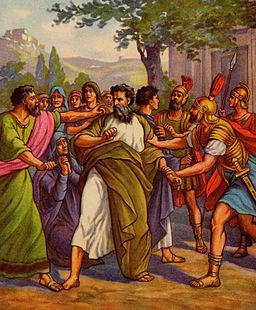
Why Did St. Paul Get Arrested at Philippi?

At daily Mass, we are reading the story of St. Paul’s arrival in Philippi and later of his arrest, beating, and imprisonment. It serves as a kind of metaphor for the radical nature of true Christianity and why it so perturbs many in this world. The Christian faith, its message, and the transformation it can effect can be very unsettling to a world that literally and figuratively “banks on” sin. Let’s consider this lesser- known story and see what it ought to mean for us if we take our Christian faith seriously and do not try to “tame” it.

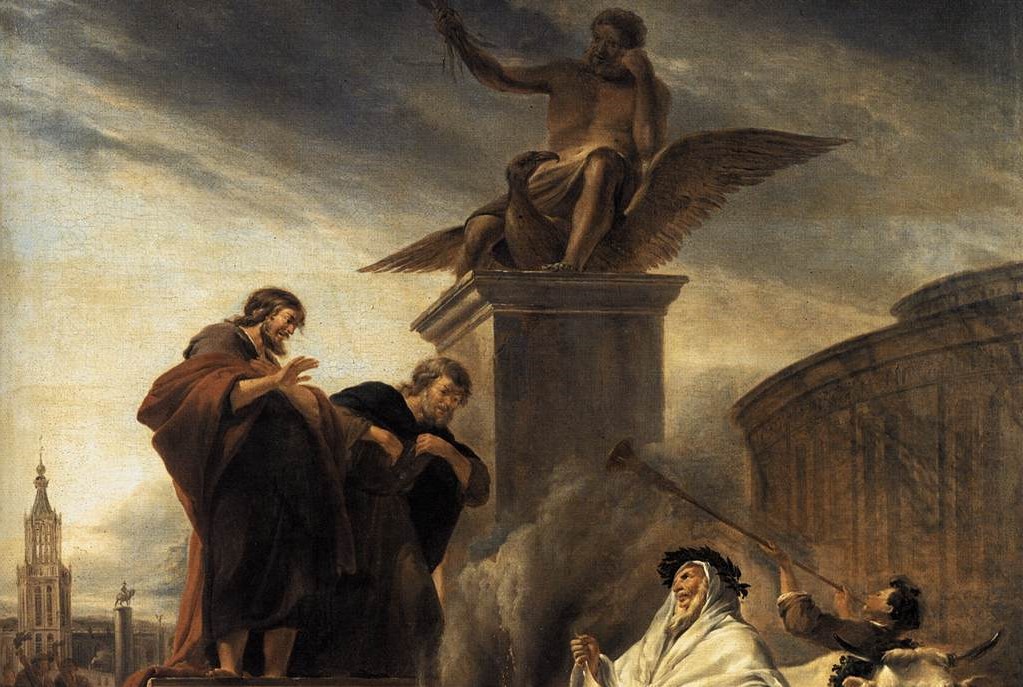
Philippi was the first “European” city that Paul evangelized when he came across from Asia Minor. Arriving at the port of Philippi in Macedonia, Paul and Silas went right to work evangelizing. One of their first converts was Lydia, a wealthy woman from Thyatira who was a dealer in purple cloth; other converts followed.

Once when we were going to the place of prayer, we were met by a slave girl who had a spirit by which she predicted the future. She earned a great deal of money for her owners by fortune-telling. This girl followed Paul and the rest of us, shouting, “These men are servants of the Most High God, who are telling you the way to be saved.” She kept this up for many days. Finally, Paul became so troubled that he turned around and said to the spirit, “In the name of Jesus Christ I command you to come out of her!” At that moment the spirit left her.

When the owners of the slave girl realized that their hope of making money was gone, they seized Paul and Silas and dragged them into the marketplace to face the authorities. They brought them before the magistrates and said, “These men are Jews, and are throwing our city into an uproar by advocating customs unlawful for us Romans to accept or practice.”

The crowd joined in the attack against Paul and Silas, and the magistrates ordered them to be stripped and beaten. After they had been severely flogged, they were thrown into prison, and the jailer was commanded to guard them carefully. Upon receiving such orders, he put them in the inner cell and fastened their feet in the stocks (Acts 16:16-24).

Note the heart of the problem: St. Paul, in setting the slave girl free of her demon has deprived her “owners” of the income they derived from her sad state. They were banking on her bad condition and profiting from her trouble. In the name and power of Jesus Christ, St. Paul sets her free. His action draws deep anger from the “owners.” He has rocked their world; he has touched their pocketbooks. They find the Christian message, for it is revolutionary, to be disconcerting, threatening, and deeply unsettling.

It is a threat not only to profit but to power. In having Paul and Silas arrested, they stir up the hatred and fear of others as well, accusing them not only of preaching some strange new religion but of advocating customs forbidden to Romans. The word translated here as “customs” is ἐθη (ethe) in Greek, and refers to “religious rites or forms of worship.” In De Legibus, ii. 8, Cicero wrote, “No person shall have any separate gods, or new ones; nor shall he privately worship any strange gods, unless they be publicly allowed.” While the Romans often overlooked the private worship of unapproved gods, publicly proclaiming new and unapproved deities was an occasion for dissension and controversy and was strictly forbidden.

Frankly, the charges against Paul and Silas are true enough. In the healing they brought about, they have hindered profit. Further, they were openly proclaiming that Jesus was Lord. To our ears that is a religious proclamation, but to Roman ears it was a provocative and revolutionary statement. It was directly contrary to their proclamation that Caesar was Lord. Yes, Paul, Silas, Luke, and the others were shaking the ground in Philippi! While they were not advocating the overthrow of any government, they were announcing a power greater than Caesar, a higher King who demanded our first loyalty.

This is not the “tame” proclamation of the faith so common today. This is not a faith that is adjusted to fit into worldly categories. This is not a faith tucked in after political, philosophical, and moral preferences. This is a faith that shakes the world and brings a revolutionary challenge to its priorities. Yes, Paul and Silas pose a serious threat.

What of us today? We have gone through a long period during which we have lived the faith quietly; it generally fit quite well into the world in which we lived. Harmony and “getting along” were highly prized. Particularly here in America, Catholics wanted to reassure the general populace that our faith in no way hindered us from being full participants in the American scene and that we could fit right in and be just like everyone else. With the election of the first Catholic president back in 1960, we could say that we had made it and had been fully accepted. Finally, we fit in.

Of course the culture was not in such disrepair in those days. There was still a fairly wide moral consensus rooted in the Judeo-Christian vision. Having finally “made it,” though, we have assumed room temperature; the fire of our distinctively Catholic culture seems to have faded away. At the same time, Western culture has also largely died. (Is that really a coincidence?)

In recent years, so-called Catholic universities and other Catholic institutions have begun caving in: giving marriage benefits to same-sex bedfellows and succumbing to the HHS mandates to provide contraceptives and abortifacients. It is sad, pathetic, wrong, and cowardly—hardly the revolutionary faith that got Paul arrested.

Now we are coming full circle. We must rediscover how revolutionary our Catholic faith truly is to this world gone mad. As we proclaim healing and an allegiance to something other than this world, however, we will become increasingly obnoxious to the world around us.

Let’s consider more thoroughly the two offenses for which Paul and Silas were beaten and imprisoned:

  1. They ate away at profit – Paul drove a terrible demon out of a slave girl, a demon that afflicted her but profited her “owners.” There is a great deal of trafficking in sin and addiction today. Terrible demons afflict many people in the areas of sexuality, drugs, and alcohol. There’s a lot of money to be made peddling pornography; sex sells. Hollywood movie producers, purveyors of contraceptives, pimps, escort services, abortionists, and even traffickers in the sex slave industry also feed at the trough. Drugs and alcohol are big money makers as well. Huge numbers of products are sold using the demon of fear that says, “You’re not pretty enough,” “You’re not healthy enough,” “You’re getting old,” “You don’t drive the right car,” “You don’t wear the right clothes.” The demons of fear, low self-esteem, and greed all work together.

What would happen if the Church were to start effectively preaching unabridged Christianity? What if we started saying, “You don’t need to be afraid of your health, your age, or what people think of you. You can find serenity in Christ so that you won’t feel you need for those drugs. You can be set free from your enslavement to sex, take authority over your passions, and discover the beauty of traditional marriage.” What if we got back in the business of driving out demons?

Well, of course the answer is that we, like Paul, would be under attack. In fact, we are under attack. We are especially hated by the sex industry and the abortionists because that that issue has so much focus these days. To them we are public enemy number one. We threaten the vision, the addiction, and the despair that fills their coffers. If we are too successful (and for now our successes are meager) their profits might dry up. Yes, we must be dealt with.

We will only be effective if we preach the unabridged faith, not a faith that is adjusted, not a faith that is subordinated to worldly priorities, not a faith that insists on being “realistic,” not a faith that apologizes to the world no matter how much we water things down. The true faith is revolutionary in the freedom it offers from sin and demons.

Paul and Silas didn’t wind up in prison by preaching a watered-down, domesticated moral vision. They unabashedly drove out a demon that was afflicting a girl; in so doing they engaged in a revolutionary threat to a world that profits handsomely from sin.

2. They threatened power – Calling Jesus “Lord” was a revolutionary threat to the incumbent power that demanded first and full loyalty. Today, many try to make Catholics fit into tidy political categories. Both Republicans and Democrats want the Church to march in lockstep with their party platform. Even many Catholics in those parties want the Church to conform. Many Catholics in fact are more loyal to their party than to the Church; they are more passionate about their political views than their faith. If there is a conflict between Church teaching and the party line, guess which one usually gives way!

In the end, the Church will not just fit into some neat political category. The true faith is too revolutionary to fit into some worldly box.

Thus there is a lot of hatred and anger directed at the Church. Republicans say we’re too liberal; Democrats say we’re too conservative. More and more we are being shown the door, kicked to the curb; our very right to religious liberty is being threatened. Religious exemptions to increasingly pernicious laws are slowly being removed and lawsuits against Catholic institutions are increasing. It will surely get worse as secular systems demand increasing loyalty. The Church must refuse to give that loyalty.

Jesus (not the federal, state or local government) is Lord. Jesus is not Republican or Democrat, conservative or liberal. He is God, and the faith He announces cannot be watered down or compromised to fit into a friendship with the world.

No domesticated Christianity will change the world. When Paul preached, the people rioted. Modern preaching too often incites only yawns and indifference.

What should we learn from St. Paul’s arrest at Philippi? That the true faith is revolutionary and threatens the world right where it hurts: in the profit and power centers. As the world becomes increasingly secular, the revolutionary aspect of the faith will become more evident.

Are you ready?
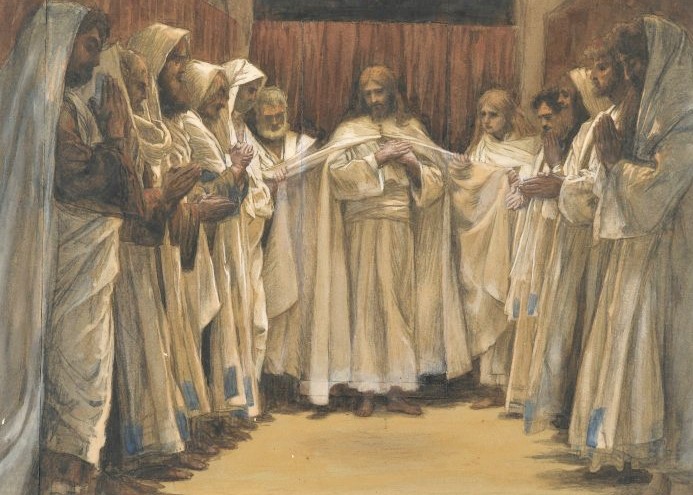
Four Gifts of Grace – A Homily for the 6th Sunday of Easter

The Gospel for Sunday has a number of “sayings” of the Lord Jesus, which together amount to a kind of litany of love. It is a setting forth of the gifts that He, by His grace, is accomplishing and will accomplish in us. Let’s consider the wonderful gifts of grace.

I. PowerJesus said to His disciples, “Whoever loves me will keep my word.”

Here is a fundamental theology of grace: keeping the commandments and mandates of the Lord’s Word is the fruit of His love, not the cause of it. The Lord says that if you love Him, the keeping of the commandments is sure to follow. Note that we do not initiate this love, God does. Scripture says, We love because he first Loved us (1 John 4:19).

No one can give what he does not have, and no one can possess what he has not received. God is the author and initiator of love. Love always starts with Him. The Lord is not setting up some sort of loyalty test here, as if He were saying, “If you love me, prove it by keeping my commandments.” That is not the gospel! The gospel is that God loved us before we were ever born, before we could do anything to merit His love. He loved us when we were dead in our sins, and He took the initiative to love us even when we hated Him and crucified Him.

If we will accept this love, it will enable us to love God with the same love with which He loves us. With His love in us, we will begin to love what He loves and whom He loves. We will love holiness, forgiveness, mercy, justice, compassion, chastity, and generosity. We will love our brethren—even our enemies. Why? Because God loves them. When His love is in our heart, so is His love for them.

Do you understand this? Love enables us to keep His Word, to live it and to love it. When I was young, I dated a girl who liked square dancing. At the time, I thought square dancing was silly, but my love for her meant that I started to love what she loved; I came to love her family, too. If we let love have its way, it changes our heart and our desires.

If you let love have its way you will keep the commandments. The keeping of the commandments is the fruit of love, not its cause. Love is the power of grace at work in us to love what and whom God loves. Jesus says, If you love me, you will keep my commandments (John 14:15).

II. Presence – [Jesus says,] and my Father will love him, and we will come to him and make our dwelling with him.

One of Jesus’ great desires was to restore us to unity with the Father. Jesus was crazy about His Father and earnestly desired to have us know Him and love Him more deeply.

If we will but accept the Father’s love and His shalom, offered through Jesus, we will have a tender and joyful relationship with our Abba, our Father. Jesus often described His Father almost as doting. He is like a shepherd who leaves the 99 in search of the one. He is like a woman who loses a coin, sweeps diligently to find it, and then celebrates by throwing a party more costly than the coin itself. He is like a father whose son effectively tells him to “drop dead,” but who, when the son finally returns, runs out to meet him and has a feast in celebration.

Do you grasp this? The Father loves you and Jesus has reconciled you to Him. Now run to Him; run to Abba, God. If you take one step, He’ll take two, and then He’ll start running to embrace you!

This is the gospel message: Jesus Christ has reconciled us to the Father at the Father’s own request. The Father loves you. Now run to Him and watch Him run to you. He does not want distance; He wants intimate presence, love, and embrace.

III. Perfection – [Jesus says,] I have told you this while I am with you. The Advocate, the Holy Spirit, whom the Father will send in my name, will teach you everything and remind you of all that I told you.

We all know that the Christian journey is not accomplished in an instant. Rather, we make this journey with God, the Holy Spirit, who teaches us and makes us mindful of all that Jesus has done for us and taught us. Little by little, we are given a new mind, a new heart, a new walk, and a new and better life. May God who has begun a good work in bring it to perfection (cf Phil 1:6).

If we are open to Him, He is faithful, and He will do it. The process may be slow, but that is only because we have foreheads of brass and necks of iron (cf Is 48:4). God is faithful and patient. I am a witness; if He can change me, He can change you. He has promised to do so, and He will.

We will be transformed by the renewal of our mind (cf Rom 12:2), for the Holy Spirit will bring to our mind all that the Lord is and all that He taught. Let the Lord change your mind and heart. If He does that, the rest will follow. Sow a thought, reap a deed; sow a deed, reap a habit; sow a habit, reap a character; sow a character, reap a destiny—and it all begins with the mind.

One of the gifts of grace is the renewing of our mind, and it leads to total transformation.

IV. Peace – [Jesus says,] Peace I leave with you; my peace I give to you. Not as the world gives do I give it to you. Do not let your hearts be troubled or afraid. You heard me tell you, “I am going away, and I will come back to you.” If you loved me, you would rejoice that I am going to the Father; for the Father is greater than I. And now I have told you this before it happens, so that when it happens you may believe.

What is the gift of peace? Peace is shalom; it is more than the absence of conflict. It is the presence in the relationship of everything that should be there. Peace is the experience that everything is all right.

For us, peace is access once again to the Father. It is being able once again to walk with Him in love, in and through Jesus Christ. We don’t just walk with Him in some earthly garden paradise, as Adam and Eve did. Rather, we walk with Him in Heaven. In Jesus we are seated with the Father in honor at His right hand.

So, what does it mean when the same Jesus who said, “The Father and I are One” (Jn 10:30), also says, “The Father is greater than I” (Jn 14:28)?

Theologically, we can distinguish two ways of understanding this text. Many theologians emphasize that Jesus is referring to His human nature when he says, “The Father is greater than I.” As God, He is equal to His Father, but as man, He is less than His Father. Other theologians remind us that, even in terms of His divinity, the Father has a certain greatness as the source in the Trinity. All the members of the Trinity are co-eternal, co-equal, and equally divine, but the Father is the Principium Deitatis (the Principle of the Deity). The Father eternally begets the Son, the Son is eternally begotten, and the Holy Spirit proceeds from them both. Because Jesus proceeds from the Father from all eternity, He is in effect saying, “I delight that the Father is the principle of my being, even though I have no origin.”

Devotionally, Jesus is saying that He always does what pleases His Father. Jesus loves His Father. He’s crazy about Him. He’s always talking about Him and pointing to Him. By calling the Father greater, He in effect says, “I look to my Father for everything. I do what I see Him doing (Jn 5:19) and what I know pleases Him (Jn 5:30). His will and mine are one. What I will to do proceeds from Him. I do what I know accords with His will.”

This is the source of our peace. With Jesus, we love the Father and always do what pleases Him. Jesus “goes to the Father,” but He takes us with Him, for we are members of His mystical Body. In Jesus, we enter the holy of holies and sit next to the Father in love and intimacy.

Here, then, are some important gifts of grace. It is up to us to lay hold of them and to live out of them. The Lord promises them to us, so they are ours. If at times they seem distant, reach out and take back what the devil stole from you. These are gifts of the Lord’s resurrected grace.

This song that speaks of peace and presence, not to mention power:


Learning from the Early Church: It is necessary for us to undergo many hardships to enter the kingdom of God.

The first reading from Sunday Mass this week (5th Sunday of Easter) is very Catholic, and it’s too informative to just pass by. It presents a Church as rather highly organized and possessed of some the structures we know today in full form. Granted, some of these structures are in seminal (seed) form, but the are there.

One can detect qualities of the original kerygma that are at variance with what some modern thinkers declare should be the methodology of the Church. The soft Christianity of many today, who remove the cross and replace it with a pillow and who insist upon inclusion and affirmation to the exclusion of all else, is strangely absent in this early setting.

Let’s examine the reading (Acts 14:21-27) and see the true path of priests, teachers, and leaders in the Church. Four steps are prescribed for our consideration based on this reading. We note that they went forth announcing, admonishing, appointing and accounting.

I. AnnouncingAfter Paul and Barnabas had proclaimed the good news to that city and made a considerable number of disciples …

Notice that the happiness is linked to the harvest. Proclaiming the Good News, they yield a great harvest. We are not, as Catholics, sent out to proclaim a mere list of duties. We are sent to proclaim the gospel: that God has loved the world and sent His Son, who by dying and rising from the dead has purchased for us a whole new life, free from sin and the rebellious obsessions of this world. He is victorious over all the death-directed drives of this present evil age. Simply put, He has triumphed over these forces and enabled us to walk in newness of life.

We are sent to announce a new life, set free from the bondage of sin, rebellion, sensuality, greed, lust, domination, and revenge. We are sent to announce a life of joy, confidence, purity, chastity, generosity, and devotion to the truth rooted in love.

Yes, here is a joyful announcement rooted in the cry Anastasis (Resurrection)! New life, the old order of sin is gone, a new life of freedom from sin is here!

Did everyone accept this as good news? No. Some—indeed many—were offended and sought to convict Christians as disturbers of the peace. Some people don’t like to have their sin and bondage called out as such. They prefer darkness to light, holiness, and freedom.

As Catholics, we announce what is intrinsically good news and we ought to start sounding like it by proclaiming it with joy! There should be no bitterness or anger, which would be more indicative of one trying to win an argument rather than joyfully announcing something wonderful, freeing, and true.

II. Admonishing They returned to Lystra and to Iconium and to Antioch. They strengthened the spirits of the disciples and exhorted them to persevere in the faith, saying, “It is necessary for us to undergo many hardships to enter the kingdom of God.”

Preaching and teaching are processes. You don’t just do it once and then move on; you return and reiterate. Note that they retrace their steps back through towns that they have already evangelized. They do not just come, have a tent revival, and then move on. They return, and as we shall see, they establish the Church.

Notice what they do:

        • Encourage – They strengthen the spirits of the disciples
        • Exhort – They exhort them to persevere in the faith
        • Explain – They say, “It is necessary for us to undergo many hardships to enter the kingdom of God.”

Let’s focus especially on the last the point. In effect, they announce and teach, “If you’re not willing to endure the cross, no crown will come your way. If you can’t stand a little disappointment, if you can’t stand being talked about sometimes, if you think you should always be up and never down, I’ve come to remind you: no cross, no crown.”

Yes, beware of crossless Christianity. We do have good news to proclaim, but there is also the truth that we get to the resurrection and the glory through the cross. There is a test in every testimony, a trial in every triumph. There are demands of discipleship, requirements for renewal, laws of love, and sufferings set forth for saints.

Good preaching combines hardship and happiness in one message. It is a joy to follow in the footsteps of our Lord, who endured hostility, hardship, and the horrors of the cross yet triumphed and showed that the wisdom of this world is foolishness to God. Yes, He has caught the wise in their craftiness and shown that the thoughts of the wise of this world are futile (cf 1 Cor 3:20). He made a public spectacle of them, triumphing over them (paradoxically) by the cross (cf Col 2:15).

Saints Paul and Barnabas announce the cross, a stumbling block to Jews and foolishness to Gentiles (cf 1 Cor 1:23). Many today insist that the Church soft-pedal the cross, that we use “honey, not vinegar.” No can do. We joyfully announce and uphold the paradox of the cross and must be willing to be a sign of contradiction to this world, which sees only pleasure and the indulgence of sinful drives as the way forward, that exalts freedom without truth or obedience, and calls good what God calls sinful.

Too many so-called Christian denominations have adopted the pillow as their image and a “give the people what they want” mentality. It is 180 degrees out of phase with the cross.

The Catholic Church does not exist to reflect the views of her members but to reflect the views of her founder and head, Jesus Christ. Jesus announced the cross without ambiguity, saying, as he went out to die, Now is the time for judgment on this world; now the prince of this world will be driven out. And I, when I am lifted up from the earth, will draw all men to me (John 12:31-32).

We announce the cross, not merely as suffering, but as life, power, and love. By the power of the cross, it is possible to live without sin and to overcome rebellion, pride, lust, and greed. It is possible by the power of the cross to learn to forgive and to live the truth in love.

The world will hate us for this, but such hardships, such crosses, are necessary preludes to the hallelujah of Heaven. The Church can do no less than to point to the cross. The center of our faith is a cross, not a pillow, and the cross is our only hope (Ave crux, spes unica nostra!). Yes, the Church announces the cross and admonishes a world obsessed with pleasure and with passing, fake happiness.

III. AppointingThey appointed presbyters for them in each church and, with prayer and fasting, commended them to the Lord in whom they had put their faith. Then they traveled through Pisidia and reached Pamphylia. After proclaiming the word at Perga they went down to Attalia.

Thus, we see the ordination of priest leaders in every place. “Priest” is just an English mispronunciation of “presbyter.” Paul and Barnabas did not simply go about vaguely preaching and then moving on. They established local churches with a structure of authority. The whole Pauline corpus of writings indicates a need to continue oversight of these local churches and to stay in touch with the priest leaders established to lead these local parishes.

Later, St. Paul spoke of the need for this structure in other places, when he wrote to Titus, This is why I left you in Crete, that you might amend what was defective, and appoint presbyters in every town as I directed you (Titus 1:5).

This appointment was done through the laying on of hands and is called ordination today. It was a way of establishing order and office in the Church to make sure the work continued and that the Church was governed by order. This why we call the sacrament involved here the “Sacrament of Holy Orders.”

Note, too, that a critical task for leaders in the Church is developing and training new leaders. Too many parishes today depend on charismatic and gifted leaders, whose inevitable departure leaves a void rather than an ongoing ministry or organization. This should not be so. Good leaders train new leaders.

IV. Accounting From there they sailed to Antioch, where they had been commended to the grace of God for the work they had now accomplished. And when they arrived, they called the church together and reported what God had done with them and how he had opened the door of faith to the Gentiles.

Note that Saints Paul and Barnabas are now returning to render an account for what they have done. Accountability is part of a healthy Church. Every priest should render an account to his bishop, every bishop to his metropolitan and to the Pope. Today’s ad limina visits of bishops to the Pope is the way this is done. Further, priests are accountable to their bishop through various mechanisms such as yearly reports and other meetings.

A further background to this text is that Paul and Barnabas are returning to Antioch because it was from there that they were sent forth by the local bishops and priests on this missionary task.

While they were worshiping the Lord and fasting, the Holy Spirit said, “Set apart for me Barnabas and Saul for the work to which I have called them.” 3 Then after fasting and praying they laid their hands on them and sent them off. (Acts 13:2).

Thus, St. Paul was not the lone ranger some think him to be. He was sent and was accountable.

But when he who had set me apart before I was born, and had called me through his grace, was pleased to reveal his Son to me, in order that I might preach him among the Gentiles, I did not confer with flesh and blood, nor did I go up to Jerusalem to those who were apostles before me, but I went away into Arabia; and again I returned to Damascus. Then after three years I went up to Jerusalem to visit Cephas and remained with him fifteen days (Gal 1:15-18).

Then after fourteen years I went up again to Jerusalem with Barnabas, taking Titus along with me. I went up by revelation; and I laid before them (but privately before those who were of repute) the gospel which I preach among the Gentiles, lest somehow I should be running or had run in vain (Gal 2:1).

The preacher and teacher must be accountable: For we shall all stand before the judgment seat of God; for it is written, “As I live, says the Lord, every knee shall bow to me, and every tongue shall give praise to God.” So each of us shall give account of himself to God (Rom 14:10-12).

Here we see some paths for priests, preachers, teachers, and leaders. We must announce the gospel as good news, with joy and confidence. We must admonish a world obsessed with pleasures (and Church members affected by this mentality) to embrace the cross as our only hope. We must continue to develop, train, and appoint leaders to follow after us. Finally, we must be accountable to one another.

Here is a nice, quick portrait of some healthy traits for the Church.


The Legacy of Love – A Homily for the 5th Week of Easter

The title of this sermon uses the word legacy, which refers to something transmitted by or received from an ancestor or predecessor.

Perhaps the most accessible image of this is money. If I receive 100 million dollars from a dying relative, I can the money to start living differently. My bills, which now seem overwhelming, can be paid with just the interest earned from my newfound wealth. I can start enjoying things I thought I could never afford in the past. In other words, a legacy can completely change the way I live and open up new possibilities.

It is in this sense that we explore today’s Gospel, wherein our Lord sets forth for us a new power: the power of love. If we tap into it and draw from its riches, we are able to live differently. If we will but lay hold of it, there is a kind of legacy, a deposit of riches from which we can draw.

Let’s look at today’s Gospel in three stages and discover what the Lord has done for us and has left us by way of a legacy.

I. The Provision and Pivot of the Passion – The text says, When Judas had left them, Jesus said, “Now is the Son of Man glorified, and God is glorified in him. If God is glorified in him, God will also glorify him in himself, and God will glorify him at once.

Note how the text speaks in the present tense: the Son of Man is glorified. Judas’ going forth has started a process that is now underway and will, by God’s grace, result in liberation and glorification for Jesus and for us. The Lord Jesus is no mere victim. Everything is unfolding exactly as foretold. The Son of Man will suffer but, in the end, will be glorified. This glory will make available for us a whole new life.

Now this leads us to a question: What happened when the Son of God died and rose for me? This question is not posed in order to receive merely the answer from the catechism. Expressed more deeply, these are the questions: What difference does the passion, death, and resurrection of Jesus Christ make for me today? Are they just ancient historical events that are meaningful only because others say so? Or have I grasped and begun to lay hold of what Jesus has done for me?

Scripture says that Jesus’ death is glorification and new life for us: We know that our old self was crucified with him so that the sinful body might be destroyed, and we might no longer be enslaved to sin…We were buried therefore with him by baptism into death, so that as Christ was raised from the dead by the glory of the Father, we too might have a whole new life (Rom 6:4-7).

In other words, Jesus, the Son of Man, is glorified in His passion and is destroying the power of sin and death by His cross and resurrection. We need to spend our life pondering what happened when the Son of God died for us. It is not merely some historical event. It is that, but it is far more. To the degree that we will lay hold of this saving work, we will come to see and experience the power of the cross of our Lord Jesus Christ to put sin to death and to bring new life forth in Christ.

Of this, I am a witness, for I have seen the power of the cross to quell sinful fears, worldly lusts, and endless preoccupations. On account of what Jesus endures for us, He ascends on high not to leave us but to open the way for us to a greater and fuller life. It is a life in which we see sin put to death and many graces and charisms come alive: charisms of confidence, joy, and hope; it is an increasingly victorious life. It is up to us to grasp this saving work and the new life it offers us by the power of the cross of Christ and Him crucified.

This is the moment of glory, the pivotal point of all things. This the glory and the basis of a new life. Because of what Jesus does at this moment, His glory and ours is ushered in; it is all based on this.

II. The Power and Produce of the Passion – The text says, I give you a new commandment: love one another. As I have loved you, so you also should love one another.

When we hear the phrase “Love one another as I have loved you.” we can fall into the trap of thinking, “Uh oh, I have to do more! I have to try harder. Because He loved me, now I, with the power of my own flesh, have to love others.” However, this is not about rules; it’s about relationship. Jesus is not just saddling us with more responsibilities. He is equipping, empowering, and enabling us to love with the same love with which He has loved us.

The point here is to let Jesus love you, to experience His love, and with this love, experienced and embraced, be empowered to love others.

The Lord does not just say, “Love.” Rather, He says, “Receive love and then love with the love that you have received.” Scripture says,

      • We love, because he first loved us (1 John 4:19).
      • As the Father has loved me, so have I loved you. Abide in my love! If you keep my commandments, you will abide in my love, just as I have kept my Father’s commandments and abide in his love (John 15:9).

In other words, we have the power to keep His commandments and to love others to the degree that we receive and abide—that is, remain—in His love. We love with His love, not merely with our own love.

Do not miss this point! Do you see it? This is the message: by the power of His love and grace we are empowered to love, to keep His commandments, and to see our life changed. Today’s Gospel is not a moralism that tells us to obey a bunch of rules. It is that God has sent His Son, who died for us and rose to give us a wholly new and transformed life, a life that keeps the commandments and loves others with the power of God’s own love, received and experienced.

III. The Proof Positive of the Passion – The text says, This is how all will know that you are my disciples, if you have love for one another.

We have discussed many times on this blog the fact that the usual Greek word for “know” is richer than our modern notion of “intellectual knowing.” The Greek word for merely knowing something intellectually is oida, but the verb used in today’s Gospel is γινώσκω (ginosko), which refers to experiential knowing, to knowing in a deep, personal, and experiential way.

Thus, the point is that others will notice the legacy of love living us in a very real and experiential way. The faith, hope, and love that we proclaim will not, and cannot, be a mere intellectualism; it must be something that others can see and experience at work within us.

Hence, the proof, the evidence, the picture of God’s love, is not some vague feeling or a mere intellectual attribute in us. It is a powerful and dynamic force that equips, empowers, and enables us to love. The Lord says here that His love is something that changes us in a way that others will notice. It changes our relationships in a palpable, tangible, and noticeable way. We notice and experience its power and so do others.

Yes, we will love even our enemies, and we will do this not out of the power of our own flesh or because have to, but because we want to receive, and have received from the Lord, a new heart and the power to love.

Note also that the love we have will not be a merely sentimental one. It will be a true love, a love rooted in truth. It will be a love like Jesus has, one that does not compromise the truth or water down its demands. It will be a love that speaks the truth but does so not merely to win an argument but to summon the other to fulfillment and flourishing. This is what Jesus did. He loved, but He loved in truth and integrity. Nothing would compromise His love for His Father or the glorious vision and plan of the Father for all His children to abide in truth and holiness.

The proof positive that the legacy of love is at work within us is, first of all, our own transformed lives, which others can see. Second, it is the love that others can and do experience from us. Granted, this love will sometimes challenge and irritate others, but it is a love that is difficult to deny, an integrity that is hard to impugn, a love that, even if disconcerting, is real, palpable, and obvious.

This, then, is the legacy of love. It is a treasure, an inheritance that the Lord Jesus has left us to draw upon. This love is not our work; it is not our wealth, not our power. It is all His. He has left it for us to draw upon. Will we? Or will we make excuses about how we are not able to do the things to which He has summoned us? Don’t you get it? It is not our power, not our love; it is His, and He has left us this legacy, this inheritance, to draw upon.

Lay hold of this power, this love, and let it transform your life. Let it turn you into proof positive of the power of the cross to transform lives and to bestow new life.


Do You Fear the Right Thing? A Meditation on the Story of Chicken Little

In the wake of the COVID-19 explosion of fear, we do well to begin reflecting on fear. Fear is a complex passion. On the one hand, there are things that we ought to fear such as grave physical and spiritual dangers. The fear of being near the edge of a cliff might well save our life. The fear of serious sin and the punishment we might experience or the offense to God (who loves us) is both appropriate and holy. Sadly, more people lack this holy fear rooted in the possible loss of what is most precious to us: our eternal life with God.

There are also things we fear that we should not, and things that we fear more than we should. These sorts of fears are usually rooted in our disordered and inordinate affections.

A disordered affection is a love for something that is sinful. We ought not to love it at all, but we do; this causes us to fear anyone or anything that interferes with accessing and enjoying what is fundamentally sinful.

An inordinate affection is a love for something that is good in itself, but the love we have for it is too great. Loving it too much causes us to fear the loss of it more than we should. Many things in this world are lawful pleasures, but we come to love them too much. We love things more than people, and both things and people more than God. This is all out of order. We are to use things, love people, and worship God. Too often, though, we use people, love things, and forget about God.

There is also the great struggle that many have called the “sin of human respect,” wherein we fear people more than we fear God and seek to please people more than to please God. When we fall prey to this, we are willing to do sinful things in order to ingratiate ourselves to other human beings, fearing and revering them more than we do God.

Fear is a necessary passion for us, but too often our fears are misplaced and inordinate. Our fears are easily manipulated by Satan and the world.

A major area for spiritual growth is knowing what and whom to fear. Apart from God we will seldom get this answer right. We are easy prey for the devil and the world to draw us into all sorts of inordinate and even foolish fears.

Because a story can often have an impact that mere discourse cannot, I would like to illustrate this teaching with a well-known children’s story.

The story is the basis for two phrases in common use. Most are familiar with them, but some have never read (or have forgotten) the story from which they come. The first is “The sky is falling!” and the second is “Chicken Little” (used as a description of a person).

Both these phrases come from the children’s story Chicken Little. It is a story that speaks to the need to be careful about what we fear and what we do not fear. For indeed, one of the traps of Satan is to get us to focus on what we ought not to fear, or on what is secondary, so that we do not focus on what we should fear, or on what is more important. Aristotle, citing Socrates, said that courage is the virtue of knowing what to fear and what not to fear.

Please take the time to read this story completely. It may seem tedious to us modern folks with limited attention spans, but its conclusion is made more powerful by the litany of details. Please share it with your children as well.

Chicken Little was in the woods one day when an acorn fell on her head.
It scared her so much she trembled all over.
She shook so hard, half her feathers fell out.
“Help! Help!” she cried. “The sky is falling! I must go tell the king!”
So she ran in great fright to tell the king.

Along the way she met Henny Penny.
“Where are you going, Chicken Little?” Henny Penny asked.

“Oh, help!” Chicken Little cried. “The sky is falling!”
“How do you know?” asked Henny Penny.
“Oh! I saw it with my own eyes, and heard it with my own ears,
and part of it fell on my head!”
“This is terrible, just terrible!” Henny Penny clucked. “We’d better run.”

So they both ran away as fast as they could. Soon they met Ducky Lucky. “Where are you going, Chicken Little and Henny Penny?” he asked.
“The sky is falling! The sky is falling! We’re going to tell the king!” they cried. “How do you know?” asked Ducky Lucky.
“I saw it with my own eyes, and heard it with my own ears, and part of it fell on my head,” Chicken Little said.
“Oh dear, oh dear!” Ducky Lucky quacked. “We’d better run!” So they all ran down the road as fast as they could.

Soon they met Goosey Loosey waddling along the roadside.
“Hello there, Chicken Little, Henny Penny, and Ducky Lucky,” called Goosey Loosey. “Where are you all going in such a hurry?”
“We’re running for our lives!” cried Chicken Little. “The sky is falling!” clucked Henny Penny. “And we’re running to tell the king!” quacked Ducky Lucky.
“How do you know the sky is falling?” asked Goosey Loosey.
“I saw it with my own eyes, and heard it with my own ears, and part of it fell on my head,” Chicken Little said. “Goodness!” squawked Goosey Loosey. “Then I’d better run with you.”

And they all ran in a great fright across a meadow. Before long they met Turkey Lurkey strutting back and forth. “Hello there, Chicken Little, Henny Penny, Ducky Lucky, and Goosey Loosey,” he called. “Where are you all going in such a hurry?” “Help! Help!” cried Chicken Little. “We’re running for our lives!” clucked Henny Penny. “The sky is falling!” quacked Ducky Lucky. “And we’re running to tell the king!” squawked Goosey Loosey.
“How do you know the sky is falling?” asked Turkey Lurkey.
“I saw it with my own eyes, and heard it with my own ears, and part of it fell on my head,” Chicken Little said. “Oh dear! I always suspected the sky would fall someday,” Turkey Lurkey gobbled. “I’d better run with you.”

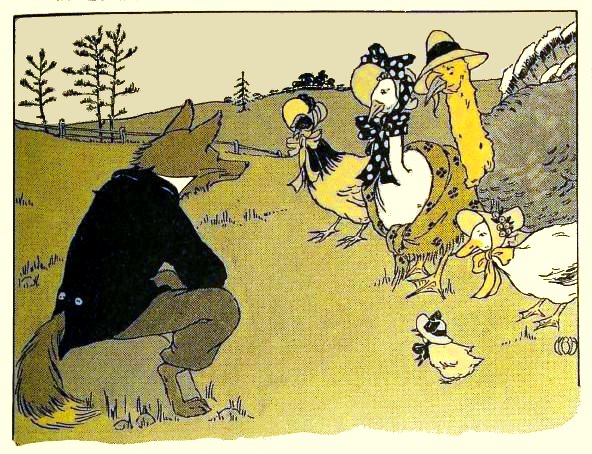
So they all ran with all their might, until they met the fox, Foxy Loxy. “Well, well,” said Foxy Loxy. “Where are you rushing on such a fine day?”
“Help! Help!” cried Chicken Little, Henny Penny, Ducky Lucky, Goosey Loosey, and Turkey Lurkey. “It’s not a fine day at all. The sky is falling, and we’re running to tell the king!” “How do you know the sky is falling?” said Foxy Loxy.
“I saw it with my own eyes, and heard it with my own ears, and part of it fell on my head,” Chicken Little said. “I see,” said Foxy Loxy. “Well then, follow me, and I’ll show you the way to the king.”

So Foxy Loxy led Chicken Little, Henny Penny, Ducky Lucky, Goosey Loosey, and Turkey Lurkey across a field and through the woods. He led them straight to his den, and they never saw the king to tell him the sky was falling.

Notice how fearing the wrong thing, and fearing it to excess, blinded them to what was more truly to be feared, what was more truly a threat. Here lies a doorway for the devil. He incites us to fear lesser things like unpopularity, loss of money, poor health, the loss of worldly trinkets, the next election, global warming, persecution, and worldly setbacks, so that we do not fear Judgment Day and the possibility of Hell.

The day of destiny is closing in, but never mind that! The sky is falling: the wrong political party is in power; the planet is overheating; the economy is about to collapse COVID-19 everywhere! You might lose your home to a storm; people might not think you are pretty enough, tall enough, or thin enough. Be afraid; be very afraid! You don’t have time to pray and ask God to get you ready for Judgment Day because you are too busy being afraid that eating food X may cause cancer, or that people may be laughing at you because of the five or ten pounds you gained last Christmas, or that the Yellowstone Caldera may blow at any time.

I will not tell you that the aforementioned concerns have no merit, only that they have less merit than what most people never think about or fear: where they are going to spend eternity. Chicken Little and her friends were easy prey for Foxy Loxy because they were obsessed with lesser things and ignored more dangerous (and obvious in this case) things like a fox!

Yes, “Foxy Loxy” has you worried about smaller and passing things. Now you are easy prey. It will take but a moment for him to lead you astray and have you for dinner!

Make sure you fear the right thing. God has a plan to simplify our lives. We are to fear Him and be sober about getting ready, with His help, for the certain-to-come Day of Judgment. If we fear Him, we don’t need to fear anyone or anything else.

Bishop Robert Barron has observed that the three tallest buildings in Chicago are insurance buildings. Fear “looms large” in our culture, but no insurance company can insure you against the only certain threat you face: Judgment Day. Only God can do that.

The sky may or may not be falling. (Personally, I doubt 80% of the media’s fearmongering.) But Judgment Day surely is looming. Foxy Loxy (Satan) is waiting for you. Will he get you? Will your fear of the Lord help you to avoid falling prey to his deceptions?


What Did Jesus Call Us? – A Homily for the 4th Sunday of Easter

The Lord says, “My sheep hear my voice.” That’s right, He called us sheep. Get a little indignant with me here! The Lord is comparing us not to majestic eagles, beautiful gazelles, swift horses, mighty lions, or clever doges, but to sheep. While reality may hurt, the truth can liberate. Although sheep are considered somewhat lowly animals, they are valuable as well. Let’s consider today’s Gospel in three stages.

I. THE SIGN OF THE SHEEP What does the Lord mean in using sheep as a sign for us? Here are some qualities of sheep that may help illustrate what He is teaching.

Sheep are WAYWARD – They tend to wander off. A sheep will graze for a while and then look around and seem to wonder, “Where am I?” He doesn’t know how to get back to the fold unless the shepherd goes out and brings him back. Sheep just keep on going and don’t come back. Dogs and cats can find their way home, horses can find the barn, but sheep can’t manage to find their way back without the shepherd seeking them out and guiding them.

Don’t tell me that doesn’t describe us! Like sheep, we have gone astray, each to his own way (Isaiah 53:6). Yes, we easily become lost. We need the sheepfold of the Church; we need Christ the Shepherd, ministering through His Pope, bishops, and priests. Without that we would just wander here and there.

Sheep are WITLESS – Sheep are just not that bright. We train dogs, birds, horses, and even lions, but you don’t hear about trained sheep too frequently!

We human sheep like to think we’re smart. Sure, we’ve been to the moon, and we have all this advanced technology, but too many of us aren’t even bright enough to pray every day, go to Mass on Sundays, and follow God’s basic directions for life.

We’re so witless that we do things that we know will harm us. Even the simplest directions from God we either confuse or stubbornly refuse to follow. We cop an attitude and say, “We know a few things too.” That’s right, we know very few things.

In fact, we’re so dumb that we think we’re smarter than God! We think our way is better than His way. Now that is really dumb!

Sheep are WEAK – Sheep have no way to protect themselves. Mules can kick, cats can scratch, dogs can bite, rabbits can run away, and skunks—well, you know what they can do—but without the care of the shepherd and the help of sheep dogs, sheep are doomed! The wolf comes and all they can do is stand there get devoured.

So it is with us. If it were not for the care of Jesus the Good Shepherd, we’d be cornered by the world, the flesh, and the devil. If it were not for the Lord and the power of His grace, we would be toast!

We like to think we’re strong; we have armies, political power, monetary power, and star power that can feed that illusion. Then at the slightest temptation we fall! We need the Lord and His grace and mercy, or we don’t stand a chance. We are weak and prone to sin.

YET …

Sheep are WORTHWHILE – In Jesus’ day, many a man counted his wealth by the number of sheep he owned. Shepherds made many sacrifices to breed, herd, and protect these valuable animals, which provided meat, milk, and wool. So it is with us. At times we may not feel worthy, but apparently we were worth saving because the Lord paid the price of our redemption. He knew the price and paid it all—not with silver and gold but with His own precious blood (1 Peter 1:18-19).

Sheep WALK together – Sheep flock together and are safer that way. To be a solitary sheep is dangerous; it’s a good way to get eaten.

Be sober, be vigilant; because your adversary the devil, as a roaring lion, walketh about, seeking whom he may devour (1 Peter 5:8). Scripture also says, Woe to the solitary man! For if he should fall, he has no one to lift him up (Eccles 4:10). Sheep are not supposed to go off on their own, and neither are we.

We are called to part of a flock and to be under the care of a shepherd. Most of us realize this in a parish setting, but in the wider sense, each of us is under the care of a bishop and ultimately the care of the Pope, who is the chief shepherd and Vicar of Christ, the Good Shepherd.

The Lord Jesus said that there is to be one flock and one shepherd (John 10:16). God wants us to be in the protection of the flock with a shepherd watching over us. An old spiritual says, “Walk together, children. Don’t you get weary. There’s a great camp meeting in the promised land.” Too many like to point out that the Pope doesn’t know this or that, but please consider that to wander from the care of the flock and the shepherd is a mighty dangerous thing.

Sheep are WARY – In the Gospel of John, Jesus says, He who enters by the door is the shepherd of the sheep. To him the gatekeeper opens; the sheep hear his voice, and he calls his own sheep by name and leads them out. When he has brought out all his own, he goes before them, and the sheep follow him, for they know his voice. A stranger they will not follow, but they will flee from him, for they do not know the voice of strangers (John 10:11-14).

Sheep have the remarkable quality of knowing their master’s voice and of instinctively fearing any other.

In this matter, sheep are smarter than most of us, for we do not flee voices contrary to Christ’s. Instead, we draw close to those voices and ask, “Tell me more.” In fact, we spend a lot of time and money to listen to those other voices. We buy televisions so that the enemy’s voice can influence us and our children. We spend large amounts of time watching television, listening to the radio, and perusing the Internet.

Yes, we can so easily be drawn to the enemy’s voice. Not only do we not flee from it, we feast upon it. Instead of rebuking it, we rebuke the voice of God. We put His Word on trial instead of putting the world on trial.

We must be more wary, like sheep, and respond only to one voice: that of the Lord speaking though His Church. We must flee every other voice.

II. THE SAFETY OF THE SHEEP – Jesus goes on to say, my sheep hear my voice; I know them, and they follow me. No one can take them out of my hand. My Father, who has given them to me, is greater than all, and no one can take them out of the Father’s hand.

Note Jesus’ promise that He will not be overpowered, no one can snatch from His hand. The Book of Daniel says, His kingdom is an everlasting kingdom that shall not be destroyed, his kingship shall not be destroyed (Dan 7:14). In no way can the devil have power over Jesus or His flock.

This is all predicated on what’s been said: if we want protection and safety, we have to know only Jesus’ voice and stop running after all sorts of false shepherds and contrary voices. We have to stay with the true Shepherd, Jesus, and within the protection of His flock. If you want safety, stay in the shelter of Jesus’ shepherding.

Let us be clear on this point: no weapon waged against us can ever prosper (Isaiah 54:17). Satan cannot harm us unless we open the door. Satan is like a dog on a leash: he can only harm us if we get too close to him through our own foolish decisions! Satan is a chained dog; do not stray into his range or territory!

Yet so many people do! They savor the darkness of pop culture, visit pornographic Internet sites, consume a steady diet of revengeful “action” movies, and are drawn in by commercials telling them to buy the latest product with its promises of empty fulfillment. A steady stream of polluted water and then we wonder why we are sick and weak, full of the parasites of sin.

Is it any wonder that our thinking is distorted, unbiblical, dark, and foolish? At least sheep know to flee a false shepherd. Too many of us are intrigued by the ranting of false shepherds. We glamorize evil and fill our minds with false teaching and improper priorities.

Thus, while no one can snatch from Jesus’ hand, this is not some magical protection that prevents us from foolishly and sinfully walking away from Him. If we do walk away, woe to us; if we stray, our strength will fail!

Pay attention, fellow sheep: do not stray from the Shepherd. The protection of the Lord is only for those who desire and freely choose such protection. He can protect you, but not if you live a double life or open the door to your heart to Satan. The Lord is not a slave owner; He is a lover who invites us to freely accept His offer of new life rooted in a loving and trusting relationship with Him.

Do you know His voice? Do you know only His voice? Do you run form every voice contrary to His, or do you seek counselors who tell you what your itching ears want to hear? (cf 2 Tim 4:3) If you remain true, you have the protection of the Savior Jesus Christ, and nothing will ever harm you (Luke 10:19)—but if you stray, be not surprised at the presence of wolves.

III. THE SALVATION OF THE SHEEP – The text goes on to say, I give them eternal life, and they shall never perish.

For the flock of the Lord there is the gift of “eternal life.” Too many Christians equate this with some distant future that they vaguely hope to attain.

Eternal life does mean the capacity to “live forever and never die,” but it is so much more than that! “Eternal” refers not only to length of life but to its fullness.

In this sense, eternal life is now, as we become ever more aware that If anyone is in Christ, he is a new creation (2 Cor 5:17). Of this I am a witness, being far more alive in my fifties than I ever was in my twenties! My body ages, but my soul is younger and more vibrant than ever.

Here is the promise to lay hold of: those who are in the shepherd’s care come, in stages, to experience life more fully, to become more fully alive. Jesus our Shepherd promises us eternal life, but this does not wait until Heaven—it is now. We sheep are brought to salvation, to healing, if we will accept it. If we choose freedom and the Shepherd’s cares, it is ours! If we reject some or all of it, then we live apart from His care and vision and become easy prey for savage wolves.

Are you smarter than a sheep? Do you know how to recognize the Shepherd’s voice and follow only Him, or are you foolishly running after worldly advice and sinful priorities? On this Good Shepherd Sunday, strive to be good sheep.

Yes, He called us that—sheep. Sheep have this going for them: they recognize only their shepherd’s voice and run from any other.


Why Does It Take So Long to Build and Almost No Time to Destroy?

One of the questions I have asked God is, “Why does it always take so long to build something up while it only seems to take moment to tear it down or destroy it?”

Destruction is always so much easier than construction. Decades, centuries, even a millennium of building a culture (e.g., Christendom) seems to have vanished overnight.

All I get from God is, “Never mind, just keep working.” It would seem that God finds value in the work, not just in the results. Even so, my question (my frustration, actually) remains. However, I will do what He asks and keep on teaching, building, and working.

The following commercial speaks humorously to my concern. Months of mathematical analysis is destroyed in a moment by a tuned-out man who does not recognize the beauty or value of what he erases.

Your Life is Not About You, As Illustrated in a Biblical Story

In Wednesday’s reading, the Acts of the Apostles sets forth an event that amounts to a tale of one Church in two cities or regions. It illustrates well a couple of points: that the Church is always in need of reform and that our lives are not merely about us and what we want. Let’s look at the event in two scenes.

Scene 1: The Church in Jerusalem –

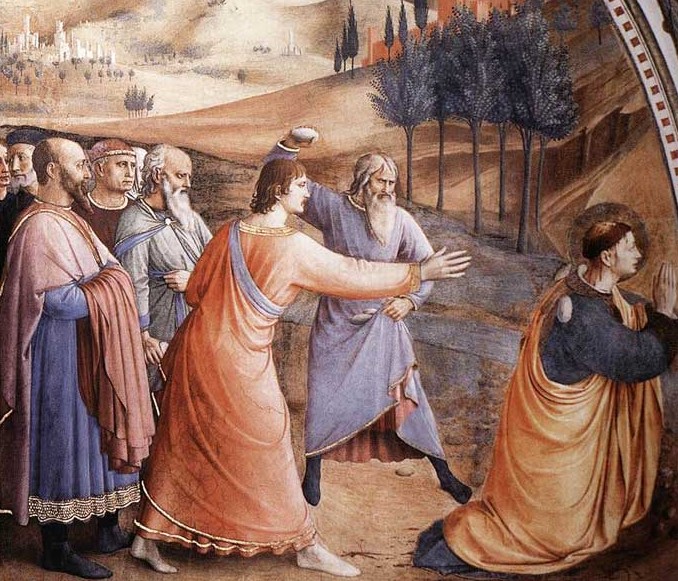
There broke out a severe persecution of the Church in Jerusalem, and all were scattered throughout the countryside of Judea and Samaria, except the Apostles. Devout men buried Stephen and made a loud lament over him.
Saul, meanwhile, was trying to destroy the Church; entering house after house and dragging out men and women, he handed them over for imprisonment
. (Acts 8:1-4)

Up until now the Church in Jerusalem has experienced steady growth. To be sure there has been some persecution, but mainly of Peter, John and the other apostles. A passage from earlier in Acts describes a kind of springtime for the Church in Jerusalem following Pentecost: 

They devoted themselves to the apostles’ teaching and to the fellowship, to the breaking of bread and to prayer. A sense of awe came over everyone, and the apostles performed many wonders and signs. …With one accord they continued to meet daily in the temple courts…sharing their meals with gladness and sincerity of heart, praising God and enjoying the favor of all the people. And the Lord added to their number daily those who were being saved. (Acts 2:42-47)

And yet, just at this moment of growth the Lord permits a persecution that, in many ways devastates the young community. There is the first martyrdom, a widespread arrest of Christians (led by Saul) and a scattering of “all” the community.  A worldly perspective may ask, “Why O Lord?! This is bad timing. The Church was just getting her feet on the ground in Jerusalem and you have permitted her to be all but destroyed!”

Yes, the Lord had summoned the Church to the cross. And why? God alone knows the full reason, but we can speculate as to some reasons.

In the first place, the idyllic picture of Acts 2 has already been marred by squabbles and injustice of ethnic origin. The Greek-speaking widows were being neglected, it would seem (Acts 6:1). This may also point to other internal struggles that give the impression that the Church may be losing focus on essentials and that the outward priority of evangelizing is giving way to inward squabbles.

Further, there is the emerging picture of a Church rather settled in Jerusalem. But had the Lord not summoned them to go into all the world teaching, evangelizing, saving and drawing people to the sacraments? (see Matthew 28:19-20; Luke 24:47). There is no mention to this point of that taking place, or of any plans for it. So, perhaps the Lord permits this persecution to give the Church a nudge out of the nest. In saying they were scattered, we get the image of seed being sown. The blood of martyrs is seed for the Church and persecution fires up the faithful and distinguishes them from the merely fair-weather friends of the Lord. Ecclesia semper reformanda (the Church is always in need of reform).

The upshot of the whole episode is evangelical, for the faith now spreads north to Samaria and into Judah.

Scene 2:  The Church in Samaria (The Church and Mission are Bigger than Us) –

Now those who had been scattered went about preaching the word.
Thus Philip went down to the city of Samaria
and proclaimed the Christ to them.
With one accord, the crowds paid attention to what was said by Philip
when they heard it and saw the signs he was doing.
For unclean spirits, crying out in a loud voice,
came out of many possessed people,
and many paralyzed and crippled people were cured.
There was great joy in that city
. (Acts 8:4-8)

Here is a very different picture! Having been prodded by the Lord through a permitted persecution, the tears and suffering in one city, in one part of the Church, benefit others in a new and different part of the Church. Demons are being cast out, healings are taking place, the lame are walking, and there is great joy!

The seeds of faith are being sown by the suffering of some and watered by their tears that others be saved and come to joy. A psalm comes to mind: He who goes out weeping, bearing the seed for sowing, shall come home with shouts of joy, bringing his sheaves with him. (Psalm 126:6)

So, the Lord had to prod the early Church to get moving. But this is only so that the work may become more fruitful and many more be saved. 

And this points to two hard truths that, if accepted, are liberating:

  1. Your life is not (only) about you.
  2. You are not THAT important.

If we are not careful, we are very prone to become self-absorbed and think that our situation is the only thing on God’s radar. But the truth is, God has everyone’s needs in mind. My life is not simply about me and what I want and need and think and see. My life is also about what others need, and what others see and can contribute. I am not so important that God will sacrifice everything and everyone else just to answer my needs. God might actually ask me to suffer and sacrifice so that others may thrive. Our lives are intertwined with the lives of others. I have surely benefited from the sacrifices others have made, and I am called at times to sacrifice that others may come to know God and thrive. Thus, the Church at Jerusalem was permitted by God a persecution and a suffering so that others in Samaria and throughout the world would come to hear the Gospel and be saved. Scripture says elsewhere:

He who has an ear, let him hear.  “If anyone is destined for captivity, into captivity he will go; If anyone is to die by the sword, by the sword he must be killed.” Here is a call for the perseverance and faith of the saints. (Rev 13:9-11)

In our times of self-esteem, we can go too far and presume that my life is all about me and nothing and no one is more important that me and I what I and my family need. Or we can become very focused on the issues that preoccupy us in the Church in America or think that everyone sees what we see, or experiences what we do. This is myopic. The Church is bigger than me or my parish or my country. The Church is in every land, speaks every language and extends back in time and forward as well. God has a little more on his radar than “me” or our small and temporary group.  

This small story from Acts reminds us that the Church is always in need of reform. It also reminds us that the Church is more than me or us. Here is one Church with two scenes. In Jerusalem there is weeping, but in Samaria there is joy. My life is not about me alone. I both benefit from the sacrifices of others and am called to make sacrifices for others. The blood of martyrs is seed for the Church, the tears of the persecuted will often water those seeds. It is a hard but a freeing truth. In heaven we will see what our sufferings accomplished. For now, we must accept whatever the Lord decides, be it suffering or joy, or some combination of both. My life isn’t just about me or what I want. It’s also about you and what you need.