What Are Your Five Loaves and Two Fishes? A Homily for the 17th Sunday of the Year

We have in this Sunday’s Gospel the very familiar miracle of the loaves and the fishes. One is tempted to say, “Oh, that one …” and then tune out, but it contains a personal appeal directly from the Lord’s lips to our ears: “Where can we buy enough food for them to eat?”

Immediately, objections begin to pop up in our minds, but let’s be still and allow the Lord to instruct us by applying this gospel in three stages. I would like to apply it in such a way as to illustrate our need to evangelize the culture in which we live. It is an immense task, one that can easily overwhelm us, but the Lord still bids us to get busy and join Him in feeding the multitudes.

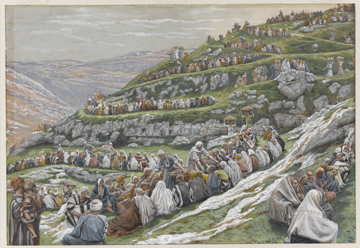
I. THE IMAGE THAT IS EXTOLLED – The text says, Jesus went up on the mountain and there he sat down with his disciples. The Jewish feast of Passover was near. Jesus raised his eyes and saw that a large crowd was coming to him.

The text says that Jesus saw a large crowd. Do we? Often when we think of the Church, declining numbers come to mind. This is because we tend to think in terms of the number of members. Jesus, however, thinks in terms of those who need to be reached. As we know that is a staggering number today. While it seems clear that the gospel is currently “out of season,” we must never forget that everyone is precious to the Lord; He wants to reach all and feed them with His grace, mercy, truth, and love.

So, the image that is extolled is that of need, not of believers and non-believers. Is this how we see the world? Jesus sees it as a vineyard, a mission field. He sees all as hungry, even if they insist they are not. Unfortunately, many reject the food that we in the Church offer. Many deny that they are hungry, but they are hungry, and Jesus is about to ask our help in feeding them. While we may see such people as opponents to the faith, this text presents an image that is rooted in the universal human problem of hunger, physical and spiritual.

II. THE INSUFFICIENCY THAT IS EXPRESSED – The text says, “Where can we buy enough food for them to eat?” Jesus said this to test Philip, because he himself knew what he was going to do. Philip answered him, “Two hundred days’ wages worth of food would not be enough for each of them to have a little.” One of his disciples, Andrew, the brother of Simon Peter, said to him, “There is a boy here who has five barley loaves and two fishes; but what good are these for so many?”

It is easy for us to feel overwhelmed. This is understandable, as the task of evangelizing and feeding the world is a daunting one to say the least.

Note that in this gospel, the apostles are not without any resources at all with which to feed the crowd. What they have may seem insufficient, but it is not nothing.

Similarly, we today may feel overwhelmed by the cultural meltdown taking place before our very eyes. It seems that every number we want to go down is going up, and every number we want to go up is going down. The cultural war is occurring on multiple fronts: family, marriage, sexuality, life issues, religious freedom, schools, church attendance, the rise of secularism and atheism, and the lack of personal responsibility and self-control. The list could go on and on. It is not difficult to see the disrepair in our culture. The task of evangelizing our culture may seem far more difficult than coming up with two hundred days’ wages.

Notice that Jesus says, “Where can we” get enough (food in this case) to solve the problem. It is not only up to us mere mortals to resolve the grave issues of the day. The Lord asks us to work with Him. With Him we have a fighting chance!

III. THE IMMENSITY THAT IS EXPERIENCED – The text says, Jesus said, “Have the people recline.” Now there was a great deal of grass in that place. So the men reclined, about five thousand in number. Then Jesus took the loaves, gave thanks, and distributed them to those who were reclining, and also as much of the fish as they wanted. When they had had their fill, he said to his disciples,” Gather the fragments left over, so that nothing will be wasted.” So they collected them, and filled twelve wicker baskets with fragments from the five barley loaves.

By now this story is so familiar that we are not shocked by the outcome, but no matter how many times we hear it, it’s still hard to accept its astonishing truth. These Scripture passages also speak to that truth:

  • I can do all things in God who strengthens me (Phil 4:13).
  • All things are possible to him who believes (Mk 9:23).
  • For man it is impossible, but not with God, for all things are possible with God (Mk 10:27).
  • Now he who supplies seed to the sower and bread for food will also supply and increase your store of seed and will enlarge the harvest of your righteousness (2 Cor 9:10).

We all know that this world is in an increasingly bad state and the problems feel overwhelming. In addition, the resources we have seem so limited to be able turn back the tide. What will we ever do with only five loaves and two fishes?

Jesus says, “Bring them to me.”

Remember that a journey of a thousand miles begins with a single step. The conversion of the whole world begins with each one of us. As we look at the huge problems before us, each of us must assess our “loaves and fishes”:

  • I can work on my own conversion. A holier world must start with me. If I get holier, the world gets holier.
  • I can serve the poor, perhaps with money, maybe by using my talents to instruct or counsel, perhaps just by giving of my time to listen.
  • I can pick up the phone and call a family member who I know is hurting.
  • I can love my spouse and my children.
  • I can spend time raising my children to know the Lord and to seek His kingdom.
  • I can exhort the weak in my own family. With love, I can rebuke sin and encourage righteousness.
  • If I am a priest or religious, I can faithfully live my vocation and heroically call others to Christ by teaching and proclaiming the gospel without compromise.
  • If I am young, I can prepare myself devoutly for a vocation to marriage, the priesthood, or religious life.
  • If I am older, I can seek to manifest wisdom and to provide a good example to the young.
  • If I am elderly, I can prepare myself for death devoutly and display the desire for Heaven.
  • I can pray for this world and attend Mass faithfully, begging God’s mercy on this sin-soaked world.

It is too easy to lament the condition of the world and, like the apostles, feel overwhelmed. Jesus says tells us that we should just bring Him what we have so that we can get started together. The conversion of the whole world will begin with each of us, with our own meager loaves and fishes.

Jesus will surely multiply them; He will not fail. Already there is renewal evident in the Church through a faithful remnant who are willing to bring their “loaves and fishes.” They are bringing them to Jesus and He is multiplying them. Renewal is happening; signs of spring are evident in the Church.

It’s been said that it’s easier to put on slippers than to carpet the whole world. Indeed it is! If it’s a converted world that you want, start with yourself. Bring your loaves and fishes to Jesus; bring your slippers and let’s get started. It begins with each one of us.

The Stain of Sin, as Seen in an Advertisement

The video below, an ad for a carpet cleaning product, is masterfully done and has a surprise ending. In the ad, the horror caused by the carpet stain is palpable.

I’d like to relate this mere carpet stain to the growing and ominous stain that represents evil.

This stain (macula in Latin) should cause us revulsion and horror similar to that which we have for things that go bump in the night.

Sin ought to spook us! The horror of the stain of sin can lead us to the Lord, who alone can make us immacula (without stain).

“Enjoy” this video!

https://youtu.be/80juKtg1TSk

The Paschal Mystery Writ Personally and Writ Large

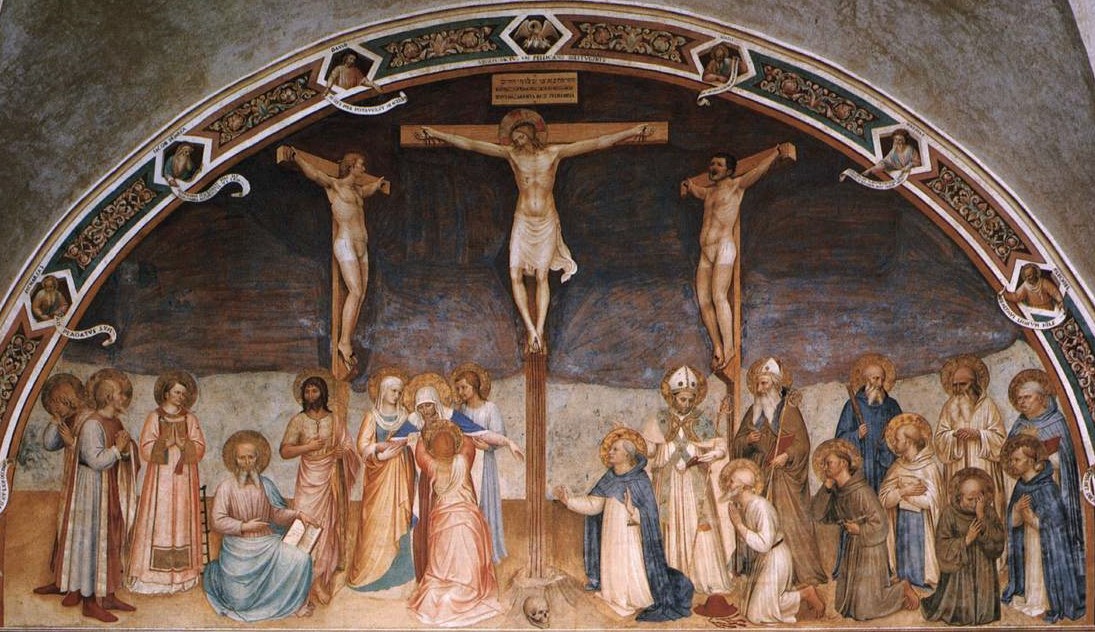
The Crucifixion With Saints, by Fra Angelico (1441-42)

For the Feast of St. James on Wednesday, the first reading was from the Second Letter to the Corinthians. In it, St. Paul speaks of the Christian life on two levels: the individual and the Church. Let’s look at each.

Level One: The Individual

Many times every day we are asked, “How are you?” We often respond by saying, “I’m doing OK.”

But consider, fellow Christian, the truest answer to this question. For us who are Christian, St, Paul supplies a beautiful answer:

Always carrying about in our bodies the dying of Jesus so that the life of Jesus may also be manifest in us (2 Cor 4:10).

As Christians, the Paschal Mystery is our life. We are immersed in the dying, rising, and ascending of Jesus. At every moment of our life, the great Easter mysteries of Christ’s passion, death, and resurrection are at work. With Jesus, we are ascending to the Father. No matter what you may think, this is what is really going on.

This cycle may go on several times each day as both good and bad things happen to us or around us. The pattern is also evident in the fact that there are challenging and difficult years in our life as well as ones that are more serene and joyful. Yes, we die, and we rise with Christ. This is the Paschal Mystery; this is our life.

We experience trials, difficulties, disappointments, losses, and even devastation. This is the dying of Christ. That dying, however, leads to new life and so we rise with Christ. It may take “three days” in the tomb, but if we are faithful we rise, not just to where we were before, but more and more alive in Christ Jesus. As the old Adam dies in us we gradually experience the New Adam, Christ Jesus. The old life that dies is replaced by the fuller life of Christ.

Unless the gain of wheat falls to earth and dies to itself it remains just a grain of wheat. But if it dies it [rises and] produces abundant fruit (Jn 12:24).

Consider how much greater the mighty oak tree is compared to the acorn that fell to earth and “died.” There is hardly a resemblance at all. So it is that the life of the New Adam is incomprehensibly greater than the life it replaces: the dying life of the old Adam.

We are dying, and we are rising, but it is not a simple trade off, for in all of it we are ascending higher and higher with Jesus. The next time someone asks, “How’s it going?” or “How are you?” surprise him with the truest answer: Always carrying about in our bodies the dying of Jesus so that the life of Jesus may also be manifest in us (2 Cor 4:10). No matter what you think, this is what’s really going on: the Paschal Mystery is writ personally in our lives.

Level Two: The Church.

In the same passage, St. Paul writes on another level, that of the Body of Christ, the Church. Referring to himself, his sufferings, imprisonments, and difficulties he says,

So death is at work in us, but life in you …. We are afflicted in every way, but not constrained; perplexed, but not driven to despair; persecuted, but not abandoned; struck down, but not destroyed; … Everything indeed is for you, so that the grace bestowed in abundance on more and more people may cause the thanksgiving to overflow for the glory of God (2 Cor 4:8-9; 14-15).

In this way, St. Paul views his suffering (and that of others in the apostolic band) as being for the sake of others in the Church. He suffers so that they might have faith and life. Historically this has been the case: The blood of martyrs is the seed of the Church (Tertullian). Some in the Church have suffered and died so that others might have faith and life. One of the hard but freeing truths of life is this: “Your life is not about you.” The ink of the Creed is the blood of martyrs. We ought never to forget how much others have suffered so that we might have faith.

This is the Paschal Mystery writ large: some in the Church are suffering, even now, and others are thriving and experiencing growth. The Church, the Body of Christ, is dying and rising. St. Paul says elsewhere,

For I think that God has exhibited us apostles as last of all, like men sentenced to death, because we have become a spectacle to the world, to angels, and to men. We are fools for Christ’s sake … (1 Cor 4:9-10).

Indeed! Of the first 33 popes, thirty died as martyrs, two died in exile, and only one died in his own bed. Today’s bishops are often protected, surrounded by layers of staff, cautious in the face of conflict, and in some cases possessed of a comfortable life. St. Paul calls bishops and pastors to a willingness to suffer for the flock if necessary.

Many in the Church today are suffering, although this is often unnoticed by our inwardly focused eyes. (To remedy this, read regularly here: Today’s Martyrs.) Yet in their sufferings the Church obtains mercy and continues to grow. The blood of martyrs is still seed for the Church. In the often-decadent West, we should be somewhat embarrassed at how others are willing to suffer loss, imprisonment, and even death for the faith, while we can barely stir ourselves to roll out of bed and get to Mass on Sunday.

The Lord has so designed His Body, the Church, such that some do suffer, do carry the weight, so that others may thrive and grow. We should be grateful for these sacrifices, often hidden from us but not from God. From their sufferings come life for the rest. It is the Paschal Mystery writ large!

“Strange but Rich Verses” File: What Does Acts 1:4 Mean by Saying that Jesus was Eating Salt with Them?

There is an unusual verse that occurs in the first chapter of the Acts of the Apostles, describing a gathering of Jesus and the apostles after the resurrection but before the ascension. For the most part, modern translations do not reveal the full oddity of the verse. The verse in question, as rendered by the Revised Standard Version Catholic Edition, is this:

And while staying with them he charged them not to depart from Jerusalem, but to wait for the promise of the Father (Acts 1:4).

However, a number of scripture scholars, including none other than Joseph Ratzinger, point out that the verse is more literally translated as follows:

And while eating salt with them he charged them not to depart from Jerusalem, but to wait for the promise of the Father.

The Exhaustive Concordance of the Bible, better known as Strong’s Concordance, makes no mention of the connection of the word συναλιζόμενος (synalizomenos) to salt. It parses the word as syn (with) + halizo (to throng or accumulate) to arrive at the definition “to assemble together.”

However, another source, A Grammatical Analysis of the Greek New Testament (Pontifical Biblical Institute), includes a different analysis of the word: syn (with) + halas (salt), to arrive at the definition “to take salt together” or by extension, “to share a meal.”

So, there seem to be two rather different notions of the etymology. It is also interesting that none of the writings of the Greek Fathers that I was able to consult make any mention of the possible connection to salt, though St. John Chrysostom does connect the word to a meal rather than a mere gathering.

I know just enough Greek to be dangerous; I certainly cannot sort out why different sources parse the word differently, but for our purposes let’s just chalk it up to a difference among experts, much as is the case with another passage on which I have written here: Agapas vs. Philo.

I would like to explore the translation that the Lord was “eating salt with them.” How odd to our modern ears, especially when the “food police” today treat salt almost as a poison! Despite that, salt is still precious today, even if less necessary than it was in the ancient world.

Let’s consider what Pope Emeritus Benedict wrote (as Joseph Ratzinger):

For a correct understanding … the word used by Luke—synalizómenos—is of great significance. Literally translated, it means “eating salt with them.” Luke must have chosen the word quite deliberately. Yet what is it supposed to mean? In the Old Testament the enjoyment of bread and salt, or of salt alone, served to establish lasting covenants (cf Num 18:19, 2 Chron 13:5). Salt is regarded as a guarantee of durability. It is a remedy against putrefaction, against the corruption that pertains to the nature of death. To eat is always to hold death at bay—it is a way of preserving life. The “eating of salt” by Jesus after the Resurrection, which we therefore encounter as a sign of new and everlasting life, points to the Lord’s new banquet with his followers … it has an inner association with the Last Supper, when the Lord established the New Covenant. So the mysterious cipher of eating salt expresses an inner bond between the [Last Supper] and the risen Lord’s new table fellowship; he gives himself to his followers as food and thus makes them sharers in his life, in life itself … the Lord is drawing the disciples into a New Covenant-fellowship with him … he is giving them a share in the real life, making them truly alive and slating their lives through participation in his Passion, the purifying power of his suffering (Jesus of Nazareth Vol. 2, pp. 271-272).

So indeed, salt and covenants are tied. Here are a few verses that make the connection:

  • Whatever is set aside from the holy offerings the Israelites present to the Lord I give to you and your sons and daughters as your perpetual share. It is an everlasting covenant of salt before the Lord for both you and your offspring (Numbers 18:19).
  • Don’t you know that the Lord, the God of Israel, has given the kingship of Israel to David and his descendants forever by a covenant of salt? (2 Chronicles 13:5)
  • Season all your grain offerings with salt. Do not leave the salt of the covenant of your God out of your grain offerings; add salt to all your offerings (Leviticus 2:13).

It makes sense that Luke would refer to Jesus as eating salt with the disciples. To untrained ears it may seem odd, but to ears tuned to the biblical world the reference has great significance. Jesus is affirming the New Covenant and this expression points to that.

Of course, it is no mere table fellowship; it is the meal of the New Covenant we have come to call the Mass. Hence, without doing disservice to Luke’s description, we can say (in our more developed theological language) that during the forty days before He ascended, the Lord celebrated Mass with them. Thus, the Emmaus description (Luke 24:30) of Jesus at the table giving thanks, blessing the bread, breaking it, and giving it to them so that they recognize Him therein, is not the only allusion to a post-resurrection Mass.

Is it “Eating salt with them” or “Staying with them”? You decide, but I vote for salt. 😉

And with Sweet Sleep Mine Eyelids Close – A Meditation on a Beautiful Hymn of the Night

Blog-07-25One of the great night prayer hymns, “All Praise to Thee My God This Night,” appears in numerous hymnals of the English tradition. Sadly, it is not in our current breviary, but I hope that the new one might feature it. It was written by Thomas Ken in 1709 and is most often sung to the beautiful tune of Tallis’ Ordinal, which you can hear in the video below.

Ideally, night prayer should include acts of thanksgiving and praise to God along with repentance for any sins committed. Night prayer is also a time to ponder death and ask God’s graces to be prepared for death and judgment.

This hymn does all of that and more. It is beautiful English poetry, edifying and wonderfully descriptive in just a few verses. It is worth printing out and keeping by your bedside.

Allow me to list its verses and then follow with a short commentary on its themes.

All praise to thee, my God, this night,
for all the blessings of the light:
keep me, O keep me, King of kings,
beneath thine own almighty wings.

Forgive me, Lord, for thy dear Son,
the ill that I this day have done;
that with the world, myself, and thee,
I, ere I sleep, at peace may be.

Teach me to live that I may dread
The grave as little as my bed;
Teach me to die so that I may
Rise glorious at the Judgment Day

O may my soul on thee repose,
and with sweet sleep mine eyelids close;
sleep that shall me more vigorous make
to serve my God when I awake.

When in the night I sleepless lie,
My soul with heavenly thoughts supply;
Let no ill dreams disturb my rest,
No powers of darkness me molest.

And when shall I, in endless day,
Forever chase dark sleep away;
And hymns divine with angels sing,
All praise to thee eternal king?

Praise God, from whom all blessings flow;
praise him, all creatures here below;
praise him above, ye heavenly host:
praise Father, Son, and Holy Ghost.

Commentary:

As I often do, I have named the themes that are set forth in the hymn using alliteration.

PraiseAll praise to thee, my God, this night, for all the blessings of the light. For indeed, every good and perfect gift comes from above, comes from you, Lord, the Father lights (James 1:17). The verse bids me to praise you, God, for “all” the blessings. Some of your blessings come in strange packages, but as your Scripture says, all things work together for good to them that love God, to them who are the called according to his purpose (Rom 8:28). Therefore, at night we ought to acknowledge that “all is gift.” Some gifts are obvious; others only show themselves as gifts later. Even our sufferings produce glory if we are in your Christ. For our light and momentary troubles are achieving for us an eternal glory that far outweighs them all (2 Cor 4:17). Thus I begin, O Lord, my night prayer, praising God for all your blessings of the day, the obvious and the not-so-obvious.

Preservation keep me, O keep me, King of kings, beneath thine own almighty wings. That you “keep” us, Lord, surely means that you guard and protect us. And surely we need your protection. Without you we are sitting ducks; we are low-hanging fruit for the evil one. And while this is true in our waking hours, it is even more so in our sleep, for while sleeping we have even less authority over our thoughts. Night is the time of dreams, not all of them good or pleasant. Night is a time when some of our defenses are down and we cannot make sense of every thought or dream. Protect us, Lord! Do not allow Satan, our flesh, or the vain remembrances of worldly things to overwhelm our sleeping minds! Speak your truth to us even as we sleep. Guard our hearts from fear and sinful inclinations!

PardonForgive me, Lord, for thy dear Son, the ill that I this day have done. Yes, even in the bright of day I have sinned. I need your mercy, Lord. Without it I do not stand a chance. My sin is a kind of sickness. So forgive me, but also heal me. Forgive me, Father, considering the death your Son endured for my salvation. Look beyond my fault and see my need. May my sins be nailed to the cross; may my soul be washed in the Blood of the Lamb!

Purifiedthat with the world, myself, and thee, I, ere I sleep, at peace may be. Of course there is no peace without the forgiveness of sin and the reconciliation with the Father. I need your peace, Lord, not the false peace of the world, which demands silence and compromise with sin in order to avoid conflict. I want to be at peace with the world, by your grace, so that I am no longer enamored by its false promises. I also seek peace within myself, so that with my sins forgiven I no longer am troubled by my conscience, which rightly condemns my unrepented sins. And most fully, I seek peace with you and know that it is my sins alone that separate me from your peace. Yes, Lord, I need your mercy; this alone brings true peace.

Pondering deathTeach me to live that I may dread, the grave as little as my bed. I know, Lord, that for me each night is a dress rehearsal for death. For indeed in a moment I shall lose consciousness and be dead, in a way, to this world. I shall lie in a bed not unlike the coffin in which I will one day rest. As I lie down may I ponder the sober reality that one day I shall lie down and never arise again in this world. Too easily, Lord, when I lie down at night I am assailed by thoughts of resentment, lust, vainglory, or the fear of men and worldly things. Help me, Lord, to ponder death. And may I ponder not only in fear but in longing. For it is death that will bring me out of this exile, this valley of tears, to you! May my fear of death be only of a sudden one for which I am unprepared. Spare me, O Lord, from dying while in serious sin. Preserve me in your grace and love!

Prepared for judgment Teach me to die so that I may rise glorious at the Judgment Day. Yes, Lord, keep me in your paths; order my steps in your word. Teach me to die daily to my pride and to all sin. Tonight I die to pride because I admit that I am weak and cannot carry on without rest; I am not so strong after all. If I must arise in the night, I stumble about in the darkness and fog of sleepiness. May I learn the lesson of the night and die to myself and to my pride. And through this humility may I thus be able to rise glorious on Judgment Day, trusting in your mercy and grace, for my own strength is inadequate.

PeacefulO may my soul on thee repose, and with sweet sleep mine eyelids close. Yes, Lord, holy dreams and peaceful slumber grant to me! But it shall only come to me if I sleep upon the support of your love and promises. Keep me stable on the firm foundation of your love. Hold me close with cords of kindness, with ties of love and be to me like a Father who lifts a little child to the cheek on a journey (Hosea 11:4).

Purposesleep that shall me more vigorous make to serve my God when I awake. I do not ask these gifts for me alone. I know that I must be strong and rested in order to be able to serve well. I humbly admit this and seek your blessing for my rest, that I may serve you and your people more vigorously, generously, and zealously. Help me, Lord. Without you I fail. Give me peaceful rest that I not fall in battle or under the weight of office.

Protection When in the night I sleepless lie, My soul with heavenly thoughts supply; Let no ill dreams disturb my rest, No powers of darkness me molest. Too easily, Lord, the evil one assails me while I sleep with thoughts of discouragement, fear, or sin. Please, Lord, surround me with your protection; fill my thoughts with heavenly things. My dreams are often distorted and confusing. Grant me the grace to ignore such disordered (and usually meaningless) rantings. Order my thoughts; give me the remedy of remembering holy things in the confused hours of early morning or in fitful sleep. Enable me to remember that such thoughts are of no import other than to remind me of my need for you and the goodness, beauty, and truth of your godly order and light. Soon enough morning will come and the haze of the dark hours will scatter. From the confusing hours of darkness, from the grip of disordered thoughts, rescue me, O Lord.

PiningAnd when shall I, in endless day, Forever chase dark sleep away; And hymns divine with angels sing, All praise to thee eternal king? Yes, Lord, when shall you give me wings to fly away and be at rest with you? I have a natural fear of dying, but my soul longs for you in the night, and daylight will still find me sighing for you. Some bight morning when this life is over, I’ll fly away to a home on your bight, celestial shore. May I die loving you and my neighbor. Meanwhile, Lord, keep me faithful until death and help me to remember that all my desires are really about you. I cannot wait to see you. With every day may I run faster to you, who are the desire of my heart and of the everlasting hills. Soon, Lord, soon may I sing forever to you in Heaven even as I now feebly sing this hymn of the night. May these nights usher in endless day.

Amen.

Mortal or Not, Sin Always Causes Harm

For several generations, the Church has used a kind of shorthand in referring to mortal sin, for example, “X is a mortal sin.” The problem is that this general statement is an oversimplification. In order for the individual committing a particular act to be guilty of a mortal sin, three conditions are necessary: grave matter (the act must be intrinsically evil), full knowledge, and deliberate consent (CCC 1857).

It is important to emphasize that even if a particular sinful act does not rise to the level of mortal sin, it is still a sin. No sinful action, even if committed “innocently” will bring a blessing or become good in itself. To sin is always to veer off course and it causes some sort of wound. This is true even if the person is not guilty of committing a mortal sin.

Let’s consider a couple of specific cases of potentially mortal sin and look at the three conditions required to determine that it represents a mortal sin in a particular situation.

Case 1: Skipping Mass on Sunday

Grave Matter

Missing Mass on Sunday is a grave matter because we fail to render fitting thanks and praise to God for His goodness. We sin against justice and charity by failing to gather with God’s people at Mass to do so. In addition, at Mass we are instructed by God and fed with the Body and Blood of the Lord. Jesus says, Unless you eat the flesh of the Son of Man and drink his Blood you do not have life within you (Jn 6:53). Therefore, Mass is necessary for us. Skipping Mass is also a direct violation of the Third Commandment and does harm to the First Commandment. Thus, it is grave matter.

Full Knowledge

Many Catholics today have been poorly instructed and have very few cultural moorings that dispose them to be at Mass each Sunday. Many do not even know that missing Mass is a grave matter. Even if they know that going to Mass is a good thing—surely better than just sleeping in or going shopping—they may not appreciate the seriousness of missing Mass nor understand that the Eucharist is our necessary food. Depending on how responsible they are for this ignorance, their culpability may be reduced, rendering the sin less than mortal.

Deliberate Consent

It is important to consider how thoughtfully a person decides to do something. In some situations, a person may make an impulsive decision, giving little to no thought to the matter. At others, there may be more extensive deliberation. Blameworthiness will center on questions such as these:

  • How long could the person reasonably have deliberated and formed an intention based on the circumstances? Did he take advantage of the available time to deliberate and do so by applying good moral standards?
  • Could the situation have been anticipated or did it arise so suddenly that there was little change to form a careful intention?

So, a person who chooses to miss mass due to a last-minute occurrence (e.g., an old friend calls and is in town only for the day) may be less blameworthy than a person who had time to make other arrangements but chose to miss Mass after careful deliberation of the options.

We live in a culture that makes more peripheral demands on people than was the case forty or more years ago. As more and more businesses are open seven days a week, more people are required to work on Sundays. Other activities such as youth sports leagues put pressure on families on the weekend and make scheduling chaotic. Many people travel on weekends, sometimes for pleasure but also for business. These sorts of things make it difficult to keep a regular, consistent schedule. “Juggling” the schedules of various family members is quite common today.

Unusual circumstances can impede the ability to attend Mass, such as one’s own serious illness or the need to care for someone who is seriously ill. Dangerous weather conditions can prevent attendance or make it ill advised. Emergencies, last-minute transportation problems, and the like can all limit the freedom or ability to get to Mass. If one’s freedom is eroded, culpability may be reduced, rendering the sin of missing Mass less than mortal on a particular occasion. It is always deleterious to miss Mass because one misses Holy Communion, fellowship, and instruction, but to the degree that freedom is eroded, one’s blameworthiness may be reduced, even to a minimum.

Hence, to say, “Skipping Mass on Sunday is a mortal sin,” only refers to the fact that it is a grave matter. It is not possible to speak to every possible circumstance that may legitimately excuse a person from Mass. Neither can it speak to how well formed a person’s conscience is, the quality of his deliberation, or the degree of freedom with which he acts.

There are other sins, grave in nature, where the question of freedom is more subtle. This is a common issue with the sin of drunkenness. It is a grave sin to drink to the point that we are impaired, but there are often compulsions and addictions related to alcohol that may limit the full consent of the will.

Case 2: Masturbation

Grave Matter

The Catechism sets forth why masturbation is grave matter:

Both the Magisterium of the Church, in the course of a constant tradition, and the moral sense of the faithful have been in no doubt and have firmly maintained that masturbation is an intrinsically and gravely disordered action. The deliberate use of the sexual faculty, for whatever reason, outside of marriage is essentially contrary to its purpose. For here sexual pleasure is sought outside of the sexual relationship which is demanded by the moral order and in which the total meaning of mutual self-giving and human procreation in the context of true love is achieved (CCC 2352).

Because human sexuality is a great good and is ordered by the Sixth Commandment, the violation of it is grave matter. It amounts to a turning inward, to misusing that very thing which is meant to relate us intimately to another in marriage and for procreation.

Full Knowledge

Society used to take a rather dim view of masturbation. Today it is widely accepted and even promoted to children. The Catholic Church’s position has not wavered, yet it’s unclear how many Catholics today understand the seriousness of the sin.

Deliberate Consent

The Catechism goes on to say:

To form an equitable judgment about the subjects’ moral responsibility and to guide pastoral action, one must take into account the affective immaturity, force of acquired habit, conditions of anxiety or other psychological or social factors that lessen, if not even reduce to a minimum, moral culpability (Ibid).

Hence, what is a grave matter may not always rise to the level of a mortal sin if the required freedom is lacking to some degree. The affective maturity and other psychological and social factors must be assessed by a confessor working realistically and honestly with the penitent. The confessor should neither disregard a person’s freedom and the possibility for growth, nor should he presume that acts of masturbation always proceed from malice or an utterly selfish desire to turn away from the marital and procreative purposes of sexual intimacy.

However, even if a particular penitent may not be guilty of mortal sin, masturbation is sinful. Engaging in it misconstrues the purpose of sex, indulges in fantasy, and feeds distorted notions of sexuality. It also becomes a growing habit and impedes the self-mastery needed for the gift of oneself to one’s spouse. It is a poor way to prepare for marriage and often hinders the maturity needed for marriage, in which one’s spouse is not always what the perfect fantasy describes. It feeds disappointment in one spouse and feelings of inadequacy in the other.

Thus, masturbation is a sin, even if not always a mortal one. No lack of freedom or extenuating circumstances can make a bad thing good. Masturbation should still be confessed, and one should not determine alone whether it rises to the level of mortal sin. A confessor can and should be consulted and a regular schedule of confession should be determined by the confessor based on the penitent’s struggle. The goal is to become ever freer by growing in self-mastery.

Excursus

The topic of divorce and remarriage requires more attention than I can give here but suffice it to say that whatever personal culpability may or may not accrue in a given situation, divorce and remarriage represents an ongoing situation that cannot admit to a firm purpose of amendment or improvement. The couple may not reasonably be able to make the commitment to live chastely. In addition, the fact that they are in a second “marriage” is typically clear if not to the general public, at least to family and friends. Hence, the common good most often demands that public acts be treated by public remedies. As a result, the Church has long held that couples in this situation cannot receive Holy Communion. (In contrast, a person who misses Mass or struggles with masturbation can make some purpose of amendment; furthermore, his sin is not usually public knowledge.)

Some today would like to hold that individual priests are free to offer Communion to such couples in particular situations. Some even go so far as to say that all couples in second (or third, or fourth, …) marriages can partake of Holy Communion. Even Jesus’ plain words to the contrary fail to convince them.

I understand that there are pastorally complex situations, but Jesus understood this as well and yet did not offer concessions or alternative policies. I would simply say to any priest who permits the reception of Holy Communion in these cases that he will answer to God for it and will have to explain to Jesus why His words did not apply. I will not be the judge. I only ask that he alone bear the burden of his advice and not ask the wider Church to prop him up or change her doctrine to suit his pastoral decisions. Let him carry his own practices to the judgment seat and not ask me or others to be complicit in his views or decisions. Indeed, it ill-behooves the Church to make general policies, norms, or laws out of complex and unique situations; no changes to Canon Law ought to be made.

Conclusion:

The statement “X is a mortal sin” is a simplification. It is only stating that a certain act is grave, intrinsically evil. The warning that some sins are grave ex genere suo (by their nature), ought not be dismissed. However, there are other factors to be considered when determining whether mortal culpability accrues to a certain individual in a certain set or circumstances.

Even if the determination in a particular situation is that all of the ingredients that render an act a mortal sin were not present, this should not be taken to mean that no sin was committed. An act that is objectively sinful cannot become good simply because one commits it in ignorance or out of diminished freedom.

Even if a person means well or acts in ignorance, a sin can never bring a blessing. It brings only harm and wounds. Even if I unknowingly ingest rat poison or if am forced by an enemy to do it, I will not get any benefit from rat poison. It is poison of its nature and it will still cause terrible things. I may not be condemned for ingesting rat poison ignorantly or by force, but I will surely suffer.

Rat poison is bad and causes harm. Sin is bad and causes harm. Don’t seek refuge in ignorance or insufficient freedom; just avoid it altogether!

God’s Cry to His People

Walk humbly with the Lord.

The first reading for Monday from the Book of the Prophet Micah sets forth an important teaching on what the Lord fundamentally requires of us, something that is essential for our good.

The Riv In Hebrew, a “riv” is a kind of lawsuit. The Lord summons all creation to hear the charge He levels against His people. We who are the pinnacle of His creation in some way represent all of His creation and so must also answer before all of creation as to whether we have represented creation well.

Hear, O mountains, the plea of the LORD,
pay attention, O foundations of the earth!
For the LORD has a plea against his people,
and he enters into trial with Israel
.

Allegorically, then, creation is presented as conscious and aware, as a kind of witness. Even if this is not literally the case, neither is it true that we are simply living inside some sort of machine. Creation is a revelation of God, of His glory, His law, and His order. As such, it witnesses to us through the natural law what is good or evil, and it manifests the will of the one who created it—and we are part of that creation.

God therefore turns the tables. What is a witness to us now becomes a witness to our living apart from what God expects. Whenever we violate the natural law, we experience its sentence. There is an old saying that God always forgives, and man sometimes forgives, but nature never forgives. So, it is not good when God calls nature to witness against us. It is better to fall into the hands of God!

The Reproach The core of God’s reproach is that His people weary of Him. Their hearts are far from Him:

O my people, what have I done to you,
or how have I wearied you? Answer me!
For I brought you up from the land of Egypt,
from the place of slavery I released you;
and I sent before you Moses,
Aaron, and Miriam
.

It would seem that they weary of their prayers and sacrifices and of being obedient. We who live in affluent but secular times should acknowledge that most us seldom acknowledge God; we seldom pray to Him or offer the sacrifice on Sunday morning or the sacrifice of an obedient faith. We who have been so blessed with abundance and comfort have collectively said through our actions that prayer, praise, and anything about God that might inconvenience us is wearisome.

God speaks to our heart and asks us to remember His blessings. He does not do this because He has a big ego and needs praise but because we need to keep our hearts close to Him. We must listen to Him and heed what he says. Otherwise, we block our future blessings as well as those of our descendants.

The Reaction God’s people react with what can be interpreted either as scornful hyperbole or as a cry of desperation.

With what shall I come before the LORD,
and bow before God most high?
Shall I come before him with burnt offerings,
with calves a year old?
Will the LORD be pleased with thousands of rams,
with myriad streams of oil?
Shall I give my first-born for my crime,
the fruit of my body for the sin of my soul?

If the text is hyperbole, then it can be read to mean: “What? You want even more? Are the Temple sacrifices not enough? Must I multiply these wearisome things even more? Do you now seek even thousands of sheep, rivers of oils, my first-born, even me?”

This cry goes up today as religious practice seems burdensome to many: “You want even more of my time? Is there another Holy Day when I must go to Mass? Do you really want a tenth of my income? When will you stop asking me to think of the poor? Haven’t I done enough already? Rosaries, devotions, Lenten sacrifices, abstinence, regular confession—when is it ever enough?” Never mind that we devote far more time and money and make more sacrifices for things related to work, the American dream, and sporting events. An hour at Mass is a burden, but three or four hours watching football is a delight.

Another way to interpret ancient Israel’s reaction is to see it as a cry of desperation. Convicted of a wearisome heart, she admits her fault and despairs of ever being able to love the Lord wholeheartedly. Israel is weary, but in her weariness, she sees no strength to be rejuvenated and have her heart come alive again.

In our times, too, there are those who know of their sin and yet despair that they can change or do better. This amounts to a sin against hope and a lack of trust in God, who seeks not our ruin or depression, but our salvation and joy.

Both the despairing cry and the scornful hyperbole amount to a false absolute of what God seeks.

The Requirement In the end, the Lord seeks the one thing He does not have: entrance to their hearts. God, who is all powerful, stands at the door of our hearts and knocks (see Rev. 3:20).

You have been told, O man, what is good,
and what the LORD requires of you:
Only to do the right and to love goodness,
and to walk humbly with your God
.

It helps to reverse the order of these requirements to see how they are a work of grace. Thus, to be humble is realize that we need God; we need His wisdom, grace, and truth. Without these we cannot walk; we stumble and fall. With humility, though, we admit God into hearts and we walk with Him.

This in turn makes us love goodness, for when God enters our heart by His grace, we begin to love who and what God loves. Thus, our loving of goodness is not merely the stirring up of an emotion; it is a transformation by God’s grace, which comes when we humbly admit our need and allow Him entrance to our heart.

What we love, we do. So, as we love goodness we will do it, not because we have to but because we want to. This is the effect of God’s transforming grace.

In the end, the requirement is not thousands of fat lambs; it is our heart, humbly seeking Him. God “requires” it because He respects our freedom. It is required for us to open the door from the inside when God knocks.

So, in this passage God enters into a “riv” or legal case with us. In the end, though, it is the cry of a loving God to His beloved: “I sense your weariness. Where has your heart gone?” The beloved cries out in exasperation or despair, “What more do you want?” The Lord replies, “Nothing but you, nothing but you.”

Four Teachings on Personal Prayer – A Homily for the 16th Sunday of the Year

The Gospel this Sunday speaks to us of the priority of personal prayer. In last week’s Gospel, Jesus sent the apostles out two by two to proclaim the Kingdom. Now they return, eager to report their progress and the graces they encountered.

As Jesus listens, He urges them (perhaps because they are so overjoyed) to come away and rest awhile, for they have labored long. In so doing, Jesus also teaches us about prayer. Let’s consider four teachings on prayer that are evident in today’s Gospel.

I. The Practice of Praise-Filled Prayer – As the text opens, the apostles are with Jesus, joyfully recounting all they experienced on their missionary journey. In a similar text in Luke (10:17), the apostles return rejoicing, saying that even demons are subject to them (through Jesus’ name). Thus, their first instinct is joyful gratitude before the Lord.

Is your prayer filled with praise and thanksgiving? Are you grateful to God for all He has done? Do you tell God what is happening in your life and give Him thanks for all He has enabled you to do?

Too many people think of prayer only in relation to petition, but praise is also an essential component. When Jesus began His instruction on prayer, He said, When you pray, say, ‘Our Father, who art in heaven hallowed be thy name’ (Mat 6:9). In other words, “Father, your name is holy. You are a great God, a wonderful God. You can do all things and I praise you! Thank you, Father; your name is holy, and you are holy.”

Praise the Lord. Thank Him for what He is doing and tell Him everything that you are experiencing. Scripture says that we were made for the praise of his glory (Eph. 1:16). So, praise the Lord in your prayer. How? Take a psalm of praise. Pray or sing the Gloria from Mass. Sing or recite a hymn. No matter how you do it, praise Him!

II. The Peace of Personal Prayer – Jesus invites the apostles to come away by themselves to a quiet place and rest for a while. Most people don’t think of their personal prayer as a privileged invitation from the Lord, nor do they think of it as rest.

Yet, consider that the Lord invites us to come aside and spend personal and private time with Him. Most people would relish personal attention from a famous person. Why not from the Lord? An old song says, “What a privilege to carry everything to God in prayer.”

Note the description of this time as “rest.” Most people think of prayer more as a task than as a time of rest. Yet to pray is to rest, to withdraw from this world for a brief time and enjoy the Lord’s presence. Scripture says, For thus the Lord GOD, the Holy One of Israel, has said, “In repentance and rest you will be saved. In quietness and trust is your strength” (Is 30:15).

An old hymn says,

Sweet hour of prayer! Sweet hour of prayer!
That calls me from a world of care,
And bids me at my Father’s throne
Make all my wants and wishes known.
In seasons of distress and grief,
My soul has often found relief,
And oft escaped the tempter’s snare,
By thy return, sweet hour of prayer!

Learn to think of prayer as quiet time, as rest with the Lord, when He soothes, strengthens, refreshes, and blesses us.

III. The Primacy of Prioritized Prayer – The text says that people were coming in great numbers seeking the attention of the Lord and the apostles; they could not even get a moment to eat!

There is no doubt that the people had critical needs. They needed to be taught, healed, fed, and cared for in many ways. Yet despite this Jesus said, in effect, “We have to get away from all this for a while.” He directed the apostles to go off in the boat to a deserted place.

Indeed, one of the few places they could “get away” was out on the water. There, the crowds could not follow them, and they could be alone and quiet for a short time.

Jesus made prayer a priority. Scripture says of Him, But Jesus often withdrew to lonely places and prayed (Luke 5:16). Scripture also speaks of Him rising early to pray (Mark 1:35), praying late into the night (Matt 14:23), praying all night long (Luke 6:12), and praying in the mountains (Matt 14:23) and other deserted places.

Understanding prayer as rest helps us to understand why prayer must be a priority in our lives. If we are going to engage in the work to which God has called us, we need to be replenished and refreshed daily by spending time with Him.

If we were to engage in physical work without ever stopping to rest, we would collapse. The spiritual life has a similar law. Resting with God in prayer fills us with His presence, grace, and strength so that we can be equipped, empowered, and enabled unto the tasks that He has given us.

No one can give or share what he does not have, so if we aren’t praying and experiencing God’s presence, how can we share it? To share grace, we must first receive it. To speak the Word, we must first receive it. To witness to the Lord, we must first know Him.

Jesus often had to hide in order to pray. Sometimes the only quiet place He could find was out on the lake, but He did make time for prayer. He invites the apostles and us to do the same, not only despite the busyness of life, but because of it.

A Brief Story –

A priest friend of mine told me that back in the 1970s he once gave spiritual direction to a religious sister. At that time, it was common for people to say, “My work is my prayer.” When this priest inquired about the good sister’s prayer life she answered, “Oh, I’m too busy to pray, but that’s OK because my work is my prayer; that’s my spirituality.” He replied, “Sister, if you’re not praying, you don’t have a spirituality.” He got her to start praying for one hour a day. Some years later, he ran into her at the airport. By now, she had moved on to become a major superior in her order. “How are you doing, Mother?” he asked. “Oh,” she replied, “I am very busy!” He cringed, but then she added, “I’m so busy these days that I have to spend two hours a day praying!”

Now there’s a smart woman! When we’re being foolish we say, “I’m too busy to pray.” When we’re smart we say, “I’m so busy that I need to pray more.”

Jesus made prayer a priority. Prayer is the rest that strengthens us for the task; it is the refreshment that gives us new vigor and zeal.

IV. The Power of Pious Prayer – The text says that after Jesus spent this time alone with the apostles on the boat, they reached the other shore. Sure enough, the crowd was there waiting for them, but Jesus and the apostles had been refreshed and were now well-rested. Jesus, renewed and refreshed, saw the vast crowd and began to teach them at great length.

Prayer has that effect. In drawing close to God, who is love, we are better equipped to love others. Jesus, though He never lacked love for them, models this renewal for us. The text says that upon seeing the crowd, His heart was moved with pity for them. The Greek word translated as “pity” is σπλαγχνίζομαι (splagchnizomai), which means “to be moved with compassion.” The word “pity” often carries with it a condescending tone, but what happens here is that Jesus sees them, loves them, and has compassion for their state. The religious leaders in Jerusalem have largely abandoned them, considering them “the great unwashed,” but Jesus loves them and teaches them at great length.

It often takes many years and a lot of prayer to equip our hearts in this way. One of the signs that grace and prayer are having their effect is that our love for others, even for the multitudes, grows deeper, more compassionate, more patient, and more merciful. This takes great prayer and long hours of sitting at the Lord’s feet learning from Him.

Here is the power that prayer bestows: we are more fully equipped for our mission, more zealous, and more loving. The rest afforded by prayer rejuvenates our better nature and helps it to grow.

So, here are four teachings on prayer. Jesus found time to pray; He made it a priority. How about you?