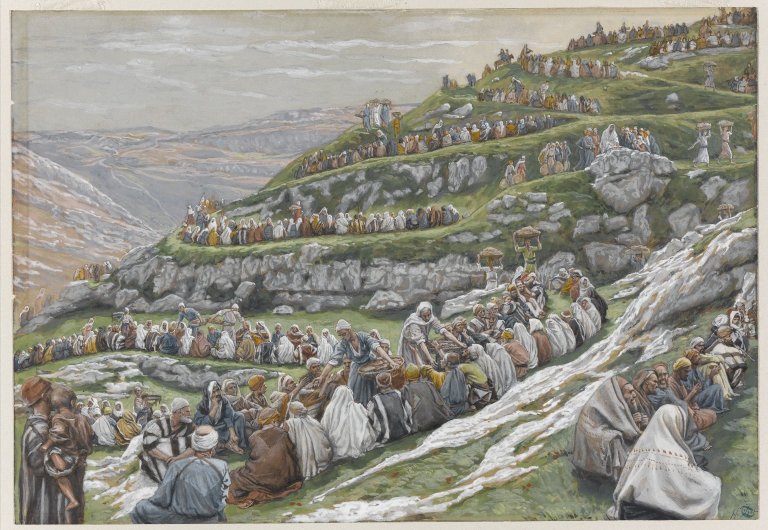
Jesus Wants to Feed You! Corpus Christi

On the Feast of Corpus Christi, we do well to mediate on the desire of the Lord to feed His people and the shocking indifference many have to this fact. This indifference is not just on the part of those who do not come to Mass; it is also found among those in the pews, many of whom don’t seem to care that so many people no longer attend. We should recognize the passionate concern the Lord has to feed all His people—yes even your wayward spouse or child.

Let’s consider today’s Gospel in three ways.

I. Desire that is Discerned – Jesus has been teaching the crowds all day by the lake. The text says, As the day was drawing to a close, the Twelve approached him and said, “Dismiss the crowd so that they can go to the surrounding villages and farms and find lodging and provisions; for we are in a deserted place here.”

The diagnosis here is that the crowd is hungry. And this is a diagnosis of the human condition in general: we are hungry.

How are we hungry? Let us count the ways. We are a veritable sea of desires. We desire food, drink, life, health, honor, respect, popularity, intimacy, family, security, goodness, beauty, truth, serenity, justice, and so much more. Yes, we have so many desires; we are hungry. And herein lies an insight for evangelization. For Somehow amidst all this hunger, God is calling us. We are like the woman at the well, who came thirsty for the water of this world but was shown by the Lord that she actually desired Him, and that it was only He who could satisfy her.

It is sad that while every advertiser on Madison Avenue knows how to tap into people’s desire and draw forth loyalty, we Christians have so little insight. For the people of this world are more shrewd in dealing with their own kind than are the people of the light (Lk 16:8).

And thus we are like the Apostles, irritated and clueless that people have needs. In effect we say, “You are needy. Go away,” rather than “You are needy. Wow, have I got an answer for you! You want what is good, true, and beautiful? You want what satisfies? Wow, have I got a meal for you!”

So the diagnosis is clear: the crowd is hungry. Sadly, though, the Apostles in that moment were “out to lunch.” They were out of ideas. This could describe us today as well.

II. Directive for the Disciples Note that the Lord has a deep desire to feed these people. He said to them, “Give them some food yourselves.” The Apostles, of course, can only protest the impracticality of such a thing. They are staring right in the face of Jesus Christ yet think it impossible to feed this crowd. They see only five loaves and two fishes; they can’t see Jesus. They don’t know Jesus! Do you see their lack of faith? What about yours?

Yes, this is also a picture of many in the Church today, who think that nothing can possibly be done to reverse the cultural decline or bring people back to the Church. They see only our meager five loaves and two fishes and forget that we have Jesus, who is still in the business of working miracles.

Jesus will not allow all their negativity crush His desire. Yes, the Lord insists; He has a deep desire to feed them. All this foolishness about being unable to do so does not impress Him. Jesus says,

“Have them sit down in groups of about fifty.” They did so and made them all sit down. In effect, the Lord says, “Enough of all this negativity! I’m in charge here. Let’s get to work now.”

What is this about “groups of fifty”? The answer is debatable, but I believe it points to what we have come to call the “parish system.” That is, the whole world is divided up into small, manageable units (parishes) in which a pastor and his flock are responsible for ensuring that all people in that territory are invited to the wedding feast of the Lamb. The Lord desires to feed every person in every parish. He says to me and my parish, “Give them something to eat yourselves.” In other words, “Draw them to the Eucharistic table! Draw them to me!”

Yes, the Lord has a deep desire to feed us. Consider the following: What loving parents, noticing that their child had stopped eating, would not move Heaven and Earth to find out why and to get them back to eating saving food? Yes, they would go emergency rooms and doctors’ offices until their child began eating again.

Why is this not so with our Eucharistic food? Clearly the Lord deeply wants to feed us. So then why aren’t we as desirous to be sure that others, especially our children and family, are receiving the Lord?

To all this the Lords says, “Give them something to eat.” He is not talking to the person next to you; He is talking to you: “Bring them to me; give them something to eat.”

And it is so easy for us to reply, “But I have so little, just five loaves and two fishes. I’m not eloquent. I haven’t studied the faith enough. I don’t have an answer to everyone’s questions!” Still, the Lord says, “Give me what you have and then have them sit down. Work on the fifty I have assigned to you and your parish.”

III. Determination to Deliver The text says the following of the disciples: They did so and made them all sit down. Then taking the five loaves and the two fish, and looking up to heaven, he said the blessing over them, broke them, and gave them to the disciples to set before the crowd. They all ate and were satisfied. And when the leftover fragments were picked up, they filled twelve wicker baskets.

Note well that the Lord is determined to feed these people; and He insists that His disciples help him to do it. They are expected to gather the faithful and make them sit down in groups of fifty. Then the Lord—the Lord Himself—blesses and multiplies the food. But once again, He has the disciples help. He gives the food to His apostles, but they set it before the crowd.

And this is the Church. Jesus is the Great High Priest of every Liturgy. It is He who takes our meager offerings and then multiples and transubstantiates them. But He works this ministry through His priests, and in an extended sense, through the whole Church. The Lord feeds His people, but He does so through others. It is the role of the Church to take what Jesus sets before us and then see that it is distributed to others in due season.

On the Feast of Corpus Christi, we acknowledge that the Lord feeds us through His Body and Blood, but does so through the ministry of His priests and through His Church. Do we see this as central to our mission? Is the Liturgy really at the heart of our parish life or are liturgies hurried so that we can get to our next activity on time? What is our highest priority? Is it the same priority of Jesus rooted in the deep desire he has to feed his people?

The Gospel today says that they all ate and were satisfied. Does this describe the Liturgy at your parish? Are people fed? Do they experience an abundance at the Lord’s Banquet? Or is Mass merely something to be endured, something more akin to a flu shot, which is hoped to be as quick and painless as possible?

Of course the Liturgy should be satisfying to God’s people. During the Liturgy, people should be instructed in God’s Word and then have that Word cause their hearts to catch fire with joy, inspiration, and, yes, conviction on the need for repentance. The faithful should expect and experience a great transformation on account of the Eucharist. How can someone fruitfully receive the Body of Christ and not experience great change and be satisfied?

Yet, sadly, most people put more faith in Tylenol than they do in the Eucharist. When they take Tylenol, they expect something to happen: the pain to go away or the swelling to go down. Do people expect this of the Eucharist? If not, why not?

On this Feast of Corpus Christi, please understand that the Lord wants to feed you and your loved ones. He wants to do this in order to save you and to satisfy you. Do you care about this? Is this a reality or just a ritual? Why not ask the Lord to engender within you the same desire that He has to feed others, and to make you a magnet to draw people to Him? Who are the “fifty” the Lord has put in your charge? Gather them and have them seated at Mass next Sunday.

Cross-posted at the Catholic Standard: Jesus Wants to Feed You! Corpus Christi

Understanding and Context Are Important, As Seen in a Commercial

Have you ever wondered what some of the crazy things we do look like to outsiders like our pets? The commercial below shows what a couple of cats might think as they watch the behavior at a Super Bowl party.

Every now and again it’s good to be able to laugh at ourselves and to realize that context is important.

As the cats observe the Super Bowl rituals (some of which are silly, some stupid, and some harmful) what they really lack is context. They don’t understand that people sometimes have fun by being goofy. They’re only cats; they don’t have intellects and cannot appreciate humor, friendly competition, or silliness.

On Fridays I like to feature a commercial or cartoon that is lighter fare, but there is still a point to be made.

Some people laugh at our Catholic rituals and traditions, mostly because they lack context and understanding. A commercial like this reminds us how important those are. Without them, many who criticize our faith show more about what they lack than what we do.

Cross-posted at the Catholic Standard: Understanding and Context Are Important, As Seen in a Commercial

Four Common Tactics of the Devil

In recent years there has been a resurgence of interest in demonic possession. Movies and books, along with human fears and fascinations, are largely the cause. Although actual demonic possession is somewhat rare, it does occur. Each diocese ought to have an appointed exorcist to assess possession. This exorcist, with the permission of the bishop, should use the Rite of Major Exorcism when true and morally certain possession has been determined.

But because actual possession is quite rare, most of us should be looking out for the more common ways that the devil attacks us. His usual tactics are more subtle and pervasive, and we ought not let the exotic distract us from the more commonplace.

One of the key elements in any contest is to understand the tactics of your opponent and to recognize the subtleties of his strategy. In the spiritual battle of life we need to develop some sophistication in recognizing, naming, and understanding the subtleties of the Devil’s common tactics.

A 2011 book by Fr. Louis Cameli, The Devil You Don’t Know, is of great assistance in this matter. Having read it a couple of years ago, I think it would be of value to reflect on four broad categories of the Devil’s tactics, which Fr. Cameli analyzes in his book.

While the four categories are Fr. Cameli’s, the reflections here are largely my own, though surely rooted in Fr. Cameli’s excellent work. I highly recommend reading the work, in which the categories are more fully described.

Here are four common tactics of the devil.

I. Deception – Jesus says, The devil was a murderer from the beginning and does not stand in the truth, because there is no truth in him. When he lies he speaks according to his own nature, he is a liar and the father of lies. (John 8:44).

The devil deceives us with many false and empty promises. Most of these relate to the lie that we will be happier and more fulfilled if we sin or deny aspects of the truth. Whatever passing pleasures come with sin, they are just that—passing. Great and accumulated suffering eventually comes from almost all sinful activity. Yet despite this experience, we humans remain very gullible; we seem to love empty promises and put all sorts of false hopes in them.

The devil also deceives us by suggesting all sorts of complexities, especially in our thinking. He seeks to confuse us and conceal the fundamental truth about our actions. Our minds are very wily and love to indulge complexity as a way of avoiding the truth and making excuses. So we, conniving with the devil, entertain endless complications by asking, “But what if this? And what about that?” Along with the devil, we project all sorts of possible difficulties, exceptions, or potential sob stories in order to avoid insisting that we or others behave well and live according to the truth.

The devil also seeks to deceive us with “wordsmithing.” And thus the dismemberment and murder of a child through abortion becomes “reproductive freedom” or “choice.” Sodomy is called “gay” (a word that used to mean “happy”). Our luminous Faith and ancient wisdom are called “darkness” and “ignorance.” Fornication is called “cohabitation.” The redefinition of marriage as it is been known for millennia is labeled “marriage freedom” or “marriage equality.” And thus through exaggerations and outright false labeling, the devil deceives us. We too easily cooperate by calling “good,” or “no big deal,” what God calls sinful.

The devil also deceives us through sheer volume of information. Information is not the same as truth. Data can be assembled very craftily to make deceptive points. Further, certain facts and figures can be emphasized to the exclusion of other balancing truths. And thus even information that is true in itself can become a form of deception. The news media sometimes exercise their greatest power in what they do not report. And this, too, is a way that the devil brings deceptions upon us.

We do well to carefully assess the many ways Satan seeks to deceive us. Do not believe everything you think or hear. And while we ought not be cynical, we ought to be sober. We should seek to verify what we see and hear and square it with God’s revealed truth.

II. Division – One of Jesus’ final prayers for us was that we would be one (cf John 17:22). He prayed this at the Last Supper just before He went out to suffer and die for us. As such, He highlights that a chief aspect of his work on the cross is to overcome the divisions intensified by Satan. Some point out that the Greek root of the word “diabolical” (diabolein) means to cut, tear, or divide. Jesus prays and works to reunify what the devil divides.

The devil’s work of division starts within each one of us as we experience many contrary drives: some noble, creative, and edifying; others base, sinful, and destructive. So often we struggle internally and feel torn apart, much as Paul describes in Romans chapter 7: The good that I want to do, I do not do … and when I try to do good, evil is at hand. This is the work of the devil: to divide us within. And as St. Paul lays out in Romans 8, the chief work of the Lord is to establish within us the unity of soul and body, in accordance with the unity of His truth.

And of course the devil’s attack against our inner unity spills out into many divisions among us externally. So many things help drive this division and the devil surely taps into them all: anger, past hurts, resentments, fears, misunderstandings, greed, pride, and arrogance. There is also the impatience that we so easily develop regarding those we love, and the flawed notion that we should seek other more perfect and desirable people. And thus many abandon their marriages, families, churches, and communities, always in search of the elusive goal of finding better and more perfect people and situations.

Yes, the devil has a real field day tapping into a plethora of sinful drives within us. His goal is always to divide us, both internally, and from one another. We do well to recognize that regardless of our struggles with others, we all share a common enemy. As St Paul writes, For our struggle is not against flesh and blood, but against the rulers, against the authorities, against the powers of this dark world and against the spiritual forces of evil in the heavenly realms (Eph 6:12). Feuding brothers will reconcile when there is a maniac at the door. But the first step is noticing the maniac, and then setting aside lesser divisions.

III. Diversion – To be diverted is to be turned away from our primary goal or task. And for all of us, the most critical focus is God and the good things waiting for us in Heaven. Our path is toward Heaven, along the path of faith, obedience to the truth, love of God, and love of neighbor. And thus the devil does all that he can to turn us away from our one true goal.

Perhaps he will do this by making us too absorbed in the passing things of the world. Many claim that they are too busy to pray, or go to Church, or seek other forms of spiritual nourishment. They become absorbed in passing, worldly things and ignore the lasting reality that looms.

Anxieties and fears also distract us. Through these, the devil causes us to fixate on fears about passing things and fail to have the proper fear of the judgment that awaits us. Jesus says, Do not be afraid of those who kill the body but cannot kill the soul. Rather, be afraid of the One who can destroy both soul and body in hell (Matt 10:28). In other words, we should have a holy reverence and fear directed towards the Lord. In this way, many of our other fears will be seen in better perspective, or will even go away altogether. But in this matter of fear, the devil says just the opposite: we should be afraid of the thousands of things that might afflict us on this passing earth, and not think about the one most significant thing that awaits us—our judgment.

At the heart of all diversion is the fact that the devil wants us to focus on lesser things in order to avoid focusing on greater things such as a moral decisions and the overall direction of our life.

Once again, we must learn to focus on what matters most and refuse to allow our attention to be diverted to lesser things.

IV. Discouragement – As human beings, and certainly as Christians, it is good to have high aspirations. But Satan often seeks to poison that which is good. For along with high aspirations we sometimes lack the humility to recognize that we must make a journey to what is good and best. Too easily, then, Satan tempts us to be impatient with ourselves or others. We sometimes expect to reach our aspirations in an unreasonably short amount of time and show a lack charity toward ourselves or others. Some grow discouraged with themselves or others and give up on the pursuit of holiness. Others give up on the church because of the imperfections found there.

The devil also discourages us with open-ended aspirations. The fact is, there is always room for improvement; we can always do more. But here the devil enters, for if we can always do more, then it is also possible to think that we’ve never done enough. And thus the devil discourages us, sowing unreasonable demands within us as to what we can or should do each day.

The devil also discourages us through simple things like fatigue, personal failings, setbacks, and other obstacles that are common to our human condition and to living in a fallen world with limited resources.

In all these ways the devil seeks to discourage us, to make us want to give up. Only a properly developed sense of humility can help to save us from these discouraging works of Satan. Humility, which is reverence for the truth about ourselves, teaches us that we grow and develop slowly, that we do have setbacks, and that we live in a world that is hard and far from perfect. Being humble and recognizing these things helps us to lean more on the Lord, and to trust in His providential help, which grows in us incrementally.

Here, then, are four common tactics of the devil. Learn to recognize and name them. In this way we can start to gain authority over them. Consider reading Fr. Louis Cameli’s book to learn more.

I have compiled here a list of demonic titles and descriptions from the Rite of Major Exorcism that refer to some of these tactics of the Father of Lies. You can view it here: Titles of Satan from the Rite.

Cross-posted at the Catholic Standard: Four Common Tactics of the Devil

Fix Me, Jesus; Fix Me – Three Reasons Even Our Spiritual Life Needs Fixing

When I was a good bit younger – in college, actually – I took a few courses in economics and marketing. I remember thinking to myself, “God has a bad marketing department,” because it seemed to me that things like Scripture and prayer were often so difficult to understand and do. God wants us to pray, but everyone I ever asked admitted that prayer was difficult even if the specific reasons were different in each case. I wondered why God didn’t just make prayer delightful. “Yes,” I thought, “God has a bad marketing plan.”

God isn’t selling products, of course—He’s raising children. He’s healing hearts, and heart surgery is a lengthy procedure that often involves pain for the patient. Many purifications, mortifications, and changes are going to be necessary if we want to attain holiness and get to Heaven.

Let’s look at three reasons our soul needs purification. Note that purifications of the soul are akin to, but distinct from, the mortifications necessary for our body to control the passions related to it (e.g., gluttony, lust, and greed). Our soul, too, can be weighed down with excesses and defects.

Drawing from the spiritual masters and St. Thomas Aquinas, Fr. Reginald Garrigou-Lagrange details three reasons that our soul needs purification, especially as we begin to make progress. They are spiritual pride, spiritual gluttony, and spiritual sloth. Each of these brings conditions and temptations to a soul that is beginning to make some progress in prayer and fervency. The very gifts of progress and fervency are also possible dangers to the ongoing growth that is needed. God purifies us in different ways in order to avoid having these traps capture us entirely.

Let’s look at each in turn. The writing is my own, but the insights and inspiration came from Fr. Garrigou-LaGrange’s Three Ages of the Interior Life, Volume two, pp. 44ff, Tan Publications.

I. Spiritual pride This comes when a person, having made some progress and experienced consolations as well as the deeper prayer of a proficient, begins to consider himself a spiritual master. He may also start to pass judgement on others who seem to have made less progress.

A person afflicted with spiritual pride often “shops around” for a spiritual director, looking for someone who affirms rather than challenges his insights. Further, he tends to minimize his sins out of a desire to appear better than he really is.

Soon enough he becomes a Pharisee of sorts, regarding himself too favorably and others too harshly. He also tends towards hypocrisy, playing the role of a spiritual master and proficient, when he is not.

God, therefore, must often humble the soul that has begun to make progress. In a certain sense He slows the growth, lest the greatest enemy—pride—claim all the growth.

II. Spiritual sensuality – This is a kind of spiritual gluttony, which consists in being immoderately attached to spiritual consolations. God does sometimes grant these to the soul, but the danger is that the consolations can come to be sought for their own sake. One starts to love the consolations of God more than the God of all consolations. Growth in the love of God for His own sake can easily be lost or become confused and entangled. Even worse, it may become contingent upon consolations, visions, and the like.

Hence, God must often withhold consolations so that the soul can master the discipline of prayer with or without consolations and learn to love God for His own sake. Uncorrected, spiritual gluttony can lead to spiritual sloth.

III. Spiritual sloth This emerges when spiritual gluttony or other expectations of prayer are not met. There sets up a kind of impatience or even disgust for prayer and for the narrow way of the spiritual life. Flowing from this is discouragement, a sluggishness that cancels zeal, and the dissipation of prayer and other spiritual practices. One begins to fall prey to distraction, to make excuses to avoid prayer, and to shorten prayer and other spiritual exercises or do them in a perfunctory manner.

Here, too, God must seek to purify the soul of attachment to consolations, lest such sloth lead to a complete disgust and a refusal to walk the narrow way of the spiritual life. The Lord can effect this sort of purification through a spiritual director who insists on prayer no matter how difficult. God sometimes uses certain seasons such as Lent and Advent or other ember days to bring greater zeal to the soul weighed down by spiritual sloth.

Clearly, God must correct spiritual sloth and help us to accept Him and prayer on His terms, not ours. The insistence on delight and consolations on our own terms is a great enemy to the docility and humility necessary for true growth.

Yes, we need many purifications, whether we like to admit it or not. We might like to think that our spiritual life would be free from excess or defect or at least would be a sign of great progress, but often even the most beautiful prayer experiences and spiritual stages are replete with the need for purification and further growth. Perhaps this is what Isaiah meant when he wrote,

In our sins we have been a long time, and shall we be saved?  We have all become like one who is unclean, and even our righteous deeds are like a polluted garment (Is 64:5-6).

This song says, “Fix me, Jesus; Fix me.”

https://youtu.be/6L479BPsDlk

Cross-posted with the Catholic Standard: Fix Me, Jesus; Fix Me – Three Reasons Even Our Spiritual Life Needs Fixing

A Scriptural Guide for Living and Evangelizing in Troubled, Confused Times

There is a Christian hymn, written in the 1940s during World War II, that says, “In times like these, you need a Savior. In times like these, you need an anchor. Be very sure, be very sure, your anchor holds and grips the Solid Rock.”

There are very few faithful Catholics who are not shocked and dismayed by the rapidity of decline into confusion (sexual and otherwise) of a culture once described as Judeo-Christian. Whatever our sectarian differences of the past (and they were significant and embarrassingly numerous), there was at least basic agreement on the fundamentals of biblical morality and the authority of the Word of God. Most of this is gone—and it has gone quickly. Consider some of the things going on in the world today:

Celebration of homosexual acts (exemplified by “Pride Month”), transgenderism, physician-assisted suicide/euthanasia, the decline of marriage and the family (due, among other things, to widespread promiscuity), the seeming impossibility of balancing generous welcome of immigrants with the need for order and respect for the rule of law.

Even within the Church, sexual abuse and sexual harassment have been too easily overlooked or not taken seriously.

The rapid acceptance in our culture of things that even ten years ago it would have seemed impossible to imagine gaining widespread approval feels like whiplash. Those of us who hold to tradition and believe that God’s teaching and five thousand years of recorded history should be respected have suddenly become out-of-touch—or even worse, hateful, bigoted, homophobic, and just plain mean! All this for failing to fall into step with the new “morality.”

Yes, in times like these we need a Savior!

The early Church experienced similar struggles. As the gospel left the relatively sane but religiously hostile world of Judaism, it encountered the pagan world, which, while not religiously hostile, was morally confused by corrupting sexual practices and entertainment marked by violence and the destruction and disposability of the human person. Sound familiar?

There is one difference, though, and it was noted by C.S. Lewis in his Latin Letters (1948-53): ancient Greece and Europe were like a virgin awaiting her husband while the modern West resembles an angry divorcée. This makes our task today even more difficult. We seek to re-propose the gospel to a cynical world that responds, been there, done that, divorced that, and am now demanding an annulment.

Nevertheless, we have much to learn from the early Church, which experienced similar decadence and confusion. Perhaps a survey of some texts that both describe the all-too-familiar situation and offer advice may be helpful.

These texts from God’s Word do not mince words. They are a tough assessment of a world at odds with God. We live in soft times and shy away from strong, clear descriptions; we prefer euphemisms and pleasantries. However, the world of the New Testament, especially Jesus Himself, spoke boldly, plainly, and without any hint of political correctness.

That said, these texts do not mean to say that everyone who opposes Church teaching has all of these qualities. They speak to the collective qualities of a fallen world governed by a fallen angel. Even we who strive to come out of the world and not be of it do so gradually and imperfectly.

The passages are addressed to both believers and non-believers, all of whom have fallen natures and need to be vividly reminded of this, summoned to courage, and called to speak the truth in love.

The scripture passages are presented in bold, black italics while my commentary appears in plain red text.

Let’s begin first with texts that describe the situation:

Grace to you and peace from God our Father and the Lord Jesus Christ, who gave himself for our sins to deliver us from the present evil age, according to the will of our God and Father (Gal 1:3-5).

The age then (and now) is described simply as an evil age, for this world is at odds with God and what He teaches. This has been more or less obvious over the centuries, but Jesus Himself warns that the most consistent experience of His followers will be persecution and hatred from the world (cf John 15).

And you were once dead in the trespasses and sins in which you walked, following the course of this world, following the prince of the power of the air, the spirit that is now at work in the sons of disobedience—among whom we all once lived in the passions of our flesh, carrying out the desires of the body and the mind, and were by nature children of wrath, like the rest of mankind (Eph 2:1-3).

The unrepentant are described as following the prince of this world (Satan), being in disobedience, living in the passions of the flesh, and destined for wrath. These are tragic truths for many unless they repent, and for us if we turn away from the faith.

And even if our gospel is veiled, it is veiled to those who are perishing, in whose case the god of this world has blinded the minds of the unbelieving so that they might not see the light of the gospel of the glory of Christ, who is the image of God. For we do not preach ourselves but Christ Jesus as Lord, and ourselves as your bond-servants for Jesus’ sake (2 Cor 4:3-5).

The confused are described as being blinded and deceived by the “god” of this age and time. This is a prophetic description of the world in which we live. Do not excessively admire the wisdom or thoughts of this age. Science has accomplished much, but knowledge is not on par with wisdom, and wisdom is what this world lacks. Knowledge without wisdom is like a car without a key or a life without a known purpose.

For the time that is past suffices for doing what the Gentiles want to do, living in sensuality, passions, drunkenness, orgies, drinking parties, and lawless idolatry. With respect to this they are surprised when you do not join them in the same flood of debauchery, and they malign you; but they will give account to him who is ready to judge the living and the dead (1 Peter 4:3-5).

Sound familiar? Adultery, premarital sex, cohabitation, promiscuity, homosexual acts, and the acceptance and even celebration of all these disordered actions. Add to this our modern struggles with addiction and all forms of excess. Yet let anyone, especially the Church, say that there should be limits on behavior and the pitchforks come out: Intolerant, bigoted, homophobic, uptight, hateful! Many don’t understand why we do not simply join in their celebration of all sorts of illicit sexual union, debauchery, and greed. But see what the text says: we do not owe them assent; it is the unrepentant disobedient who will have to render an account to Him who will be their Judge.

But you must remember, beloved, the predictions of the apostles of our Lord Jesus Christ. They said to you, “In the last time there will be scoffers, following their own ungodly passions.” It is these who cause divisions, worldly people, devoid of the Spirit. But you, beloved, building yourselves up in your most holy faith and praying in the Holy Spirit, keep yourselves in the love of God, waiting for the mercy of our Lord Jesus Christ that leads to eternal life. And have mercy on those who doubt; save others by snatching them out of the fire; to others show mercy with fear, hating even the garment stained by the flesh (Jude 1:17-23).

In other words, do not be dismayed. The times are unpleasant but not unexpected. For our part, we must not be fascinated by or enamored of what we see around us, nor should we be discouraged. Draw back from this confusion and see it for what it is: ungodly, worldly, and devoid of the Spirit. Have nothing to do with it.

But the Spirit explicitly says that in later times some will fall away from the faith, paying attention to deceitful spirits and doctrines of demons, by means of the hypocrisy of liars seared in their own conscience as with a branding iron, … (1 Tim 4:1-2).

Take note: lies, deceit, demonic doctrines, and seared consciences.

But understand this, that in the last days there will come times of great trouble. For people will be lovers of self, lovers of money, proud, arrogant, abusive, disobedient to their parents, ungrateful, unholy, heartless, unappeasable, slanderous, without self-control, brutal, not loving good, treacherous, reckless, swollen with conceit, lovers of pleasure rather than lovers of God, having the appearance of godliness, but denying its power … so these men also oppose the truth, men corrupted in mind and disqualified regarding the faith … But as for you, continue in what you have learned and have firmly believed, knowing from whom you learned it and how from childhood you have been acquainted with the sacred writings, which are able to make you wise for salvation through faith in Christ Jesus (2 Tim 3:1-8; 14-15).

This is all too familiar. Let’s be clear that there are more problems today than just sex. Greed, consumerism, excess, the arrogance of scientism, the prideful belief that we know better than the ancients, the demand for comfort, and the insistence on flattering our massive egos are all common problems today. We who would believe and seek to come out of this world must examine our lives and repent of drives and actions like these.

The Lord knows how to rescue the godly from trials, and to keep the unrighteous under punishment until the day of judgment, and especially those who indulge in the lust and defiling passion and despise authority. Bold and willful, they do not tremble as they blaspheme … blaspheming about matters of which they are ignorant … reveling in their deceptions … They have eyes full of adultery, insatiable for sin. They entice unsteady souls. They have hearts trained in greed. Accursed children! Forsaking the right way, they have gone astray … For them the gloom of utter darkness has been reserved. For, speaking loud boasts of folly, they entice by sensual passions of the flesh those who are barely escaping from those who live in error. They promise them freedom, but they themselves are slaves of corruption. For whatever overcomes a person, to that he is enslaved (2 Peter, various verses).

The hatred of the truth, the blasphemy, and the contempt for sacred doctrine are nothing new, but they are now more arrogantly on display than ever before.

In these passages were many descriptions of what is only too familiar today. It has returned on our watch, and we need to take responsibility for the situation. As the Lord’s witnesses, we are supposed to be prophets to this world. If things have declined—and they have—it happened on our watch! As a Church, we have not been as clear as we should be; we have made compromises and been intimidated into silence. Parents, too, have been largely passive. We have collectively and too easily tolerated contraception, promiscuity, cohabitation, divorce, single motherhood (absent fatherhood), and all sorts of confusion about life, marriage, and family.

What then are we to do? Scripture speaks to witnessing to a dubious, resistant, and rebellious age. Consider some of these passages:

For it is written, “I WILL DESTROY THE WISDOM OF THE WISE, AND THE CLEVERNESS OF THE CLEVER I WILL SET ASIDE.” Where is the wise man? Where is the scribe? Where is the debater of this age? Has not God made foolish the wisdom of the world? For since in the wisdom of God the world through its wisdom did not come to know God, God was well-pleased through the foolishness of the message preached to save those who believe (1 Cor 1:19-21).

Preach with confidence, and when ridiculed, remember that the Wisdom of God is unfathomable to the world, but the thoughts of this age are foolishness to Him. Do not be impressed by or fearful of the foolishness that parades as enlightenment and tolerance. It will neither last nor emerge victorious. God and His wisdom will out!

Yet we do speak wisdom among those who are mature; a wisdom, however, not of this age nor of the rulers of this age, who are passing away; but we speak God’s wisdom in a mystery, the hidden wisdom which God predestined before the ages to our glory (1 Cor 2:6-7).

Notice that the rulers of this world are passing away, but the word of the Lord remains forever. Do not lose heart!

Look carefully then how you walk, not as unwise but as wise, making the best use of the time, because the days are evil. Therefore do not be foolish, but understand what the will of the Lord is (Eph 5:15-17).

Stay in conformity with God’s will no matter how much the world scoffs.

Walk in wisdom toward outsiders, making the best use of the time. Let your speech always be gracious, seasoned with salt, so that you may know how you ought to answer each person (Col 4:5-6).

Be gracious but clear. Give answers to doubters with kindness but also with clarity. Do not hide; do not fail to answer.

Sanctify Christ as Lord in your hearts, always being ready to make a defense to everyone who asks you to give an account for the hope that is in you, yet with gentleness and reverence; and keep a good conscience so that in the thing in which you are slandered, those who revile your good behavior in Christ will be put to shame (1 Peter 3:15-16).

Never, never, never defile the faith through bad conduct or inconsistency. Allow the joy of the gospel to permeate your life such that people will notice and ask you for the reason. Not everyone in this world is so jaded that he will not respond to joy and the message of the truth.

Preach the word; be ready in season and out of season; reprove, rebuke, exhort, with great patience and instruction. For the time will come when they will not endure sound doctrine; but wanting to have their ears tickled, they will accumulate for themselves teachers in accordance to their own desires, and will turn away their ears from the truth and will turn aside (2 Tim 4:2-4).

Never give up. Preach and teach even if people laugh, ridicule, walk out, write to the bishop, or threaten. Preach, preach, preach, even if your own children scoff or manifest confusion and error. Many today will resist and quote so-called authorities to seek to refute you; just keep on preaching. Stay anchored in the Scriptures and the Catechism. Read the Fathers and do not succumb to trendy revisions of the Word of God.

Let this be advice for difficult days. In times like these we need a Savior; thankfully, the Lord Jesus is still here. He himself was scoffed at, ridiculed, called a threat, and finally crucified outside the city gates. Let us be willing to go out and die with Him if necessary, out of love for the many who have been deceived by this confused culture.

Cross-posted at the Catholic Standard: A Scriptural Guide for Living and Evangelizing in Troubled, Confused Times

Corpus Christi Procession in the Nation’s Capital – Our Privilege and our Purpose

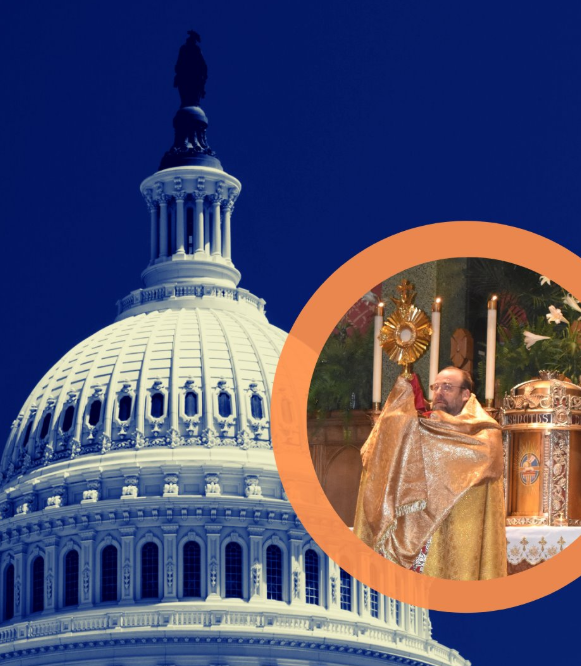
Sunday, June 23, I will have the privilege of carrying the Lord Jesus in a Corpus Christi procession through the heart of the Capitol Hill area in Washington, D.C. We have named it “Corpus Christi in the Capital.” It will begin at 1:00 PM at my parish (Holy Comforter-St. Cyprian Church, 1357 East Capitol St. SE) and proceed for approximately one mile, past the Capitol and Supreme Court, ending at St. Joseph’s Church (313 2nd St. NE). I have long desired to do this, and God-willing we will process this Sunday.

Allow a brief reflection on our purpose and our privilege to process with our Lord.

For the past twelve years I have pastored a parish in the Capitol Hill neighborhood. It is a location that inspires both awe and anger. It is the epicenter of power in our country, power for both great good and great evil. Yet here we are as well, the Church. There are two other parishes in the area: St Peter’s, to the south (the House side), and St. Joseph’s, to the north (the Senate side). My parish, Holy Comforter, is located due east of the Capitol.

In my years here I have been privileged and challenged to give weekly bible studies, both in the Capitol and at the White House. I spent four years preaching and teaching in the Capitol during the 1990s and five years at the White House (2003-2008). It was both a wonderful opportunity and a heavy responsibility to represent Christ in these places where great decisions were and are made.

Political sea changes occur frequently in this town. My ability to walk those halls changed after 2008, but that did not end my ability to spread God’s Word. My primary pulpit is always my parish, but in recent years my writing and my radio work have grown. I also walk this neighborhood and pray for life in front of a Planned Parenthood center (I refuse to call it a clinic) along with members of five area parishes. God is always opening doors even if our task is tragic and painful; thank you, Lord. In these ways, I (and many others) have tried to manifest the Lord’s presence in the Capitol Hill neighborhood.

This year, we plan to do something new yet at the same time old. There’s a 1970s Doobie Brothers song that talks about “takin’ it to the streets.” This year, I will walk, along with Catholic Men United and others, and take Jesus to the streets. Yes, Sunday June 23, the Feast of Corpus Christi, we will take Jesus to the street—East Capitol Street, to be specific.

We will process up a street where many protesters have walked before, past the homes of believers as well as non-believers, past rainbow flags as well as Madonnas in front yards, past the homes of members of Congress and “ordinary” folks as well.

There will be believers who will rejoice as we walk past and non-believers who will wonder what we are doing and perhaps scoff at us. But the Lord loves them all and wants to save their souls. We will walk in love and witness.

Though we will sing and pray, our testimony will be more visual than verbal. We will honor the One who makes everything possible. Jesus will be carried by priests of the Church with great solemnity, under a canopy of honor, surrounded by six torchbearers, and accompanied by the sounds of praise and adoration and the smell of incense.

In a town accustomed to motorcades with revving motorcycle engines and blaring sirens that seem to say, “Get out of our way,” this procession will be at a more leisurely, prayerful pace. Its message is more tender, even if it delays people for a moment:

“He who loves you and died for you is passing by. He is calling you now to the repentance that gives joy. His power is not worldly and passing but heavenly and eternal. Yes, let us praise and adore Him, who alone can save us. In a city of potentates here is the true King, without whom nothing is possible!”

As we march, the dome of the Capitol will grow ever larger in the center of our line of sight. To our left, the Library of Congress, and to our right, the Supreme Court, will also become closer. We will stop twice at the homes of believers: at 10th and East Capitol and at 3rd and East Capitol; in each home we will enthrone Jesus truly present and worship Him at an altar prepared there. We will pass the Capitol and the Supreme Court, begging that His blessing and truth be established there. Finally, we will end our mile-long procession at St. Joseph’s Church, just behind the Senate Building.

We will not march in a triumphalist manner but in reparation for the sins and shortcomings of the members of the Church, both clergy and lay. The march will not be easy, especially in the heat of late June. We will commit ourselves anew to the Lord, acknowledging our past sins and seeking grace to overcome our shortcomings and resist temptations. We will cry for God’s mercy on us and on our nation. Without grace and mercy, we do not stand a chance, but with the Lord there is mercy and fullness of redemption.

Join us if you can, but even if you can’t, unite with us in prayer and purpose. We pray for ourselves and our nation, we make reparation for our sins and those of this land, and we remind others that Christ is King, Lord, Savior, and our only hope. May the heart of Jesus in the most Blessed Sacrament be praised, adored, and loved with great affection at every moment in all the tabernacles of the world even unto the end of time.

Cross-posted at the Catholic Standard: Corpus Christi Procession in the Nation’s Capital – Our Privilege and our Purpose

Why Does Jesus Say That the Father Is Greater Than He If the Members of the Trinity Are Equal?

A common question arising around the time of Trinity Sunday is rooted in this passage from John’s Gospel:

If you loved me, you would be glad that I am going to the Father, for the Father is greater than I (Jn 14:28).

This is somewhat puzzling because we are taught that each Divine Person of the Blessed Trinity fully possesses the nature of God and is equally to be adored and glorified. What, then, did Jesus mean when He said, “the Father is greater than I”?

The most common (and correct) answer is that in this passage Jesus was speaking in reference to His human nature, in which He is inferior to the Father; in His divine nature He is equal to the Father. Many of the Church Fathers spoke in this way. For example,

    • St Augustine said, Let us acknowledge then the twofold substance of Christ, the divine, which is equal to the Father, and the human, which is inferior. But Christ is both together, not two, but one Christ: else the Godhead is a quaternity, not a Trinity. Wherefore He says, If ye loved Me, ye would rejoice, because I said, I go to the Father; for human nature should exult at being thus taken up by the Only Begotten Word, and made immortal in heaven; at earth being raised to heaven, and dust sitting incorruptible at the right hand of the Father. Who, that loves Christ, will not rejoice at this, seeing, as he doth, his own nature immortal in Christ, and hoping that He Himself will be so by Christ (Quoted in the Catena Aurea at John 14:28).
    • Didymus the Blind said, When he says “greater” he indicates that his divinity can be equaled to the Father, since he is of the same substance as him, but the Father is greater because the Son accepted a body…The Son’s nature is understood to be less than that of the Father inasmuch as the Son became man (Fragments on John at 14).
    • Hilary of Poitiers said, By the birth of the Son the Father is constituted greater … in that the Son, born of the Father, after assuming an earthly body, is taken back to the glory of the Father (On the Trinity, 9:56).
    • Theodoret of Cyr had Jesus speak, saying, Sometimes therefore I, [Jesus] say that I am equal to the Father, and at other times say that the Father is greater than I. I am not contradicting myself, but I am showing that I am God and a human being … If you want to know how the Father is greater than I, I was talking from the flesh, not from the person of the Divinity (Dialogue 1:56).

Thus, the first answer is clear: As God, Jesus is equal to the Father, but as Man, He is inferior to the Father.

In a qualified way, however, it is also possible to speak of a particular greatness of the Father even within the Trinity. While all three persons of the Trinity are co-eternal, co-equal, and equally divine, the Father is the Principium Deitatis (the Source in the Deity). So, although the members of the Trinity are all equal in dignity, there are processions in the Trinity. The Father is the Principium, the Son eternally proceeds from Him and is eternally begotten by Him (Jn 8:42); the Holy Spirit eternally proceeds from the Father and the Son as from one principal (Jn 15:26).

Thus, even from the perspective of His divinity it is possible for Jesus to say, “I delight that the Father is the eternal principal of my being. Even though I have no origin in time, I do eternally proceed from Him.”

The Athanasian Creed says the following regarding these processions:

The Father is made by none, neither created nor begotten.
The Son is of the Father alone, neither made nor created, but begotten.
The Holy Spirit is of the Father and of the Son, not made, nor created, nor begotten, but he proceeds from them.

St. Thomas Aquinas speaks poetically of the Trinity in the familiar hymn “Tantum Ergo”:

Genitori, Genitoque … Procedenti ab utroque … compar sit laudautio.
(To the One Who Begets, and to the Begotten One, and to the One who proceeds from them both, be equal praise.)

So, although the Persons of the Trinity are equal, the processions within the Trinity do have an order. The Father is “greater” in the very qualified sense that He is the Principium Deitatis, the Principal of the Deity, but is co-eternal and equal in dignity to the Son and the Holy Spirit.

Devotionally, Jesus may also be speaking of the Father as greater in the sense that He always does what pleases His Father. Jesus loves His Father; He’s crazy about Him. He is always talking about Him and pointing to Him. By calling the Father “greater,” Jesus says (in effect), “I look to my Father for everything. I do what I see Him doing (Jn 5:19) and what I know pleases Him (Jn 5:30). As God, we share one will; as human, my human will and His will are one. What I will to do proceeds from Him. I do what I know accords with His will.”

Cross-posted at the Catholic Standard: Why Does Jesus Say That the Father Is Greater Than He If the Members of the Trinity Are Equal?

One and One and One Are One – A Homily for Trinity Sunday

There is an old spiritual that says, “My God is so high you can’t get over Him. He’s so low you can’t get under Him. He’s so wide you can’t get around Him. You must come in, by and through the Lamb.”

It’s not a bad way of saying that God is “other.” He is beyond what human words can describe, beyond what human thoughts can conjure. And on the Feast of the Most Holy Trinity, we do well to remember that we are pondering a mystery that cannot fit in our minds.

A mystery, though, is not something wholly unknown. In the Christian tradition, the word “mystery” refers (among other things) to something that is partially revealed, something much more of which remains hidden. Thus, as we ponder the Trinity, consider that although there are some things we can know by revelation, much more is beyond our understanding.

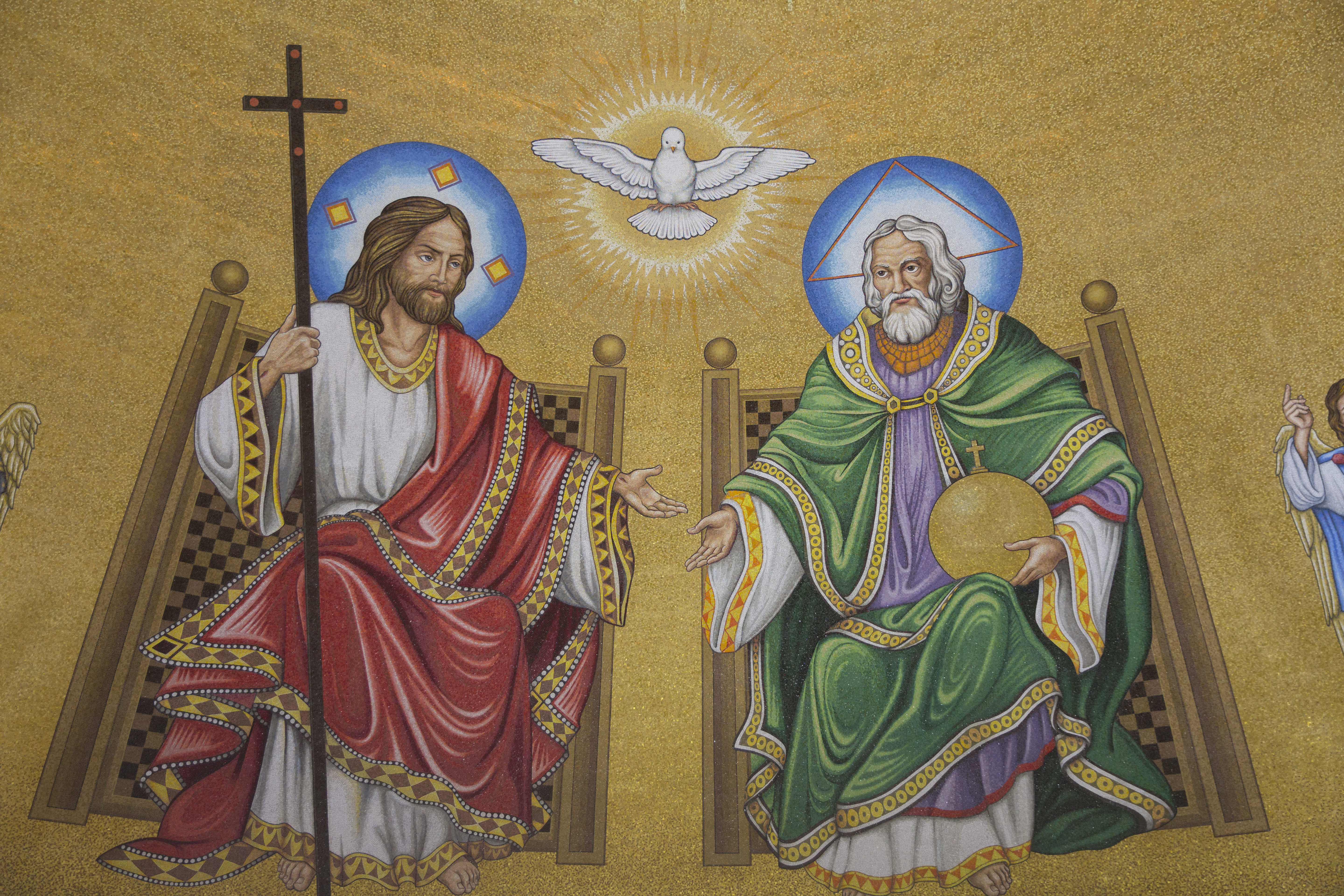
Let’s ponder the Trinity by exploring it, seeing how it is exhibited in Scripture, and observing how we, who are made in God’s image, experience it.

I. The Teaching on the Trinity Explored – Perhaps we do best to begin by quoting the Catechism, which says, The Trinity is One. We do not confess three Gods, but one God in three persons: [Father, Son, and Holy Spirit] … The divine persons do not share the one divinity among themselves but each of them is God, whole and entire (Catechism, 253).

So there is one God, and each of the three persons of the Trinity possesses the one divine nature fully. The Father is God; He is not one-third of God. Likewise, the Son, Jesus, is God; He is not one-third of God. And the Holy Spirit is God, not merely one-third of God.

It is our human experience that if there is only one of something and someone possesses it fully, then there is nothing left for anyone else. Yet, mysteriously, each of the three persons of the Trinity fully possesses the one and only divine nature, while remaining a distinct person.

One of the great masterpieces of the Latin Liturgy is the preface for Trinity Sunday. It compactly and clearly sets forth the Christian teaching on the Trinity. The following translation of the Latin is my own:

It is truly fitting and just, right and helpful unto salvation that we should always and everywhere give thanks to you O Holy Lord, Father almighty and eternal God: who, with your only begotten Son and the Holy Spirit are one God, one Lord: not in the oneness of a single person, but in a Trinity of one substance. For that which we believe from your revelation concerning your glory, we acknowledge of your Son and the Holy Spirit without difference or distinction. Thus, in the confession of the true and eternal Godhead there is adored a distinctness of persons, a oneness in essence, and an equality in majesty, whom the angels and archangels, the Cherubim also and the Seraphim, do not cease to daily cry out with one voice saying, Holy, Holy, Holy

Wow! A careful and clear masterpiece, but one that baffles the mind. So deep is this mystery that we had to “invent” a paradoxical word to summarize it: triune (or Trinity). Triune literally means, “three-one” (tri + unus) and “Trinity is a conflation of “Tri-unity,” meaning the “three-oneness” of God.

If all this baffles you, good! If you were to say that you fully understood all this, I would have to call you a likely heretic. For the teaching on the Trinity, while not contrary to reason per se, does transcend it and it is surely beyond human understanding.

And now a final image before we leave our exploration stage. The picture at the upper right is from an experiment I remember doing when I was in high school. We took three projectors, each of which projected a circle: one red, one green, and one blue (the three primary colors). At the intersection of the three circles the color white appeared (see above). Mysteriously, the three primary colors are present in the color white, but only one shows forth. The analogy is not perfect (no analogy is or it wouldn’t be an analogy) for Father, Son, and Spirit do not “blend” to make God. But the analogy does manifest a mysterious “three-oneness” of the color white. Somehow in the one, three are present. (By the way, this experiment only works with light; don’t try it with paint!)

II. The Teaching on the Trinity Exhibited – Scripture also presents images of the Trinity. Interestingly enough, most of the pictures I want to present are from the Old Testament.

I’d like to point out as a disclaimer that Scripture scholars debate the meaning of the texts I am about to present; that’s what they get paid the big bucks to do. I am reading these texts as a New Testament Christian and seeing in them a doctrine that later became clear. I am not getting into a time machine and trying to understand them as a Jew from the 8th century B.C. might have. Why should I? That’s not what I am. I am reading these texts as a Christian in the light of the New Testament, as I have a perfect right to do. You, of course, are free to decide whether you think these texts really are images or hints of the Trinity. Here they are:

Then God said, “Let us make man in our image, after our likeness …” (Gen 1:26)

God speaks of himself in the plural: “Let us … our …” Some claim that this is just an instance of the “royal we” being used. Perhaps, but I see an image of the Trinity. There is one (“God said”) but there is also a plural (us, our). Right at the very beginning in Genesis there is already a hint that God is not all by himself, but rather is in a communion of love.

Elohim

In the passage above, the word used for God is אֱלֹהִ֔ים (Elohim). It is interesting to note that this word is in the plural form. From a grammatical standpoint, Elohim actually means “Gods,” but the Jewish people understood the sense of the word to be singular. This is a much debated point, however; you can read more about it from a Jewish perspective here: Elohim as Plural yet Singular.

(We have certain words like this in English, words that are plural in form but singular in meaning: news, mathematics, acoustics, etc.) My point here is not to try to understand it as a Jew from the 8th century B.C. or even as a present day Jew. Rather, I am observing with interest that one of the main words for God in the Old Testament is plural yet singular, singular yet plural. God is one yet three. I say this as a Christian observing this about one of the main titles of God. I see an image of the Trinity.

And the LORD appeared to [Abram] by the oaks of Mamre, as he sat at the door of his tent in the heat of the day. He lifted up his eyes and looked, and behold, three men stood in front of him. When he saw them, he ran from the tent door to meet them, and bowed himself to the earth, and said, “My Lord, if I have found favor in your sight, do not pass by your servant. Let a little water be brought, and wash your feet, and rest yourselves under the tree, while I fetch a morsel of bread, that you may refresh yourselves, and after that you may pass on—since you have come to your servant.” So they said, “Do as you have said (Gen 18:1-5).

From a purely grammatical standpoint this is a very difficult passage because it switches back and forth between singular and plural references. The Lord (singular) appears to Abram, yet Abram sees three men (some have said that this is just God and two angels, but I think it is the Trinity). And then when Abram addresses “them” he says, “My Lord” (singular). The tortured grammar continues as Abram suggests that the Lord (singular) rest “yourselves” (plural) under the tree. The same thing happens in the next sentence, in which Abram wants to fetch bread so that you may refresh “yourselves” (plural) In the end, the Lord (singular) answers, but it is rendered as “So they said.” Plural, singular … which is it? Both. God is one; God is three. For me as a Christian, this is a picture of the Trinity. Because the reality of God cannot be reduced to mere words, we have here a grammatically difficult passage. But I can “see” what is going on: God is one and God is three; He is singular and He is plural.

Having come down in a cloud, the Lord stood with Moses there and proclaimed his Name, “Lord.” Thus the Lord passed before him and cried out, “The Lord, the Lord, a merciful and gracious God, slow to anger and rich in kindness and fidelity” (Exodus 34:5).

When God announces His name, He does so in a threefold way: Lord! … The Lord, the Lord. There is implicit a threefold introduction or announcement of God. Is it a coincidence or is it significant? You decide.

In the year that King Uzziah died I saw the Lord sitting upon a throne, high and lifted up; and his train filled the temple. Above him stood the Seraphim; each had six wings: with two he covered his face, and with two he covered his feet, and with two he flew. And one called to another and said: “Holy, holy, holy is the Lord of hosts; the whole earth is full of his glory” (Is 6:1-3).

God is Holy, Holy, and yet again, Holy. Some say that this is just a Jewish way of saying “very Holy,” but as Christian I see more. I see a reference to each of the three persons of the Trinity. Perfect praise here requires three “holys.” Why? Omni Trinum Perfectum (all things are perfect in threes). But why? As a Christian, I see the angels praising each of the three persons of the Trinity. God is three (Holy, holy, holy …) and yet God is one (holy is the Lord …). There are three declarations of the word “Holy.” Is it a coincidence or is it significant? You decide.

Here are three (of many) references to the Trinity in the New Testament:

        • Jesus says, The Father and I are one (Jn 10:30).
        • Jesus also says, To have seen me is to have seen the Father (Jn 14:9).
        • Have you ever noticed that in the baptismal formula, Jesus uses “bad” grammar? He says, Baptize them in the name (not names (plural)) of the Father and of the Son and of the Holy Spirit (Matt 28:19). God is one (name) and God is three (Father, Son, and Holy Spirit).

Thus Scripture exhibits the teaching of the Trinity, going back even to the beginning.

III. The Teaching of the Trinity Experienced – We who are made in the image and likeness of God ought to experience something of the mystery of the Trinity within us. And sure enough, we do.

    • It is clear that we are all distinct individuals. I am not you; you are not I. Yet it is also true that we are made for communion. We humans cannot exist apart from one another. Obviously we depend on our parents, through whom God made us, but even beyond that we need one another for completion.
    • Despite what the Paul Simon song says, no man is a rock or an island. There is no such thing as a self-made man. Even the private business owner needs customers, suppliers, shippers, and other middle men. He uses roads he did not build, has electricity supplied to him over lines he did not string, and speaks a language to his customers that he did not create. Further, the product he makes was likely the result of technologies and processes he did not invent. The list could go on and on.
    • We are individual, but we are social. We are one, but we are linked to many. Clearly we do not possess the kind of unity that God does, but the “three-oneness” of God echoes in us. We are one, yet we are many.
    • We have entered into perilous times where our interdependence and communal influence are under-appreciated. That attitude that prevails today is a rather extreme individualism wherein “I can do as I please.” There is a reduced sense at how our individual choices affect the whole of the community, Church or nation. That I am an individual is true, but it is also true that I live in communion with others and must respect that dimension of who I am. I exist not only for me, but for others. And what I do affects others, for good or ill.
    • The attitude that it’s none of my business what others do needs some attention. Privacy and discretion have important places in our life, but so does concern for what others think and do, the choices they make, and the effects that such things have on others. A common moral and religious vision is an important thing to cultivate. It is ultimately quite important what others think and do. We should care about fundamental things like respect for life, love, care for the poor, education, marriage, and family. Indeed, marriage and family are fundamental to community, nation, and the Church. I am one, but I am also in communion with others and they with me.
    • Finally, there is a rather remarkable conclusion that some have drawn: the best image of God in us is not a man alone, or a woman alone, but, rather, a man and a woman together in lasting a fruitful relationship we call marriage. For when God said, “Let us make man in our image” (Genesis 1:26), the text goes on to say, “Male and female he created them” (Genesis 1:27). And God says to them, “Be fruitful and multiply” (Gen 1:28). So the image of God (as God sets it forth most perfectly) is the married and fruitful couple.

We must be careful to understand that what we humans manifest sexually, God manifests spiritually. For God is neither male nor female in His essence. Thus, we may say, The First Person loves the Second Person and the Second Person loves the First Person. And so real is that love, that it bears fruit in the Third Person. In this way the married couple images God, for the husband and wife love each other and their love bears fruit in their children [1].

So today, as we extol the great mystery of the Trinity, we look not merely outward and upward so as to understand, but also inward to discover that mystery at work in us, who are made in the image and likeness of God.

Cross-posted at the Catholic Standard: One and One and One Are One – A Homily for Trinity Sunday