On the Connection Between Sound Doctrine and Civility

A key theme of St. Paul’s Letters to Timothy and Titus, bishops he appointed to oversee the churches of Ephesus and Crete respectively, is their insistence on sound doctrine. He writes to Titus, “As for you, speak the things that are consistent with sound doctrine …” (Titus 2:1). He tells Timothy that if he passes on this doctrine to others, he “… will be a good servant of Christ Jesus, nourished by the words of faith and sound doctrine that you have followed” (1 Tim 4:6).

St. Paul also makes an interesting connection between doctrine and civility. He writes of those who diverge from sound doctrine and describes the effects of their dissent:

Whoever teaches something different and does not agree with the sound words of our Lord Jesus Christ and the religious teaching is conceited, understanding nothing, and has morbid disposition for arguments and verbal disputes. From these come envy, rivalry, insults, evil suspicions, and mutual friction among people with corrupted minds, who are deprived of the truth … (1 Tim 6:3-5).

We can see this clearly today, when so many people—even within the Church—spread false teaching and call good, or no big deal, what God calls sin.

Note that the effect of rejecting sound doctrine is, in effect, widespread incivility (rivalry, insults, suspicions, and friction). Yes, welcome to the modern Western world.

What is the connection between spreading false teachings and incivility? It is the loss of a shared foundation of fundamental truths. Without such a foundation it is difficult to have reasonable, rational discussions in which one begins with agreed-upon principles and builds upon them logically to form conclusions. Here is an extremely simple example:

  1. An obtuse angle is one whose measure is greater than 90° and less than 180°.
  2. This angle measures 120°.
  3. Therefore, this angle is an obtuse angle.

You can see that you wouldn’t get very far if you couldn’t agree on the definition of an obtuse angle or on how to use a protractor to measure angles or on how to compare the magnitudes of numbers!

The problem today is that, due to radical individualism and subjectivism, many basic realities are no longer accepted as legitimate premises upon which to base an argument. Without the ability to have reasoned arguments like the ones so beautifully depicted in the St. Thomas Aquinas’ Summa Theologica, we have descended into vehement disagreements, strident protests, heated rivalries, and even hatred.

The most extreme example of this is the relatively recent word “transgender.” Merriam-Webster defines it as follows: “of, relating to, or being a person whose gender identity differs from the sex the person had or was identified as having at birth.” Nothing is more obvious than that humans come in two sexes, male and female. The ability to determine one’s sex is neither difficult nor mysterious; a simple look at one’s private parts (in more than 99.9 percent of the population) is quite sufficient. When even something this simple or obvious is no longer accepted as such, the ability to have a conversation, let alone a rational argument, is diminished, to say the least.

In such a radically subjective climate, whose view “wins”? Generally, it’s the one who yells the loudest or has the most influence or is the most famous. It is not reason that triumphs but power. We have today what Pope Benedict XVI called the “dictatorship of relativism,” in which nothing is accepted as definitively true. The tyranny comes in the force (cultural, political, or legal) used to impose the standard that there is no standard. It is impossible to argue for a position from first principles when there are no agreed-upon first principles. Today, one achieves the highest level of popularity and acceptance by having no principles at all (other than that everyone’s “principles” are equally valid). Interestingly, the principle that there are principles is not considered an acceptable principle!

St. Paul rightly highlights the necessity for pastors to teach sound doctrine. This helps build a sturdy foundation of truth for the Church and the culture. Having agreed-upon principles provides the basis for rational discussion. It also sets limits on diversion: a range of views may be allowed but only within reasonable boundaries. It is like the rules on a multilane highway: a person can drive in any one of several different lanes, but only those going in a certain direction and certainly not on the shoulder or off on the grass. Sound doctrine provides limits; it helps us avoid getting in an accident or winding up at the bottom of a roadside ravine.

In the modern West, we seem to be engaged in a massive social experiment as to whether there can be a culture without a shared cultus. A cultus indicates a shared set of beliefs in God and in what He teaches and expects. Once upon a time in the U.S., though we had sectarian differences, there was still a fundamental agreement on basic moral norms rooted in the Ten Commandments and the long experience of Christianity. This common ground has disappeared, and the picture of St. Paul describes above is very much in evidence. Even in the Church there are factions, suspicions, rivalries, and even insults. That is what happens when doctrine is set aside, when silence and/or ambiguity are widespread and even weaponized. When the sheep are fighting, the shepherd should step in with clear teaching. In today’s radical uncertainty, even the shepherds are afraid to fight.

When doctrine collapses, incivility and fierce anger rule the day. St. Paul paints the picture vividly and accurately. The only real solution is to rebuild the sure and sturdy foundation of sound doctrine. Pray for greater courage among bishops, pastors, and Catholic Cultural leaders to rebuke dissent, solidly restore the foundation of truth, and then insist upon it. Without the truth there will be no peace.

Cross-posted at the Catholic Standard: On the Connection Between Sound Doctrine and Civility
On Being Faithful in a Few Things before Being Ruler over Many Things – A Homily for the 25th Sunday of the Year

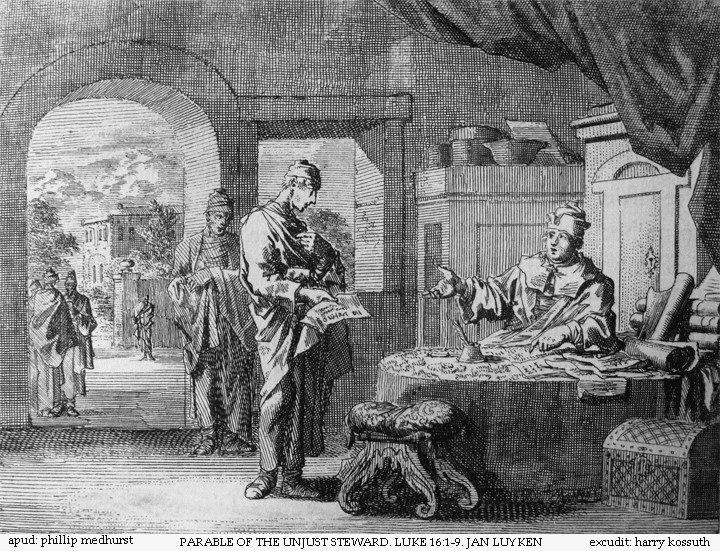
https://commons.wikimedia.org/wiki/File:Teachings_of_Jesus_31_of_40._parable_of_the_unjust_steward._Jan_Luyken_etching._Bowyer_Bible.gif

In this Sunday’s Gospel, the Lord Jesus gives a penetrating analysis of the state of the sinner and some very sobering advice to us would-be saints. Let’s look at the Gospel in two stages:

I. ANALYSIS OF THE SINNER – In the opening lines of the Gospel, Jesus describes a sinful steward.

DELUSION (of the sinner) Jesus said to his disciples, “A rich man had a steward …”

 Notice that the man is referred to as a steward rather than an owner. God is the owner of everything; we are but stewards. A steward must deal with the goods of another according to that person’s will. We may have ownership in relation to other human beings, but before God we own nothing, absolutely nothing.

Part of the essence of sin is behaving as though we are the owner. We develop the arrogant attitude that what we have is ours to do with as we please: “It’s mine; I can do what I want with it.” “It’s my body, and I can do with it as I please.” But in fact, everything belongs to God.

Scripture affirms, The earth is the LORD’S and the fullness thereof; the world, and they that dwell therein (Ps. 24:1). Even of our bodies, which we like to think of as our own, Scripture says, You are not your own; you were bought with a price. So glorify God in your body (1 Cor 6:19). There’s a song that says, “God and God alone created all these things we call our own. From the mighty to the small, the glory in them all is God’s and God’s alone.” The Lord compares the sinner to a steward who acts as if he were the owner.

DISSIPATION (of the sinner) “… who was reported to him for squandering his property.”

The Lord here describes the essence of many of our sins: we squander His gifts. We waste the gifts we have received and use them for sinful ends.

For example, in greed we hoard the gifts He gave us. Instead of using them to help others, as God intended, we store them up for ourselves. Yet all the goods of the world belong to all the people of the world, and they ought to be shared to the extent that we are able.

Other examples of squandering the things of God are these: in gossip, lying, and cursing, wherein we misuse the gift of speech; in laziness, wherein we misuse the gift of time; in all sin, wherein we abuse the gift of our freedom. This is the dissipation, the squandering, of God’s goods.

God has given us many good things, but instead of using them to build the Kingdom, we squander them and dissipate it.

DEATH (of the sinner)“He summoned him and said, ‘What is this I hear about you? Prepare a full account of your stewardship, because you can no longer be my steward.’”

Here the Lord reminds us that someday our stewardship will end, and we will be called to account. Scripture reminds us, So whether we are at home or away, we make it our aim to please him. For we must all appear before the judgment seat of Christ, so that each one may receive good or evil, according to what he has done in the body (2 Cor 5:9).

We have an appointed time to exercise our stewardship, but at some point, our stewardship will end, and the books will be opened. Scripture says, And books were opened. Another book was opened, which is the book of life. The dead were judged according to what they had done as recorded in the books (Rev 20:11).

Although many pay little heed to the fact of judgment, Scripture warns, Say not, “I have sinned, yet what has befallen me?” For the Lord bides his time. Of forgiveness be not over-confident, adding sin upon sin. Say not, “Great is his mercy, my many sins he will forgive.” For mercy and anger are alike with him; upon the wicked alights his wrath. Delay not your conversion to the Lord, put it not off from day to day. For suddenly his wrath flames forth; at the time of vengeance you will be destroyed (Sirach 5:4).

Every steward (each of us) will die. Our stewardship will end and we will be called to render an account. Therefore, we ought to listen to the Lord’s advice.

II. ADVICE TO THE SAINTS After analyzing the sinner, the Lord has some advice for those of us sinners who want to be saints. He lays out four principles we ought to follow:

1. Principle of INTENSITY – The text says, the steward said to himself, ‘What shall I do, now that my master is taking the position of steward away from me? I am not strong enough to dig and I am ashamed to beg. I know what I shall do so that, when I am removed from the stewardship, they may welcome me into their homes.’ He called in his master’s debtors one by one. To the first he said, ‘How much do you owe my master?’ He replied, ‘One hundred measures of olive oil.’ He said to him, ‘Here is your promissory note. Sit down and quickly write one for fifty.’ Then to another the steward said, ‘And you, how much do you owe?’ He replied, ‘One hundred kors of wheat.’ The steward said to him, ‘Here is your promissory note; write one for eighty.’ And the master commended that dishonest steward for acting shrewdly. For the children of this world are more shrewd in dealing with their own generation than are the children of light.

The Lord is telling us here that many of the worldly are craftier in what matters to them than are the spiritually minded in what (supposedly) matters to them.

Many people are dedicated and intense in worldly matters. They spend years in college, preparing for their career. They work hard to climb the company ladder. They develop (worldly) skills and become knowledgeable in their profession. In earning money and holding down a job, many display great discipline: getting up early to go to work, working late, going the extra mile to please the boss.

When it comes to faith, however, many of these same people display only a rudimentary knowledge of things spiritual and show little interest in praying or advancing in the faith. They will expend effort to please the boss, to please other people, but not to please God. Parents will fight for scholarships for their children to get into the “best” schools but not quite so dedicated to ensuring they learn the saving truth; the pews are empty, and Sunday School is poorly attended.

The Lord says to us here that the spiritually minded ought to show the same intensity, organization, dedication, and craftiness that the worldly show in their pursuits. We ought to be zealous for the truth, for prayer, and for opportunities to sharpen our spiritual skills and increase our holiness. We ought to be as zealous to be rich in grace as we are to be rich in money.

2. Principle of INVESTMENT I tell you, make friends for yourselves with dishonest wealth, so that when it fails, you will be welcomed into eternal dwellings.

(Read here for more information on what the Lord means by “dishonest wealth”: What Does the Lord Mean by “Unrighteous Mammon”?.)

The Lord tells of how the dishonest steward made use of the money at his disposal to make friends who would help him in the next stage of his life. How about us? Are we willing to use our money and resources to bless others (especially the poor, who can bless us in the next stage of our life)?

On the day of your judgment, will the poor and needy be able to speak up on your behalf? Will they be among the angels and saints who welcome you to eternal dwellings? I don’t know about you, but I’m going to want the poor to pray and to speak to God on my behalf! Scripture says that the Lord hears the cry of the poor and needy. In this world, the poor need us but in the next world we’re going to need them. In this world, those with money and power are heard; in the Kingdom, it’s the poor and suffering who are heard. It’s a wise investment to bless the poor and needy.

In effect, the Lord Jesus tells us to be wise in our use of worldly wealth. The world tells us to take our money and invest it so that it will reap future rewards; so too does the Lord. How? By storing our wealth up in Heaven. And how do we do that? By giving it away! Then it will really be ours.

You can’t take it with you, but you can send it on ahead. Scripture elaborates on this idea: Command those who are rich in this present world not to be arrogant nor to put their hope in wealth, which is so uncertain, but to put their hope in God, who richly provides us with everything for our enjoyment. Command them to do good, to be rich in good deeds, and to be generous and willing to share. In this way they will lay up treasure for themselves as a firm foundation for the coming age, so that they may take hold of the life that is truly life (1 Tim 6:17). Notice that the passage says that through their generosity in this world, the rich store up treasure for themselves in Heaven.

This is the scriptural principle and the great paradox in the Kingdom of God: we keep something for eternity only by giving it away. We save our life by losing it. By giving away our treasure, we keep it and store it in Heaven.

So, invest, my friends. Invest wisely! Store up for yourselves treasures in heaven, where moth and rust do not destroy, and where thieves do not break in and steal (Matt 6:20).

3. Principle of INCREASEThe person who is trustworthy in very small matters is also trustworthy in great ones; and the person who is dishonest in very small matters is also dishonest in great ones. If, therefore, you are not trustworthy with dishonest wealth, who will trust you with true wealth? If you are not trustworthy with what belongs to another, who will give you what is yours?

What is the “small matter” of which the Lord speaks and in which we can prove trustworthy? The small matter is money. Most people make money the most important thing in life, but spiritual matters are far more important.

Scripture attests to this clearly. The Book of 1st Peter says that our faith is more precious than fire-tried gold. The Book of Psalms (19:10) says, The words of the Lord are more precious than gold, than much pure gold; they are sweeter than honey, than honey from the comb.

So, God says, let’s see how you are in the small but significant matter of money; then I’ll decide if you’re able to able to handle bigger blessings. Do you think you can handle Heaven and the spiritual blessings of holiness? If you’re trustworthy with worldly wealth, God will give you true wealth. If you’re trustworthy in what belongs to God, He’ll give one day what is yours.

Do you want more? Then use well what you’ve already received. Only then will God know that He can trust you with more. There’s a gospel song that says, “You must be faithful over a few things to be ruler over many things. Be faithful unto death, and God will give you a crown of life.”

4. Principle of INDIVISIBILITYNo servant can serve two masters. He will either hate one and love the other, or be devoted to one and despise the other. You cannot serve both God and mammon.

Pay attention! To serve means to obey. Most people obey money and affluence; they worship a high standard of living before they obey God. They meet their world obligations first and then give God what is left over.

We are called to obey God alone, to have an undivided heart. The wording here is strong. You cannot obey the world (money) and think that you’re also going to obey God. You must choose which will be more important.

Now don’t tell me we don’t need a lot of grace and mercy! Money and the lure of the world are very powerful. It’s time to get on our knees and pray for the miracle of preferring God to the world.

Cross-posted at the Catholic Standard: On Being Faithful in a Few Things before Being Ruler over Many Things – A Homily for the 25th Sunday of the Year

A Guardian Angel Unlike Any You’ve Ever Seen!

Most of us have sentimental notions about angels in general and guardian angels in particular, yet the Bible depicts then as powerful, fierce, and almost warlike. They are holy and good, but their glory overwhelms. In Scripture, people encountering angels are often disconcerted and filled with fear.

Many of us think of the angels as here more to help us, but God tells us to obey them.

[The Lord God says,] See, I am sending an angel ahead of you to guard you along the way and to bring you to the place I have prepared. Pay attention to him and listen to what he says. Do not rebel against him; he will not forgive your rebellion, since my Name is in him. If you listen carefully to what he says and do all that I say, I will be an enemy to your enemies and will oppose those who oppose you (Exodus 23:20-22).

Angels are to be revered and respected; they are not the prancing, doll-like figures we often imagine.

I do not write this to dash sentimental notions, only to add balance. Our angels love and serve us, but they do this with a divine authority that we ought not to trivialize.

For some reason I thought of all this when I ran across this commercial first shown during the Super Bowl in 2003. It featured linebacker Terry Tate, who is brought into a business to “motivate” the workers to follow their better natures. I am certainly not implying that angels act in this manner, but I have often wondered whether my own guardian angel doesn’t sometimes need tactics like this in order to shape me up!

Enjoy the commercial, and remember to obey your guardian angel!

Cross-posted at the Catholic Standard: A Guardian Angel Unlike Any You’ve Ever Seen!

On the Power of Liturgy and Prayer

There is a text from the Acts of the Apostles that sets forth quite well some of the qualities of the Sacred Liturgy. Although the “liturgy” cited in this passage is not a Mass, the description should apply to all our liturgies; from the Liturgy of the Hours to baptism, from a penance service to a full sung Mass. Let’s look at the passage and learn from it the power of liturgy to deliver, instruct, and transform us and the world.

About midnight, while Paul and Silas were praying and singing hymns to God as the prisoners listened, there was suddenly such a severe earthquake that the foundations of the jail shook; all the doors flew open, and the chains of all were pulled loose.

When the jailer woke up and saw the prison doors wide open, he drew his sword and was about to kill himself, thinking that the prisoners had escaped. But Paul shouted out in a loud voice, “Do no harm to yourself; we are all here.” He asked for a light and rushed in and, trembling with fear, he fell down before Paul and Silas.

Then he brought them out and said, “Sirs, what must I do to be saved?” And they said, “Believe in the Lord Jesus and you and your household will be saved.” And they spoke the word of the Lord to him and to all who were in his house. And he took them the same hour of the night and washed their wounds; and he was baptized at once, he and all his family (Acts 15:25-33).

Determination About midnight, while Paul and Silas were praying and singing hymns to God as the prisoners listened … Here they are in an awful place, a deep dungeon with rats and filth all about, and yet they are singing.

An old hymn reminds us to persevere in praise: “Whatever my lot, thou hast taught me to say, ‘It is well with my soul, it is well.’” Yes, happiness is an inside job. There may be times when we don’t feel emotionally ready to praise God, but we have to command our soul. In the words of the psalm, I will bless the Lord at all times. His praise shall continually be in my mouth (Psalm 34:1).

Note that this is communal not personal prayer, and thus it is a kind of liturgy. They are singing hymns, a form of communal and liturgical prayer. More literally, the Greek text says that they were singing praises (humneo) to God. “Hymn” comes from humneo. Perhaps they were singing psalms or perhaps they were singing newly composed hymns such as we see in Philippians 2:5-11, Ephesians 1:3-14, or Colossians 1:15-19. But note their determination to praise the Lord anyway. Such praises will bring blessings, for when praises go up, blessings come down.

The Church must always be determined to celebrate the liturgy. The last thing we should ever consider stopping is the Mass! Recall how many priests and bishops locked up in prisons were earnest to obtain even the slightest scraps of bread or drops of wine in order to celebrate the Mass. Recall the many martyred priests during troubled times in England who risked everything to celebrate the Holy Mass. We must always be determined to pray, and whenever possible, to celebrate the Sacred Liturgy, even at great risk.

Disturbance … suddenly such a severe earthquake that the foundations of the jail shook … Does our worship rock this world to its foundations? It should. The world ought to know and experience that we are at prayer! We should rock this world with our refusal to be discouraged at what it dishes out.

Further, good prayer, preaching, and the simple presence of the Church ought to shake things up a bit. It is said that a good preacher will comfort the afflicted and afflict the comfortable. Each of us has a little of both within us.

Note that the early Christians were often arrested for being “disturbers of the peace.” They said politically dangerous things like “Jesus is Lord” rather than “Caesar is Lord.” Religiously, they upset the order by announcing that many of the old rites were now fulfilled. Temple worship was over. Jesus was the true temple and Lord, and the Eucharist now supplanted the lucrative temple rites. Morally, the Church shook things up by demanding love of one’s enemies and that people no longer live as did the pagans, in the futility of their minds. These things and more tended to disturb the political, social, and religious order. Liturgically, we gather to celebrate and learn many earthshaking truths and to be liberated from the hold of the world, the flesh, and the devil.

Yes, the presence of the early Church was a kind of earthquake. When the Church is strong she not only consoles; she disturbs and even rocks things to their foundations by the simple declaration, “Thus says the Lord” and by our praise of Him who is true Lord and Sovereign King, far outranking all other kings and those who demand our loyalty and conformity.

Deliverance … all the doors flew open, and the chains of all were pulled loose. The liturgy of praise and worship of God should effect an ongoing deliverance. The prayer of the Church in her liturgy should set people free: prison doors swing open, chains fall loose, and increasing freedom is granted to faithful.

I am a witness to this and I pray that you are as well. I have attended and celebrated Mass every day for more than thirty years now. In that time, through praise, hearing God’s Word, being instructed in God’s Word, receiving the Word Made Flesh in Holy Communion, and deep abiding fellowship with believers, I am a changed man. Many shackles have come loose. A new mind and heart have been given to me and the prison cells of anxiety are no longer. Deliverance is what happened to us when the Lord took us out of the kingdom of darkness and into the Kingdom of Light. Through the liturgy, that deliverance becomes deeper, richer, broader, and higher.

Dignity When the jailer woke up and saw the prison doors wide open, he drew his sword and was about to kill himself, thinking that the prisoners had escaped. But Paul shouted out in a loud voice, “Do no harm to yourself; we are all here.” The liturgy we celebrate is that of the Catholic Church. The term Catholic refers to the universality of the Church’s mission. All are to be called.

One effect of the liturgy on us should be that we neither hate nor exclude anyone. Paul and Silas do not gloat over the misfortune of their jailer. Knowing his dignity, they call out to him, even at the risk of their lives.

The Church, too, seeks the welfare and salvation of even our most bitter opponents. Our liturgy is celebrated not only for our friends but for the whole world.

The Church is Catholic; all are called. Painting a picture of the Church, Scripture says, I [John] looked, and there before me was a great multitude that no one could count, from every nation, tribe, people and language, standing before the throne and before the Lamb. They were wearing white robes and were holding palm branches in their hands (Rev 7:9). I realize how true it is that God does not show favoritism but accepts from every nation the one who fears him and does what is right. Everyone who believes in him receives forgiveness of sins through his name (Acts 10: 34-35, 43).

Discipleship [The jailer] asked for a light and rushed in and, trembling with fear, he fell down before Paul and Silas. Then he brought them out and said, “Sirs, what must I do to be saved?” And they said, “Believe in the Lord Jesus and you and your household will be saved.” And they spoke the word of the Lord to him and to all who were in his house. And he took them the same hour of the night and washed their wounds; and he was baptized at once, he and all his family.

Making disciples (not just members) is the primary job of the Church. To be a disciple is to be a follower of the Lord, but the word “disciple” also comes from the same Latin root (discere) as the word “learning.” Thus, the Church in her liturgy not only worships the Lord, she instructs the faithful and supplies the sacraments.

Note that the jailer asks for light. Do not think of this as merely a practical request. Asking for light is asking for the enlightenment that comes from Faith and Baptism. The Church in her liturgy and by her witness supplies light and acclimates the faithful to that light.

The jailer, having asked for the light, been instructed, and become accustomed to the light, is baptized.

Here, then, are some goals of and a description of true liturgy, one that rocks the world and yet delivers the faith, forming the people in the beauty of God’s grace. Do you and your fellow parishioners see the liturgy this way or do you see it as distant, even boring? See what this Scripture passage teaches about the truest goals and nature of every liturgy, great or small, in the Church.

Cross-posted at the Catholic Standard: On the Power of Liturgy and Prayer

The Church Is a Bride, Not a Widow

Venerable Fulton J. Sheen once wrote, “The Church knows after 1900 years’ experience that any institution which suits the spirit of any age will be a widow in the next one” (War and Guilt, OSV Press, 1941, pp. 138-139).

This is a clear admonition to the many who demand that the Church update her teachings, particularly (1) her moral doctrines, and (2) the dogma that salvation is exclusively through Jesus Christ. Some say that the Catholic Church is hopelessly out-of-date and irrelevant. Some point out that even her own members disagree with a large number of her teachings. But the role of the Church is not to reflect the age or even the views of her members; it is to represent the teachings of her head and founder, Jesus Christ. The Church cannot love or admire the world if she is to remain the Bride of Christ. Scripture says,

You adulterous people! Do you not know that friendship with the world is enmity with God? Therefore, whoever wishes to be a friend of the world makes himself an enemy of God (James 4:4).

Much is made of the declining numbers in the Catholic Church. The loss over the past fifty years has been staggering. Today, fewer than one fourth of Catholics attend Mass each week. But if the Church were to become the world, the number of Catholics would go to zero. Mainline Protestant denominations have tried just this method—giving the world what it wants—and their services are far emptier than our Masses. Some of them are in so steep a decline that it is hard to imagine them even existing in twenty years except on paper or in tiny pockets.

As Sheen notes, the Catholic Church brings two millennia of experience to this modern problem. That experience says, in effect, “This too shall pass.” In the age of the Church, empires have risen and fallen, nations come and gone, heresies have flourished then decayed, enemies have advanced and then retreated; but we are still here preaching the same gospel. Where is Caesar now? Where is Napoleon now? Where is the Soviet Union now? They are all gone. So shall it be with the scoffers and deceivers of this age. When this present foolishness has passed, the Church will still be here, preaching, teaching, and celebrating the sacraments.

The teachings of Scripture stretch back some 5,000 years to the earliest writings. They have perdured for a reason: they are true, and they work to bring us the greatest fulfillment possible in this world. These time-tested truths wait patiently while trends and popular notions pass away like mist at dawn.

In Sheen’s time he spoke of the Church knowing this truth, which implies that this was widely understood by Catholics of his era. Sadly, that is less true today, when many in the Church—right up to the highest levels in the hierarchy—have tried to adapt, compromise, and even discard ancient, tested doctrines in favor of worldly preferences, errors, and trendy notions. Many people today, even within the Church, need to rediscover Sheen’s maxim.

Yes, the Church is a bride, not a widow.

Cross-posted at the Catholic Standard: The Church Is a Bride, Not a Widow

A Prescription for Peace in a World of Woe

The Gospel for Tuesday of the 24th Week provides a kind of prescription for peace in a world of woe. Let’s look at it in four stages.

I. The PlaceJesus journeyed to a city called Nain, and his disciples and a large crowd accompanied him.

The name of the city, Nain, means fair (in the sense of beautiful)—and it was, for it sat upon a high hill and commanded a magnificent view.

This is an apt description of this world as well, which has its beauty, its magnificent vistas, and its pleasures and offerings. As men and women of faith, we ought to appreciate the beauty of what God has created. It makes God angry, to quote Alice Walker’s The Color Purple, “when you walk by the color purple in a field somewhere and don’t notice it.” God has given us many gifts and the mystic in all of us is invited to wonder, awe, gratitude, and serene joy.

Thus, we have the first prescription for peace. The world, with all its woe, never loses the beauty of God’s glory. Appreciating this brings serene peace even in the midst of storms. God is always present and speaking to us in what He has made and is continually sustaining.

II. The Pain – Fair though this world is, the very next thing we encounter in the text is pain: As he drew near to the gate of the city, a man who had died was being carried out, the only son of his mother, and she was a widow. A large crowd from the city was with her.

Indeed, we live in a fallen world, governed by a fallen angel, and we have fallen natures. God had made paradise for us, and while we cannot fully understand what that paradise would have been like, it is clear that Adam and Eve were driven from the best of what God had made.

Adam was told that the ground was now cursed on account of him; it brought forth thorns and thistles in a kind of protest. For Adam, work became arduous and sweat-producing; a kind of battle set up, pitting him against the forces of nature in order to provide for his basic needs.

Having simple sobriety about this provides a strange kind of serenity. If we are willing to accept them, there are certain hard truths that will set us free. One of those is that life is hard. Joy will come with the morning light, but some nights of weeping must be endured as we journey to our heavenly homeland where sorrows and sighs are no more.

Accepting the pain of this world is the second part of the prescription for peace in a world of woe.

III. The Portrait of Jesus When the Lord saw her, he was moved with pity for her. This woman’s sorrow becomes His own. While there is a mystery to God’s allowance of suffering, we must never think that He is unmoved or uncaring.

There is a saying (attributed to various sources) that “Jesus didn’t come to get us out of trouble; He came to get into trouble with us.” Yes, He takes up our pain and experiences it to the utmost. An old hymn says, “Jesus knows all about our struggles, He will guide till the day is done; There’s not a friend like the lowly Jesus, No, not one! No, not one!”

Note that the word pity comes from the Latin pietas, a word for family love. Jesus looks at this woman and sees a sister, a mother, a dear family member, and He is moved with family love.

Learning to trust in Jesus’ love for us, especially when we suffer, is a critical part of the prescription for peace. We need to pray constantly in our suffering: “Jesus I trust in your love for me!” If we pray this in the Holy Spirit, it brings peace.

IV. The Preview [Jesus] said to her, “Do not weep.” He stepped forward and touched the coffin; at this the bearers halted, and he said, “Young man, I tell you, arise!” The dead man sat up and began to speak, and Jesus gave him to his mother.

We have here a directive from Jesus not to weep. That directive is rooted in what He plans to do. This is more than a human, “Cheer up. Don’t be sad” sort of exhortation. Jesus is about to give her back her son. Based on this fact, He says, “Do not weep.”

In a very moving line we are told simply, “Jesus gave him to his mother.”

Do you realize that one day the Lord will do this for you? Jesus will return and restore everyone and everything that the devil and this world have stolen from us. It will all be given back and more than we could ever imagine will be added to it.

In my own life the Lord has given me victories over sufferings and setbacks. I have experienced healings and restorations, as I’m sure you have. These are previews; they are down payments, if you will, on the total restoration that the Lord is going to effect in your life. Whatever you have lost, you will recover it all and far more besides.

What previews have you had in your life? What victories? What healings? What restorations? These are like previews of the promised and more-than-full restoration that is to come. What is your testimony?

It is important for you to reflect on the previews the Lord has already given, for these are another important part of the prescription for peace: the promise of complete restoration and the previews he has already given of that promise.

Here, then, is a prescription for peace in a world of woe:

  1. Make the journey to Nain, a place called fair and beautiful. That is, let the Lord open your eyes to the beauty and blessings all around you. Come to see the magnificence of His glory on display at every moment. It will give you peace and serene joy.
  2. Ask for the grace to accept that we currently live in a “paradise lost” and that life is hard. This sober acceptance of life’s sorrows brings a paradoxical serenity because our resentment that we do not live in a perfect world goes away. Accepting that this world, with all its beauty, also has hardships, brings peace and a determination to journey to the place where joys will never end.
  3. Accept the Lord’s love for you even amidst His mysterious allowance of suffering. Accept that He is deeply moved and just say over and over, “Jesus, I trust in your love for me.”
  4. Be alert to the previews that God gives and has already given you, previews of the future glory that awaits the faithful. Once you have accepted this evidence, this testimony from the Holy Spirit, peacefully accept the Lord’s instruction not to weep and His promise that you will recover it all—and much more besides.

This motet from Night Prayer is by John Shepherd. The translation of the Latin text (In pace, in idipsum dormiam) is “In peace, in the self-same, I will rest.”

Cross-posted at the Catholic Standard: A Prescription for Peace in a World of Woe

Love of the World Fuels the Fear of Death – A Meditation on a Teaching of St. Cyprian

On this Feast of St. Cyprian, a classic writing by St. Cyprian comes to mind. It is a meditation on the fundamental human struggle to be free of undue attachment to this world and to have God (and the things waiting for us in Heaven) as our highest priority.

In this meditation, St. Cyprian has in mind the Book of James and the Epistle of St. John. Yes, surely these dramatic texts are present in his mind as he writes. Hence, before pondering St. Cyprian, it may be good to reference these forceful and uncompromising texts:

You adulterous people, don’t you know that friendship with the world is hatred toward God? Anyone who chooses to be a friend of the world becomes an enemy of God … Draw near to God, and he will draw near to you. Cleanse your hands, you sinners, and purify your hearts, you double-minded (James 4:4,8).

The Lord Jesus, of course, had first said,

No one can serve two masters. Either he will hate the one and love the other, or he will be devoted to the one and despise the other. You cannot serve both God and Money (Matt 6:24).

And St. John also adds,

Do not love the world or anything in the world. If anyone loves the world, the love of the Father is not in him. For everything in the world–the cravings of sinful man, the lust of his eyes and the boasting of what he has and does–comes not from the Father but from the world. The world and its desires pass away, but the man who does the will of God lives forever (1 John 2:15-17).

Nothing is perhaps so difficult to imagine, especially for us moderns, as being wholly free of the enticements of the world. These texts, so adamant and uncompromising, shock us by their sweeping condemnation of “the world.” For who can really say that he has no love for the world?

We may, however, be able to find temporary refuge in some distinctions. The adulterous love of attachment and the preference for the world over its creator is certainly to be condemned. Yet surely the love for what is good, true, and beautiful in the world is proper. St. Paul speaks of those things “which God created to be received with thanksgiving by those who believe and who know the truth. For everything God created is good, and nothing is to be rejected if it is received with thanksgiving, because it is consecrated by the word of God and prayer” (1 Tim 4:3-5).

However, our distinction, though proper, cannot provide most of us with full cover, since we also know that the adulterous love of this world is still aplenty in our soul, however much noble love we also have. And the lust of the world is more than willing to sacrifice the good, the true, and the beautiful (not to mention God himself) for baser pleasures.

Only God can free us. And while some are gifted to achieve remarkable poverty of spirit long before departing this world, most of us are not ultimately freed from the lust of this world until God uses the dying process itself to free us. Slowly we die to this world as we see our skills, strength, and looks begin to fade as we age. And as old age sets in, we say farewell to friends, perhaps a spouse, and maybe the home we owned. Our eyesight, hearing, and general health begin to suffer many and lasting assaults; complications begin to set in.

For those who are faithful (and I have made this journey with many an older parishioner as well as some family members), it begins to become clear that what matters most is no longer here in this world, that our true treasure is in Heaven and with God. A gentle longing for what is above grows. For those who are faithful, slowly the lust of this world dies as we let God do His work.

Yet too many, even of those who believe, resist this work of God. While a natural fear of death is to be expected, too many live in open denial of and resistance to what is inevitably coming. Our many medicines and creature comforts help maintain the illusion that we can hold on to this world, and some people try to tighten their grip on it. A natural fear of death is supplanted by a grasping, clinging fear, rooted in a lack of faith and little desire for God.

And this is where we pick up with St. Cyprian:

How unreasonable it is to pray that God’s will be done, and then not promptly obey it when he calls us from this world!

Instead we struggle and resist [death] like self-willed slaves and are brought into the Lord’s presence with sorrow and lamentation, not freely consenting to our departure, but constrained by necessity.

And yet we expect to be rewarded with heavenly honors by him to whom we come against our will! Why then do we pray for the kingdom of heaven to come if this earthly bondage pleases us? What is the point of praying so often for its early arrival if we should rather serve the devil here, than reign with Christ.

The world hates Christians, so why give your love to it instead of following Christ, who loves you and has redeemed you?

John is most urgent in his epistle when he tells us not to love the world by yielding to sensual desires. Never give your love to the world, he warns, or to anything in it. A man cannot love the Father and love the world at the same time. All that the world offers is the lust of the flesh, the lust of the eyes and earthly ambition. The world and its allurements will pass away, but the man who has done the will of God shall live for ever.

Our part, my dear brothers, is to be single-minded, firm in faith, and steadfast in courage, ready for God’s will, whatever it may be.

Banish the fear of death and think of the eternal life that follows. That will show people that we really live our faith.

We ought never to forget, beloved, that we have renounced the world. We are living here now as aliens and only for a time. When the day of our homecoming puts an end to our exile, frees us from the bonds of the world, and restores us to paradise and to a kingdom, we should welcome it.

What man, stationed in a foreign land, would not want to return to his own country as soon as possible? Well, we look upon paradise as our country, and a great crowd of our loved ones awaits us there, a countless throng of parents, brothers and children longs for us to join them. Assured though they are of their own salvation, they are still concerned about ours. What joy both for them and for us to see one another and embrace! O the delight of that heavenly kingdom where there is no fear of death! O the supreme and endless bliss of everlasting life!

There is the glorious band of apostles, there, the exultant assembly of prophets, there, the innumerable host of martyrs, crowned for their glorious victory in combat and in death. There, in triumph, are the virgins who subdued their passions by the strength of continence. There the merciful are rewarded, those who fulfilled the demands of justice by providing for the poor. In obedience to the Lord’s command, they turned their earthly patrimony into heavenly treasure.

My dear brothers, let all our longing be to join them as soon as we may. May God see our desire, may Christ see this resolve that springs from faith, for he will give the rewards of his love more abundantly to those who have longed for him more fervently (Treatise on Mortality: Cap 18:24, 26: CSEL 3, 308, 312-314).

Amen.

Remember the four last things: death, judgment, Heaven, and Hell. Prepare to meet God eagerly; run toward Him with joy and confidence, calling on Him who made you for Himself. Death will surely come. Why not let it find you joyful, victorious, and confident—eager to go and meet God?

Cross-posted at the Catholic Standard: Love of the World Fuels the Fear of Death – A Meditation on a Teaching of St. Cyprian

Crazy! A Homily for the 24th Sunday of the Year

The three parables in this Sunday’s lengthy Gospel challenge conventional thinking. They describe people doing things that we most likely would not do. All three of them – especially the first two – seem crazy. Who would ever do what the shepherd of the lost sheep does or what the woman with the lost coin does? Probably no one. Likewise, the father in the Prodigal Son parable breaks all the rules of “tough love.” His forgiveness has an almost reckless quality to it. No father in Jesus’ time would ever have tolerated such insolence from his sons. So all three of these parables, on one level, are just plain crazy.

But that is one of the fundamental points Jesus seems to be making here: The Heavenly Father’s love for us is just plain “crazy.” By that I do not mean that it is irrational but that it stretches the limits of human thinking.

I also intend no irreverence in my use of the word “crazy.” Please permit me a bit of hyperbole in trying to describe the astonishing quality of God’s love and mercy. Permit, too, my stepping away from the normal interpretation of these parables. The typical approach is to try to make sense of them through certain presumptions, but I wonder if that approach does not miss the Lord’s truer intent: presenting His love for us as mysterious and to some degree unexplainable in human terms. Who really understands unlimited and unconditional love? Who can really grasp the depths of God’s mercy? His grace is “amazing” in that it goes completely beyond our ability to comprehend. It transcends human concepts. Thank God! If He were like us, we’d all be in trouble; frankly, we’d all be in Hell.

Let’s look at each parable in turn. (The Gospel is too lengthy to reproduce in this post; you can read the entirety of it here: Luke 15.)

The Parable of the Lost Sheep – The Lord speaks of a shepherd who leaves ninety-nine sheep to search for one that is lost. Would a shepherd do this? Probably not! The passage drips with irony, even absurdity. If he knew the lost sheep were nearby, a shepherd might venture over the next hill, but it would be more likely that he would cut his losses and stay with the ninety-nine. Some of us might even consider it irresponsible to leave the ninety-nine to search for the one.

Many scholars and Church Fathers believe that the “ninety-nine” refers to the angels the Lord left in Heaven and the one lost sheep refers to us. Yet, if that be the case then why does the Lord describe the shepherd as leaving the ninety-nine “in the desert”? There are many other theories as well, but I wonder if they all do not miss the point: God’s love is extravagant, personal, and puzzling. In the end, it would seem that God loves us for “no good reason.” He seems to love us even more when we stray. He intensifies His focus on the one who strays. To us this is not only crazy, it is dangerous—possibly enabling. God’s love for us is extravagant beyond what is humanly reasonable or explainable. Don’t try to figure it out. Don’t try to analyze it too much. Just be astonished; be amazed. Yes, this is crazy. That God loves us is crazy, unexplainable.

The Parable of the Lost Coin – A woman loses a drachma. It’s a small coin, worth perhaps a day’s wages for an agricultural worker. In modern terms it would equate to less than $100. It’s not an insignificant amount, but it’s not a huge amount, either. Some speculate that it was a special coin, perhaps one from her wedding headdress, but the parable does not say that. At any rate, she sweeps the floor diligently looking for it, a reasonable reaction. I’d probably look around a while for a missing $100 bill!

Things get crazy, though, when she finds it. She rejoices to such an extent that she spends most (if not all) of it on a party celebrating its recovery! Crazy!

That is exactly the point. God doesn’t count the cost. He doesn’t weigh His love for us in terms of whether or not it is “worth it.” Some commentators try to explain the craziness away by suggesting that perhaps the coin had sentimental value, but trying to make sense of it may well miss the point.

This woman is crazy because God is “crazy.” His love for us is extravagant beyond what is humanly reasonable or explainable. Don’t try to figure it out. Don’t try to analyze it too much. Just be astonished; be amazed. Yes, this is crazy. That God loves us is crazy, unexplainable.

The Parable of the Prodigal Son – A young man, entitled by law to a third of his father’s estate, essentially tells his father to “drop dead.” He wants his inheritance now and the old man isn’t dying quickly enough. Incredibly, the father gives it to him!

Crazy! The father is a nobleman (land owner) and could hand his son over for serious punishment for such dishonor. Inheritance in hand, the son leaves his father and goes off to “a distant land,” where he sinks so low that he ends up envying pigs. He comes to his senses and returns to his father, daring only to hope to become one of his father’s hired workers.

Then it gets even crazier! The father sees his son from a long way off (meaning that he was looking for him), and then does something a nobleman would never do: he runs. Running was considered beneath the dignity of a nobleman because it would imply that he was either a slave on an errand or a fugitive. Further, in order for a man to run in the ancient world, he first had to “hike up” his long flowing robe. Otherwise, his legs would get tangled up in the garment and he would likely trip and fall. For a nobleman to show his legs was considered an indignity.

Do you get the picture? This nobleman, this father, is debasing himself, humbling himself. He is running and his legs are showing. This is crazy! Do you know what this son has done? Does he deserve this humble love? No! The father is crazy!

Exactly! The heavenly Father is “crazy” too. He actually loves us and humbles Himself for us. He even sent His own Son for us. Do we understand what we have done? Do we deserve this? No! It’s crazy!

The second son is also a handful. When he hears of the party being given for his wayward brother, he refuses to come in. Again, it would have been unthinkable in the ancient world for a son to refuse to come when summoned by his father. And what does the father do? He comes out and pleads with him to enter!

Again, it’s crazy! It’s unthinkable. No father in the ancient world would ever have permitted his son to speak to him in this way. The son basically calls him a slave-driver who issues orders; he refuses to enter the party that his father is hosting, saying that he’d rather celebrate with his friends than with his father. But—pay attention here—our goal in life is not celebrate with our friends; it is to celebrate with the Father in Heaven.

This father is crazy. He is crazy because God the Father is crazy. Do you know what it means to refuse to do what God says? Yet we do it every time we sin! Our heavenly Father should not have to tolerate this. He is God and we are His creatures. If He wanted to, He could squash us like bugs! But He does not. The father in this parable is almost “dangerously” merciful. Shouldn’t his sons be taught a lesson? Shouldn’t he punish them both for their insolence? All our human thinking kicks in when we hear this parable.

But God is God, not man. There are other Scriptures that speak of God’s punishments, but in the end, none of us get what we really deserve. Jesus’ point in this parable is that God is merciful, and His love is crazy; it makes no human sense. His love for us is extravagant beyond what is humanly reasonable or explainable. Don’t try to figure it out. Don’t try to analyze it too much. Just be astonished; be amazed. Yes, this is crazy. That God loves us is crazy, unexplainable.

Yes, it’s crazy!

Cross-posted at the Catholic Standard: Crazy! A Homily for the 24th Sunday of the Year