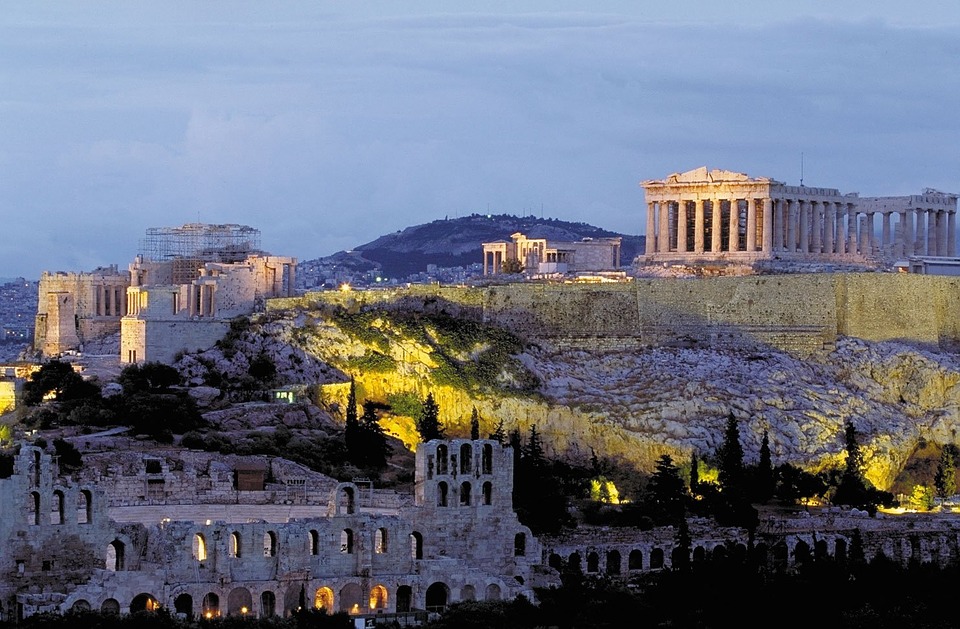
I’ve seen many animations of life in ancient cities. Most of them show rather pristine, antiseptic scenes. (Here is an example of one: Ancient Corinth.) Such animations don’t show the noisy, cluttered open markets or the garbage and human waste in the streets.
The video below, however, does a fairly good job of depicting the less-seemly aspects of ancient Athens. Watch it and see Athens the way it likely was in St. Paul’s day. While the animations were developed for a video game, many scholars have been impressed by the archaeological and sociological authenticity.
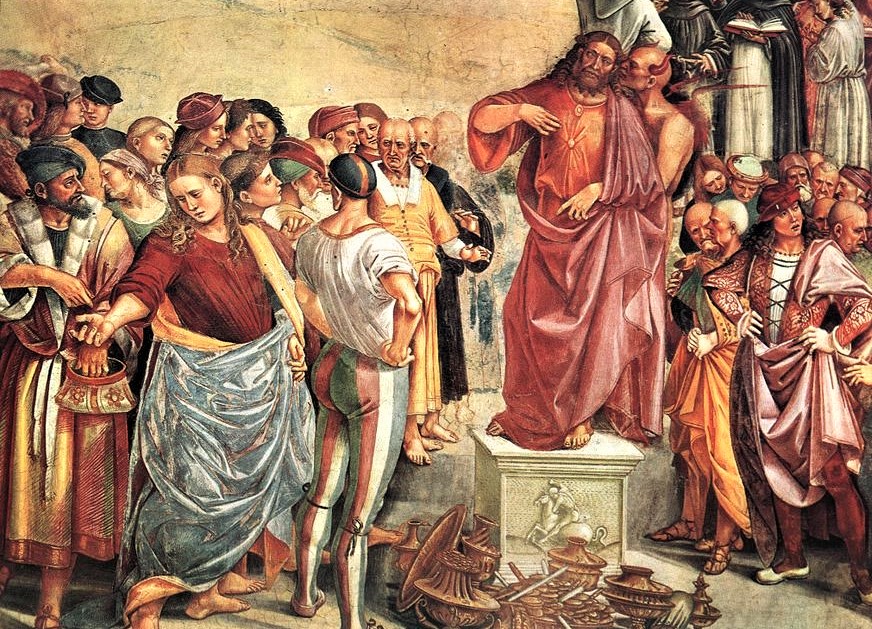
There is much lore about the antichrist (especially among certain Evangelicals) that is out of proportion to the attention Scripture pays to the concept, and more importantly is at possible variance from what is certainly taught. It easily becomes fodder for movies and novels: the antichrist figure steps on the scene, deceiving many, and mesmerizing the whole world with apparent miracles and a message of false peace.
But is this really what or whom the Scriptures call the antichrist? I would argue not, for in order to create such a picture one would have to splice in images from the Book of Revelation and the Letter to the Thessalonians that do not likely apply to antichrists.
In fact, the use of the term antichrist occurs only in the Johannine epistles. It does not occur in the Book of Revelation at all, though many have the mistaken idea that it does. There are plenty of beasts, dragons, harlots, demons, and satanic legions in Revelation, but no mention of antichrists.
Many also stitch the teaching about antichrists together with St. Paul’s teaching on the “man of lawlessness” (also called “the lawless one”) who is to appear just before the end. The lawless one may well be the stuff of movies, but calling him the antichrist may be to borrow too much from a concept that is more specific. While it is not inauthentic to make a connection between them (some of the Church Fathers seem to), it is not necessarily correct to do so.
In this reflection I take the position that it is improbable that the antichrist and the man of lawlessness are one and the same. In order to explain why, let’s first look at the occurrences of the term antichrist in St. John’s Epistles.
Little children, it is the last hour: and as you have heard that antichrist shall come, even now are there many antichrists; whereby we know that it is the last time (1 John 2:18).
Who is the liar but the one who denies that Jesus is the Christ? This is the antichrist, the one who denies the Father and the Son (1 John 2:22).
By this you know the Spirit of God: every spirit that confesses that Jesus Christ has come in the flesh is from God, and every spirit that does not confess Jesus is not from God. And this is the spirit of the antichrist, of which you have heard that it is coming; and now it is already in the world (1 John 4:2–3).
Many deceivers have gone out into the world, those who do not confess that Jesus Christ has come in the flesh; any such person is the deceiver and the antichrist! (2 John 1:7)
Note two things about antichrists. First, St. John (writing in the first century) teaches that he has already appeared. In calling this the “last hour,” St. John and the Holy Spirit do not mean that the Second Coming will take place in the next sixty minutes or even in the next few years. Rather, the teaching is that we are in the Last Age, the Age of the Messiah (also called the Age of the Church), when God is sending out His angels to the four winds to gather all the elect from the ends of the earth (cf Mark 4:21). Sadly, St. John also teaches that the antichrist has already come as well.
Second, after saying that the antichrist has come, St. John immediately clarifies by saying that actually many antichrists have appeared.
Thus St. John does not seem to present the antichrist as a single figure who has come. Rather, he says that there are many antichrists.
And what do these antichrists do? They perpetrate heresy, error, and false teaching. St. John notes in particular that heretics who deny that Jesus is the Christ (the Messiah) are antichrists. He also calls antichrists those who deny Christ having come in the flesh.
What does it mean to deny Christ having come in the flesh? It means reducing the saving work of God to mere appearances by claiming that Jesus did not actually take up a human nature but only appeared to do so. By extension, these same antichrists reduce the Christian moral and spiritual life to mere gnostic ideas rather than a true flesh-and-blood, body-and-soul change in our lives.
Many today extend these denials of the incarnation by undermining the historic authenticity of the Gospels, doubting or outright denying what Jesus actually said and did. Some of them say that Jesus’ resurrection was not a bodily one, but rather that His “ideas live on.” There can be no more fundamental heresy that to deny the bodily resurrection of Christ. As St. Paul says, And if Christ has not been raised, then our preaching is in vain and your faith is in vain … if Christ has not been raised, your faith is futile and you are still in your sins … [and] we are of all people most to be pitied (1 Cor 15:14-17).
Thus St. John, along with all the early Church, emphatically upholds an incarnational faith. We could actually touch our God and He touched us by taking up our human nature. He suffered on the cross and died. And though His suffering was tied to His human nature (for His divine nature is impassible), Jesus, the Second Person of the Blessed Trinity, hypostatically united to His human nature, suffered and died for us. It was this same human nature that God raised from the dead, gloriously transformed.
John takes up this theme elsewhere when he says that Christ came in water and in blood, not in water alone (cf 1 John 5:6). A certain heretic of that time, Cerinthus, held that the Second Person of the Blessed Trinity departed just before Jesus’ passion. John refutes this, insisting that just as at His baptism Jesus’ divine nature was affirmed (This is my beloved Son in whom I am well pleased), so also was it affirmed during the shedding of His blood on Calvary (the inspired word of God records the centurion, on seeing the manner of Jesus’ death, saying, Surely this was the Son of God (Mat 27:54)). Jesus Christ, the Son of God, though of two natures, is one person, and He did in fact die suffer and die for us.
Thus to St. John, the essence of the antichrist is denial that Jesus came in the flesh. An antichrist is one who would relegate Jesus’ presence among us to mere appearances or His teachings to mere abstractions or ideals rather than transformative realities.
By extension, it can be argued that the term antichrist refers to all deceivers, though only logically, not specifically in the text. St. John does not indicate that he means the term antichrist this broadly, but in a wider sense all heresy pertains to the antichrist because Jesus Christ is the truth. Jesus teaches through His apostles that to deny the truth is to deny Christ Himself; it is to deny truth itself and thus to be an antichrist.
So perhaps this is not fodder for movies and novels after all; sorry! And that’s a shame because the term antichrist is so catchy! This brings us to a discussion of the man of lawlessness (or the lawless one).
What or who is the man of lawlessness whom St. Paul mentions and how is he related to the antichrist? As I stated above, I do not think there is a connection. To see why, let’s consider what St. Paul teaches:
As to the coming of our Lord Jesus Christ and our being gathered together to him, we beg you, brothers and sisters, not to be quickly shaken in mind or alarmed, either by spirit or by word or by letter, as though from us, to the effect that the day of the Lord is already here. Let no one deceive you in any way; for that day will not come unless the rebellion comes first and the Man of lawlessness is revealed, the one destined for destruction. He opposes and exalts himself above every so-called god or object of worship, so that he takes his seat in the temple of God, declaring himself to be God (2 Thessalonians 2:1–4).
For the mystery of lawlessness is already at work, but only until the one who now restrains it is removed. And then the lawless one will be revealed, whom the Lord Jesus will destroy with the breath of his mouth, annihilating him by the manifestation of his coming. The coming of the lawless one is apparent in the working of Satan, who uses all power, signs, lying wonders, and every kind of wicked deception for those who are perishing, because they refused to love the truth and so be saved (2 Thessalonians 2:7–10).
Note the following crucial differences between antichrists and the lawless one:
John speaks of antichrists in the plural whereas St. Paul speaks in the singular: the man of lawlessness or the lawless one.
The lawless one’s deceptions are rather general (every kind of wicked deception), whereas deceptions of antichrists are more specifically related to denying the incarnation of the Son of God.
Jesus also speaks of those who will lead many astray, though He speaks of them in the plural and is likely referring to occurrences in the first century during the time leading up to the war with the Romans in 70 A.D: For false messiahs and false prophets will appear and produce great signs and wonders, to lead astray, if possible, even the elect (Matthew 24:24).
As you can see, there are a lot of moving parts here as well as a lot of singulars and plurals to sort out and time frames to consider. Permit me the following conclusions:
Antichrist is a more restrictive term than most people today think. While the antichrist is not a single person but rather any number of persons, the concept of antichrists seems limited to those who deny that Jesus is the Christ, come in the flesh. However, the term can possibly be applied to heretics in general.
Jesus warns of false prophets and messiahs, but the context of His warning seems to be the first century and the looming destruction of Jerusalem not the end times per se. Further, He speak of many false prophets, not a single one.
It is the man of lawlessness spoken of by St. Paul that most fits the charismatic figure of our “movie script,” a person able to unite the world in a false peace by mesmerizing and deceiving the nations. This lawless one will signal the end times. While I am not saying that these are the end times, I will note that the advent of instant, worldwide communication has made things easier than ever before for the lawless one. One individual actually could mesmerize and deceive all the nations—right on the worldwide web!
All that said, I believe that equating this lawless one with one of the beasts of Revelation or with the antichrist may be too speculative, and possibly inaccurate.
I hope I haven’t toyed with your “movie script” too much, but Scripture is nuanced in these matters and we do well to avoid reducing its teachings to popular concepts and catchy notions.
Scripture does speak to us of the end times and of difficult times preceding them, but the information is often given in general, even cryptic, terms. It is as if Scripture wants to tell us to be ready and to let us know that we don’t need to (and shouldn’t want to) know all the details. Just be ready, and when those times set in remember that Christ has already won the battle. Viva Christo Rey!
When I was a teenager in the 1970s, I enjoyed much of the popular music of the day but paid little attention to the words. It was usually the rhythm and melody that got my attention; the lyrics were more like another instrumental track than something to analyze. As I got older and especially when I became a writer, the words and their message became much more important to me. When I listen to the ’70s music now, I’m surprised by some of the radical, impure, and foolish philosophies we teens of that time “grooved” to.
One of my favorite groups was the Eagles, though I preferred their lyrical songs like “Desperado” to their hard-driving rock songs like “Life in the Fast Lane.” Among their more lyrical offerings was a song entitled “The Last Resort.” It has a beautiful melody and builds from a simple piano accompaniment to a full-on orchestra. I was oblivious at the time to the preachy and even anti-human lyrics.
It was written in 1976 by bandmembers Don Henley and Glenn Frey and reflected the sentiments of the newly emerging environmentalist movement (the first “Earth Day” was in 1970). Its lyrics argue, in effect, that man destroys everything he calls paradise; he ruins everything he sees as beautiful.
Don Henley would later say that “The Last Resort” was one of his favorite songs
because I care more about the environment than about writing songs about drugs or love affairs or excesses of any kind. The gist of the song was that when we find something good, we destroy it by our presence—by the very fact that man is the only animal on earth that is capable of destroying his environment. The environment is the reason I got into politics: to try to do something about what I saw as the complete destruction of most of the resources that we have left. We have mortgaged our future for gain and greed. [1]
His comments convey the anti-human belief that somehow, by our mere presence and capabilities, we destroy whatever is pristine and naturally beautiful. This pessimistic and cynical view of the 1970s has only gotten worse today. Notice also that “the complete destruction of most of our resources” he spoke of still hasn’t occurred more than forty years later. Before I critique any further, let’s examine the lyrics.
The first part of the song describes a young woman from Providence, Rhode Island. To his credit, Henley begins by featuring a young, liberal interloper. She is depicted as one of the dope-smoking hippies who experimented with commune life in the 1960s and 1970s. She sets out for the Rocky Mountains to live like “the red man,” but the presence of filthy communes wrecks the place and “laid the mountains low.”
She came from Providence The one in Rhode Island Where the old-world shadows hang Heavy in the air She packed her hopes and dreams Like a refugee Just as her father came across the sea
She heard about a place people were smiling They spoke about the red man’s way And how they loved the land And they came from everywhere To the Great Divide Seeking a place to stand Or a place to hide
Down in the crowded bars Out for a good time Can’t wait to tell you all What it’s like up there And they called it paradise I don’t know why Somebody laid the mountains low While the town got high
The second part of the song addresses suburbia. The human plague is depicted as a chilly wind that blows down the mountains all the way to Malibu. The claim is made that we wrecked the deserts, the canyons, and the coast; that rich developers raped the land with ugly houses and neon lights. The natural beauty was appreciated as a kind of paradise by the dwellers, but Henley argues that their mere presence means that paradise is lost, destroyed.
Then the chilly winds blew down across the desert Through the canyons of the coast to the Malibu Where the pretty people play hungry for power To light their neon way and give them things to do
Some rich men came and raped the land Nobody caught them Put up a bunch of ugly boxes and Jesus people bought them And they called it paradise The place to be They watched the hazy sun sinking in the sea
Part three laments that, having ruined every paradise in the continental U.S., some now set their sights on Lahaina (in Hawaii). Yes, you too can sail to a far-off land and destroy it the way the Catholic Missionaries did to California! They just had to get in an anti-Catholic jab. To radicals, the Catholic Church is a mortal enemy. Protestants and unbelievers get a pass; somehow was Catholic missionaries that brought “the white man’s burden,” the “white man’s reign.” Catholics are also mocked for singing in our parishes of a paradise “up there.” We’re so awful, though, that apparently if we ever got there, we’d ruin that too just by being there. The lyrics are tinged with the lament of Jean Paul Sartre in his play No Exit: “Hell is other people” So, in this final part of the song, we have all three of the favorite whipping boys of the radical left: humans, white men, and Catholics:
You can leave it all behind and sail to Lahaina Just like the missionaries did so many years ago They even brought a neon sign ‘Jesus is Coming’ Brought the white man’s burden down, brought the white man’s reign
Who will provide the grand design, what is yours and what is mine? ’Cause there is no more new frontier, we have got to make it here We satisfy our endless needs and justify our bloody deeds In the name of destiny and in the name of God
And you can see them there on Sunday morning Stand up and sing about what it’s like up there They called it paradise, I don’t know why You call some place paradise, kiss it goodbye.
Things have only gotten worse severe since this song was written in the 1970s. For too many environmentalists, mankind is the problem; like a plague of locusts, we must be limited or even removed completely.
As I have written here before, Catholics should be aware that radical environmentalists, including climate change extremists, have “solutions” that no Catholic can countenance. Many of them are advocates of abortion, euthanasia, and forced sterilization. They support government involvement in the economy in ways that contravene the principle of subsidiarity, violate the natural rights of the human person, and disproportionately harm the poor and developing nations.
Another problem with the radicals’ stance is that they see can little or nothing positive in man’s role in the environment. We are viewed as an unnatural interloper. We have surely transgressed in some ways against the natural world, and it is right that we work to reduce pollution and waste. However, I do not believe that there is a “climate emergency.” I’ve been hearing similarly dire predictions all my life, but we’re still here! But I digress; I’m neither a politician nor a scientist.
The point is that for all our errors or excesses, humans have also improved and even helped to advance the potential of the natural world. We have increased agricultural yields, driven back diseases, and made many parts of the world more productive and beautiful. We seldom clear-cut forests anymore. We carefully harvest trees, which are a renewable resource, and we replant them. Why is a city or a suburb inherently bad or ugly? Farms are beautiful, too, and collectively they feed billions. Humans have done some wonderful things to unlock nature’s potential and, as Scripture says, to subdue its unrulier dimensions. The Catholic and biblical view is that we are supposed to be here; we are to oversee the world as stewards and extend, in a way, the work of creation.
Contrary to the songwriters’ allegations, we do not necessarily destroy paradise just by being there. We often improve on the created world through human ingenuity, making use of its resources to feed, clothe, and shelter human beings, each beautiful one made in God’s image. We are not enemies of paradise; we are part of it. God gave it for us to enjoy in moderation and with care.
For all the finger-wagging that so many in the environmental movement do, they also drive cars on paved roads and live in homes with electricity, heat, running water, and air-conditioning. They have wood in the structure of their homes, which built on land that likely once belonged to indigenous people. They eat of the fruits of modern agriculture and fly on planes to business meetings and vacation destinations.
All of us can help by polluting less and wasting less, but human beings are important; we are not a plague on planet Earth. God gave us this earth to use with care and reason. Catholics should not accept the radical environmentalist vision in toto. The Catholic understanding of our role in the natural world is stated well in the Catechism of the Catholic Church:
To human beings God even gives the power of freely sharing in his providence by entrusting them with the responsibility of “subduing” the earth and having dominion over it. God thus enables men to be intelligent and free causes in order to complete the work of creation, to perfect its harmony for their own good and that of their neighbors. Though often unconscious collaborators with God’s will, they can also enter deliberately into the divine plan by their actions, their prayers and their sufferings. They then fully become “God’s fellow workers” and co-workers for his kingdom (CCC # 307).
Anti-human attitudes have no place in Catholic thinking. Our summons is to live up to what the Catechism so beautifully states. Whatever your views on the condition of the environment and the climate, stay Catholic, my friends, stay Catholic.
I still like the song for its melody and arrangement. The words I can live without, except that they illustrate well the problems we face today in upholding human dignity and understanding our proper role with respect to the environment.
At a past parish gathering there was a demonstration of different dance styles. One of our young adults, Lola, is a student of classical and ballroom dance. She, along with her dance partner, danced a modest tango in a most elegant way.
What was most fascinating to me was that Lola kept her eyes shut during the entire dance; I wondered how it was even possible to dance with closed eyes. So I asked her why she did that. Lola responded that it was easier for her to dance that way; it was less distracting. “I close my eyes so that I can better follow his lead.” She says that this is common in this form of dance.
All this made perfect sense to me the moment she said it. Indeed, all of us must learn this lesson in our walk, our dance, with God. Scripture says,
For we walk by faith, not by sight (2 Cor 5:7).
So we fix our eyes not on what is seen, but on what is unseen (2 Cor 4:18).
Now faith is confidence in what we hope for and assurance about what we do not see (Heb 11:1).
Blessed are those who have not seen and yet have believed (John 20:29).
Though you have not seen him, you love him; and even though you do not see him now, you believe in him and are filled with an inexpressible and glorious joy (1 Peter 1:8).
We, too, must learn to dance with our eyes shut to the world’s disruptions and demands lest they distract us from the Lord’s lead. Jesus said, You must follow me (Jn 21:22). Whoever serves me must follow me (Jn 12:26). I know my sheep, and they follow me (Jn 10:27).
So easily do our eyes become mesmerized by the flickering and distracting lights of the world. Soon enough, in the dance of faith, we get out of synch with the Lord; we stumble or lose our way. Better to close our eyes through careful custody of them and listen to the Lord, feeling His subtle moves and promptings. Scripture says, So faith comes from hearing, and hearing through the word of Christ (Rom 10:17).
Beware; we are very visual creatures, but our eyes are easily deceived and too easily drawn to what is fast and flickering. Faith comes through quiet hearing, patient listening, and experience of the Lord’s subtle moves and promptings. Blinded by the world’s flickering lights we fall in the dance of God’s love.
For some years now there has been a constant onslaught of images, lights and colors that blind man. His interior dwelling is violated by the unhealthy, provocative images of pornography, bestial violence, and all sorts of worldly obscenities that assault purity of heart and infiltrate through the door of sight.
The faculty of sight, which ought to see and contemplate the essential things, is turned aside to what is artificial … In the cities that shine with a thousand lights, our eyes no longer find restful areas of darkness.
… Our eyes are forced to look at a sort of ongoing spectacle. The dictatorship of the image, which plunges our attention into a perpetual whirlpool, detests silence. Man feels obliged to see ever new realities that give him an appetite to own things; but his eyes are red, haggard, and sick …. He is riveted to ephemeral things, farther and farther away from what is essential.
Our eyes are sick, intoxicated, they can no longer close. The tyranny of the image, forces man to renounce the silence of the eyes. Humanity itself has returned to the sad prophecy of Isaiah, which was repeated by Jesus: “Seeing they do not see, and hearing they do not hear, nor do they understand… For this people’s heart has grown dull, and their ears are heavy of hearing and their eyes they have closed to me, lest they should perceive with their eyes, and hear with their ears, and understand with their heart, and turn for me to heal them.” (Matthew 13:13, 15).
[The Power of Silence pp. 43-46]
There is great wisdom in Cardinal Sarah’s Book. I concur with Michael O’Brien, who commented on the Cardinal’s book in this way: It is impossible to exaggerate the importance of this profound, uniquely beautiful book. Yes, in an audibly and visually noisy world, we must regain our reverence for and experience of silence.
Lola is right. Regarding the dance, she said, “I close my eyes so that I can better follow his lead.”
For us who would seek the Lord and take up the dance of love, we too must say, “I close my eyes so that I can better follow his lead.” The “night” of the senses leads to an inner illumination and unity with the Lord, who says, “Follow me.”
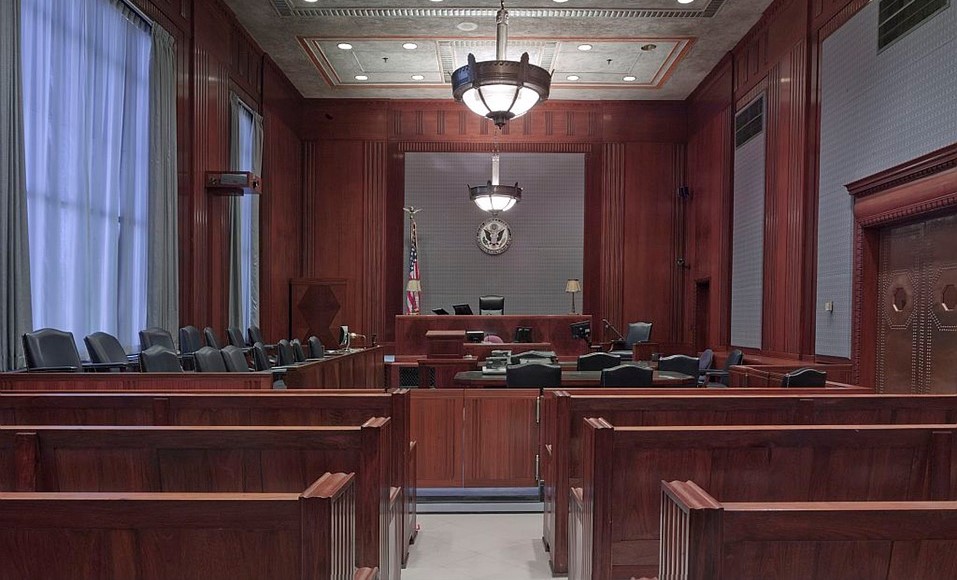
Inyesterday’s post, I wrote about my experience serving on a grand jury, describing in particular the darkness we jurors had to face each day as we listened to testimony about and video of some horrible crimes. In today’s piece, I’d like to point out some light I saw in the midst of that darkness, some positive elements of my experience.
For much of my life I have looked somewhat askance at lawyers, despite the fact that my father was a lawyer, and a good one at that. (I also enjoy lawyer jokes – all in good fun, of course.) I had this vague impression that lawyers just make everything difficult. The lawyers with whom I come into contact in the Church warn us about so many things that I sometimes cynically remark that if we took every one of their precautions, we’d never open our doors. However, their cautions are usually well-founded given our litigious society. Then, too, there are the ambulance chasers whose advertisements seem to be everywhere. There are also lawyers who file frivolous lawsuits knowing that it’s easier for companies to settle out of court than to fight back. Such things give the profession a bad reputation even though most attorneys do not engage in such practices. Those were some of the biases I harbored when I was summoned.
There I was at the beginning of grand jury duty, unsure of what to expect, when in walked the first of many Assistant U.S. Attorneys I would meet over the next several weeks. I must say that I was impressed by every one of them; they were consummate professionals who had obviously done a lot of meticulous work assembling the cases. In the initial stages of an investigation, these attorneys work closely with the police to examine evidence. They interview many witnesses in their office before ever setting foot in the grand jury room. Witnesses are not always cooperative and some even fail to appear. Their testimony is not always clear and must be disambiguated. Further, witnesses sometimes contradict one another as they recall a traumatic event. Even the victims themselves can be uncooperative due to the fear of repercussions from testifying or supplying information. I can only imagine how difficult and painstaking the attorneys’ work is. Surely it requires great dedication, patience, and perseverance. I was also impressed with their command of the facts in each case, especially considering that they work on numerous cases simultaneously.
In the grand jury room, I was taken by the great respect the attorneys showed for the law while at the same time treating the victims and their families compassionately. Their presentations were well-organized and focused on the evidence. They carefully led the witnesses through what was often gut-wrenching testimony with gentleness, empathy, and understanding. At no time did I see any of them being overzealous. These attorneys have earned my respect and I am grateful to them for all that they do.
Another thing I appreciated during my service was becoming deeply immersed in one of the last bastions of reason and order in our society. In recent years, our culture has experienced an almost complete loss of reason and clear meaning. We are currently in a desert of existentialism, in which individuals define their own meaning because they believe there is no intrinsic purpose or meaning to human existence. This has led to the current bizarre idea that a man can declare himself to be a woman or a woman can declare herself to be a man – and that the rest of society must accept such declarations as fact. It’s hard to have a good argument, let alone a conversation, when basic terms and realities are no longer a given.
The legal world, however, is still steeped in reason and careful, precise definitions. For example, what it means to “possess” a weapon and what is meant by “intent to kill” are precisely defined. The conditions under which charges can be enhanced due to prior convictions must meet strict, definitive criteria. The specifics of a firearm, down to the length of the barrel and the capacity of the ammunition clip, play an important role in applying the law. Jurors and judges in trials are expected to evaluate the evidence and testimony with respect to the law and then draw a well-reasoned conclusion.
In legal proceedings there is the careful assessment of what is meant by a particular crime and what the law provides in terms of adjudication and outcomes. I am not making a case for legal positivism (i.e., whatever the law says is good or right) but merely remarking that we grand jurors were provided with clear definitions and instructions on how to evaluate the evidence and testimony before us.
Hearing the word “reason” used again and witnessing the precision of language and meaning was refreshing. It was almost like stepping back in time a few decades, to a time when words still had clear meanings and basic moral norms were accepted. Even if we didn’t live perfectly moral lives, we knew when the moral law was broken and did not commonly call good or no big deal what God calls sinful.
St. Thomas Aquinas wrote that law is an ordinance of reason for the common good (Summa Theologica I IIae 90.1). As an ordinance of reason, the law binds people to the reasonable limits it sets forth. The very word “law” comes from the Latin word ligere, which means “to bind.” Law, properly understood, concerns reason, order, and limits we must all accept to enjoy the greatest freedom. The only true freedom is limited freedom. Consider the dangerous chaos that would ensue if we did not limit our freedom to drive by following agreed upon traffic laws.
While we on the jury were looking into a world of chaos and disorder, our attention was always drawn back to the world of reason and order. Lawyers are agents of stability in this milieu, where the rule of law is still important, and words and reality still matter.
I was not born yesterday; I realize that the courts have also been infected with existentialism and the political correctness that is its offspring. This is especially evident at the higher levels of the judicial system, where unelected activist judges “legislate from the bench” and find new rights in the “penumbras” and “emanations” of the Constitution. Supreme Court Justice Anthony Kennedy once ignominiously wrote, “At the heart of liberty is the right to define one’s own concept of existence, of meaning, of the universe, and of the mystery of human life” (Planned Parenthood v. Casey). There you have it – pure existentialism. The right of people to define their own meaning and their own concept of existence is not a path to liberty but to chaos and anarchy. This is increasingly the case in our society today.
At the lower levels of the judicial system, reason, law, and objectivity are still the meat and potatoes of the daily work. At its best, our legal system is one of the last sectors of our society in which reason and the application of clear definitions are still evident. My grand jury experience made me deeply aware of this. It was uplifting and encouraging and was not a light I expected to see within the darkness.
I have new respect for the criminal justice system. In this antinomian and politicized age, it is a popular whipping boy. Though no system is perfect, I came away impressed with its thoroughness and fairness. Prosecutors don’t just prosecute criminals; they also work to secure justice for victims and their families and to protect the common good. Defense attorneys play a critical role as well. The attorneys do all this within the careful confines of the law, which seeks to protect the rights of both the accused and the victims.
Doxology
Thank You, Lord, for the good and hard work of those in our criminal justice system, many of whom labor behind the scenes. Often, they must deal with the worst of crimes and endure frustrating setbacks, yet they persevere in their work. Thank you too, Lord, for the rule of law that You have given us over the centuries. May we protect it from the erosion by existentialism and relativism. May our law be just and in perfect accord with Your eternal law. May the rights and dignity of every person, accused and victim, be upheld and honored. True justice can only be Your work. May all of us, especially those who are lawyers, judges, and jurors be instruments in Your hand.
This song speaks of the sadness of existentialism and relativism. While it idealizes the past, it does point out that we have lost something important.
In early September, I was summoned to serve on a criminal grand jury here in Washington, D.C. through mid-October. It was difficult and emotionally draining work; I frequently wondered why the Lord would permit such a huge addition to my already overwhelming schedule. When I complained to Him, all I got back was that He wanted me to see something.
Many expressed their surprise that a priest would be compelled to serve. Frankly, as a clergyman, I fully expected to be dismissed. As I discovered, however, grand juries are quite different from petit juries, from which priests, religious, and other sorts of people who might sway fellow jurors are often dismissed. Very few occupations (e.g., active duty military personnel) are exempted from serving on a grand jury.
As that morning unfolded, I began to realize I wasn’t going to escape this time. By noon it became clear that I was going to have to serve not just for one day or one trial but every weekday for the next five weeks, from nine to five. Don’t expect to be called and told not to come in, they warned us, because there’s just too much work to be done; you’ll be reviewing evidence on over forty cases. I didn’t think it was possible for me to get any busier, but I just had. Twenty-three of us were sworn in and marched over to the grand jury room. Suddenly, my tightly scheduled calendar was thrown into complete disarray. My staff was shocked; they were bewildered by all the implications of a pastor being essentially unreachable every working day during normal business hours.
What is a grand jury? Grand juries are called “grand” because they are typically composed of more members than are petit juries. In our jurisdiction, a grand jury has 23 members, with 16 required for a quorum. Petit juries are typically composed of 12 jurors and two alternates. Another difference is that grand juries do not determine guilt or innocence; rather, they examine the evidence and decide whether there is “probable cause” for it to proceed to trial. In effect, grand juries exist as a kind of buffer, protecting citizens from overly aggressive prosecution. If the jury finds that sufficient evidence exists in relation to the charge(s), it returns an indictment. If not, it issues an “ignoramus” (meaning “we are ignorant” or “we don’t know”).
I was not fully prepared for what the Lord wanted me to see. Indeed, I found myself peering into a deep, deep darkness. In the midst of it, though, I also saw light.
As for the darkness, it was very dark. In our jurisdiction there are five grand juries seated and working at any given time. I was assigned to the one focused on the very worst kinds of cases: first degree murder, assault with intent to kill, assault with a deadly weapon, negligent homicide, armed robbery, kidnapping, and aggravated rape. I am not permitted to reveal any details, but I can say that those details are now written deeply in my heart. On many evenings, after hearing testimony and viewing evidence all day, I went into the rectory chapel and wept. So many of the killings and attacks considered by such grand juries are brutal and cold-blooded, not acts committed in the heat of a passion but rather planned and vengeful. Serving on one, I wondered how people could have the capacity to be so cruel to fellow human beings. I don’t know how some of the victims could ever really recover. All I could do was to sigh inwardly and pray as we saw the evidence and heard the victims testify.
Another thing that both surprised me and added to my sorrow was to discover that in so many incidents there is significant video evidence – sometimes of the very crime itself being committed. It is clear to me now that there are video cameras just about everywhere. It is one thing to see a violent crime “committed” in a movie, but quite another to watch a real one. It is impossible for me to drive past certain locations in this city now and not feel a solemn reverence for what I know happened there. May God have mercy on the victims, many dead, but some still living though forever changed. May God also have mercy on the perpetrators, who somehow lost their way in a world of darkness, evil, and hopelessness that so often sets up in the poorest areas of the city.
When God told me that He wanted me to see something, I thought that I had seen it before. As pastor of St. Thomas More parish in Ward 8, I spent eight years living in one of D.C.’s poorest neighborhoods. Even there, however, I was surrounded with a loving, supportive parish family. During that time there were two murders on our parish grounds (one by stabbing, the other by shooting), but we were able to come together and heal. We even responded by building a five-million-dollar community center to try to get kids off the streets and away from gangs.
But this was different. I think it was both the sheer number of violent cases and the “up-close” experience of them through video footage and witness testimony. Although I was surrounded by the other grand jurors, the mandated secrecy outside the jury room meant that we could only discuss things within the formal setting.
Doxology
You told me, Lord, that you wanted me to see something. I did indeed see it. I am now more mindful to pray and offer Masses for what I saw. I am not sure what to do about all the situations that lead to the kinds of crimes we investigated, but I am more aware of the burdens that others carry and the things they suffer, particularly in areas of this city where there is frequent disorder and violent crime. What You had me see weighs heavily on me, but You, O Lord, surely carried the heaviest burden of all when, dying on the cross, the full horror of every sin ever committed or to be committed, including my own, flashed before You and increased Your pain. Thank You, Lord Jesus, for what You endured. I carry only a sliver of the cross You bore; I have seen and know a minuscule fraction of what You do. I can only be more grateful for what You did for us on that dreadful hill of Golgotha, where the full fury of our anger and inhumanity was violently unleashed upon You. I am grateful for Your mercy, Lord, so grateful. We need it more than ever.
I wrote above that I also saw light – in a place I did not expect. More on that in tomorrow’s post.
This Sunday’s readings speak to us of the power of persistent prayer. The first reading (Exodus 17:8-13) in particular depicts prayer quite powerfully. In it, we can discern six fundamental teachings on prayer.
I. The Problem for Prayer – In those days, Amalek came and waged war against Israel. None of us like problems, but one good thing about them is that they help to keep us praying. Israel was at war and her enemies were strong; it was time to pray.
The Gospel concerns a widow who is troubled about something, and this problem keeps her coming back to the judge. Sometimes God allows us to have problems in order to keep us praying. Problems also keep us humble and remind us of our need for God and others.
Problems aren’t the only reason we pray, but they are one important motivator. It shouldn’t be necessary for us to have problems, but they certainly have a way of summoning us to prayer.
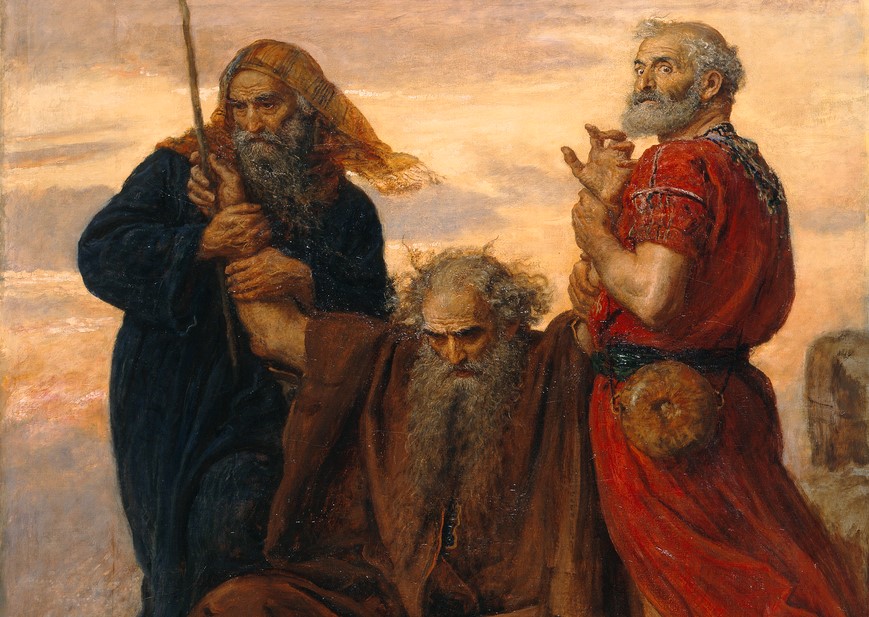
II. The Priority of Prayer – Moses, therefore, said to Joshua, “Pick out certain men, and tomorrow go out and engage Amalek in battle. I will be standing on top of the hill with the staff of God in my hand.” So Joshua did as Moses told him: he engaged Amalek in battle after Moses had climbed to the top of the hill with Aaron and Hur.
Notice that Joshua and the army did not go forth until after Moses took up his position of prayer. Prayer ought to precede any major decision or action.
We often rush into things without praying. We should begin each day with prayer. Important decisions should also elicit prayer from us. Prayer needs to come first; it has priority.
Too many people use prayer as a kind of rear-guard action through which they ask God to clean up the mess they’ve made. We end up doing a lot of things we shouldn’t because we didn’t pray first. We also end up doing a lot of things poorly that prayer might have clarified or enriched.
Prayer isn’t just about asking for this or that specific thing. It involves an ongoing relationship with God, through which we gradually receive a new mind and heart, and our vision and priorities are clarified and purified. The new mind and heart that we receive through prayer and the study of our faith are an essential part of the prayer that precedes decisions and actions.
III. The Power of Prayer – As long as Moses kept his hands raised up, Israel had the better of the fight, but when he let his hands rest, Amalek had the better of the fight.
As long as Moses prayed, Israel got the better of the battle, but when fatigue caused his prayer to diminish, Israel began to lose.
Prayer changes things. Here in this world, we may never fully know how our prayers helped to change history, but I am sure that one of the joys of Heaven will be to see what a difference our prayers—even the distracted and poor ones—made. In Heaven, we’ll tell stories of prayer’s power and will be able to appreciate the difference it made for us and for others. For now, much of this is hidden from our eyes, but one day, we’ll see with a glorious vision what prayer accomplished.
I suppose, too, that one of the pains of purgatory might be seeing the negative effects of our failure to pray and realizing that it was only God’s mercy that counteracted our laziness.
In this passage, Moses struggles to pray—so do we. Remembering prayer’s power is an important motivator to keep us on our knees and at our beads.
IV. The Partnership of Prayer – Moses’ hands, however, grew tired; so they put a rock in place for him to sit on. Meanwhile Aaron and Hur supported his hands, one on one side and one on the other.
Moses knew that because of his fatigue he needed the assistance of Aaron and Hur. They all prayed together and, once again, Israel was strengthened and regained the upper hand.
Prayer is not supposed to be merely a solitary experience. While personal prayer is important, so is communal and group prayer. The Lord said, Where two or three are gathered in my name, there am I in the midst of them (Matt 18:20). He also said, Again, I tell you that if two of you on earth agree about anything you ask for, it will be done for you by my Father in heaven (Matt 18:19).
We are taught to gather in prayer liturgically and also to find partners for prayer. Because prayer is so essential and we are individually so weak, we ought not to have it all depend on us. We need our own Aaron and Hur to support us in prayer and to help make up for our weakness.
Do you have some friends who help you, not only to pray but also to walk uprightly? Scripture says, Woe to the solitary man! For if he should fall, he has no one to lift him up. … where a lone man may be overcome, two together can resist. A three-ply cord is not easily broken (Ecclesiastes 4:10,12).
Do not pray or journey alone. Find some spiritual friends to accompany you.
V. The Persistence of Prayer – so that [Moses] hands remained steady till sunset.
With Aaron and Hur to help him, Moses prayed right through until sunset. They prayed right up to the end—so must we. There is a mystery as to why God sometimes makes us wait, but we must continue to pray anyway. We may get frustrated, fatigued, or disheartened by the delay, but we must pray on. Like Moses, we should get friends to help us, be we must not stop praying.
Be like the woman in the Gospel, who just kept returning to that judge until he rendered justice for her. I have brought people back into the Church long after the spouse or parent who prayed for them died.
VI. The Product of Prayer – And Joshua mowed down Amalek and his people with the edge of the sword.
The text says that the enemies of Israel were utterly defeated. This shows the powerful result of persistent prayer.
We may not fully see the results of our prayer on this side of the veil, but on glory’s side we one day will. We may not need God to mow down a foreign enemy for us, but how about enemies like fear, poverty, illness, and sin? Yes, we have enemies, and God answers prayers. Pray and then wait patiently for the product of prayer.
There you have it, six practices and teachings on prayer.
There are different ways to look at life, and two of these are captured in a couple of seemingly contradictory sayings. The more famous aphorism is this one: “The perfect is the enemy of the good,” but you’ll also hear its converse: “The good is the enemy of the best.” The second expression cautions that we sometimes settle for something that is merely good enough when we should be aiming higher; excellence is certainly something for which to strive.
In today’s blog, though, I’d like to concentrate on the original: “The perfect is the enemy of the good.” In striving for the perfect thing, we can miss the good. We live in a fallen world, less than perfect. Likewise, you and I are incomplete, unfinished, imperfect. Yet this does not mean that we lack anything good at all or that this imperfect world has nothing to offer.
Being more than halfway through my expected lifespan, I have moved from the perfectionist world of the second saying to the contented world of the first, though each has its place. I have come to understand that contentedness is a very great gift and that true perfection only exists in Heaven.
There is another, similar, saying: “Unrealistic expectations are premeditated resentments.” Many, believing that life should be a peachy, are resentful to discover that even peaches have pits. Such an expectation is a sure-fire recipe for resentment, discouragement, and depression.
I think this is one of the problems with marriage today. Despite the modern tendency to be cynical about pretty much everything, many still have very high ideals expectations of marriage: that it will always be romantic, joyful, and fulfilling, that love will magically solve every problem.
This is not realistic. Marriage is like life; it has its ups and downs. There are things we like and things we wish were different. There is no perfect spouse and there is no perfect marriage. There are many good marriages that are far from perfect. There are many spouses who, though basically decent, do not act perfectly all of the time.
When people enter marriage with unrealistically high expectations, they may be tempted to focus on the negative things, to magnify them because they are not perfect as was expected; resentments begin to build. It’s sad, really. The marriage may not actually be that bad; the less-than-ideal spouse may not really be so awful.
But the perfect becomes the enemy of the good; decent things are trampled underfoot in the elusive search for the perfect, the best, the ideal.
Indeed, there is yet another related saying about marriage: “Many people want their marriage to be ideal, and if there is any ordeal, they want a new deal.”
We do a lot of this: discarding the good as we chase in vain after the perfect. There is always a better parish, a better job, a better boss, a better house, a better car, a better neighborhood, a better deal.
There is something freeing and calming about being able to accept the good, the imperfect, and be content with it. The perfect will come, but probably not before Heaven. In the meantime, the good will suffice. Sometimes we don’t recognize or appreciate the good until we accept that the best, the perfect, will have to wait.
All of this occurred to me as I watched this animated short about a “man” who creates a work of art. At first he loves it, but then, noticing an imperfection, he is driven to try to make it perfect, even as everything else around him is being destroyed in the process. Just before it is too late, he realizes his folly. Clinging desperately to his creation, he learns to love it as it is. To some extent this has been my journey; I pray that it is yours, too.