Fundamentals for Fruitful Discipleship – A Homily for the 5th Sunday of Easter

In this Easter Season, we continue to reflect on how the Risen Lord Jesus minsters to us and supplies our needs. Last week we considered Him as our shepherd. This week we learn how He is the vine and we the branches, wholly dependent on Him for everything. As we consider how He cares for us as His disciples, we need to rescue the word “care” from its rather sentimental modern sense. True care does not merely include pleasant things such as providing food and shelter. Sometimes care involves difficult things, but ones that are necessary to discipline and purify us so that we grow and bear more fruit. Thus, the Lord speaks of “pruning” in this passage. While caring, pruning is not often pleasant, but it is proper care. Let’s look at how the Lord cares for us so that we can be true disciples.

The Lord presents us with four basic principles that assist us in being better, more fruitful disciples.

I. The Purpose of Disciples – The text says, I am the true vine, and my Father is the vine grower. He takes away every branch in me that does not bear fruit … Anyone who does not remain in me will be thrown out like a branch and wither; people will gather them and throw them into a fire and they will be burned.

The purpose of a vine is to bear fruit. What are the fruits that the Father seeks? Surely justice, righteousness, and holiness are chief among them. The Letter to the Galatians speaks of them in this way: But the fruit of the Spirit is love, joy, peace, patience, kindness, goodness, faithfulness, gentleness, and self-control (Gal 5:23). Surely, we can add virtues and fruits such as generosity, chastity, mercy, forgiveness, and zeal for God and His kingdom. These are among the fruits God seeks, and which are the purpose of the vine, His son Jesus, whom He sent to nourish us so that these fruits would come to pass.

Yet there are some branches that, though they take nourishment from the vine, do not bear fruit. Not only do they fail to bear fruit, they often harm the vine by drawing strength away from the fruit-bearing branches.

I know little of grapes, but for many years now I have grown tomatoes. As the tomato plant grows, small shoots emerge from the base of the vine branches. These are usually called “suckers,” because they draw strength away from the main branch where the tomatoes are growing. These suckers should be plucked for the health and vigor of the plant and the best development of the fruit.

God will often do the same. In our modern age, with its stress on individualism, hearing that God cuts off unfruitful branches strikes us as unmerciful and harsh. However, God has in mind not just the individual, but the strength and fruitfulness of the whole vine. Failing to bear fruit does not just affect the individual; it affects the whole vine. Therefore, God, as a loving vine-dresser, cuts away the harmful branches. Your life is not just about you. My life is not just about me. We exist in myriad, complex relationships with one another, and God must care for all of them. Because the purpose of the vine is to bear fruit, God tends the vine with that in mind.

The text goes on to say that severed branches wither and that “people” will gather them and throw them into the fire. If I don’t know who I am and whose I am, if I am no longer rooted in Christ, anyone can name me and carry me off. Yes, without the stability of abiding on the vine, I can get “carried away” by worldly things. In this way, I wither and die spiritually; the slightest breeze can blow me about. Like any dried and withered branch, I am good for nothing but to be thrown into the fire. Unless Christ carries me and sustains me, I am carried away by others, who cast me into the fire.

II. The Pruning of Disciples – The text says, and every [branch] that does he prunes so that it bears more fruit. You are already pruned because of the word that I spoke to you.

Most of us who have cared for roses know how important pruning is. Without this careful and necessary cutting, the rose bush grows long and gnarly. It expends its strength more on the branches than on the flowers. Little by little the flowers become smaller and less beautiful; the leaves lose their beauty, shape, and color, becoming smaller and lighter green. Eventually the rose bush looks little better than a weed.

I imagine that if a rose bush could talk, it would protest and cry out in pain every November as I descend upon it and cut back its growth to a mere one foot above the ground. In May, though, the gorgeous roses in the front yard are a masterpiece and all the pain of November is forgotten.

Pain and pruning are part of the Christian journey; God knows what He is doing. We often do not, and like the roses in November that cry out in pain and protest, we look for answers. Yet no more than I can explain my purpose to the roses (they are only rose bushes, after all), can God explain to us what He is about (we are mere mortals with minds too small to comprehend the whole picture).

Just the same, November pruning gives way to May glory; God the vine-dresser knows what He is doing.

Note, too, that the Lord says that His Word “prunes” us. If we let the Word enter us uncompromised and unabridged, we read, For the word of God is living and active. Sharper than any double-edged sword, it penetrates even to dividing soul and spirit, joints and marrow; it judges the thoughts and attitudes of the heart (Heb 4:12). Yes, God’s Word can humble our pride, cut to the quick our distorted and wrongful thinking, and hold us accountable. It can cut away error and mend the decayed wounds of sin.

We must allow the Word of God to be what it is. Too many of us seek a filtered and watered-down version of God’s Word. No! Let the undiluted Word go to work, of which Scripture itself says, Is not my word like fire, declares the LORD, and like a hammer that breaks a rock in pieces? (Jer 23:29)

A pruned vine bears abundant fruit. None of us like pruning, but nothing is more necessary.

III. Persistence of Disciples – The text says, Remain in me, as I remain in you. Just as a branch cannot bear fruit on its own unless it remains on the vine, so neither can you unless you remain in me. I am the vine, you are the branches. Whoever remains in me and I in him will bear much fruit, because without me you can do nothing.

In this short Gospel, the word “remain” occurs seven times. Do you get the point? Remain! The Greek word μείνατε (meinate) is the plural imperative of the verb meno, meaning, “to abide.” To abide means to remain habitually or to stay somewhere. It speaks of stability and persistence.

It is clear that a branch must always stay attached to the vine or else it is doomed. Absolutely nothing is possible to a branch (except to wither and die) unless it is attached to the vine 24 x 7 x 365. Nothing could be clearer in this analogy than this truth.

Yet it seems very unclear to the average disciple of Jesus, who so easily walks away, finding abiding both tedious and difficult. Then we wonder why our spiritual life is tepid and its fruits lackluster! We can’t have even a mediocre spiritual life apart from Christ; the text says we can’t do anything at all but be scattered.

How do we abide with and in the Lord? Scripture distinguishes four ways. We abide and experience union with the Lord through

HIS WORDIf you abide in me, and my words abide in you, ask whatever you will, and it shall be done for you (Jn 15:7). Anyone who loves me will be true to my word and my Father will love him and we will come to him (Jn 14:22).

HOLY COMMUNION –  He who eats my flesh and drinks my blood abides in me, and I in him (Jn 6:56).

PRAYER (especially communal prayer) –  For where two or three are gathered in my name, there am I in the midst of them (Matt 18:20).

KEEPING HIS COMMANDMENTSThose who keep his commandments abide in him and He in them (1 John 3:22).

Yes, abiding is accomplished through prayer, Scripture, sacraments, fellowship, and walking uprightly. This Gospel could not be more clear: abide, abide, abide, abide, abide, abide, abide. Seven times the word is used.

Do you get it? Abide. Abide persistently.

IV. The Produce of Disciples – The text says, If you remain in me and my words remain in you, ask for whatever you want and it will be done for you. By this is my Father glorified, that you bear much fruit and become my disciples.

Attached to and abiding in the vine, we will produce abundant fruit. Note that this is linked to a kind of fruitfulness in prayer that comes from the Father’s good pleasure.

Why is He pleased to answer our prayers if we abide? Because He can trust us with His blessings. In effect, He can say, “Here is someone who is close to my Son, who habitually remains with Him and abides with Him. Yes, here is someone I can trust with blessings. Here is a wise steward who is in union with my Son.” Scripture speaks often of the correlation between wise stewardship and blessings:

  • (Luke 16:10-11) Whoever can be trusted with very little can also be trusted with much, and whoever is dishonest with very little will also be dishonest with much. So, if you have not been trustworthy in handling worldly wealth, who will trust you with true riches?
  • (Matt 25:21) His master replied, “Well done, good and faithful servant! You have been faithful with a few things; I will put you in charge of many things. Come and share your master’s happiness!”
  • (Luke 12:48) From everyone who has been given much, much will be demanded; and from the one who has been entrusted with much, much more will be asked.

Do you want more? Then use well what you already have. Be someone whom the Father can trust because you stay close and abide with His Son. Be like those who can say, with mother Ruth, Wherever you go I will go, and where you stay I will stay (Ruth 1:16). Be like the man who said to his wife, “If you ever leave me, I’m going with you.”

Abide, abide, abide.
At the Gate Called “Beautiful” – What the Miracle by Peter and John Teaches us about our Spiritual Journey

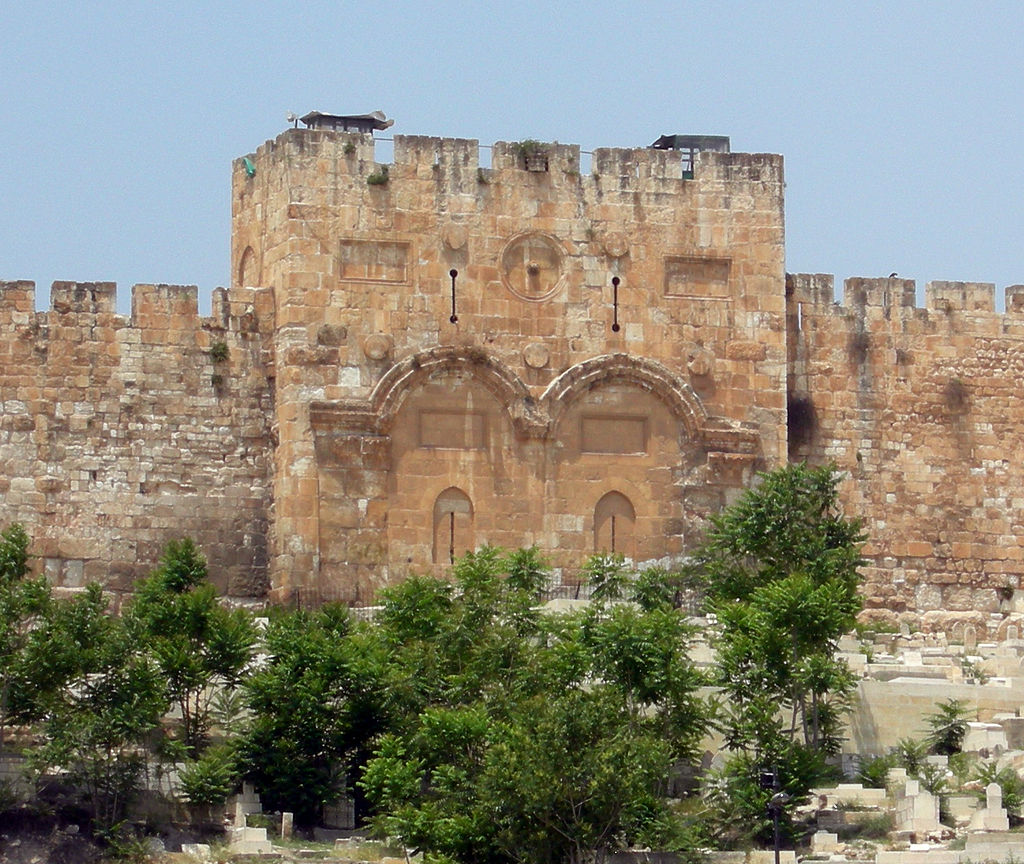
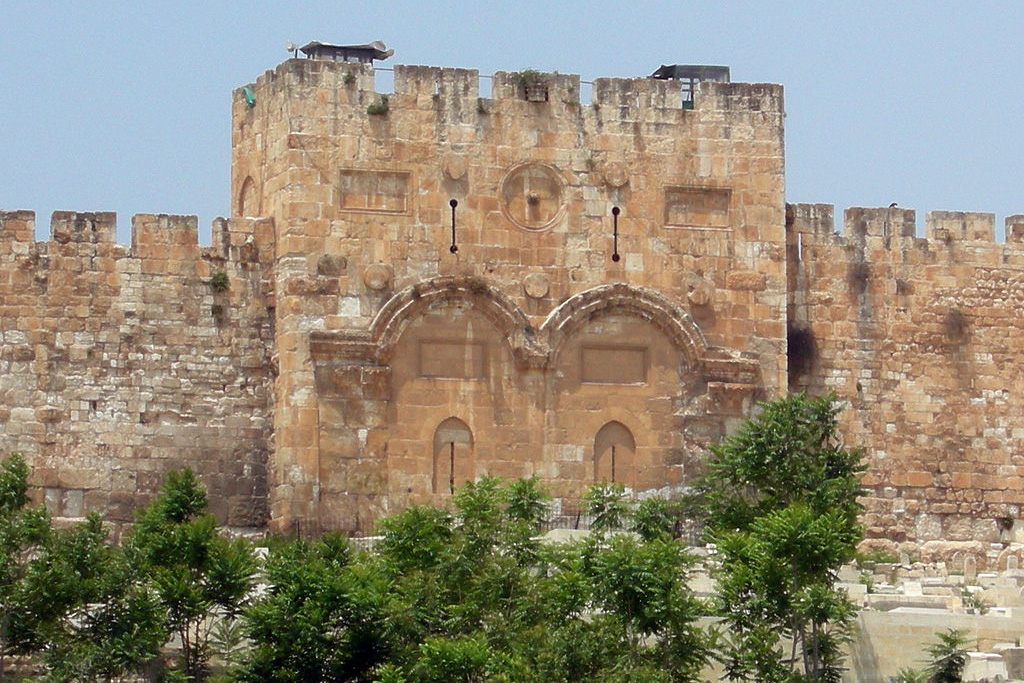
042414At the daily masses of the Easter Octave, we have been reading about, among other things, the story of a paralyzed man whom Peter and John encounter just outside the Temple at the Gate called “Beautiful.” This paralyzed man’s story is our story and as we read it we learn something of our own spiritual journey to the Lord and to heaven, symbolized here by the Temple. Let’s look at this moving story, as it is not merely the recounting of an event taking place 2000 years ago; rather it is our story. (N.B. You can see “the Beautiful Gate” (the gold-plated doors) in the foreground of the picture to the right.)

1. As the Story opens, we see that Peter and John were going up to the temple area for the three o’clock hour of prayer. Allow if you will that Peter and John represent the Church. Both of them are bishops: Peter, the great leader and first Pope, holding the keys of the Kingdom of heaven; and John the great contemplative and mystic. Here is the Church, with the authority to preach and teach in Jesus’ Name, and also given the great gift to mystically contemplate the Lord, whom she announces. And what are they (the Church) doing? They (She) are journeying to the Temple. Allow going to the Temple (though now surpassed by Christ’s body) to symbolize going up to heaven and to God himself. Yes, here is the (visible) head of the Church shown forth by Peter, and the heart of the Church shown forth by John, and they are on a pilgrimage to be with God in prayer. They are going up to worship him (as we all will one day, pray God), to be caught up into the heavenly liturgy.

2. What time is it? The text says it is three in the afternoon. Now the Jewish context for this, is that this was a time for regular prayer. Fair enough. But in the Christian context three o’clock is the hour of mercy. It is the hour when Christ died. It is the hour when salvation’s price is paid. It is the hour when we begin to stand a chance to ever make it out of the long reign of sin. It is three o’clock in the afternoon.

3. And a man crippled from birth was carried and placed at the gate of the temple called “the Beautiful Gate” every day to beg for alms from the people who entered the temple. Who is this man? We are. We are crippled from our birth, incapable of, and lacking the strength, to walk uprightly. And what has this man done in his condition? He has turned to the world around him to seek help. People carry him so that he can beg. But notice that they can only place him outside the Gate called Beautiful. He is still outside the Temple itself. He cannot get in on his own, and no one has gotten him beyond that gate. He is outside the Temple, outside of the Kingdom of Heaven. He cannot save himself. Neither has the world saved him or gotten him inside the gate.

This describes us. We cannot save ourselves. We do not have the strength to walk uprightly through the beautiful gate and into heaven. And the world cannot help us either. It can only carry us to the gate, not beyond it. Life will only deliver us to death. Medicine cannot save us. Science cannot save us. Philosophy, education, money, and power cannot save us. The world carries us a certain distance but cannot close the gap; it cannot get us inside the gate.

And so we sit outside the gate, begging for mercy, incapable of saving ourselves or of being saved by others, who can do no more than toss us the equivalent of coins in the face of our massive debt.

4. But thanks be to God it is three o’clock and the Church has come to pray, and by God’s grace, to enter heaven.

5. Disclosure – When [the crippled man] saw Peter and John about to go into the temple, he asked for alms. But Peter looked intently at him, as did John, and said, “Look at us.” He paid attention to them, expecting to receive something from them.

Something of a “theology of disclosure” is unfolding here. As the man first encounters Peter and John (that is, the Church) he does not see anything extraordinary. He thinks that perhaps they will be a source of money. But money is not what he really needs. What he needs is to get inside the gate, into the Temple, which symbolizes the Kingdom of God and heaven.

As he looks at Peter and John, he is unaware of anything unique. Many people see the Church in this way. They are content for the Church to be merely a place of social gathering and they think of her only in human terms. Even worse, they see her as merely a human institution and call her “it.” They regard her liturgy as ordinary and focus more on the human elements such as who the celebrant was, how good his sermon was, whether the music was good, or the congregation pleasant. They see only the human, the ordinary.

They do not know that her liturgy draws us up to heaven where Christ, the Bridegroom and High Priest, ministers to us and leads us in perfect worship of the Father. They do not see her sacraments as powerful beyond measure, and the Word she proclaims as bearing the transformative power of God. Like this crippled man, who saw Peter and John (the Church) as ordinary, so do many today continue to see the Church as ordinary.

But Peter looks intently at him and says: “Look at us!” In other words, look again. See something beyond the human. For Christ is the head of the Body, the Church. He indwells his Church and has mystical union with her. The “us” here is not merely Peter and John, it is the Church and Christ! And so the Church rightfully declares, “Look at us!” And we who are crippled must first overcome our blindness and learn to see Christ ministering in and through his Church.

6. Word – Peter said, “I have neither silver nor gold, but what I do have I give you: in the name of Jesus Christ the Nazorean, rise and walk.” Then Peter took him by the right hand and raised him up, and immediately his feet and ankles grew strong.

It is right that the Church should feed the poor, help the sick, clothe the naked, and engage in all the corporal works of mercy. But she has even more to offer; she has Christ himself. And we who are the crippled man learn to seek Christ, not just worldly improvements and consolations. And then Peter and John, the Church, do what the Church must always do, they (she) announce Jesus Christ. And in his name, and by the power of his Word speaking through them, (a Word that does not just inform but also performs and transforms), they say what the Church has always said to a fallen and crippled world: “Rise and Walk!” Rise, for you are dead to your sins, and walk, for though you have not had the strength to walk uprightly before, now by God’s grace you do! The world is skeptical of the Church’s moral vision, for they do not figure on grace and the power of God’s Word to transform. But the Church does not bid us to end fornication, addiction, anger, greed, and so forth by our flesh, but rather in the Name of Jesus Christ. That is, by the power of His grace, now present and available, we have the capacity, the strength, to rise and walk.

7. And Sacrament – And notice too, Peter does not merely speak the Word to him, but also takes him by the hand and raises him up. Hence the Church does not merely preach God’s word, she stretches out her hand through the Sacraments and the liturgy to strengthen and heal us by God’s power working through them. Every Sacrament touches us somehow. Perhaps it is water splashing on us in Baptism to make us rise from the dead; or oil being applied to strengthen and sanctify us in confirmation, anointing of the sick, or holy orders; or hands being laid on us in those same Sacraments and in confession. And, most preeminently, it is the Church stretching out a hand to feed us so that we are nourished by the Lord through Holy Communion.

So the Church does not just stand in a pulpit and preach, she stretches out a hand and touches us. And that hand is really the hand of Jesus Christ mystically united with her and extended through the priests of the Church.

By the power of God’s Word, spoken through the Church, and the outstretched hand symbolizing the touch of the Sacraments, the man becomes strong and is now, by the grace of God, standing.

8. He walks, upright, and enters! He leaped up, stood, and walked around, and went into the temple with them, walking and jumping and praising God. And now comes the astonishing fact that he enters through the Gate into the Temple, which symbolizes the Kingdom of God and Heaven. By the Grace of God, he has made it through the gate!

And notice that the grace of God did not come in some merely personal, private way. Rather it came by and through the ministry of the Church. Christ has worked his justification through the ministry of the Church, which he established to teach, govern, and sanctify in His Name. Notice that the text says that the man went into the Temple WITH THEM. He is now within the Kingdom. Before him looms the inner court of the Temple and the Holy of Holies, a great testimony to the presence of God, experienced now, and one day, perfectly, in heaven.

9. This ancient Temple in which they stand will soon be destroyed, but its place will be taken by every Catholic church, wherein dwells the more perfect Holy of Holies, the Tabernacle. For we, who are (or were) the crippled man, have now been strengthened through the ministry of the Church, and are standing within the Church. The tabernacle looms before us as the great presence of God.

Every journey we make up the aisle is symbolic of the pilgrimage we are on to Heaven. We now have the strength to walk that final leg into the Holy of Holies if we but persevere and allow Christ to minister to us through His Church. We who once were crippled and unable to walk, through baptism, confirmation, and the Eucharist are now strengthened to walk uprightly (with confession to help with the stumbles) toward the Holy of Holies. And one day, by God’s grace working through the Church, we shall journey fully into the Holy of Holies.

All this at the Gate Called Beautiful: A Picture of the Church and Our Spiritual Journey.

The Paradoxical Source of Trust in the Lord

One of the Five Hard Truths that will set us free is this one: “You are not in control.” This unnerves us, even terrifies us at times. We like to be in control, but control is an illusion; things you think you control are resting on things you cannot control such as the next beat of your heart or even the continued existence of the cosmos! No, we are not in control.

Come now, you who say, “Today or tomorrow we will go into such and such a town and spend a year there and trade and make a profit”— yet you do not know what tomorrow will bring. What is your life? For you are a mist that appears for a little time and then vanishes. Instead you ought to say, “If the Lord wills, we will live and do this or that.” As it is, you boast in your arrogance. All such boasting is evil (James 4:13-16).

This is just another way of saying that we are not in control.

The paradox is that accepting this hard, even terrifying truth is what frees us from many fears and anxieties. Uncertainty is not the deepest source of our anxiety, rather it is our desperate clinging to control and our insistence on our own preferred outcomes. We don’t always (or even usually) know what is best for us. Abandoning ourselves to God’s wisdom and leadership is the only path to true peace. C.S. Lewis wrote,

What are we to make of Christ? … [Rather] it is entirely a question of what he intends to make of us …. Try to retain your own life and you will be inevitably ruined. Give yourself away and you will be saved …. Whatever is keeping you from God … whatever it is, throw it away …. And do not be afraid. I have overcome the whole universe (The Business of Heaven, p. 33).

The only solution is to trust God. Now trusting does not mean assuming God will eventually give what you want. No, trusting is believing that you will be just fine with whatever the Lord wants. Notice that trusting doesn’t necessarily mean jumping for joy at what God decides. What He decides may not turn out to align with our preferred outcome. Most of us prefer health to sickness, wealth to poverty. We want God to say yes to our requests, not no or later. Trusting means being serene and “OK” with what God decides. In this is our path to peace.

All of this is easy to say but hard to do. We need to accept our poverty, our inability to relinquish our illusion of control and trust God. We need to beg for greater trust. Say with the ancient disciple, “I do believe, Lord. Help my unbelief” (Mk 9:24). Say with the apostles, “Lord, increase our faith” (Lk 17:5).

On the Importance of Little Things

I have found that one of my favorite quotes from St. Augustine is not all that well known. Here it is in Latin, followed by my own translation:

Quod minimum, minimum est,
Sed in minimo fidelem esse,
magnum est
.

What is a little thing, is (just) a little thing,
But to be faithful in a little thing,
is a great thing.

(De Doctrina Christiana, IV,35)

I first saw this quote on the frontispiece of a book by Adrian Fortescue. Fortescue applied it to the intricate details of celebrating the Old Latin Mass. That form of the Mass has an enormous amount of detail to learn: how exactly to hold the hands, when and how to bow, what tone of voice to use when, what fingers should be used to pick up the host, and so on. Some might see these details as picky and overwhelming, but Fortescue apparently wanted us to think about the fact that love is often shown through attention to the little things.

It’s so easy to become lazy, even about sacred things like saying Mass. I often have to remind myself about little things. Are my shoes in good condition? Are my vestments clean? Have the altar linens been properly cared for? Am I bowing and pausing during Mass when I should? Am I using the proper tone of voice? Am I walking reverently in the sanctuary? Am I pronouncing the sacred words of the liturgy with care and a prayerful spirit? Some may find such questions tedious or even too scrupulous, but when you love, little things are often important.

Married couples may also struggle to remember the little things that show love: a kind remark, a thank you, flowers brought home for no particular reason, a caring look, the gift of listening attentively, cleaning up after yourself in the kitchen, a reassurance like “I’m glad I married you” or “You’re such a great father to our children,” a quick phone call saying “I love you and was thinking about you.”

Yes, they’re just little things, but to be faithful in little things is a great thing. These passages come to mind:

Well done, good and faithful servant! You have been faithful with a few things; I will put you in charge of many things. Come and share your master’s happiness (Matt 25:21).

Whoever can be trusted with very little can also be trusted with much, and whoever is dishonest with very little will also be dishonest with much (Luke 16:10).

Little things—who cares? God does. Little things are great things to those who love.

This song says, “You must be faithful over a few things to be ruler over many things. Be thou faithful unto death and God will give you a crown of life.” It ends with this rousing chorus: “Well done good and faithful servant, well done!”

And because I mentioned the details of the traditional Latin Mass, here is a video that illustrates that little things can mean a lot. Those who are unaccustomed to this form may find such details stuffy, but to those who appreciate them, these “little things” are small signs of love for God and are a way of suppressing a kind of careless informality. One should be natural, not robotic, but some of these small details can add a lot to reverence.

The Lament of God: You Forgot

The following tale is from the Hasidic tradition:

Yechiel was playing hide and seek with another child. He hid himself for some time, but his playmate did not look for him. Little Yechiel ran to Rabbi Baruch and said amid tears, “He did not look for me!” The Rabbi said, “That is also God’s complaint, that we seek Him not.”

Indeed, one of the most frequent laments of God is that we forget Him. So often He said, שָׁכַח (shakach): You forgot! Here are just a few examples from Scripture.

  • You neglected the Rock who begot you, and forgot the God who gave you birth (Dt. 32:18).
  • Your fathers forgot the God who saved them, who had done great things in Egypt, miracles in the land of Ham and awesome deeds by the Red Sea (Ps 106:21-22).
  • Your heart will become proud and you will forget the LORD your God who brought you out from the land of Egypt, out of the house of slavery (Dt 8:14).
  • Can a virgin forget her ornaments, or a bride her attire? Yet My people have forgotten Me, days without number (Jer 2:32).
  • You have forgotten Me and cast Me behind your back (Ez 23:35).
  • You have forgotten Me, declares the Lord GOD (Ez 22:12).
  • And being satisfied, their heart became proud. Therefore, they forgot Me (Hos 13:6).
  • Your sons have forsaken Me and sworn by those who are not gods. When I had fed them to the full, they committed adultery and trooped to the harlot’s house (Jer 5:7).

Note in particular the final two, which place the source of the problem in the very gifts that God bestows. Receiving such gifts without gratitude and awe we become satiated and forget the very God who gave them to us. St. Augustine lamented this as a long source of his problem:

Late have I loved you,
Beauty so ancient and so new,
late have I loved you!
Lo, you were within,
but I outside, seeking there for you,
and upon the shapely things you have made
I rushed headlong –I, misshapen.
You were with me, but I was not with you.
They held me back far from you,
those things which would have no being,
were they not in you.
(Confessions Book 10)

Yes, we are so easily forgetful and unreflective. Surrounded by God’s gifts, we grow dull of mind and claim as our own what really belongs to God.

The little child’s lament, “He did not look for me!” is God’s as well. Yet it is not God who is wounded or hurt by this—it is we. Isaiah exhorts, Seek the LORD while he may be found; call on him while he is near (Is 55:6). In this alone is our salvation.

This song says, “Always remember Jesus. Always keep Him on your mind.”

What’s So Sinful About a Census and Why Was Israel Punished for Something David Did?

Today I want to return to a reading from last week’s Mass. In that reading (from 2 Samuel 24) we hear the story of how King David ordered a census to be taken. Joab, David’s general, strongly cautioned the King against it, but David insisted. When the census had been completed, the Prophet Gad informed David of God’s anger and of His intention to punish David and all Israel. God offered David his choice of punishments: a three-year famine, three months of military fighting from Israel’s enemies, or three days of pestilence. David chose the pestilence, figuring that it was better to fall by God’s hand than an enemy’s. About 70,000 people died during those three days.

This raises two central questions:

  1. What’s wrong with a census?
  2. Why was Israel punished for something David did?

What’s wrong with a census? – The first explanation can be found by focusing David’s lack of trust. God had called David to trust in Him—not in man, not in numbers. We have a tendency to rely too much on numbers, thinking that something is good, or right, or successful based on how many people attended or how many supported our cause or view. Of this tendency we must be very careful. Is our power or rightness rooted in numbers, in popularity, in profit, or in God? In counting his people, David seems to be seeking confidence in numbers rather than God; this is a sin.

David may also be guilty of pride. It could well be that he considered with pride the fact that he had amassed such a large number of people in reuniting Israel and Judah, in conquering the Philistines, the Hittites, and others. Taking a census was perhaps a way of flattering himself, of making a name for himself. The numbers are quite impressive—so impressive in fact that we moderns doubt them: 800,000 men fit for military service in Israel and 500,000 in Judah. Including women, children, and those men too old or frail for service, would probably bring the number closer to 5 million people. Such a figure seems unlikely number and is a source of great debate among biblical scholars about biblical enumeration. That debate is too much to handle in this post, but may be a topic for future discussion. For now, let’s simply say that David ruled over a populous nation; his taking of a census likely indicates that he was proud of his accomplishment and wanted it acknowledged by his contemporaries and recorded in the annals of history: David, King of multitudes!

Others point out the sinfulness of counting God’s people. These are not David’s people to enumerate; they are God’s. Because counting hints at accomplishment and control, David sins in trying to know a number that is none of his business. This is a number that is for God alone to know, for He numbers His people and calls them by name (cf Gen 15:15).

A final area of sinfulness surrounds the manner in which a census can be and often is used as an oppressive tool of government. The census provides David with the number of men “fit for military service.” In the ancient world, a census was often a tool for military draft. It was also a basis for exacting taxes. Finally, kings used it to measure their power and to manipulate and coerce based on that power. Even in our own time, the taking of the official U.S. census every ten years is often surrounded by power struggles, gerrymandering, tax policy changes, spending priorities, and the pitting of certain ethnic and racial groups against one another. A lot of troubles can be tied back to the census; numbers are powerful things. Those that have “the numbers” get seats at the table while those who do not have to wait outside. In amassing numbers, David increases his power and his ability to manipulate the people in sinful and/or unjust ways.

The taking of a census is not necessarily morally neutral. While there may be legitimate reasons for a country to collect this information, it can be used in sinful or unjust ways and can lead to power struggles. With this in mind we can see why the military commander Joab may have advised David against taking a census.

Exactly where David’s sin lay—a lack of trust, pride, acting as if they were his people rather than God’s, amassing power, or in some combination of all these things—is not made clear in the text. God is clear though in letting David know that he has sinned and seriously so. This leads to a second and more difficult question.

Why was Israel punished for something David did? As an opening disclaimer we ought to admit that there are some mysterious aspects of this incident and we may not be able to know the answer fully. All we can do is to offer some speculation. Let’s look at a few thoughts as to why all of Israel was punished.

The most common explanation emphasizes that Israel was not sinless in the matter. The census story begins as follows: The Lord’s anger against Israel flared again and incited David … to number Israel and Judah.  Hence God was angry with the whole nation for some undisclosed reason, and therefore permitted David to fall into this sin. Perhaps the census was also a matter of national pride, with the people thinking, “Look how big, prosperous, and powerful we have become.” This is only speculation, but the point is that according to the text, Israel was not blameless.

Another point must be to emphasize that the modern western notion of individualism is not a biblical one. We tend to think that what we do is our own business and what others do is theirs. We are thus outraged at the idea that many would suffer for the sins of one. In the biblical worldview, though, we are all interconnected:  There should be no division in the body, but that its parts should have equal concern for each other. If one member suffers, every member suffers; if one member is honored, every member rejoices. Now you are the body of Christ, and each one of you is a member of it (1 Cor 12:25-27). Dr. Martin Luther King, Jr. said, Injustice anywhere is a threat to justice everywhere. This is the biblical vision.

The decisions we make affect the people around us for better or worse. Even what we call “private” sins set evil loose, reduce goodness, and increase the likelihood of future and more public sins. We are our brother’s keeper and what we do or fail to do affects others.

To those who would say that God is not being “fair” in punishing Israel for what David did, there must be this strong advice: Be very careful before you ask God to be fair. If God were fair, we would all be in Hell right now. Rather, it is mercy we should seek. Fairness is a bad bet; it will land us in Hell.

This is a difficult passage, but God knows how to shepherd us rightly. There are times when tough measures are needed. We do not know the precise nature of Israel’s sin that angered God, but His anger is His passion to set things right. He’s getting us ready for the “Great Day.”

Eyes that Are Humble – A Meditation on the Conversion of St. Paul

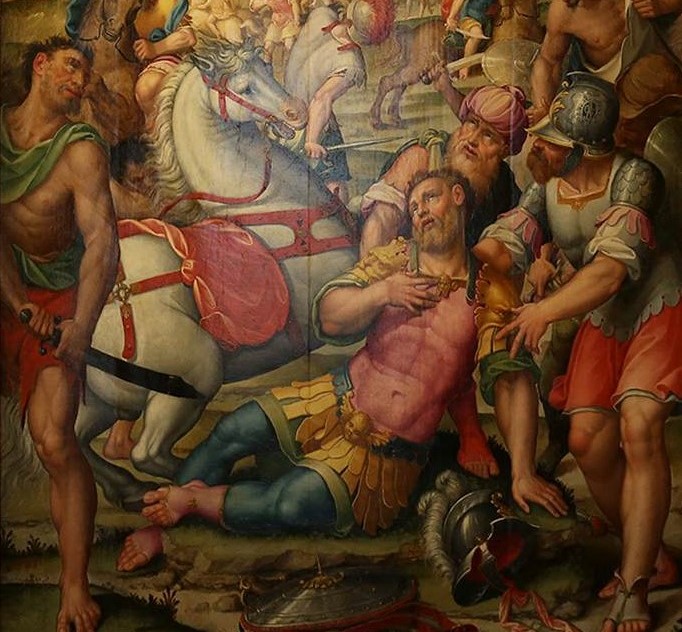
Today in daily Mass we read the well-known story of St. Paul’s conversion. There is a detail in the story that I have often pondered. Although I am speculating on the specifics, I think it ought not to be overlooked. Even my choice of the words “speculating” and “overlooked” (both of which refer to the eyes) indicate that we ought to “give an eye” to St. Paul’s eyes.

As you probably recall, St. Paul was not just struck down on the road to Damascus—he was blinded as well.

Saul got up from the ground,
but when he opened his eyes he could see nothing;
so they led him by the hand and brought him to Damascus.
For three days he was unable to see, and he neither ate nor drank (Acts 9:8-10).

Having persecuted the Lord, Paul was now confronted with the darkness of sin and unbelief. It is as though the Lord wanted nothing to distract Paul as he pondered his experience, neither the delights of food and drink nor the delights of the eye. It was a kind of dying and being with Christ for three days in the tomb before rising. Like the dead, Paul was unable to eat and was enveloped in complete darkness of blindness. He could do little during that time but think and pray.

And pray he did!

[The Lord said to Ananias,]“Get up and go to the street called Straight
and ask at the house of Judas for a man from Tarsus named Saul.
He is there praying,
and in a vision he has seen a man named Ananias
come in and lay his hands on him,
that he may regain his sight.”

… Ananias went and entered the house;
laying his hands on him, he said,
“Saul, my brother, the Lord has sent me,
Jesus who appeared to you on the way by which you came,
that you may regain your sight and be filled with the Holy Spirit.”
Immediately things like scales fell from his eyes
and he regained his sight.
He got up and was baptized,
and when he had eaten, he recovered his strength.

Through Word and Sacrament, Paul’s eyes were healed—or were they? Surely they were, for in the years that would follow, Paul saw well enough to travel the world speaking of Christ.

I’m convinced that some vestige of blindness, some physical memory remained in Paul’s eyes for his entire life, something to remind him of his need for mercy and to keep him humbly mindful of how that mercy was extended.

As background, we do well to recall the story of Jacob, who wrestled with God one night. Jacob proved strong in that great contest, so strong that God gave him a new name, Israel, which means “he wrestles (or struggles) with God.” God also left Jacob with a permanent memory of that nighttime battle. Scripture says that God knocked out Jacob’s sciatic muscle (Genesis 32:32), such that he would walk with a limp for the rest of his life, leaning on a staff. It was a reminder to Jacob that he was always to lean on the Lord (Heb 11:21).

So, too, perhaps, for St. Paul. Although he persevered through three dark days with God and although his eyesight was restored, it would seem that some weakness remained in his eyes. Later, St. Paul would speak of an ailment, a mysterious thorn in his flesh (2 Cor 12:7). Three times he begged God to remove it but the Lord told him to endure it for the sake of humility.

What was it? What was this mysterious physical affliction? I’m convinced that it had something to do with his eyes. Paul told the Galatians,

As you know, it was because of an illness that I first preached the gospel to you, and even though my illness was a trial to you, you did not treat me with contempt or scorn. Instead, you welcomed me as if I were an angel of God, as if I were Christ Jesus himself. Where, then, is your blessing of me now? I can testify that, if you could have done so, you would have torn out your eyes and given them to me (Gal 4:13-15).

While I am speculating, it seems to me that Paul had something to akin to conjunctivitis (pink eye), an affliction that make the eyes fill with a sticky yellowish discharge and become red. It can be extremely contagious and is often repulsive to others. Indeed, it was quite difficult to endure in the era before modern medicine.

Whatever his actual affliction, it seems (if the Galatians text is acknowledged as descriptive) to have involved Paul’s eyes, the same eyes that had been healed but perhaps with a reminder left in them of the need for humility and for remembrance of how God saved him.

What is your thorn? What is your limp? What is your conjunctivitis? All of us have things that keep us humble. They remind us of our need to lean on God and to look to Him, not with haughty eyes, but with eyes that are humble, respectful, and grateful.

This song says, “Nobody knows the trouble I’ve seen. Nobody knows but Jesus”

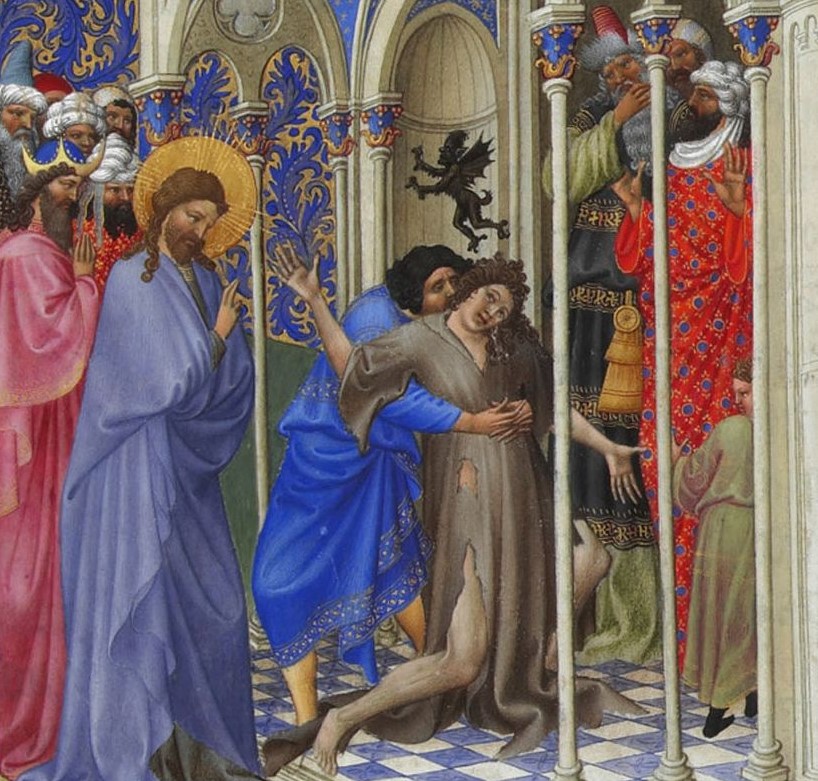
If Demons Believe and Tremble, What about Us?

As we begin the ordinary time of the Church year, we follow the Lord’s public ministry. The curtain lifts and we are in the synagogue at Capernaum:

Jesus entered the synagogue and taught. The people were astonished at his teaching, for he taught them as one having authority and not as the scribes.
In their synagogue was a man with an unclean spirit; he cried out, “What have you to do with us, Jesus of Nazareth? Have you come to destroy us? I know who you are – the Holy One of God!”
Jesus rebuked him and said, “Quiet! Come out of him!”
The unclean spirit convulsed him and with a loud cry came out of him
. (Mark 1:21-26)

Here are two brief thoughts:

First, note the astonishment of the people. The preaching of the Word of God is not meant to be a perfunctory part of the Mass. Even when the preacher is not gifted with eloquence or charisma, God’s Word has the power to astonish us.

The Greek word used in this passage is very strong: ἐξεπλήσσοντο (exeplessonto). It comes from combining exe or ek (wholly out) and plesso (to strike) Thus the most literal translation is that Jesus “knocked them out” with his proclamation. The word indicates the state of being utterly amazed, dumbfounded, or left at a complete loss after witnessing something incredible. One can picture someone gaping in sheer astonishment.

If we carefully attend to the Word of God rather than just listening half-heartedly, we should expect to be astonished. It may make us mad, sad, or glad; it may console or afflict us; but we cannot be unchanged if we open our heart and mind to its power.

Do you go to Church expecting to hear a Word that will change you? When you read Scripture, do you expect to be surprised, astonished, or even intrigued? If not, why not?

Second, notice that the demon recognizes Christ for who He is: The Holy One of God. James rather sadly observed that demons believe and even tremble (see James 2:19). If even demons recognize and are thunderstruck by the glory of God, how is it that so many of us are half asleep during the sacred liturgy?

Those who have attended exorcisms are quite surprised at the power that simple holy water, the touch of the priest’s hand, and the priest’s stole have over demons. This is also true of relics and sacramentals. The demons experience their power, yet so many of us are casual and unexpectant around such realities.

These observations are meant not so much to shame as to remind us that in the sacred liturgy we encounter the Lord of Glory. He is present in both word and sacrament. If a demon can know that and have servile fear, how about us? Can we know this and have a reverential fear and love?

Tomorrow I will post more on the power of Jesus’ preaching.